

Good tax planning for 2025 comes down to five moves: claim the new deductions, choose between the standard deduction and itemizing, fund tax-advantaged accounts, expense business purchases, and close the gaps on your return. Workers who earn tips or overtime and taxpayers over 65 should start with strategy 1. Homeowners in high-tax states should start with 2. Savers should start with 3, business owners with 4, and anyone who has not filed or paid yet with 5.
There is a timing problem you should know about. The 2025 tax year ended on December 31, 2025, and the filing deadline was April 15, 2026. Most year-end moves, such as 401(k) deferrals, charitable gifts and IRA contributions, can no longer change your 2025 bill. What still works is claiming what you missed on your 2025 return and carrying the same tax planning strategies into the 2026 year-end.
This guide covers the rules that applied for 2025 under the law signed on July 4, 2025. For each strategy it tells you what the rule is and what you can still do about it. Our CPA and Enrolled Agent at Tax Experts of OC help clients with tax planning decisions like these.
1. Claim the new 2025 worker and senior deductions
The 2025 tax year added four deductions that you can take even if you do not itemize. Each one lowers taxable income, and each is easy to overlook if you file in a hurry.

What you need to know
All four are temporary and cover tax years 2025 through 2028. They sit on top of the standard deduction and phase out as your modified adjusted gross income (MAGI) rises.
| Deduction | 2025 maximum | Phase-out begins (single / joint) |
|---|---|---|
| Qualified tips | $25,000 | $150,000 / $300,000 |
| Qualified overtime | $12,500 ($25,000 joint) | $150,000 / $300,000 |
| Age 65 and older | $6,000 per eligible person | $75,000 / $150,000 |
| Car loan interest | $10,000 | $100,000 / $200,000 |
Each deduction has a catch. The overtime deduction covers only the premium portion, the "half" in time-and-a-half, not your full overtime pay. The tips deduction applies only to occupations that customarily received tips. The car loan deduction requires a new vehicle with final assembly in the United States, bought for personal use after 2024.
Four new deductions applied to 2025, and none of them require you to itemize.
What to do now
Look at your filed 2025 return for these lines. If you qualified and skipped them, file Form 1040-X to amend. You generally have three years from the original filing date to claim the refund.
For 2026, keep a running total of overtime premium pay and tips, and save your lender's interest statement. Employers and lenders report these amounts, but the figures can be wrong, and you are the one who signs the return.
2. Compare the standard deduction with itemizing again
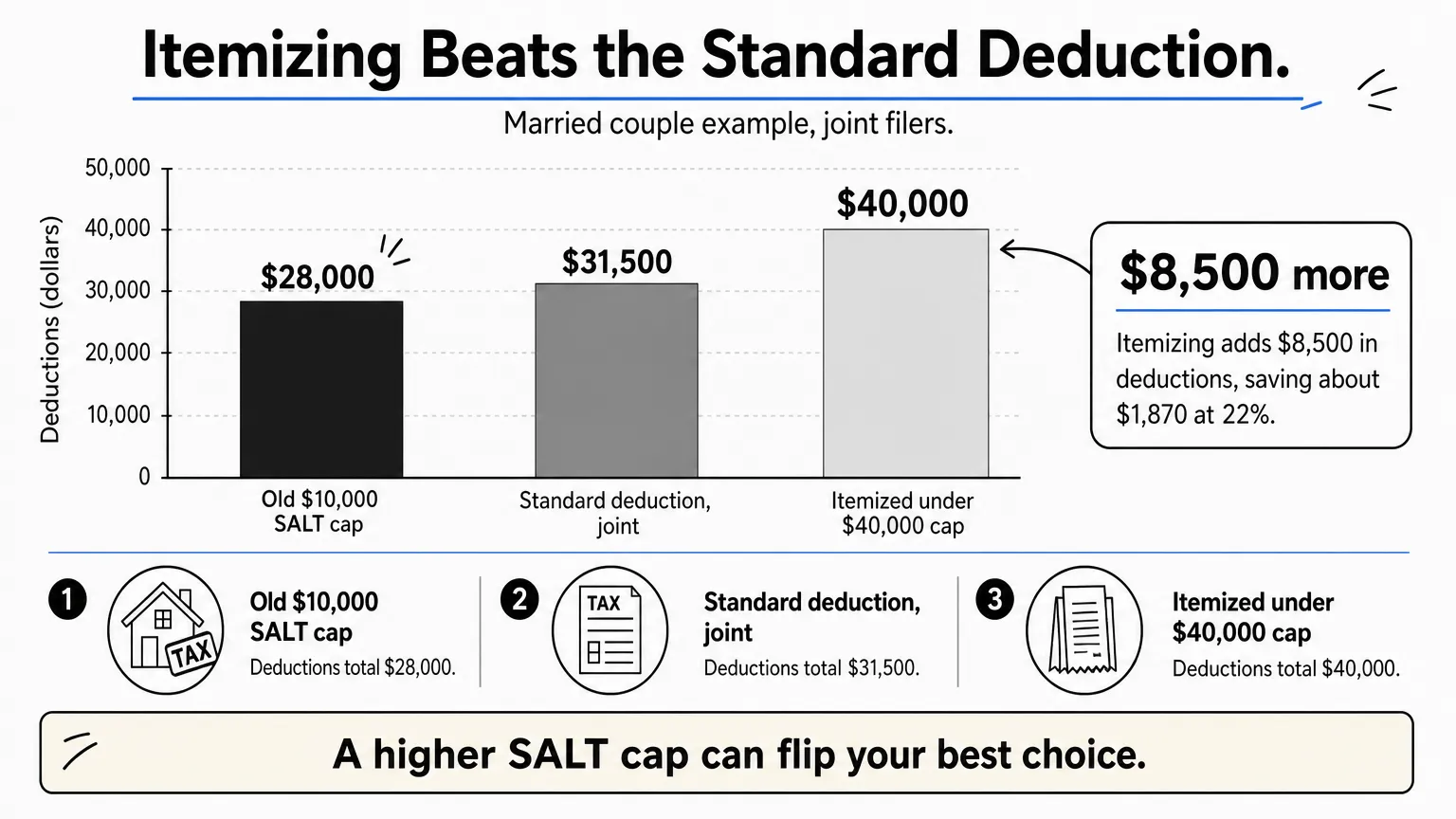
You should itemize only when your deductible expenses beat the standard deduction, and the 2025 law changed that math for many homeowners. The state and local tax (SALT) cap moved from $10,000 to $40,000.
What you need to know
The 2025 standard deduction was $15,750 for single filers, $23,625 for heads of household and $31,500 for joint filers. The $40,000 SALT cap ($20,000 if married filing separately) covers state income or sales tax plus property tax. It phases down for MAGI above $500,000, to a floor of $10,000. It rises 1% a year through 2029 and then reverts to $10,000 in 2030.
Here is a worked example. A married couple paid $22,000 in state income and property taxes, $14,000 in mortgage interest and gave $4,000 to charity. Their itemized total is $40,000, against a $31,500 standard deduction. Itemizing adds $8,500 in deductions, which saves about $1,870 at a 22% rate. Under the old $10,000 cap, their total would have been $28,000, and the standard deduction would have won.
A higher SALT cap can flip your best choice from the standard deduction to itemizing.
What to do now
If you took the standard deduction on your 2025 return and your itemized total would have been higher, an amended return can recover the difference. Run both numbers before you decide.
For 2026, charitable rules shift. Itemizers can deduct gifts only above 0.5% of AGI. Non-itemizers can deduct up to $1,000 in cash gifts ($2,000 joint). If you itemize, bunching two years of gifts into one year, directly or through a donor-advised fund, is the strategy to test.
3. Fund retirement accounts and HSAs
Pre-tax contributions to a 401(k), IRA or health savings account (HSA) remain the most dependable way to lower taxable income. Their value depends on your bracket, which stayed at 10% to 37% after the 2025 law made those rates permanent.
What you need to know
These were the 2025 limits.
| Account | 2025 limit | Catch-up |
|---|---|---|
| 401(k) deferral | $23,500 | $7,500 at 50+, $11,250 at ages 60 to 63 |
| IRA | $7,000 | $1,000 at 50+ |
| HSA | $4,300 self-only, $8,550 family | $1,000 at 55+ |
A 40-year-old in the 24% bracket who defers the full $23,500 lowers federal tax by about $5,640. An HSA requires a high-deductible health plan, and it is the only account that gives you a deduction, tax-free growth and tax-free withdrawals for medical costs.
A dollar deferred in a 24% bracket saves 24 cents in federal tax this year.
What to do now
The deadline to fund an IRA or HSA for 2025 was April 15, 2026, and the 401(k) window closed on December 31, 2025. Raise your payroll deferral for 2026 now, because it only works on paychecks still to come. Limits rise most years, so confirm the new figures at IRS.gov.
A Roth conversion must be completed by December 31 of the year you want it taxed. It works best in a year when your income is unusually low.
4. Use business expensing and the pass-through deduction
Business owners got the biggest permanent changes in the 2025 law. You can deduct many equipment purchases in full, and the 20% qualified business income deduction no longer expires.

What you need to know
100% bonus depreciation is permanent for qualifying property acquired after January 19, 2025. The Section 179 limit for 2025 was $2.5 million, with a phase-out that starts at $4 million of purchases. Pass-through owners (sole proprietors, partners, S corporation shareholders) can also deduct up to 20% of qualified business income, subject to limits at higher incomes.
For example, a contractor who buys and starts using a $60,000 truck in 2025 can deduct the whole cost in year one. At a 24% bracket, that is about $14,400 in federal tax savings. It is a timing benefit, though, because you have less depreciation later.
Expensing moves a deduction into the year you spend the money, so make sure the cash flow works first.
What to do now
If you bought qualifying assets in 2025 and used old depreciation schedules, ask your preparer whether an amended return can fix it. For 2026, the asset must be placed in service, not just ordered, by December 31.
Entity choice matters too. An LLC taxed as an S corporation can change your self-employment tax, and our Tax Planning service covers entity selection for new businesses. Run the numbers before you convert, because payroll and filing costs rise.
5. Fix the gaps in your 2025 return
If you have not filed or paid your 2025 taxes, every month of delay adds penalties. This is the strategy where acting quickly saves the most money.
What you need to know
The April 15, 2026 deadline has passed, and so has the October 15, 2026 extended deadline. Two penalties apply to unpaid tax:
- Failure to file: 5% of the unpaid tax per month, up to 25%.
- Failure to pay: 0.5% of the unpaid tax per month, up to 25%.
Interest also accrues on the balance. If you are owed a refund, you generally lose it if you do not file within three years of the original due date.
Filing late costs far less than not filing, so file even if you cannot pay in full.
What to do now
File the 2025 return now, even if you cannot pay everything. Then ask the IRS for a payment plan, which stops the larger failure-to-file penalty from growing. If you have received an IRS notice, respond before the deadline printed on it. Missing unfiled years for several tax years calls for professional representation.
To avoid a repeat in 2026, make sure your estimated payments cover at least 100% of your 2025 tax, or 110% if your AGI was above $150,000. That safe harbor protects you from underpayment penalties even if your income jumps.
Where to start with your tax plan
Tax planning for 2025 is now about two things: recovering what your 2025 return missed and carrying the new rules into 2026. Start with the deductions that apply to you, compare standard and itemized totals under the higher SALT cap, and raise your retirement deferrals while 2026 paychecks remain. Business owners should line up equipment purchases before year-end, and anyone behind on filing should act before penalties grow further.
Every strategy here depends on your income, filing status and state, so the numbers in this article are a starting point. If you want a second set of eyes on your 2025 return or your 2026 plan, book a free 30-minute tax planning consultation with our CPAs and Enrolled Agent. We work with clients in all 50 states by phone and video.