

Typing tax planning service near me into Google and scrolling through a dozen websites that all sound the same gets old fast. You need someone who actually knows your situation, whether that's a wage garnishment notice, a business with three employees, or a return you haven't filed in two years. The problem is that not every firm with a nice website can back it up with real credentials.
The short answer to your search is this: look for a firm staffed by actual CPAs and Enrolled Agents, not just seasonal preparers, and confirm they offer upfront pricing before you hand over a single document. Location matters less than you think, since a licensed professional can represent you before the IRS from anywhere in the country through secure virtual consultations.
This article breaks down the five specific things to check before you commit to a provider, from credentials and pricing transparency to how a firm handles multi-state filings and financial hardship. By the end, you'll know exactly what separates a trustworthy tax planning partner from a firm that's just chasing your refund fee.
1. Verify credentials and professional expertise
Before you sign anything, find out exactly who will be working on your case, the same standard that applies when you choose a CPA for IRS problems. A firm's website can list a dozen "tax experts," but only a handful of credentials actually carry legal weight with the IRS: Certified Public Accountant (CPA), Enrolled Agent (EA), and, in limited cases, tax attorney. Anyone without one of these designations can prepare a return, but they can't represent you in an audit or collections dispute.

What to check
Ask directly whether a CPA or EA will handle your file from start to finish, not just review it before it goes out. You can verify a CPA's license through your state board of accountancy, and you can confirm an EA's standing through the IRS Enrolled Agent verification process. Also ask how many years the specific person has spent on cases like yours, whether that's back taxes, business filings, or non-profit accounting.
Why it matters
Credentials determine what a professional is legally allowed to do for you. Only a CPA, EA, or attorney holds unlimited representation rights before the IRS, meaning they can negotiate, appeal, and appear on your behalf in any proceeding.
A preparer without proper credentials can fill out your forms, but only a licensed CPA or Enrolled Agent can stand between you and the IRS.
Red flags to avoid
Watch for firms that dodge direct questions about who's licensed, or that route every client to a call center instead of naming an actual professional. Be wary of seasonal offices that pop up every spring and disappear by May, since they often can't help if the IRS contacts you in October. If a firm hesitates to put its credentials in writing or won't name the CPA or EA assigned to your case, treat that as a firm-ending problem, not a minor inconvenience.
2. Match services to your specific tax needs
A firm that only handles simple W-2 returns isn't the right fit if you're dealing with years of back taxes you still need to file or running a growing LLC. Before you commit, map your actual situation, unfiled returns, payroll for employees, or a wage garnishment, against the services a provider actually lists.
What to check
Look for a clear breakdown of services: tax resolution, business tax preparation, bookkeeping, payroll, and outsourced CFO work. A firm offering strategic tax planning alongside resolution work can address both your immediate IRS problem and your long-term liability.
Why it matters
Generalist preparers rarely handle audits, liens, or multi-entity filings well. A specialized tax planning service built around resolution and business accounting understands IRS procedure in ways a seasonal chain typically doesn't.
The provider that fixes your refund this year should also be the one who can represent you if the IRS comes knocking next year.
Red flags to avoid
Skip any firm that gives a one-size-fits-all pitch without asking about your specific tax history first. If they can't explain how they'd handle your unfiled returns or business structure, they probably haven't dealt with cases like yours before.
3. Compare pricing and consultation offers
Price shouldn't be a mystery until after you've handed over your documents, so learn the average fees by return type before you call. A trustworthy tax planning service tells you what you'll pay before you commit, not after a preparer has already dug through your records and padded the invoice with surprise fees.
What to check
Ask whether the firm offers a free consultation, ideally 30 minutes or more, where a real professional reviews your situation before quoting a price. Confirm the quote covers your full case, not just the first form, and ask if flexible payment plans exist for clients facing financial hardship.
Why it matters
Upfront pricing protects you from scope creep, where a simple filing balloons into hundreds of extra dollars once the firm finds "complications." It also signals confidence: firms that know their process well can quote it accurately from the start.
If a firm can't give you a straight number before you sign, don't expect a straight answer once you're a client.
Red flags to avoid
Be cautious of vague quotes like "it depends" with no follow-up questions, or consultations that feel more like sales pitches than case reviews. Avoid any firm that demands payment in full before explaining what services that payment actually covers.
4. Weigh local office access against virtual convenience
Searching for a tax planning service near me usually assumes you need someone local, but a licensed CPA or EA can represent you before the IRS from any state. A firm offering remote tax filing often gives you faster access to a real professional than driving across town for an in-person appointment that gets rescheduled twice.

What to check
Find out whether the firm handles document exchange, e-signatures, and case updates through a secure client portal. Ask if virtual clients get the same access to their assigned CPA or EA as someone walking into a physical office, not a downgraded support tier.
Why it matters
Geography shouldn't limit your choice of expertise. A firm built for remote representation can serve clients in all 50 states, which matters if you move, own property elsewhere, or need multi-state filings handled by one consistent team.
The best tax professional for your case might not be the closest one, and that's fine if they work remotely.
Red flags to avoid
Steer clear of firms that treat virtual clients as an afterthought or lack secure systems for sensitive documents. If nobody can explain how they protect your data online, look elsewhere.
5. Research reputation and communication style
Before you sign anything, spend ten minutes reading what past clients say about tax resolution firms. Reviews on Google or the Better Business Bureau reveal patterns that a polished homepage never will, especially around how a firm handles tax resolution cases that drag on for months.
What to check
Search for verified reviews that mention specific outcomes, like a resolved wage garnishment or a completed audit, not just star ratings. Ask how often you'll hear from your assigned CPA or EA and through what channel, since a tax planning service near me should mean regular updates, not radio silence between filings.
Why it matters
Communication problems compound quickly when the IRS sends a deadline-driven notice. A firm with clear communication habits catches issues early, while one that goes quiet for weeks can cost you penalties you never saw coming.
A firm's silence during an active IRS case usually costs you more than its fee ever did.
Red flags to avoid
Watch for a flood of generic five-star reviews posted within days of each other, a sign of manufactured feedback. Avoid firms where every review mentions a different, unnamed staff member handling the same account.
Making your final decision
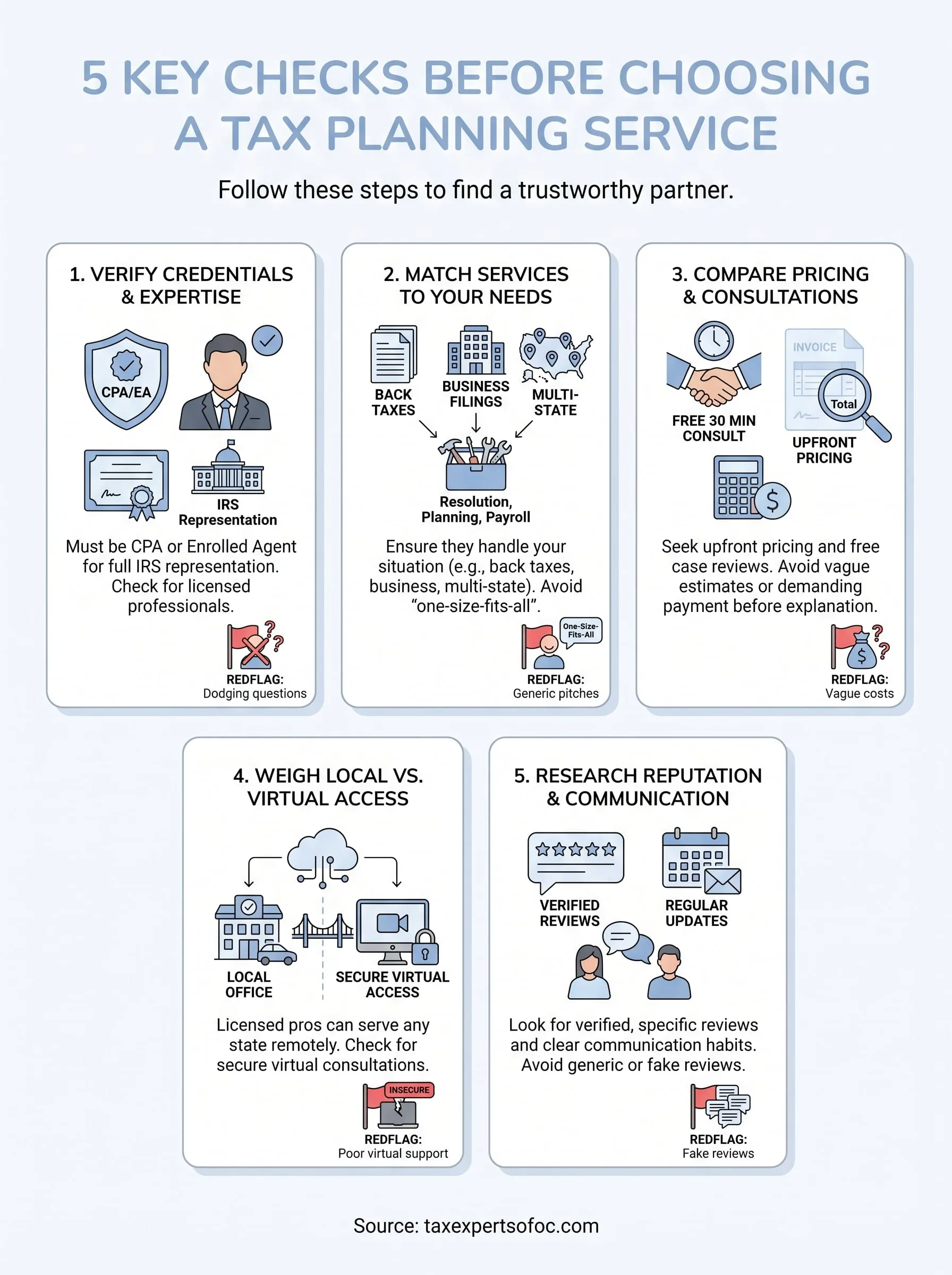
Finding the right tax planning service near me really comes down to five checks: real credentials, matching services, honest pricing, flexible access, and a solid reputation. Skip any one of these and you risk handing your financial life to someone who can't actually deliver when the IRS gets involved.
Go through each provider on your shortlist with this list in hand, and don't settle for vague answers on any point. A firm confident in its work will welcome the scrutiny, not dodge it.
You don't have to guess whether a firm checks every box. Tax Experts of OC puts licensed CPAs and Enrolled Agents on every case, quotes pricing upfront, and serves clients in all 50 states through secure virtual consultations. If you're ready to stop searching and start resolving your tax situation, book a free 30-minute tax planning consultation and talk directly with a professional who can actually help.