
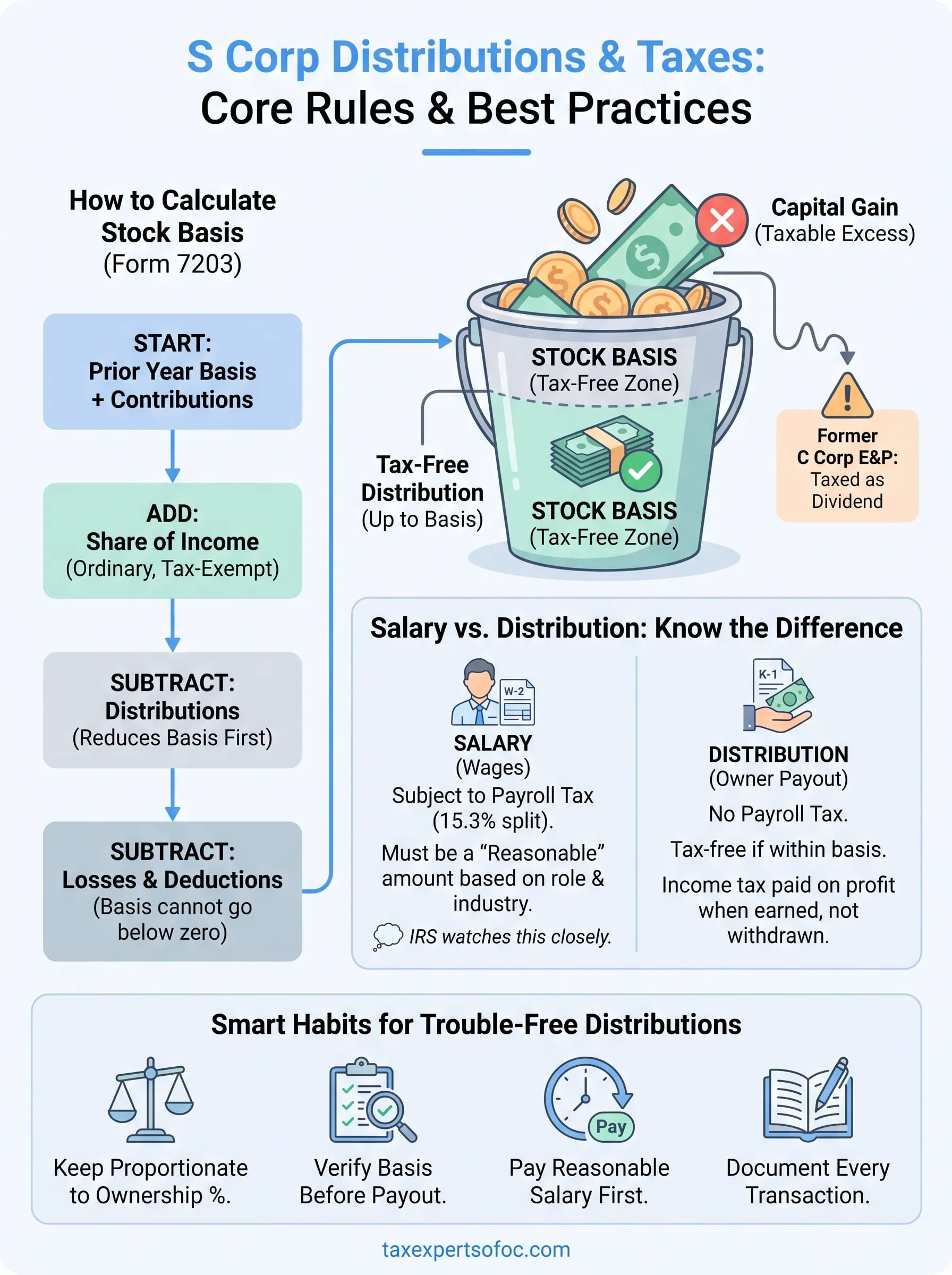
Taxes on distributions from S corp profits follow one core rule. A distribution is tax-free up to your stock basis, and any amount above your basis is taxed as capital gain. You already paid income tax on the profit when the company earned it, so taking the cash out is not taxed a second time. The exceptions are distributions that exceed your basis and distributions paid from earnings left over from a former C corporation.
A distribution is money or property an S corporation pays you as an owner, as opposed to wages paid for the work you do. It appears on your Schedule K-1, and it is separate from your share of the company's income, which you report whether or not any cash leaves the business. Most of the confusion about S corp taxes on distributions comes from mixing those two things up.
This article explains why the rule matters, how to calculate it with worked examples, when a distribution turns taxable, how distributions compare with salary, and how to take them without drawing IRS attention. Tax Experts of OC prepares business returns and helps owners choose and manage entity structures nationwide, and the examples below use the same math a CPA runs on an owner's return.
Why the tax rules for S corp distributions matter
These rules matter because your tax bill depends on what the S corporation earns, not on what you withdraw. Confusing the two leads to underpaid tax, lost deductions, and IRS notices.
You pay tax on profit, not on the cash you take
An S corporation generally pays no federal income tax itself. Its income, deductions, and credits pass through to shareholders on Schedule K-1, and you report your share on your personal return. Say you own 100% of an S corp that earns $80,000 and you withdraw $10,000. You report $80,000 of income, not $10,000. The other $70,000 stays in the business, but it is still taxed to you this year.
Distributions are the second half of the story. Because you already paid tax on the profit, the cash that comes out is generally a return of money that has been taxed. That is the main reason owners elect S status. A C corporation taxes profit once at the corporate level and again when it pays dividends. So an S corp distribution is not taxed as ordinary income by itself. The profit behind it is taxed on your return, usually at ordinary rates, although items such as capital gains keep their character.
You are taxed when the S corp earns the profit, not when you move the cash to your own account.
What goes wrong when owners get this backward
Owners who misread the rule tend to make the same few mistakes:
- They take cash and assume no tax is due, then face a bill on profit they never set money aside for.
- They take distributions above basis and never report the capital gain.
- They pay themselves little or no salary and lean on distributions, which invites the IRS to reclassify the payments as wages.
- They never track basis, so a loss on the K-1 gets disallowed or a taxable distribution goes unnoticed.
Each of these is cheap to prevent and expensive to fix after a notice arrives. The next sections show how to prevent them.
How to calculate the tax on an S corp distribution
Calculate it in three moves: find your stock basis, add this year's income to it, then compare your distributions to the result. Anything within basis is tax-free, and anything above it is gain.
Track your stock basis each year
Your stock basis starts with what you paid for your shares or the cash and property you contributed. It then changes every year, and the corporation does not track it for you. That job belongs to the shareholder. The IRS provides Form 7203 to compute stock and debt basis, and shareholders must file it in common situations, such as receiving a distribution or claiming a loss. The IRS guidance on S corporation stock and debt basis explains the form in detail.
Run the adjustments in this order, as of the last day of the corporation's year:
- Start with the prior year's ending basis, or your original contribution or purchase price in the first year.
- Add your share of income, including ordinary income, separately stated income, and tax-exempt income, plus any new capital contributions.
- Subtract distributions. The K-1 reports non-dividend distributions in box 16D.
- Subtract nondeductible expenses, then losses and deductions. Basis cannot fall below zero.
The order matters because distributions reduce basis before losses do. That rule keeps a bad quarter from making last year's cash withdrawals taxable.
Three worked examples with real numbers
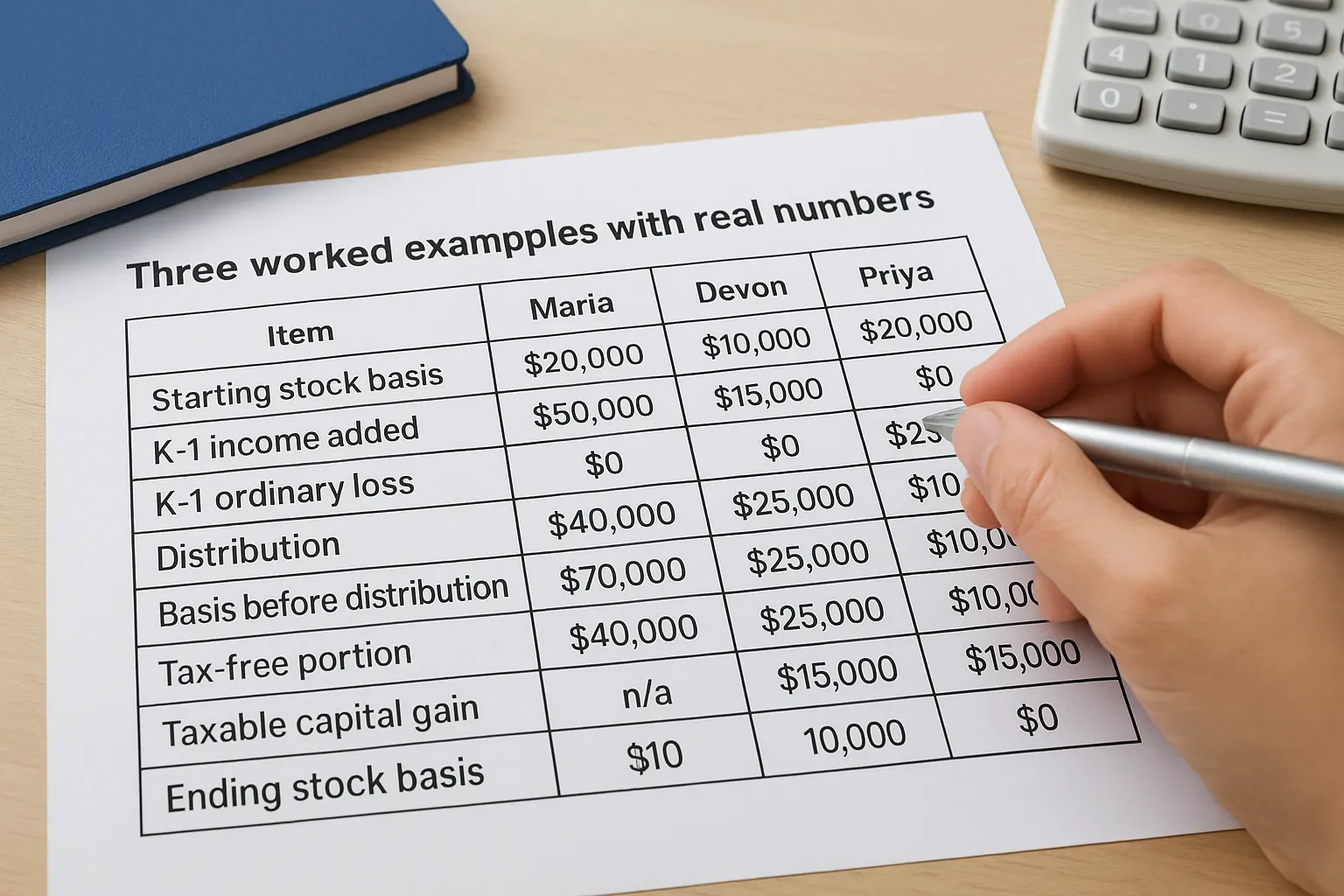
The table shows three owners who each own 100% of an S corporation that has never been a C corporation. Only basis matters in their cases.
| Item | Maria | Devon | Priya |
|---|---|---|---|
| Starting stock basis | $20,000 | $10,000 | $20,000 |
| K-1 income added | $50,000 | $15,000 | $0 |
| K-1 ordinary loss | $0 | $0 | $25,000 |
| Distribution | $40,000 | $40,000 | $10,000 |
| Basis before distribution | $70,000 | $25,000 | $20,000 |
| Tax-free portion | $40,000 | $25,000 | $10,000 |
| Taxable capital gain | $0 | $15,000 | $0 |
| Loss allowed this year | n/a | n/a | $10,000 |
| Loss suspended to next year | n/a | n/a | $15,000 |
| Ending stock basis | $30,000 | $0 | $0 |
Maria's $40,000 is entirely tax-free, and she still pays income tax on her $50,000 share of profit. Devon took out $15,000 more than his basis, so that $15,000 is capital gain. Priya shows the ordering rule at work. Her distribution comes out of basis first and stays tax-free, and basis then absorbs only $10,000 of her $25,000 loss. The other $15,000 carries forward until she has basis to use it.
Compare each distribution to your basis before the year ends, and the answer is almost always a simple subtraction.
When S corp distributions become taxable
A distribution becomes taxable when it exceeds your stock basis, or when it is paid out of leftover C corporation earnings. Those are the only two routes to a tax bill on the distribution itself.
Amounts above basis are capital gain
Any distribution beyond your stock basis is treated as a gain from selling your stock. If you have held the shares longer than one year, it is a long-term capital gain, taxed federally at 0%, 15%, or 20% depending on your taxable income. If you have held them a year or less, it is short-term and taxed at ordinary rates. The net investment income tax of 3.8% can also apply in some situations, so check your facts before assuming it does not.
That answers the question of what the tax rate on S corp distributions is. There is no special rate. Within basis the rate is zero, above basis it is a capital gains rate, and the underlying profit is taxed at your regular rates.
Be careful with loans. If you lent money to your S corporation, you may have debt basis, but debt basis does not shelter distributions. Only stock basis counts when deciding whether a distribution is taxable. A loan guarantee does not create basis either. You must have personally lent the money.
Distributions from a former C corporation
If your company was once a C corporation, or it acquired a C corporation's assets in certain transactions, it may carry accumulated earnings and profits (E&P). Those earnings were never taxed to shareholders, so the law makes sure they are taxed when paid out. An S corporation that has been an S corporation since formation has no E&P, and this section does not apply to it.
With E&P, a distribution is traced through a fixed order:
- First from the accumulated adjustments account (AAA), the profit earned as an S corporation and not yet distributed. This is tax-free up to your stock basis.
- Then from E&P, taxed as a dividend.
- Then from any remaining stock basis, tax-free.
- Then any excess, taxed as capital gain.
Dividends from E&P are reported to you on Form 1099-DIV, not on the K-1, and they may qualify for lower qualified dividend rates if holding requirements are met. If you converted from a C corporation, ask a CPA to calculate your AAA and E&P balances before you plan large distributions.
| Situation | Federal treatment | Where it shows up |
|---|---|---|
| Within stock basis, no E&P | Tax-free, reduces basis | K-1 box 16D, Form 7203 |
| Above stock basis | Capital gain | Your personal return |
| From accumulated E&P | Dividend | Form 1099-DIV |
If your company never was a C corporation, one number decides everything: your stock basis.
S corp distributions vs salary: how the taxes differ
You need both. The IRS expects a shareholder who works in the business to take a reasonable salary before taking distributions, and the mix between the two is where an S corp can save payroll tax.
Why salary and distributions are taxed differently
Salary is wages, so it is subject to payroll taxes. Social Security is 12.4% up to the annual wage base, Medicare is 2.9% with no cap, and together that is 15.3%, split between you as employee and the corporation as employer. Wages above $200,000 for a single filer also trigger an additional 0.9% Medicare tax on the employee side.
Distributions carry no payroll tax. That gap is the reason the IRS watches this area closely, and the reason taking all your pay as distributions backfires. Income tax is a separate matter. Your share of profit is taxed on your return whether it arrives as salary or as a distribution.
Salary costs 15.3% in payroll tax and distributions cost none, so the IRS requires the salary to be real before it lets the distributions be large.
Worked example with $120,000 of profit
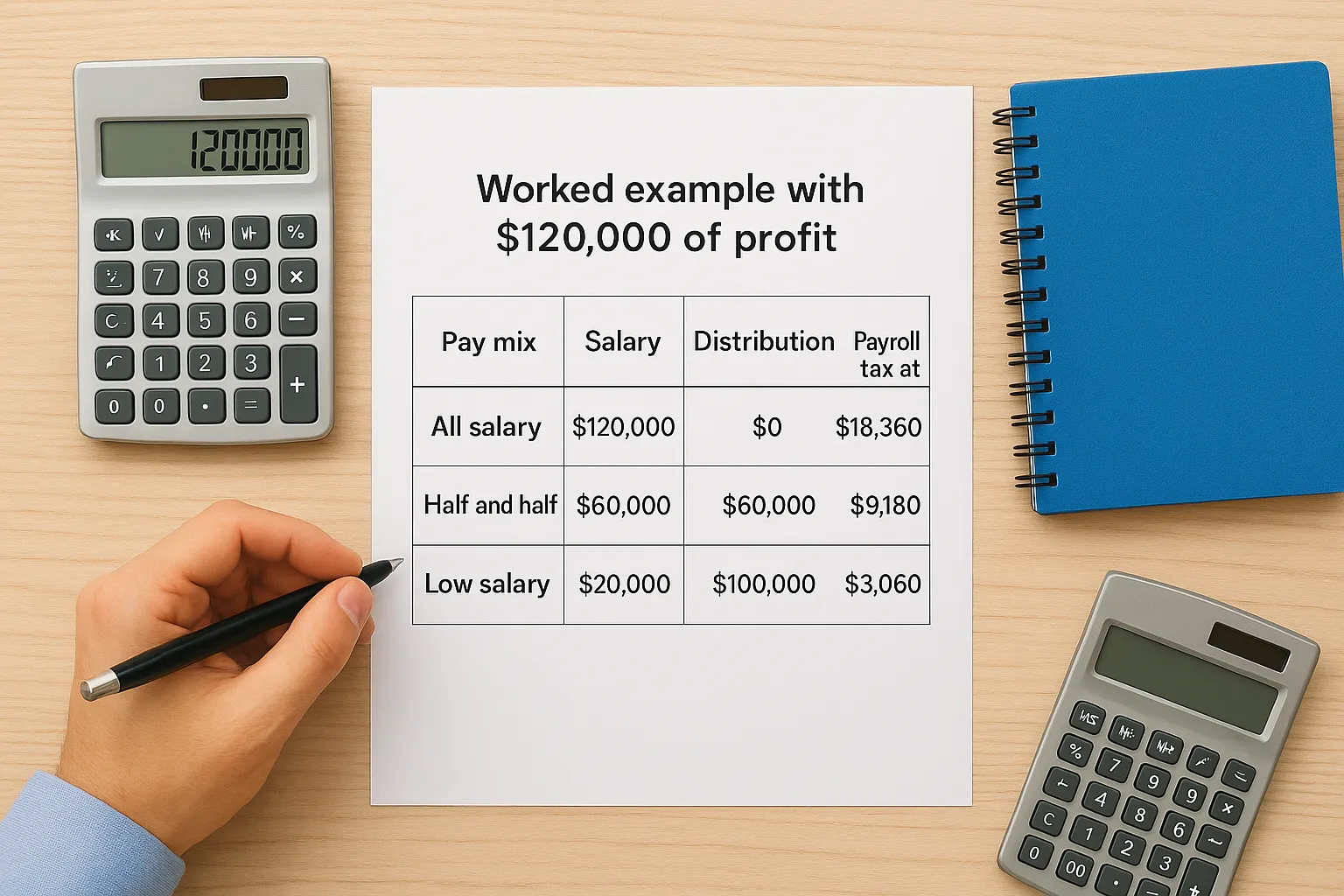
Assume the business earns $120,000 before any owner pay, and all wages fall below the Social Security wage base. The figures below are rough because they ignore the deduction for the employer half of payroll tax.
| Pay mix | Salary | Distribution | Payroll tax at 15.3% |
|---|---|---|---|
| All salary | $120,000 | $0 | $18,360 |
| Half and half | $60,000 | $60,000 | $9,180 |
| Low salary | $20,000 | $100,000 | $3,060 |
Moving from all salary to a half-and-half split saves about $9,180 in payroll tax. The low-salary row saves more on paper, but a $20,000 salary for a full-time owner of a business earning $120,000 is the pattern that gets examined. If the IRS reclassifies the payments as wages, you owe the payroll taxes plus penalties and interest.
How to set a reasonable salary
No official percentage exists, and "60/40" or similar rules of thumb are myths. The standard is what the business would pay someone else to do your job. Look at these factors:
- Your duties and the hours you work.
- What comparable businesses in your industry and area pay for the same role.
- Your training, experience, and qualifications.
- The size and profitability of the company.
- Whether you work full-time or part-time in the business.
Write down how you arrived at the number and update it when your role or profits change. Salary also interacts with the 20% qualified business income deduction, because wages reduce the pass-through income that deduction is based on. A higher salary is not always worse, so model both the payroll tax and the deduction together.
The 2% shareholder rule for benefits
The "2% rule" concerns fringe benefits, not distributions. A shareholder who owns more than 2% of the stock is treated differently from an ordinary employee. Health insurance premiums the S corporation pays for that shareholder are generally included in W-2 wages for income tax, but are not subject to Social Security and Medicare taxes. The shareholder may then claim the self-employed health insurance deduction on the personal return. Skipping the W-2 reporting is a common error, so make sure your payroll provider handles it.
How to take S corp distributions without IRS trouble
Pay salary first, keep each distribution proportionate to ownership, stay within basis, and document every payment. Those four habits prevent nearly all distribution problems.
Keep distributions proportionate to ownership
An S corporation can have only one class of stock, which means every share carries identical rights to distributions. If you own 60% and your partner owns 40%, a $100,000 distribution should be $60,000 to you and $40,000 to your partner, paid at the same time. Disproportionate distributions can raise a second-class-of-stock question and, in the worst case, put the S election at risk.
Not every mismatch is fatal. The company's governing documents are what matter most, and a timing difference can often be corrected with a catch-up distribution to the other owners. Fix the imbalance promptly and have a CPA review it if the gap is large.
A checklist to run before every distribution
Run through this list before moving cash out of the company:
- Confirm that your salary is paid on schedule through payroll first.
- Estimate your year-to-date stock basis so you know the tax-free limit.
- Make sure the business keeps enough cash for payroll, taxes, and bills.
- Pay every shareholder in proportion to ownership, on the same date.
- Record the payment as a shareholder distribution in your books, not as an expense or a loan.
- Set aside money for quarterly estimated taxes, since you owe tax on profit even when you take no cash.
- Check your state's rules, because some states tax S corporations or treat them differently than the federal government does.
Accurate books make this routine. Monthly, quarterly, or annual bookkeeping keeps equity accounts clean, which is what lets a CPA reconstruct your basis later. Paying personal expenses from the company account and calling them distributions, or the reverse, is the fastest way to create a records problem.
A distribution you cannot trace in your books is a distribution you cannot defend.
Plan the payout before you take the cash
Taxes on S corp distributions come down to basis. Profit is taxed to you when it is earned, distributions within basis are tax-free, distributions above basis become capital gain, and leftover C corporation earnings can turn part of a payout into a dividend. Salary sits alongside all of this, and it has to be reasonable before distributions can be large.
If you want a CPA or Enrolled Agent to check your basis, set a defensible salary, or model the payroll tax difference for your numbers, you can book a free 30-minute tax planning consultation with Tax Experts of OC. We work with S corp owners in all 50 states by phone and virtual meeting.