
You hired your first employee, you're working through setting up payroll for a small business, and now you're staring at a paycheck wondering what FICA, FUTA, and SUTA actually mean and why the IRS cares so much about getting them right. Payroll taxes small business owners deal with aren't optional line items you can skip when cash gets tight. Miss a deposit deadline or miscalculate a withholding, and the penalties stack up fast, sometimes reaching 100% of the unpaid amount plus interest.
This article answers the questions that actually matter: which taxes you're responsible for as an employer, how to calculate employee taxes for small business payrolls accurately, and what deposit schedule keeps you compliant with the IRS. You'll see the difference between what you withhold from employees and what you pay directly as the employer, since confusing the two is one of the most common mistakes we see.
We work with small business owners every day who come to us after a payroll tax notice lands in their mailbox, and most of those problems trace back to a misunderstood filing requirement or a missed deadline early on. Get the fundamentals right now, and you'll avoid becoming one of those calls. Let's walk through small business payroll taxes step by step, starting with what you owe and why.
Why payroll taxes matter for your small business
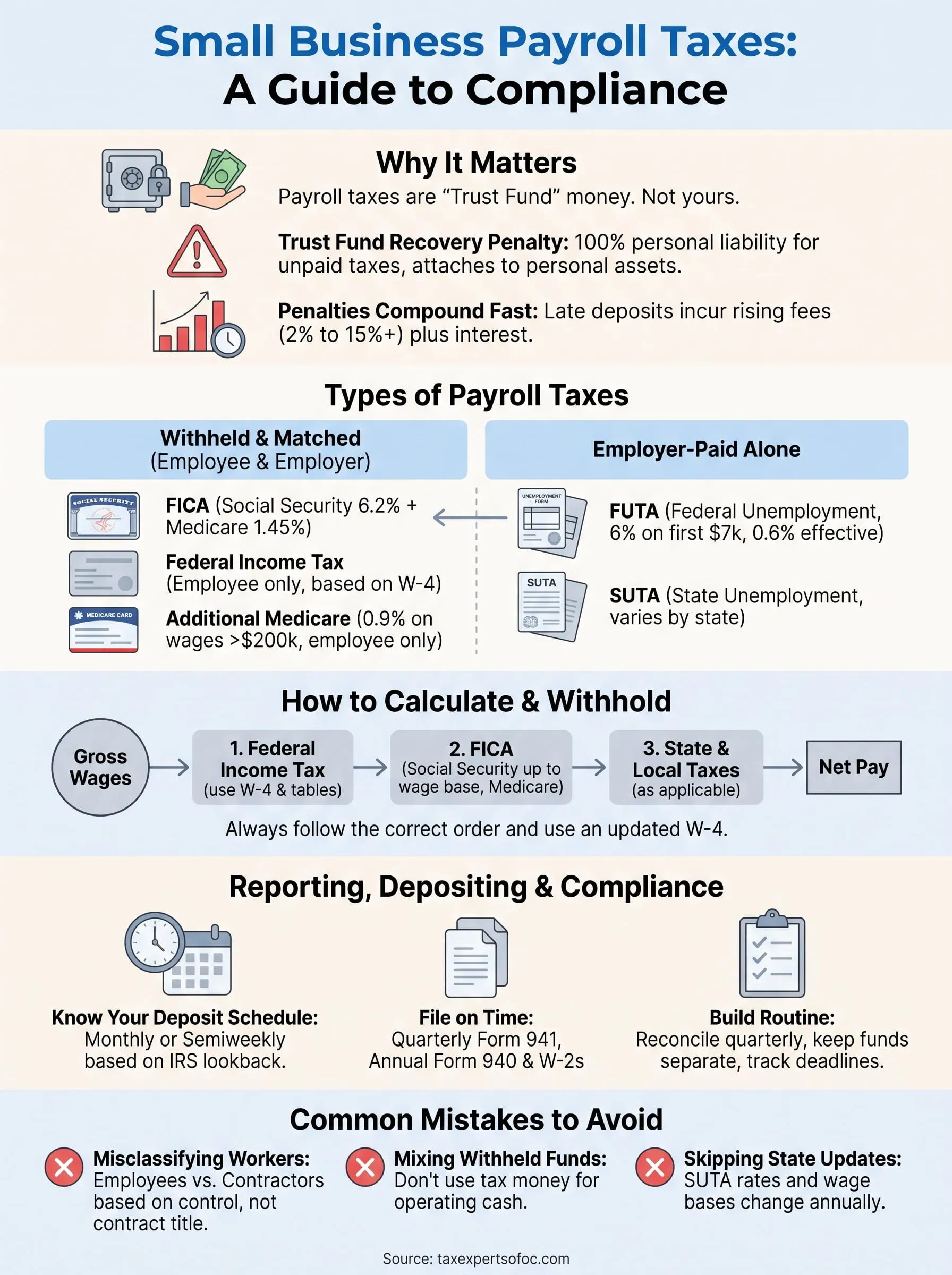
Understanding payroll and taxes for small business owners starts with one uncomfortable fact: this money never really belongs to you. When you withhold federal income tax, Social Security, and Medicare from an employee's paycheck, you're holding what the IRS calls a trust fund. That cash sits in your bank account temporarily, but legally it's already the government's. Spend it on rent or inventory during a slow month, and you've committed what the IRS treats as a serious violation, not a simple accounting error.
The Trust Fund Recovery Penalty follows you personally
Here's what surprises most first-time employers: closing your LLC or filing for bankruptcy doesn't erase payroll tax debt. The IRS can assess the Trust Fund Recovery Penalty against you as an individual, not just your business entity, if you're deemed a "responsible person" who willfully failed to collect or pay these taxes. That penalty equals 100% of the unpaid trust fund taxes, and it attaches to your personal assets, including your house and savings, regardless of how your business is structured. According to the IRS, this liability doesn't disappear when a corporation dissolves.
Payroll tax debt is the one liability that can survive your business and land on your personal finances.
Falling behind compounds faster than most owners expect
Missing a deposit deadline doesn't just trigger a flat fee, and it helps to know how payroll tax penalties work before you're facing one. The Failure to Deposit penalty scales with how late you are: 2% if you're one to five days late, climbing to 15% if the IRS has to send a notice demanding payment. Interest accrues on top of that penalty, and it keeps accruing until the balance is cleared. A business that skips two or three deposit periods in a row can find itself owing far more in penalties and interest than the original tax bill.
| Days late | Penalty rate |
|---|---|
| 1 to 5 days | 2% |
| 6 to 15 days | 5% |
| 16+ days | 10% |
| After IRS notice, within 10 days | 15% |
Compliance protects your ability to keep operating
Staying current on small business payroll taxes also protects things you might not immediately connect to payroll. The IRS can file a federal tax lien against your business, which shows up on credit reports and makes it nearly impossible to secure a loan or line of credit. Vendors and landlords who run credit checks will see it too. Unresolved payroll tax debt can also block you from bidding on government contracts or renewing certain business licenses in some states.
Beyond the penalties, there's a practical reason to get this right: employees notice when their withholdings look wrong on a pay stub, and trust erodes fast once someone suspects their employer is mishandling tax money that's supposed to fund their future Social Security benefits. Building a payroll system that withholds correctly the first time saves you from cleanup work, IRS correspondence, and the kind of reputation damage that's hard to undo once employees start talking.
The types of payroll taxes small businesses must pay
Several distinct taxes fall under the payroll umbrella, and each one works differently. Some come out of your employee's paycheck, some come straight out of your business account, and a few require both. Sorting employee taxes for small business payrolls into the right category is the first step toward getting your numbers correct, because the IRS treats withheld taxes and employer-paid taxes as separate obligations with separate consequences.

Federal taxes you withhold and match
FICA covers Social Security and Medicare, and it's split down the middle. You withhold 6.2% for Social Security (up to the annual wage base) and 1.45% for Medicare from each paycheck, then you match both amounts dollar for dollar from your business funds. Federal income tax withholding works differently: you withhold it entirely from the employee based on their W-4, and you never contribute a matching amount.
Payroll taxes for small business owners split into two buckets: money you hold for the government, and money you owe on top of it.
Federal and state taxes you pay alone
FUTA, the federal unemployment tax, comes entirely from you at 6% on the first $7,000 of each employee's wages, though most employers qualify for a credit that drops the effective rate to 0.6%. Nearly every state layers its own SUTA tax on top, with rates that vary by your claims history and industry.
| Tax | Who pays | Typical rate |
|---|---|---|
| Social Security | Employee + employer match | 6.2% each |
| Medicare | Employee + employer match | 1.45% each |
| Federal income tax | Employee only | Based on W-4 |
| FUTA | Employer only | 0.6% effective |
| SUTA | Employer only (varies by state) | State-specific |
Additional Medicare tax applies once an employee's wages cross $200,000, adding 0.9% withheld from the employee alone, with no employer match required.
How to calculate and withhold payroll taxes
Getting the math right starts with gross wages, then works through a specific order: federal income tax, FICA, and any state or local withholding. Skip a step or apply the wrong percentage, and you'll either shortchange the IRS or take too much from an employee's paycheck, both of which create cleanup work later. Most small business owners use payroll software or a professional to run these numbers automatically, but understanding the underlying calculation matters even if a system does the math for you.
Start with the employee's W-4
Every calculation begins with the information on Form W-4, which tells you filing status, dependents, and any additional withholding the employee has requested. The IRS updated this form in 2020 to remove withholding allowances entirely, so you now apply the IRS withholding tables directly to gross pay based on the answers given. Getting this step wrong is one of the most frequent sources of misunderstood filing requirement disputes, since an outdated or incorrectly completed W-4 throws off every paycheck that follows.
Run the numbers in order
Follow this sequence for every pay period:
- Calculate gross wages for the pay period.
- Withhold federal income tax using the IRS tables and the employee's W-4.
- Withhold 6.2% for Social Security, up to the annual wage base.
- Withhold 1.45% for Medicare, with no wage cap.
- Add 0.9% Additional Medicare tax once wages exceed $200,000 for the year.
- Withhold any state income tax and local taxes that apply.
- Match the employer portion of Social Security and Medicare separately.
Get the order right, and every downstream deposit and filing falls into place correctly.
Watch the wage base changes
The Social Security wage base adjusts almost every year, so a calculation that was accurate in January can become wrong by December if you're not tracking updates. Building a habit of checking the Social Security Administration's annual announcement keeps your small business payroll taxes accurate without relying on memory alone.
How to report, deposit, and stay compliant
Calculating the right amounts only matters if you actually deposit and report them on schedule. The IRS assigns every employer a deposit schedule, either monthly or semiweekly, based on a lookback period that reviews your total tax liability from the prior year. Getting payroll and taxes for small business operations right means knowing your schedule before your first payroll run, not after a missed deadline shows up as a penalty notice.

Know your deposit schedule
Most new employers default to a monthly schedule until their tax liability crosses the IRS threshold, at which point they shift to semiweekly deposits tied to payday. Larger liabilities can even trigger next-day deposit requirements. Check your assigned schedule through the IRS deposit rules each year, since it can change as your payroll grows.
Your deposit schedule isn't optional or negotiable, it's assigned to you, and missing it is what triggers most penalties.
File the right forms on time
Beyond deposits, quarterly and annual filings keep your records straight with the IRS:
- Form 941, filed quarterly, reports withheld income tax, Social Security, and Medicare (how to complete Form 941).
- Form 940, filed annually, reports federal unemployment tax (step-by-step FUTA filing guide).
- W-2s, issued to employees and filed with the Social Security Administration by January 31.
- State unemployment and withholding forms, filed on whatever schedule your state requires.
Quarterly filing catches errors before they compound across an entire year, which matters more than most owners realize until they're staring at four quarters of mismatched numbers.
Build compliance into your routine
Routine, and sometimes outside payroll compliance support, separates businesses that stay compliant from those that end up owing back taxes. Record payroll in your books and reconcile those records against bank deposits every quarter, keep a calendar with every deposit and filing deadline, and set aside withheld funds in a separate account rather than mixing them with operating cash. If your filings have already fallen behind, our payroll tax debt resolution team can help you catch up before the IRS escalates collection action.
Common payroll tax mistakes that cost businesses money
Most payroll tax problems trace back to a handful of repeated errors, not exotic IRS rules. Recognizing these patterns in your own process is the fastest way to avoid a notice landing in your mailbox.
Misclassifying workers as contractors
Owners often label a worker an independent contractor to skip withholding altogether, but the tax rules for employees versus contractors turn on behavioral and financial control, not the title on a contract. Get this wrong, and you owe back payroll taxes small business liability for every misclassified worker, plus penalties calculated as if you'd never withheld a dime. The IRS worker classification test is the standard to check before you decide, not after an audit flags it.
A wrong worker classification doesn't just cost one paycheck, it multiplies across every pay period you got it wrong.
Mixing withheld funds with operating cash
Treating withheld taxes as available cash is the single most common path to trust fund penalties. Once that money covers payroll for a slow week, it's gone, and you're now personally exposed under the rules covered earlier.
Skipping updates to state requirements
SUTA rates, wage bases, and local withholding rules change yearly, and businesses that copy last year's numbers into this year's payroll run miscalculate small business payroll taxes without noticing until reconciliation.
Here's a quick checklist to catch these before they become expensive:
- Confirm each worker's classification annually, especially after role changes.
- Keep withheld funds in a dedicated account, separate from operating cash.
- Recheck state SUTA rates and wage bases every January.
- Reconcile Form 941 totals against actual bank deposits each quarter.
- Review W-4 accuracy whenever an employee's situation changes.
None of these mistakes require complex accounting to avoid. They require attention, a routine, and someone checking the numbers before the IRS does it for you.
Keeping your payroll taxes on track
Getting payroll taxes small business obligations right isn't about mastering every IRS rule on day one. It's about building a routine: calculate withholdings in the correct order, deposit on your assigned schedule, file quarterly and annual forms on time, and keep withheld funds untouched in a separate account. Do those four things consistently, and you avoid the penalties, liens, and personal liability that catch owners who treat payroll as an afterthought.
Slip-ups happen even to careful business owners, especially when state rules change or a worker's classification gets murky. Catching an error early costs far less than fixing one after the IRS sends a notice. If your payroll filings have fallen behind, or you want a professional reviewing your numbers before problems compound, talk to Tax Experts of OC about CPA-led payroll services for small businesses in a free consultation and get your payroll back on solid ground.