
If you rent out a spare room on Airbnb, or you're a guest wondering why your total jumped at checkout, airbnb taxes probably feel more confusing than they should. Between occupancy taxes, income tax, and self-employment tax, it's not always clear who owes what, or whether Airbnb already handled it for you.
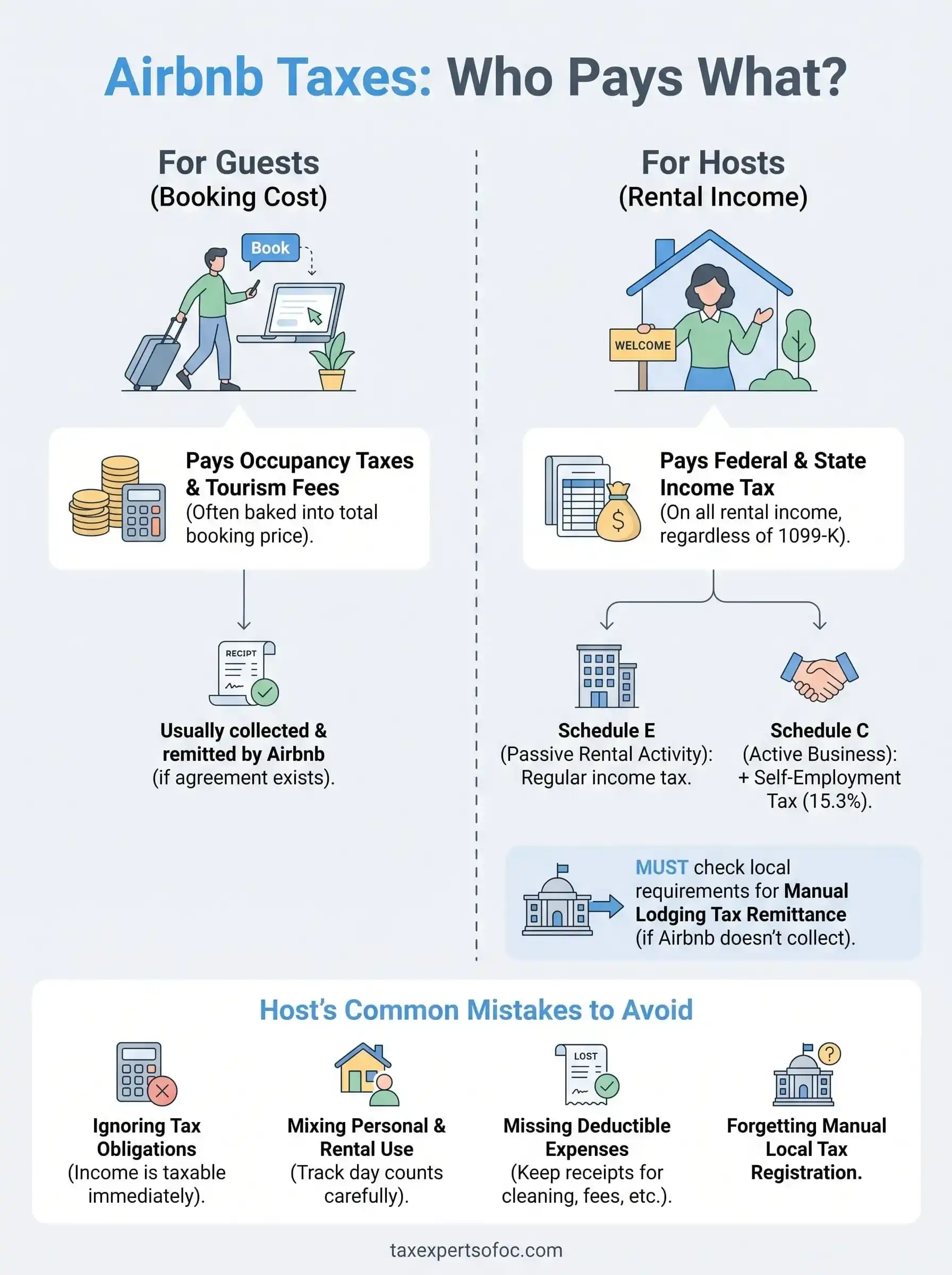
Here's the short version: guests typically pay occupancy taxes baked into the booking price, while hosts are on the hook for reporting rental income to the IRS, regardless of whether Airbnb collects and remits local lodging taxes on your behalf. That last part depends entirely on your city and state, and it's where most hosts get tripped up.
This article breaks down exactly which taxes apply to hosts versus guests, how Airbnb's tax collection works in different jurisdictions, and what you actually need to report come filing season. If you're a host trying to stay compliant, or you've gotten an IRS notice about unreported rental income, understanding these rules now saves you from a much bigger headache later, and this is exactly the kind of situation our tax resolution team at Tax Experts of OC helps clients untangle every day.
Why Airbnb taxes matter for hosts and guests
Many hosts treat Airbnb income like extra cash rather than taxable rental income, and that assumption causes real problems. Airbnb issues a Form 1099-K to hosts who cross federal reporting thresholds, and it sends a copy straight to the IRS. If the number on that form doesn't match what you reported, you're inviting a notice, and possibly an audit. Guests, meanwhile, rarely think about taxes at all until they see occupancy fees added at checkout, and they assume those charges are just part of doing business with a short-term rental platform.
For hosts, the stakes are financial and legal
Hosts who ignore their tax obligations don't just risk a larger bill later, they risk penalties, interest, and in serious cases, IRS collections action. Rental income is reportable whether or not you receive a 1099-K, and whether you rent one weekend a year or run multiple listings full time. The IRS has increased scrutiny on gig and short-term rental income in recent years, partly because platforms like Airbnb now report earnings directly through third-party information returns, closing a gap that used to let smaller hosts fly under the radar. You can read more about how the IRS treats these reports on the IRS Form 1099-K guidance page.
Airbnb income is taxable the moment it hits your account, not just when a 1099-K shows up in your inbox.
For guests, taxes affect the real cost of a stay
Guests care about occupancy taxes for a simpler reason: they change the actual price of a booking. A listing that looks like $120 a night can jump to $140 or more once local lodging taxes, tourism fees, and sometimes city-specific surcharges get added. These charges vary wildly by jurisdiction, so a guest booking in Los Angeles pays a different tax structure than one booking in Austin or New York City.
| Party | What's typically owed | Who usually handles it |
|---|---|---|
| Guest | Occupancy tax, tourism fee | Airbnb, at booking |
| Host | Federal income tax, self-employment tax | Host, at filing time |
| Host (some areas) | Local lodging tax not auto-collected | Host, manually |
Understanding this split matters because assuming Airbnb "already took care of it" is exactly the kind of mistake that leads to unpaid tax bills down the road.
How Airbnb collects and remits occupancy taxes
Airbnb doesn't handle occupancy tax collection the same way everywhere. In many major markets, the platform has agreements with state or local tax authorities to automatically add the tax to the guest's total, then send that money directly to the government. In these jurisdictions, hosts don't need to do anything extra for those specific occupancy taxes. But this automatic system only covers certain tax types and certain locations, and coverage changes as new agreements get signed or dropped.

Automatic collection in participating areas
When Airbnb has a tax agreement in place, the process generally works like this:
- The guest sees the occupancy tax added at checkout, separate from the nightly rate
- Airbnb calculates the correct rate based on the property's exact location
- The platform remits the collected tax directly to the local tax authority
- The host receives a summary showing what was collected and paid on their behalf
Just because Airbnb collects one type of local tax doesn't mean every tax obligation on your rental has been handled.
Where hosts still carry the burden
Some cities and counties require manual tax remittance because Airbnb has no collection agreement there, or because the jurisdiction taxes short-term rentals through a separate registration process the platform doesn't participate in. In these areas, the host is responsible for registering with the local tax office, collecting the tax from guests directly or building it into the price, and filing periodic returns, sometimes monthly. Hosts who assume Airbnb covers everything everywhere often discover the gap only after receiving a notice from a city revenue department. Checking your specific jurisdiction's requirements, rather than relying on assumptions, is the only reliable way to know where you stand.
How hosts report Airbnb income on their tax return
Reporting Airbnb earnings correctly starts with picking the right IRS form, and most hosts default to the wrong one without realizing it. If you rent a room or property occasionally and don't provide hotel-like services, your rental income reporting usually goes on Schedule E as passive rental activity. If you offer daily cleaning, meals, or concierge-style services, the IRS may classify your activity as a trade or business, which pushes you toward Schedule C and exposes the income to self-employment tax on top of regular income tax.
Schedule E vs Schedule C: which form applies
Getting this classification wrong doesn't just create paperwork headaches, it changes how much you owe. Schedule C income carries an additional 15.3% self-employment tax that Schedule E rental income doesn't. The IRS outlines the distinction in its Schedule C and Schedule E instructions, and reviewing the substantial-services test there is worth the ten minutes it takes.
The form you use to report Airbnb income determines whether self-employment tax applies, and that difference can run into thousands of dollars.
Deductible expenses that offset rental income
Hosts often underreport deductions right alongside overreporting income, which means paying more tax than necessary. Common deductions include:
- Mortgage interest and property taxes on the rented portion
- Cleaning fees, supplies, and platform service fees
- Depreciation on the property and furnishings
- Utilities and internet allocated to rental use
- Repairs directly tied to the rental space
Tracking these throughout the year, rather than scrambling every April, keeps your actual tax bill closer to what you truly owe.
Common Airbnb tax mistakes hosts should avoid
Several errors show up again and again when hosts get hit with an IRS notice or a surprise state bill, and most of them are avoidable with a little planning. Recognizing these patterns before filing season saves you from amending returns or negotiating penalties after the fact.
Treating Airbnb income as a hobby, not a business
Hosts who never track expenses or file quarterly estimated payments often assume a small side rental doesn't count as real income. It does. The IRS expects estimated tax payments throughout the year once you owe more than $1,000 annually, and skipping them triggers underpayment penalties even if you pay in full come April.
Mixing personal use with rental use
Properties used partly for personal stays and partly for guests require careful day-count tracking, since the ratio determines which expenses you can deduct. Blurring that line is one of the fastest ways to lose deductions in an audit.
A host who can't produce a day-by-day usage log has no defense when the IRS questions rental deductions.
Other frequent slip-ups
- Forgetting to register with a city or county that requires manual lodging tax remittance
- Reporting gross Airbnb payouts instead of gross booking income before fees
- Deducting 100% of a shared space when only a portion is rented
- Failing to save receipts for cleaning, repairs, and platform fees
- Assuming a 1099-K wasn't issued means the income wasn't reported to the IRS
Avoiding these mistakes isn't complicated, but it does require treating your Airbnb activity like the business it actually is, with records, deadlines, and documentation kept current all year rather than reconstructed under pressure.
Staying on top of your Airbnb tax obligations
Getting airbnb taxes right comes down to knowing where the split falls: guests generally cover occupancy taxes at checkout, while hosts carry the full weight of reporting rental income, paying self-employment tax when it applies, and handling local lodging taxes Airbnb never touches. None of that disappears just because a 1099-K didn't land in your inbox or a city hasn't sent a notice yet.
Waiting until the IRS or a local tax authority flags a problem almost always costs more than getting ahead of it. Proper tax compliance means tracking income and expenses year-round, filing the right form, and registering wherever manual remittance is required.
If you're already behind, or you just want a second set of eyes before filing season, talk to Tax Experts of OC for a free consultation. Our CPAs and Enrolled Agents handle Airbnb tax situations regularly, and we'd rather help you fix this now than represent you in front of the IRS later.