

You landed your first few clients, the money is coming in, and then tax season hits you with a number that makes your stomach drop. That's the moment most independent contractors realize bookkeeping for independent contractors isn't optional paperwork, it's the difference between keeping your profit and handing a chunk of it to the IRS in penalties. Without a system for tracking income and expenses, you're guessing at your quarterly taxes and missing deductions you already earned.
This guide answers the practical question every contractor asks: how do you actually track money coming in and going out when there's no employer withholding taxes or handing you a tidy paycheck? We'll walk through the exact records you need to keep, how to separate business from personal finances, and which bookkeeping methods actually hold up if the IRS ever asks questions.
You'll get a clear look at software options versus hiring a professional, how to estimate quarterly payments so you're never caught short, and the deduction categories most 1099 workers overlook. If you're managing this alone or already behind, this guide gives you a straightforward path to get your books in order and stay compliant year-round.
Why bookkeeping matters for independent contractors
As an independent contractor, you're running a business whether you think of it that way or not. That means no employer withholds taxes from your income, and nobody is tracking your deductible expenses for you. Every client payment that lands in your account is gross revenue, not take-home pay, and the gap between those two numbers is exactly what solid bookkeeping reveals. Skip the tracking and you'll either overpay the IRS out of fear or underpay and get hit with penalties you didn't see coming.
The tax exposure you're carrying alone
Contractors pay self-employment tax on top of regular income tax, currently 15.3% for Social Security and Medicare combined, according to the IRS self-employment tax guidance. That's before federal and state income tax even enter the picture. Without clean books, you can't calculate what you actually owe, and you definitely can't defend a deduction if the IRS ever sends a notice. Good records aren't about looking organized, they're your first line of defense in an audit.
Bookkeeping isn't a chore you do for tax season, it's the system that tells you whether your business is actually profitable.
What poor records actually cost you
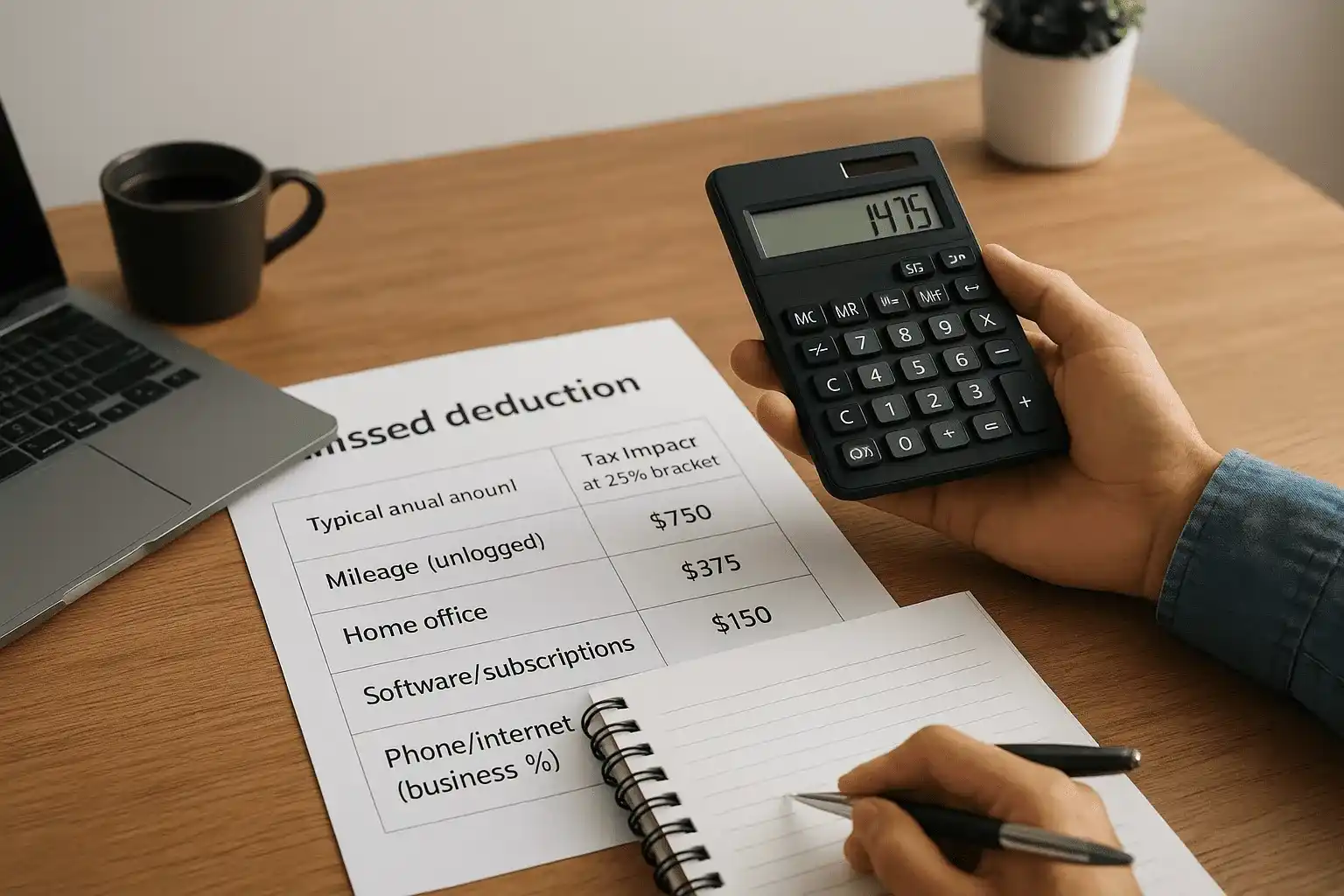
Many contractors lose thousands of dollars a year simply because they can't prove expenses they legitimately paid. A mileage log you forgot to keep, a software subscription buried in a personal credit card statement, a home office deduction you're too nervous to claim without documentation, these all add up. The table below shows how quickly small oversights compound over a year.
| Missed deduction | Typical annual amount | Tax impact at 25% bracket |
|---|---|---|
| Mileage (unlogged) | $3,000 | $750 |
| Home office | $1,500 | $375 |
| Software/subscriptions | $600 | $150 |
| Phone/internet (business %) | $800 | $200 |
That's over $1,475 in lost tax savings from four common categories alone, and that's a conservative estimate. Multiply that across several years of missed deductions and you start to see why bookkeeping pays for itself many times over.
Cash flow visibility you can't get any other way
Beyond taxes, bookkeeping gives you a real-time picture of your business health. You'll know which clients pay late, which months run lean, and whether you can afford to invest in new equipment or hire subcontractor help. Without that visibility, you're making financial decisions based on your bank balance today, which is a terrible way to run any business. Contractors who track their numbers monthly catch cash flow problems before they become emergencies, not after.
Protection if the IRS comes calling
Unfiled returns, unreported income, and disorganized records are exactly what trigger IRS notices and audits for 1099 workers. If you've ever ignored a notice hoping it would go away, you already know how quickly penalties and interest stack up. Consistent bookkeeping means you have bank statements, invoices, and receipts that match your tax filings, so if the IRS questions a deduction, you can answer with documentation instead of guesswork. That kind of preparedness is often the difference between a quick resolution and a drawn-out dispute that costs you both money and sleep.
Bookkeeping also protects you from a subtler risk: misclassifying yourself. If you're mixing personal and business transactions in one account, you lose the clarity needed to prove you're operating as a legitimate business rather than a hobby, which matters if the IRS ever challenges your deductions. Separating your finances from day one, and tracking them consistently, removes that ambiguity entirely.
How to set up a bookkeeping system as a contractor
Setting up a bookkeeping system doesn't require an accounting degree, but it does require a few decisions made correctly from the start. Get the foundation right and everything else, from tax filing to loan applications, becomes far easier. Rushing this step is what leaves most contractors scrambling every April with a shoebox of receipts and no idea what they actually owe.
Open a dedicated business account
First, open a separate business checking account and, ideally, a business credit card. Every dollar you earn as a contractor should flow through that account, and every business expense should come out of it. Mixing personal and business transactions is the single biggest reason contractors lose deductions, because you can't reconstruct six months of Starbucks runs and client dinners after the fact. This separation alone makes your books dramatically cleaner and gives you an instant audit trail if the IRS ever asks questions.
A dedicated business account is the single fastest fix for messy contractor books.
Choose a recordkeeping method
Next, decide how you'll record transactions. Spreadsheets work for very simple operations, but most contractors outgrow them within a year. A basic setup looks like this:
- Open a business checking account and credit card
- Choose bookkeeping software or a structured spreadsheet template
- Set up categories that match Schedule C line items
- Connect your bank feed so transactions import automatically
- Schedule a recurring time each week to categorize and reconcile
The IRS recordkeeping guidelines recommend keeping supporting documents for at least three years, so build your system with that retention window in mind from day one.
Build a weekly habit, not a year-end scramble
Consistency matters more than sophistication. Reconciling your accounts weekly, even for just fifteen minutes, keeps small errors from snowballing into a mess you dread untangling later. Categorize expenses as they happen instead of guessing months later what a $47 charge was for. Save digital copies of receipts immediately, either by photographing them or forwarding email confirmations into a dedicated folder, so nothing gets lost between now and tax season.
Finally, revisit your categories every quarter to make sure they still reflect how your business actually operates. Contractors who add new revenue streams or expense types often forget to update their chart of accounts, which muddies reports later. A quick quarterly review keeps your system accurate as your work evolves.
Choosing between cash and accrual accounting
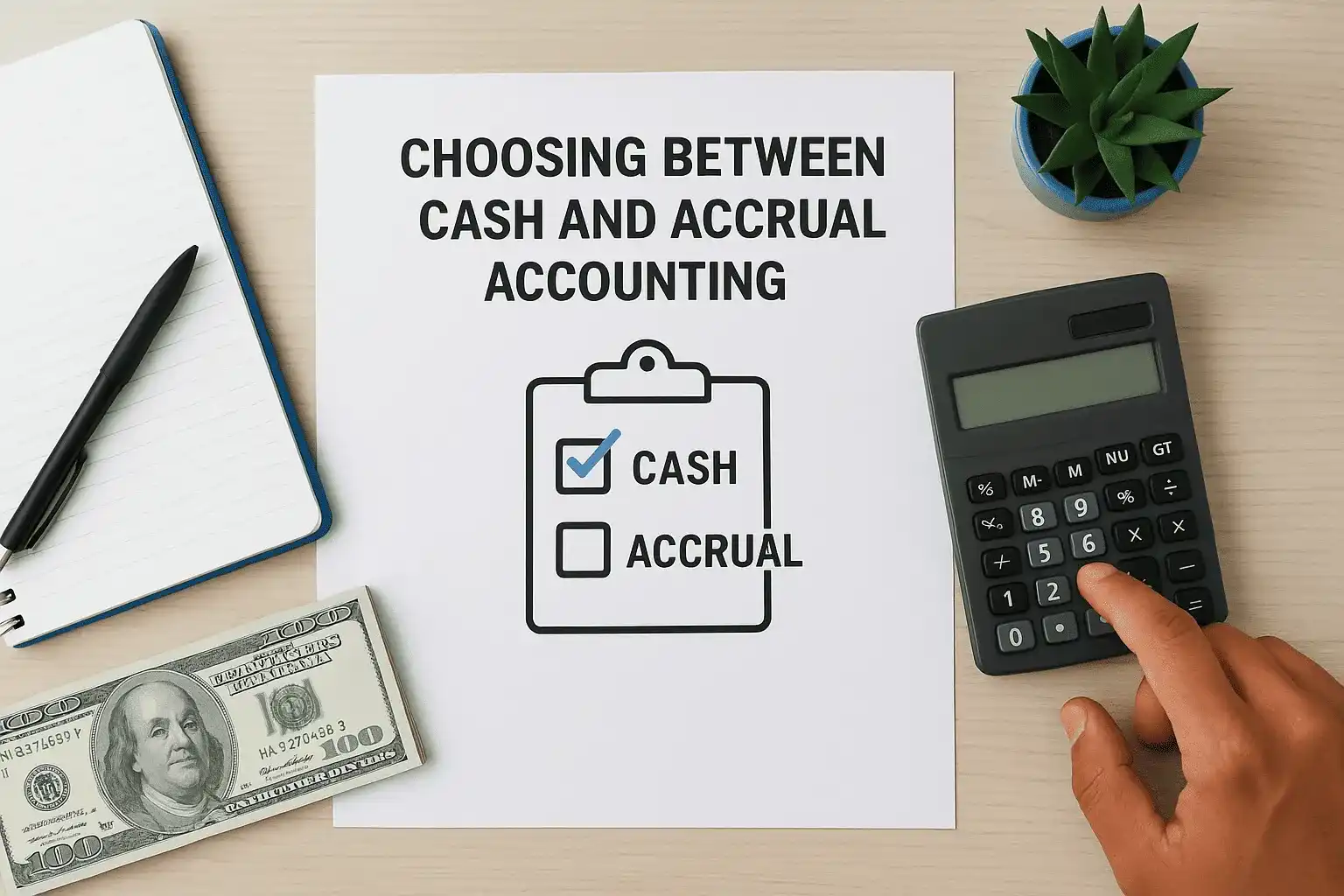
Once your accounts are set up, you need to decide how you'll actually record transactions, and that comes down to two methods: cash basis or accrual basis accounting. Cash basis records income when you receive the money and expenses when you pay them. Accrual basis records income when you earn it, meaning when you invoice a client, and expenses when you incur them, regardless of when cash actually changes hands. For most solo contractors, this choice determines how clearly your books reflect reality month to month.
Cash basis: the default for most contractors
Most independent contractors use cash basis accounting because it's simpler and matches how their business actually operates. You get paid, you record income. You pay a bill, you record an expense. There's no need to track receivables or payables, which keeps your monthly bookkeeping fast and your tax return straightforward. The IRS accounting periods and methods guidance confirms that most sole proprietors and single-member LLCs qualify to use cash basis without restriction.
If you're a solo contractor without inventory, cash basis accounting is almost always the right default.
Accrual basis: when it makes sense
Accrual basis makes more sense once your business gets complicated, for example if you carry inventory, extend credit to clients, or bill large projects with 30 to 60 day payment terms. It gives you a more accurate picture of profitability because income and expenses are matched to the period they actually belong to, not when cash happens to move. The tradeoff is added complexity: you now need to track accounts receivable and payable, which usually means dedicated software rather than a spreadsheet.
| Factor | Cash basis | Accrual basis |
|---|---|---|
| Complexity | Low | Moderate to high |
| Best for | Solo contractors, service-based work | Contractors with inventory or long invoice cycles |
| Tax timing | Matches actual cash flow | Can create tax owed on unpaid invoices |
| IRS eligibility | Most sole proprietors qualify | Required above certain revenue thresholds |
Making the switch or sticking with what works
Switching methods later requires IRS approval via Form 3115, so pick deliberately rather than defaulting without thought. Talk to a tax professional before you scale into inventory or large contracts, since the wrong method at that stage can distort your actual tax liability and cash position.
Tracking income, expenses, and deductions correctly
Every dollar that touches your business needs a paper trail, whether it's a client payment landing in your account or a software subscription leaving it. Recording transactions accurately, not just totaling them at year-end, is what separates a usable set of books from a guessing game. Accurate income tracking and consistent expense categorization are the two habits that make everything else in this guide work, from quarterly taxes to audit protection.
Recording every income source
Record income the moment you receive it, not when you remember to log it weeks later. If you invoice clients, match each payment to its invoice so you can spot late payers immediately. Contractors who work with multiple platforms, say a mix of direct clients and gig apps, often miss income entirely because 1099-NEC forms don't always arrive before you file. Reconcile your bank deposits against your own records monthly so nothing slips through.
Categorizing expenses correctly
Categorizing expenses the way the IRS expects saves you time when Schedule C rolls around. Set up categories that mirror the actual line items on Schedule C, such as supplies, advertising, insurance, and vehicle expenses, so your software can generate a tax-ready report instead of a jumbled list.
Categorize as you go, because reconstructing six months of expenses from memory almost always costs you deductions.
Deductions contractors often miss
Overlooked deductions are where most contractors leave money on the table. Common ones include:
- Home office square footage, calculated by the simplified or actual expense method
- Business mileage, tracked with a contemporaneous log
- Health insurance premiums if you're self-employed and not covered elsewhere
- Professional subscriptions, software, and continuing education
- A portion of your phone and internet bill used for work
The IRS guide to business expenses lays out what qualifies, and it's worth a read once a year even if you use software.
Documentation that holds up
Documentation is what turns a deduction from a claim into a fact. Keep digital copies of receipts, mileage logs, and bank statements tied to each expense category, and store them somewhere searchable rather than in a shoebox. Without that backup, even a legitimate deduction can get denied the moment the IRS asks a question.
Handling quarterly taxes and estimated payments
Once your books are organized, the next challenge is turning those numbers into quarterly tax payments that keep you compliant year-round. Independent contractors don't have an employer withholding taxes from every paycheck, so the IRS expects you to estimate and pay your own tax liability four times a year. Skip this step and you're not just risking a big bill in April, you're risking penalties for underpayment even if you eventually pay in full.
Why the IRS expects quarterly payments
Generally, if you expect to owe $1,000 or more in tax for the year, the IRS requires estimated payments rather than one lump sum at filing time, according to the IRS estimated taxes guidance. This system exists because the tax code assumes income gets taxed as it's earned, not months later. Contractors who ignore this rule often discover the hard way that a large refund isn't a reward, it's a sign you overpaid, and a large balance due usually comes with an underpayment penalty attached.
Waiting until April to think about taxes is the single most expensive mistake a contractor can make.
Calculating what you owe each quarter
Calculating your payment starts with your bookkeeping, not a guess. Pull your net income for the period, apply your effective tax rate including self-employment tax, and divide by four to smooth out swings between good and slow months.
| Quarter | Payment period | Typical due date |
|---|---|---|
| Q1 | Jan 1 to Mar 31 | April 15 |
| Q2 | Apr 1 to May 31 | June 15 |
| Q3 | Jun 1 to Aug 31 | September 15 |
| Q4 | Sep 1 to Dec 31 | January 15 (next year) |
Few contractors realize the quarters aren't even in length, which is exactly why relying on memory instead of your books leads to miscalculated payments.
Avoiding underpayment penalties
Setting aside a fixed percentage of every payment you receive, often 25 to 30 percent depending on your bracket, keeps you from scrambling at each deadline. Transferring that amount into a separate savings account the day you get paid removes the temptation to spend it. Reviewing your estimate every quarter against actual income, rather than paying the same flat amount all year, catches overpayment or underpayment before it becomes a problem at filing time.
Software options that simplify contractor bookkeeping
Picking the right tool matters less than using it consistently, but the right tool makes consistency far easier to maintain. Bookkeeping software built for contractors automates the tedious parts, bank feeds, receipt capture, mileage tracking, so you spend minutes a week instead of hours untangling a spreadsheet at tax time. The trick is matching the software to how complex your business actually is, not buying more than you need.
What to look for before you buy
Before comparing brand names, focus on features that actually move your bookkeeping forward. A few non-negotiables:
- Bank and credit card feed integration, so transactions import automatically
- Schedule C style expense categories built in
- Invoicing with payment tracking, so you can match deposits to invoices
- Mileage tracking, ideally with a phone app that logs trips automatically
- Quarterly tax estimate calculations based on your actual income
- Export options for your accountant, usually CSV or direct accountant access
The best bookkeeping software is the one you'll actually open every week, not the one with the longest feature list.
Matching software to your business stage
A solo contractor invoicing a handful of clients needs far less than someone running payroll for subcontractors or managing inventory. The table below breaks down typical fits by complexity level.
| Business stage | Typical needs | Software complexity |
|---|---|---|
| Solo, service-based | Invoicing, expense tracking | Basic, mobile-friendly |
| Growing with subcontractors | Payroll, 1099 filing | Mid-tier with payroll add-on |
| Multiple revenue streams | Job costing, class tracking | Full accounting suite |
| Inventory or retail-adjacent | Accrual support, inventory tracking | Full accounting suite |
Where software still falls short
Software can categorize a transaction, but it can't tell you whether a deduction will survive an audit or whether your quarterly estimate accounts for a big contract you just landed. Automated categorization occasionally misfires, especially with vague bank descriptions, so a monthly review by a human catches errors before they compound into a bigger tax problem. Software is a tool for capturing data cleanly, not a replacement for judgment when your situation gets complicated.
Many contractors also underestimate the setup time. Migrating old records, connecting every account, and building a chart of accounts that matches Schedule C takes real hours upfront. Rushing that setup is how contractors end up with software that looks organized but produces reports nobody trusts come tax season.
When to hire a bookkeeper or tax professional
At some point, your time is worth more than the hours you'd spend untangling receipts, and that's the signal to bring in outside help. Hiring a bookkeeper doesn't mean you've failed at managing your own books, it means your business has grown past the point where DIY tracking makes financial sense. The trick is recognizing that moment before it costs you a missed deadline or a denied deduction.
Signs you've outgrown the DIY approach
A few patterns show up consistently among contractors who need help sooner than they think:
- You're spending more than a few hours a week on bookkeeping instead of billable work
- You've missed a quarterly payment deadline or filed an extension more than once
- Your revenue crossed six figures and your categories are still a mess
- You've received an IRS notice and don't know how to respond
- You're hiring subcontractors or employees and now owe payroll tax filings
If bookkeeping is eating into the hours you'd otherwise spend earning, it's time to outsource it.
Bookkeeper versus tax professional versus both
A bookkeeper handles the day-to-day, categorizing transactions, reconciling accounts, and generating reports so your numbers are clean going into tax season. A CPA or Enrolled Agent takes those clean numbers and builds your tax strategy, files your return, and represents you if the IRS comes calling. Contractors dealing with straightforward income often need just a bookkeeper. Contractors facing back taxes, audits, or complex multi-state filings need someone with representation rights in front of the IRS, which only a CPA or Enrolled Agent has.
What professional help actually costs you, and saves you
Monthly bookkeeping support typically runs a few hundred dollars, while tax resolution work scales with the complexity of your case. Weigh that against the deductions you're missing, the penalties compounding on an unfiled return, or the hours you'd otherwise bill to clients. For most contractors already behind on their books or facing IRS notices, that math favors bringing in a professional immediately rather than waiting for the problem to grow. Firms staffed with CPAs and Enrolled Agents, rather than general support staff, can also negotiate directly with the IRS on your behalf, something software and spreadsheets will never do for you.
Keeping your books audit-ready year-round
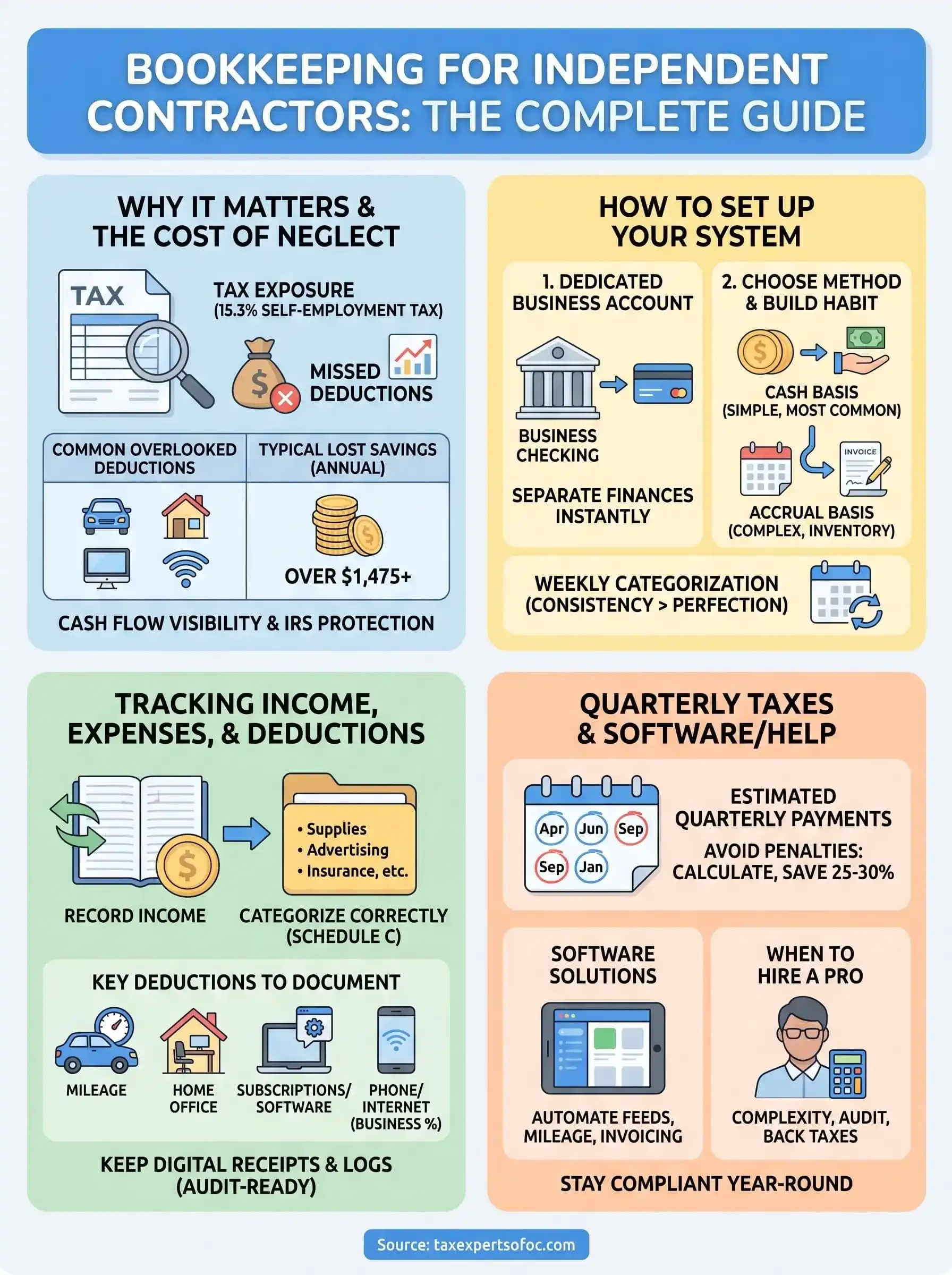
Audit-ready books aren't built the week before a deadline, they're the result of the habits covered in this guide: a dedicated business account, weekly categorization, quarterly tax payments, and documentation for every deduction you claim. Bookkeeping for independent contractors works best as a routine, not a scramble, and the contractors who treat it that way rarely dread tax season or fear an IRS notice.
Revisit your system every few months. Confirm your categories still match your business, your estimated payments still reflect your income, and your receipts are actually backed up somewhere you can find them. That consistency is what protects your deductions and your peace of mind.
If your books are already a mess or you're facing IRS pressure right now, don't wait for it to get worse. Schedule a free consultation with Tax Experts of OC and get a CPA or Enrolled Agent working on your case directly.