

If the IRS is sending notices you can't pay, or a levy is threatening your paycheck, you're probably searching for any legal way to make collections stop. Currently not collectible status is that option. It's an IRS designation that halts active collection efforts, levies, garnishments, and threatening letters, because your financial situation shows you genuinely can't pay right now.
CNC status doesn't erase your tax debt. It pauses collection while the IRS reviews your finances through Form 433-A or 433-F, confirming that paying would leave you unable to cover basic living expenses. Qualifying means proving hardship with real numbers: income, allowable expenses, assets, and monthly cash flow that the IRS compares against its own standards.
Below, we break down exactly what currently not collectible status means, who typically qualifies, what documentation the IRS expects, and how to request it without triggering red flags. We've guided clients in Orange County and across the country through this process, and we'll show you the same steps that actually stop wage garnishment and buy you breathing room while you get back on solid financial footing.
Why currently not collectible status matters for taxpayers
Getting currently not collectible status approved changes your situation overnight. The IRS stops sending levy notices, pulls back wage garnishment orders, and leaves your bank accounts alone. For someone choosing between paying rent and paying the IRS, that pause is the difference between staying housed and losing everything to a levy. This isn't a workaround or a loophole. It's a formal acknowledgment from the IRS that forcing payment right now would cause real harm, and the agency has procedures built specifically for that scenario.
Immediate relief from active collection
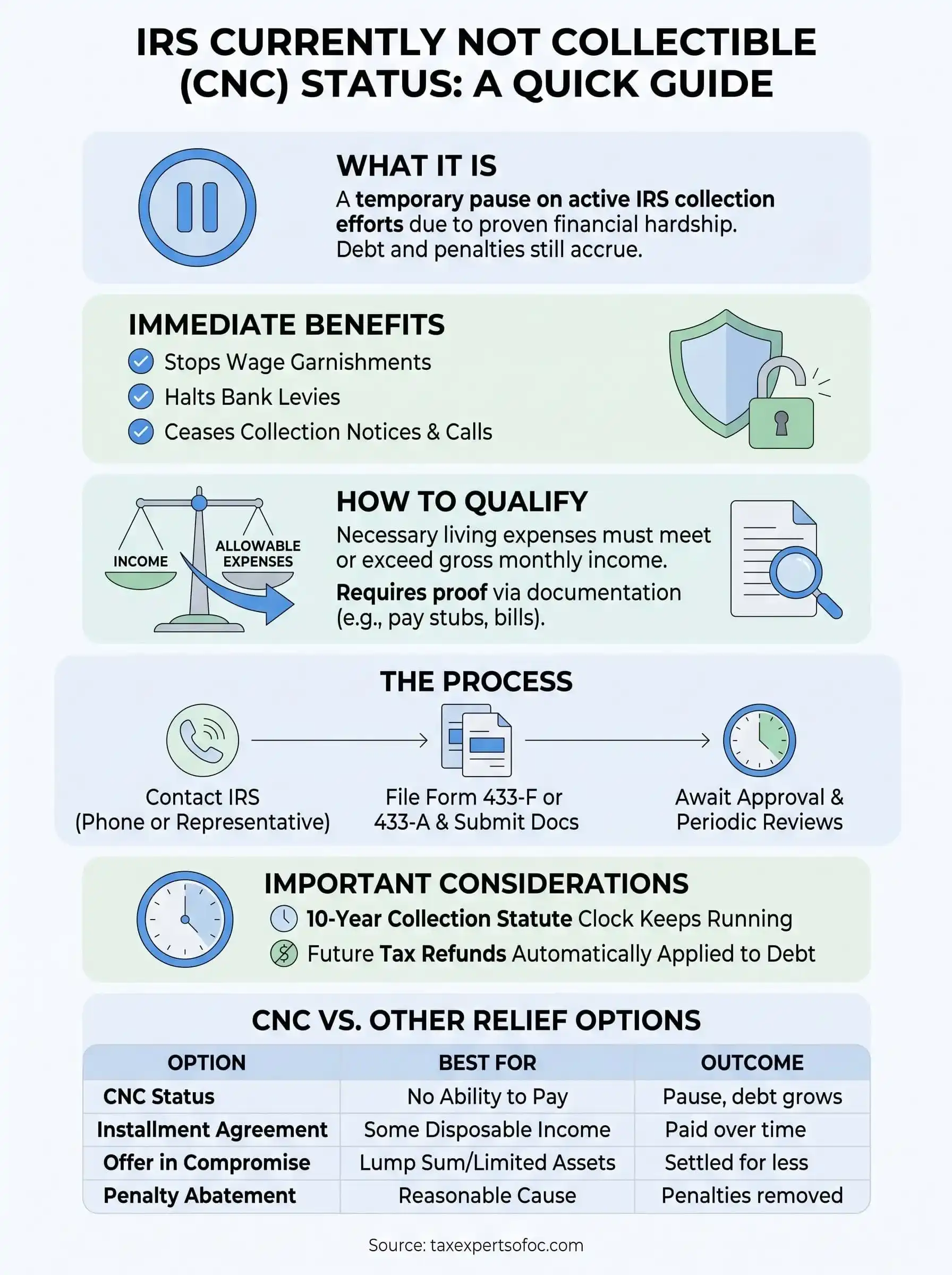
Once the IRS codes your account as CNC, several enforcement actions stop right away. Here's what typically changes:

- Wage garnishments already in place get released
- Bank levies stop, protecting whatever cash you have on hand
- Collection letters and notices demanding immediate payment cease
- Phone calls from IRS collections stop
- Your case moves off the active collections queue entirely
That list matters because most people in this situation aren't ignoring the IRS. They're drowning, and every garnished paycheck makes the hole deeper. CNC status breaks that cycle.
What CNC status doesn't fix
Here's the part people often miss: your tax debt keeps growing while you're on CNC status. Interest and penalties don't stop just because collection does. The IRS also isn't required to release an existing federal tax lien, and in some cases it may still file one, which can affect your credit and any property you own. CNC buys you time, not forgiveness.
Currently not collectible status stops the IRS from taking your money, but it doesn't stop the debt from growing.
The 10-year clock keeps running
This is the detail that actually works in your favor over time. Every tax debt has a collection statute expiration date, generally ten years from assessment, and that clock keeps ticking while you're in CNC status. The IRS confirms this statute of limitations framework in its own Collection Statute Expiration guidance. If your financial situation doesn't improve before that date hits, the debt can expire entirely. For taxpayers with little chance of ever catching up, CNC status isn't just a pause. It can be the path to the debt disappearing on its own, without a settlement or a payment plan ever being negotiated.
How to qualify for currently not collectible status
Qualifying for currently not collectible status comes down to one question: can you pay your tax debt and still afford basic living expenses? The IRS doesn't guess at this. It measures your income against its Allowable Living Expense standards, which cover housing, utilities, transportation, food, and healthcare based on your county and family size. If your necessary monthly expenses eat up everything you bring in, you're likely a candidate.
Income and expense thresholds
Generally, the IRS wants to see that your allowable expenses meet or exceed your gross monthly income. There's no fixed dollar cutoff since it varies by location and household size, but the agency publishes its Collection Financial Standards so you can check your numbers before applying. Falling short doesn't disqualify you outright, but it does mean the IRS will scrutinize your case more closely.
If your monthly expenses already consume your income, you're likely a strong candidate for CNC status.
Documentation the IRS expects
You'll need to substantiate every figure you report. Typical documentation includes:
- Recent pay stubs or proof of self-employment income
- Bank statements from the last three months
- Rent or mortgage statements
- Utility, insurance, and vehicle payment records
- Medical bills or ongoing healthcare costs
- A list of assets, including retirement accounts and vehicle equity
Missing paperwork is the number one reason CNC applications stall or get rejected outright.
Asset and equity considerations
Significant equity in a home, vehicle, or investment account can work against you, even if your monthly cash flow looks tight. The IRS reasons that you could liquidate or borrow against those assets to pay down the debt. Self-employed taxpayers and business owners face extra scrutiny here, since irregular income and business assets complicate the math. Knowing this upfront lets you prepare a stronger case instead of getting blindsided by a denial.
How to request currently not collectible status from the IRS
Requesting currently not collectible status starts with contacting the IRS directly, either by phone through the number on your notice or by working with a representative who can call the Practitioner Priority Service line. You can't apply for CNC status online through a simple form. It requires a live conversation or a mailed submission where you lay out your full financial picture and ask the IRS to classify your account as currently uncollectible.
Completing the right financial disclosure form
Which form you file depends on your debt amount and case type. Individuals typically use Form 433-F, a shorter version, while more complex cases, especially those involving revenue officers or higher balances, require the detailed Form 433-A. Both ask for the same core information: income, expenses, assets, and liabilities.
| Form | Best for | Detail level |
|---|---|---|
| 433-F | Most individual taxpayers, lower balances | Streamlined |
| 433-A | Complex cases, self-employed, revenue officer involvement | Comprehensive |
Fill these out accurately. Rounding numbers or guessing at expenses invites the IRS to ask follow-up questions, which slows everything down.
Submitting documentation and following up
Once your form is complete, attach the supporting documentation covered earlier, pay stubs, bank statements, bills, and send it through the channel the IRS specifies, whether that's fax, mail, or hand-delivery during a call. Persistence matters here. IRS phone queues run long, and cases sometimes sit for weeks before an agent reviews them.
Getting CNC status approved usually comes down to accurate paperwork and persistent follow-up, not luck.
Working with a representative
Taxpayers who hire a CPA or Enrolled Agent to handle this process often see faster resolutions, since a licensed representative can speak directly with the IRS using a signed power of attorney, correct errors in real time, and push back when a case stalls without cause. That professional layer removes a lot of the guesswork for someone already under financial strain.
What happens after the IRS grants CNC status
Once the IRS approves currently not collectible status, your account gets coded and enforcement stops within a few weeks. That's not the end of the story, though. The IRS keeps a file open on you, and it periodically checks whether your finances have improved enough to resume collection. Understanding what to expect during this period helps you avoid surprises down the road.
Periodic financial reviews
Expect the IRS to revisit your case, typically every one to two years, depending on your income level and the size of your debt. During these reviews, the agency asks for updated pay stubs, bank statements, and expense records to see if your situation has changed. Landing a raise, paying off a major expense, or selling an asset can all trigger a fresh look at your numbers.
CNC status isn't permanent protection. It's a status the IRS reviews and can revoke if your finances improve.
Tax refunds still get intercepted
Here's a detail that catches people off guard: even while you're in CNC status, any federal tax refund you'd otherwise receive gets applied directly to your outstanding balance. The IRS calls this an offset, and it happens automatically. You won't see that refund in your bank account, so plan your budget accordingly.
Staying compliant matters
You also need to keep filing every required tax return on time and paying any new tax debt as it comes due. Falling out of filing compliance while on CNC status can get your case reversed immediately, putting collection back in motion. Treat CNC status as a conditional pause, not a finish line, and you'll keep the protection working in your favor while the collection statute clock continues ticking toward expiration.
Currently not collectible vs other IRS relief options
Most taxpayers facing IRS debt qualify for more than one type of relief, and picking the wrong one wastes time you don't have. Currently not collectible status works when you have no ability to pay anything right now, but other programs fit different situations, and knowing the difference helps you or your representative pick the right path from the start.

Comparing your main options
An installment agreement spreads your balance into monthly payments you can actually afford, which makes sense if you have some disposable income but not enough to pay in full. An Offer in Compromise settles your debt for less than you owe, but it demands a lump sum or short-term payment plan and a lot more documentation than CNC status. Penalty abatement removes specific penalties if you have a reasonable cause or a clean filing history, but it doesn't touch the underlying tax bill.
| Option | Best for | Debt outcome |
|---|---|---|
| CNC status | No ability to pay anything | Paused, keeps accruing |
| Installment agreement | Some monthly disposable income | Paid over time |
| Offer in Compromise | Lump sum available, debt exceeds true ability to pay | Reduced and settled |
| Penalty abatement | Reasonable cause, clean history | Penalties removed only |
Why the comparison matters
Applying for the wrong program burns weeks you don't have while a levy sits active. A taxpayer with $200 left over each month after allowable expenses probably won't get approved for CNC status, but that same $200 might support a workable installment agreement. Someone with zero disposable income and no realistic prospect of catching up is better served pursuing CNC status now and revisiting an Offer in Compromise once their finances stabilize.
The right IRS relief option depends on what you can actually pay today, not what you owe overall.
A CPA or Enrolled Agent who reviews your Form 433-A or 433-F numbers upfront can usually tell within one conversation which program fits, saving you from a rejected application and a longer wait for real relief.
Deciding your next step with the IRS
Currently not collectible status gives you real breathing room when the IRS is threatening levies you genuinely can't afford. It won't erase what you owe, but it stops the bleeding while your finances stabilize and the collection clock keeps running toward expiration. The hard part isn't understanding the concept, it's proving your numbers hold up under IRS scrutiny and picking the right form, the right documentation, and the right timing.
That's where most people get stuck, and where a wrong move costs weeks you don't have. Working with a CPA or Enrolled Agent who handles these cases daily means someone else fights the IRS phone queues and paperwork while you focus on getting back on your feet. If a levy or garnishment notice landed in your mailbox this week, don't wait for it to escalate. Schedule your free consultation with Tax Experts of OC and find out exactly where you stand.