
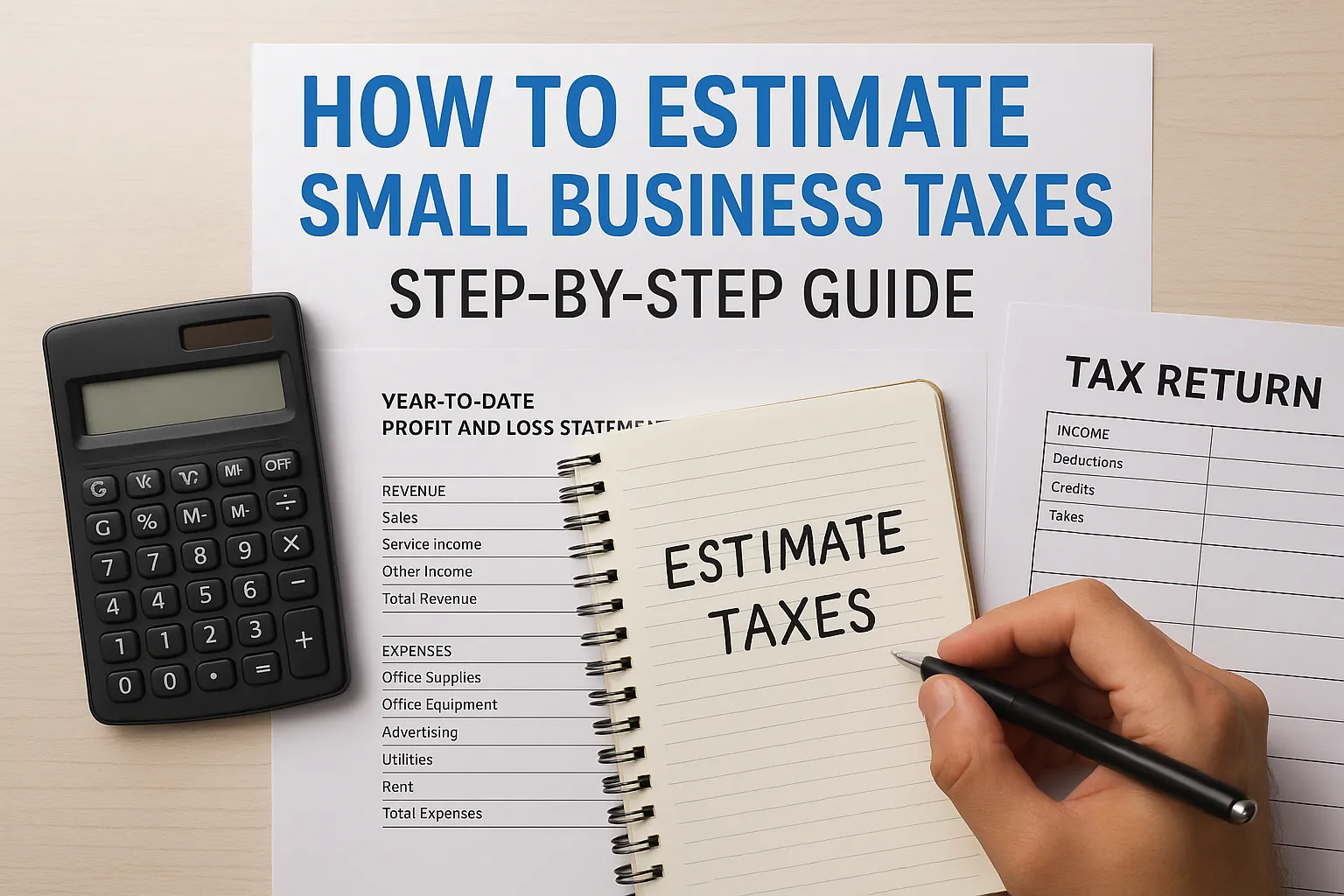
Guessing your tax bill is a bad habit that catches up with you every April, or worse, every quarter when the IRS expects estimated payments. Estimating small business taxes accurately means you avoid underpayment penalties, keep enough cash on hand, and stop dreading your CPA's phone calls. Most owners either overestimate out of fear or underestimate out of hope, and both mistakes cost real money.
The good news is that you don't need a finance degree to get a reasonable number. This guide walks you through the actual math: your self-employment tax rate, federal and state income tax brackets, deductions that lower your taxable income, and how to use a small business taxes calculator to sanity-check your work before you file or send a quarterly payment. You'll see exactly which figures to pull from your books and how they combine into one estimate.
We put this together based on what we see constantly at Tax Experts of OC: business owners who wait until tax season to think about taxes at all. By the end, you'll have a repeatable process for quarterly estimated payments and a clearer picture of where professional tax planning can save you more than a spreadsheet ever will.
What you need before estimating your business taxes
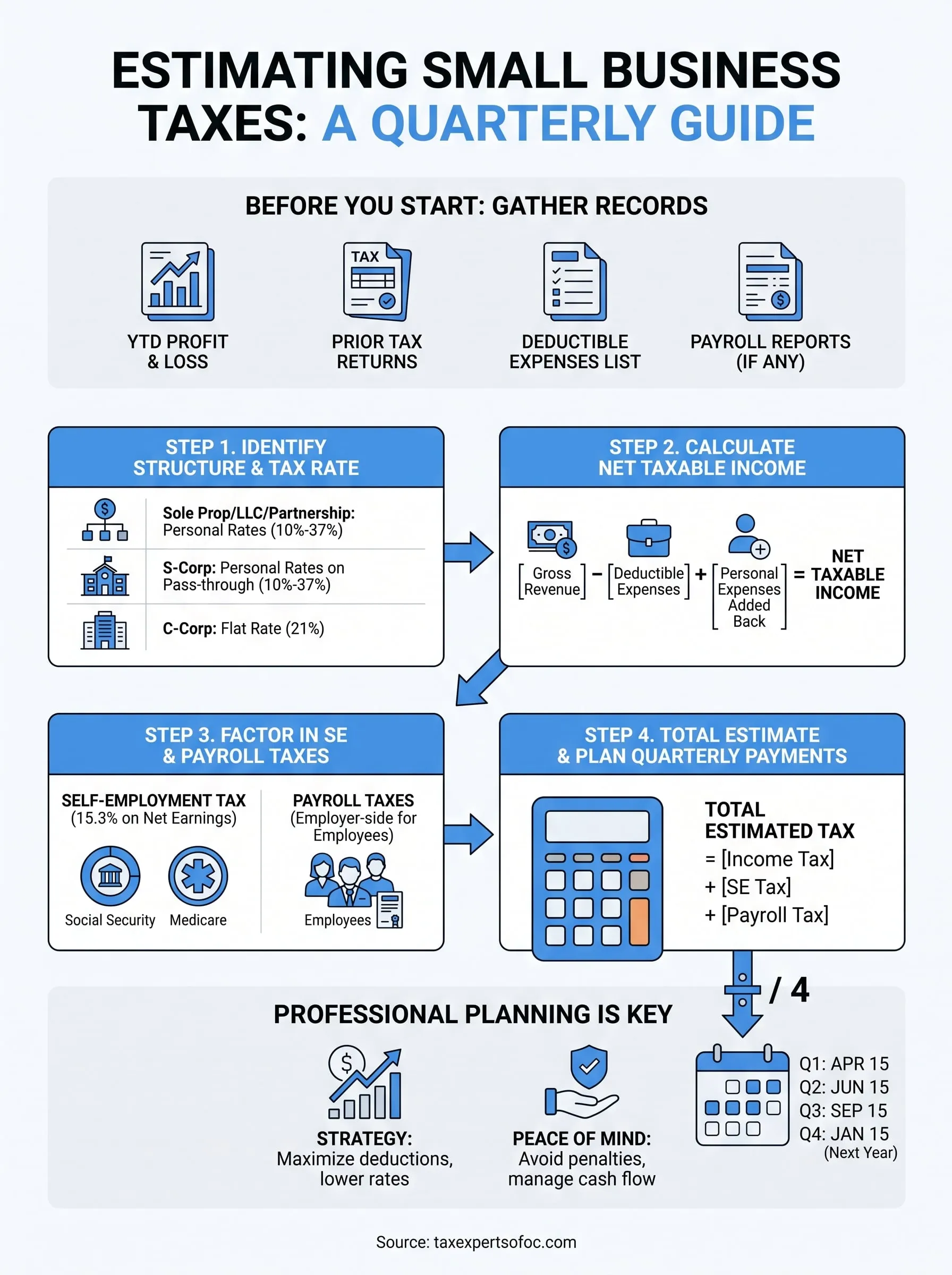
Before you touch any numbers, gather the paperwork that actually drives your estimate. Estimating small business taxes without real figures in front of you just produces a guess dressed up as a calculation. You need your year-to-date profit and loss statement, last year's tax return, and a running list of deductible expenses. If you use small business tax software like QuickBooks or Xero, export a current P&L; if you track things manually, total your income and expenses by category before moving forward.
Financial records to gather
Pull these documents together first so you're not stopping mid-calculation to hunt for a receipt:
- Year-to-date profit and loss statement
- Prior year's federal and state tax returns
- Records of estimated payments already made this year
- A list of deductible business expenses (mileage, home office, equipment, software subscriptions)
- Payroll reports if you have employees or pay yourself a salary
Numbers you need to know
Once your records are in hand, confirm three things: your business structure (sole proprietor, LLC, S-corp, or C-corp), your filing status, and your state's income tax rate if your state taxes business income. These three factors change which tax brackets apply and whether self-employment tax even comes into play.
Skip the paperwork step and every number after it is built on sand.
Finally, decide whether you're working this out by hand or leaning on a small business taxes calculator. A calculator speeds things up, but it's only as accurate as the inputs you feed it, which is exactly why the record-gathering step matters more than the math itself.
Step 1. Identify your business structure and tax rate
Your business structure determines whether your business pays tax directly or passes profit through to your personal return. Sole proprietors and single-member LLCs report business income on Schedule C, taxed at individual rates. Partnerships and S-corps pass income through to owners, who pay tax on their share, so it pays to compare how an S corp and an LLC are taxed before you settle on a structure. C-corps pay a flat corporate rate, then owners pay tax again on dividends.

Get your structure wrong in the estimate and every later step drifts off target.
Here's how the rates break down for 2025:
| Structure | How income is taxed | Applicable rate |
|---|---|---|
| Sole proprietor / single-member LLC | Personal income tax brackets | 10% to 37% |
| Partnership / multi-member LLC | Pass-through to partners | 10% to 37% |
| S-corporation | Pass-through to shareholders | 10% to 37% |
| C-corporation | Flat corporate rate | 21% |
Check the current brackets directly on the IRS website since they adjust annually for inflation. Once you know which column applies to you, note the marginal tax rate for your income bracket. That figure becomes your starting multiplier for Step 2, where you'll apply it to actual taxable income instead of gross revenue.
Step 2. Calculate your net taxable income
Subtract your deductible business expenses from gross revenue to find your net taxable income, the figure your tax rate actually applies to. Grab that year-to-date P&L and total every deduction worth claiming: cost of goods sold, home office use, mileage, equipment, software, contractor payments, and health insurance premiums if you're self-employed. Don't skip the smaller line items. A $400 software subscription and a $600 mileage deduction add up fast across twelve months.
Add back any personal expenses you may have run through the business by mistake, since those don't count. Then apply the standard deduction or itemized deductions if you're a sole proprietor filing personally, since business income flows onto your Form 1040.
Net taxable income, not gross revenue, is the number your tax bracket actually taxes.
Here's a quick example:
- Gross revenue: $180,000
- Business expenses: $65,000
- Net business income: $115,000
- Standard deduction (single filer): $14,600
- Net taxable income: $100,400
That $100,400 is what you multiply by your marginal rate from Step 1, not the original $180,000. This is where a small business taxes calculator earns its keep, since it applies bracket math automatically instead of you doing it by hand.
Step 3. Factor in self-employment and payroll taxes
Income tax is only half the bill. If you're a sole proprietor, partner, or LLC member, you also owe self-employment tax on your net earnings, covering Social Security and Medicare. This tax hits your business profit before any income tax bracket applies, so skipping it is the single biggest reason DIY estimates fall short.
Calculating self-employment tax
Multiply your net business income by 92.35% to find the taxable base, then apply the 15.3% self-employment tax rate (12.4% Social Security up to the annual wage base, plus 2.9% Medicare with no cap). Using the $115,000 net business income from Step 2: $115,000 x 0.9235 = $106,203, then x 15.3% = roughly $16,249 in self-employment tax. Confirm current wage base limits on the Social Security Administration's website since it changes yearly.
Self-employment tax runs on top of income tax, not instead of it.
Payroll taxes for employees
If you run payroll, add employer-side Social Security, Medicare, and unemployment tax obligations for each employee, the core pieces of payroll taxes for small business. S-corp owners paying themselves a reasonable salary also owe payroll tax on that wage portion, separate from pass-through profit.
Step 4. Total your estimate and plan quarterly payments
Now add everything together: income tax on your net taxable income, plus self-employment tax, plus any payroll tax obligations. Using our running example, roughly $18,000 in federal income tax (adjust for your actual bracket) plus $16,249 in self-employment tax lands you near $34,000 for the year. That's your total tax estimate, the number that should guide every quarterly payment you make going forward.
Divide your annual estimate by four and you've got a payment schedule, not just a guess.
Divide that total by four to set your quarterly estimated payments, then mark the IRS due dates on your calendar:
| Quarter | Due date |
|---|---|
| Q1 | April 15 |
| Q2 | June 15 |
| Q3 | September 15 |
| Q4 | January 15 (following year) |
File these using Form 1040-ES, available directly on the IRS website. Owners with uneven income should adjust each quarter's payment based on actual earnings rather than splitting evenly, since the IRS penalizes underpayment even if you catch up by December; here's how to pay estimated taxes when you work for yourself. Sticking to this schedule keeps your small business taxes calculator results useful all year, not just at tax time.
Turning your estimate into a solid tax plan
Getting comfortable with estimating small business taxes puts you in control of cash flow instead of reacting to a surprise bill every April. You now know how to pull the right records, apply your business structure's rate, calculate net taxable income, and layer in self-employment or payroll tax before setting quarterly payments. That process alone puts you ahead of most owners who still guess.
But an estimate is a starting point, not a strategy. Real tax planning looks for deductions you're missing, catches entity elections that could lower your rate, and adjusts your payments as income shifts throughout the year. A small business taxes calculator gets you close; a CPA or Enrolled Agent gets you accurate and keeps you out of penalty territory.
If you'd rather have a professional double-check your numbers than hope your spreadsheet holds up under IRS scrutiny, book a free consultation for professional tax planning services in Orange County and get a plan built around your actual business.