
Ask ten business owners how much do small business pay in taxes and you'll get ten different answers, mostly because they're all comparing different business structures, income levels, and states. A sole proprietor in Texas pays nothing like an S-corp owner in California, even with similar revenue. That inconsistency leaves a lot of owners guessing at tax time instead of planning ahead.
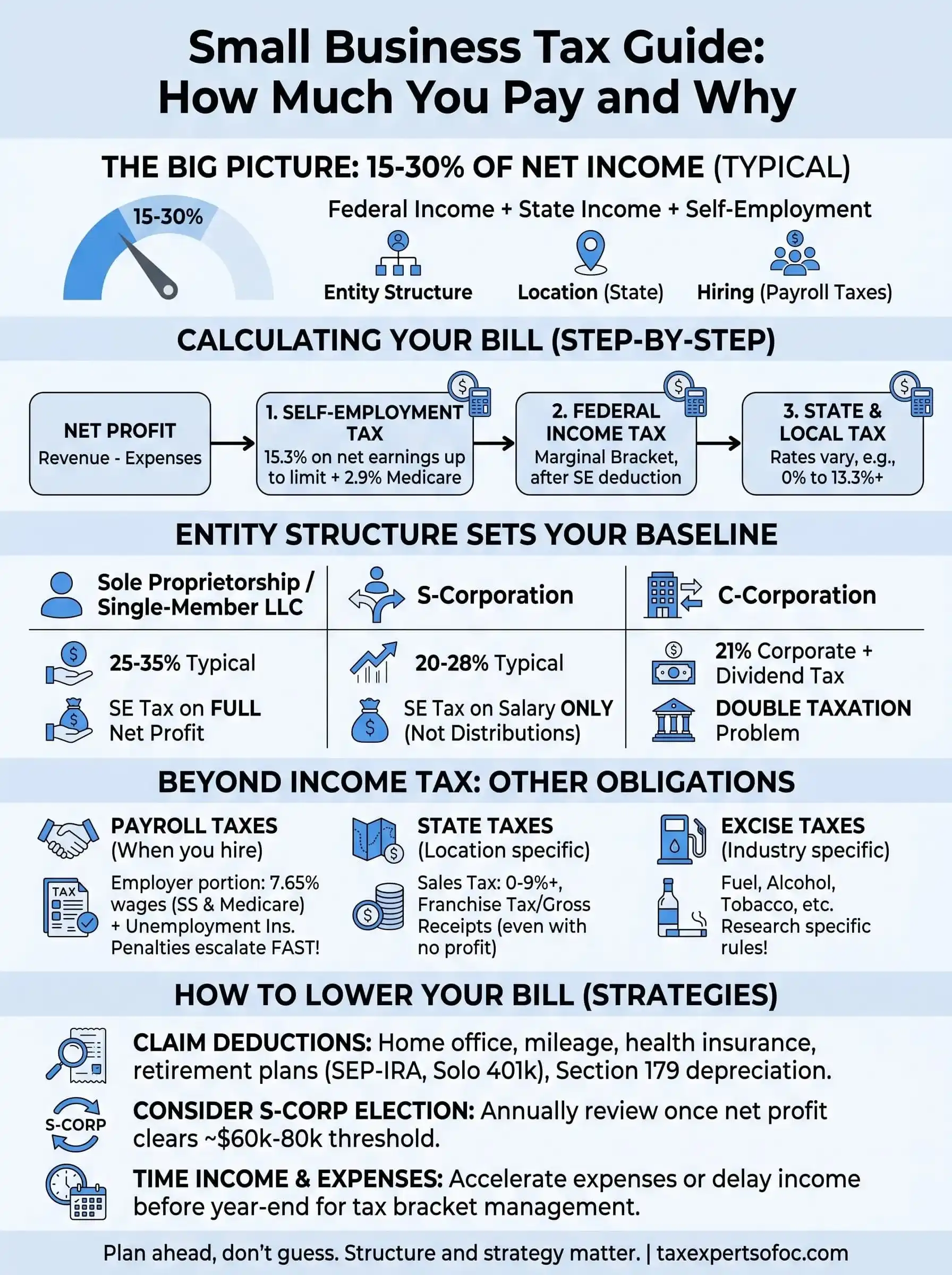
Here's the direct answer: small businesses typically pay somewhere between 15% and 30% of their net income in combined federal, state, and self-employment taxes, though the exact figure depends heavily on your entity type and where you operate. An LLC taxed as a sole proprietorship faces a different math problem than a C-corp, and payroll tax obligations stack on top of income tax for anyone with employees.
In this article, we'll break down the actual tax rates by business structure, explain which taxes apply beyond federal income tax, and show you the income thresholds that push your rate higher. If you're trying to budget accurately or wondering whether your current setup is costing you more than it should, this gives you the numbers to work from.
Why your tax rate matters more than you think
Most owners treat their tax rate as an afterthought, something to figure out in March when the paperwork lands on the desk. That's backwards. Your effective tax rate determines how much cash you actually keep from every dollar of revenue, which shapes pricing, hiring decisions, and how much you can safely pull out of the business for yourself. A contractor who nets $120,000 but loses 28% to combined taxes has a very different runway than one who structures things to land at 18%. Understanding how much are small business taxes for your specific setup before the year ends, not after, is what separates owners who plan from owners who scramble.
Entity structure sets your baseline
The business structure you picked at formation, often with little thought, now controls a huge chunk of your tax bill. Sole proprietors and single-member LLCs report profit on Schedule C and pay both income tax and self-employment tax on the full amount. S-corp owners can split income into salary and distributions, cutting the self-employment tax exposure on the distribution portion. C-corps pay a flat 21% corporate rate, then shareholders pay tax again on dividends, the classic double-taxation problem.

| Structure | Typical combined rate | Key tax exposure |
|---|---|---|
| Sole proprietorship / single-member LLC | 25-35% | Income tax + 15.3% self-employment tax on full net profit |
| Partnership / multi-member LLC | 25-35% | Same as above, split across partners |
| S-corporation | 20-28% | Income tax + SE tax on salary only, not distributions |
| C-corporation | 21% corporate + dividend tax | Double taxation on distributed profits |
The entity box you checked when you formed your business often costs or saves you more than any deduction you'll ever claim.
Location changes the math again
Where you operate stacks a second layer on top of the federal number. Nine states, including Texas, Florida, and Nevada, charge no personal income tax, which helps pass-through owners significantly. California, by contrast, adds up to 13.3% on top of federal rates and tacks on a separate franchise tax for LLCs and corporations regardless of profit. Owners who compare how much does a small business pay in taxes across states before choosing where to register or operate can save thousands annually, especially once revenue climbs past six figures.
Self-employment tax surprises new owners
Growing businesses eventually cross into higher marginal brackets, and that shift catches people off guard because it happens gradually. Self-employment tax alone runs 15.3% on net earnings up to the Social Security wage base ($176,100 for 2026), covering Social Security and Medicare in place of the payroll withholding an employee would see. New owners frequently forget this tax exists separately from income tax, then get hit with an unexpected bill and underpayment penalties in April. Setting aside a percentage of every payment received, rather than waiting until tax season, keeps this from becoming a cash-flow emergency.
How to calculate what your business actually owes
Getting a real number requires more than multiplying revenue by a percentage you saw online. Net profit, not gross revenue, is the starting point for every calculation, and from there you layer on self-employment tax, federal income tax, and state tax separately, since each uses different rules and thresholds. Owners asking how much are taxes for a small business often skip straight to a guess instead of running the actual math, which is how underpayment penalties happen.
Start with your net profit
Subtract every deductible business expense from your total revenue first. This includes cost of goods sold, home office deductions, mileage, equipment, and software subscriptions. What's left is your net profit, the figure the IRS actually taxes, not your bank deposits for the year.
Run the calculation in order
Work through the numbers in this sequence to avoid double-counting or missing a layer:
- Calculate net profit (revenue minus deductible expenses).
- Apply self-employment tax: 15.3% on net earnings up to the Social Security wage base, plus 2.9% Medicare on everything above it.
- Deduct half of your self-employment tax as an adjustment to income before figuring federal tax.
- Apply your federal marginal tax bracket to the remaining taxable income.
- Add your state income tax rate, if your state charges one.
- Add any local or franchise taxes specific to your city or entity type.
Skip step three and you'll overpay, since the IRS lets you deduct half your self-employment tax before calculating income tax owed.
A quick example
Say you net $90,000 as a sole proprietor in a state with a 5% income tax. Self-employment tax runs roughly $12,717. Federal income tax on the remaining taxable income, after deductions, might land around $9,500 depending on your bracket. State tax adds another $4,000 or so. Total tax burden lands near $26,000, close to 29% of net profit.
Tools like the IRS withholding estimator can sanity-check your own numbers once you've run through the sequence above. Precision matters here because guessing low means a scramble in April, while guessing high just ties up cash you could have used to grow the business or pay yourself.
For more detail on the actual formulas and current-year brackets, the IRS breaks down self-employment tax rules directly on its official self-employment tax page.
The main taxes small businesses pay beyond income tax
Federal income tax gets all the attention, but it's rarely the biggest line item on your tax bill. Payroll taxes, sales tax, and a handful of smaller obligations often add up to more than the income tax itself, especially once you hire your first employee. Owners calculating how much does small business pay in taxes need to look past the 1040 or 1120 form and account for every tax category that applies to their specific operation, not just the ones that show up on a W-2.

Payroll taxes hit the moment you hire
Once you bring on staff, you owe the employer half of Social Security and Medicare, currently 7.65% of each employee's wages, plus federal and state unemployment insurance. This is separate from the self-employment tax you pay on your own income, and it applies whether the business turns a profit or not. Missing a payroll tax deposit deadline triggers some of the harshest penalties in the tax code, often starting at 2% and climbing fast.
Payroll tax penalties escalate faster than almost any other IRS penalty, so treat deposit deadlines as non-negotiable.
Sales tax and franchise fees vary by state
If you sell physical goods or certain services, your state likely requires you to collect and remit sales tax, with rates ranging from 0% in states like Oregon to over 9% in parts of Louisiana. Separately, several states charge a franchise or gross receipts tax just for the privilege of operating there, regardless of whether you made a profit.
| Tax type | Who pays it | Typical rate |
|---|---|---|
| Employer payroll tax | Businesses with employees | 7.65% of wages |
| Sales tax | Retailers and service providers | 0-9%+, state-dependent |
| Franchise tax | LLCs and corporations in certain states | Flat fee or gross receipts based |
| Excise tax | Fuel, alcohol, tobacco, and specific industries | Varies by product |
Excise taxes apply to specific industries
Excise taxes target particular goods and activities rather than general income, covering things like fuel, alcohol, tobacco, and certain heavy equipment. Most small businesses never encounter these, but if yours touches a regulated product, the IRS excise tax rules spell out exactly what applies and when it's due, and skipping that research usually costs more than the tax itself.
How to lower your small business tax bill
Paying less starts with legal strategy, not aggressive guessing. Deductions and credits reduce your taxable income directly, while entity choice and retirement contributions shift how much of your profit even gets taxed in the first place. Owners who wait until December to think about this leave money on the table every single year, because most of the best moves require setup time, not a last-minute filing trick.
Claim every deduction you're entitled to
Track expenses year-round instead of reconstructing them from memory in tax season. Common deductions that owners underuse include:
- Home office space, calculated by square footage or the simplified method
- Vehicle mileage or actual vehicle expenses for business use
- Health insurance premiums for self-employed owners
- Retirement plan contributions through a SEP-IRA or Solo 401(k)
- Section 179 depreciation on equipment purchased during the year
Each of these lowers net profit before any tax rate gets applied, which matters more than a credit applied after the fact.
Revisit your entity structure annually
Questioning how much are small business taxes under your current setup versus an S-corp election is worth doing every year, not just at formation. Once net profit consistently clears roughly $60,000 to $80,000, the S-corp election often saves more in self-employment tax than it costs in extra payroll administration. Below that threshold, the added accounting fees can eat the savings, so run the comparison with real numbers rather than assuming it always helps.
The S-corp election isn't automatically a win, it only pays off once your profit clears the threshold where the tax savings beat the added administrative cost.
Time income and expenses strategically
Shifting a large purchase into December instead of January, or delaying an invoice until early in the next year, can move you into a lower bracket for the current tax year. Businesses expecting a strong year often accelerate deductible expenses before December 31, while those expecting a slower year push income into the next period instead. This kind of timing requires accurate books throughout the year, since you can't make smart decisions in December without knowing where your numbers actually stand.
Any strategy you consider should get checked against your specific structure and state rules before you act on it. A CPA who reviews your books quarterly, rather than once a year, catches these opportunities while there's still time to use them.
Staying ahead of your tax bill
So how much do small businesses pay in taxes? Somewhere between 15% and 30% of net profit, but the real number depends on your entity structure, your state, and whether you've hired anyone yet. The owners who keep more of their profit aren't the ones with better luck, they're the ones who run the numbers before December instead of after. Structure decisions, deduction tracking, and quarterly reviews all beat scrambling in April with a bill you didn't see coming.
Waiting until tax season to think about any of this almost always costs more than acting early would have. If you're unsure whether your current setup is costing you unnecessary money, or you're dealing with back taxes and want a professional to run the actual math for your situation, schedule a free consultation with Tax Experts of OC and get a straight answer instead of another guess.