
An IRS CP504 notice is a Notice of Intent to Levy. The IRS mails it when a tax balance is still unpaid after several earlier bills, and it says the agency plans to seize your state tax refund and other property to collect. It is serious, but it is not the end of the road. In nearly all cases the IRS must still send a final notice with hearing rights before it can take your wages or bank balance, so you have a window to act.
This guide explains where the notice sits in the IRS collection sequence, what the IRS can take and when, and what waiting costs you in penalties. It then walks you through the steps to respond, the payment options if you cannot pay in full, and the mistakes that turn a manageable bill into a levy.
Tax Experts of OC is an Orange County tax resolution firm that handles IRS notices for clients in all 50 states, with a CPA and an Enrolled Agent on the team. What follows reflects how these notices work in practice, so you can decide what to do yourself and when to call for help.
Why an IRS CP504 notice is serious
What the IRS can take after the notice
A CP504 exposes your state tax refund to levy right away and warns that the IRS intends to take other property next. A levy is a legal seizure of the money or asset itself. That makes it different from a lien, which is only a claim against your property.
The IRS can levy other property only after the final notice, covered below. That includes wages, which your employer keeps sending to the IRS until the levy is released, and bank accounts, where the bank holds your funds for 21 days before paying the IRS. The levy arrives as a notice of levy, such as Form 668-A, sent to your employer or bank.
Where the CP504 sits in the collection sequence
The IRS usually escalates through a series of notices. The order can vary, and not everyone receives every one.
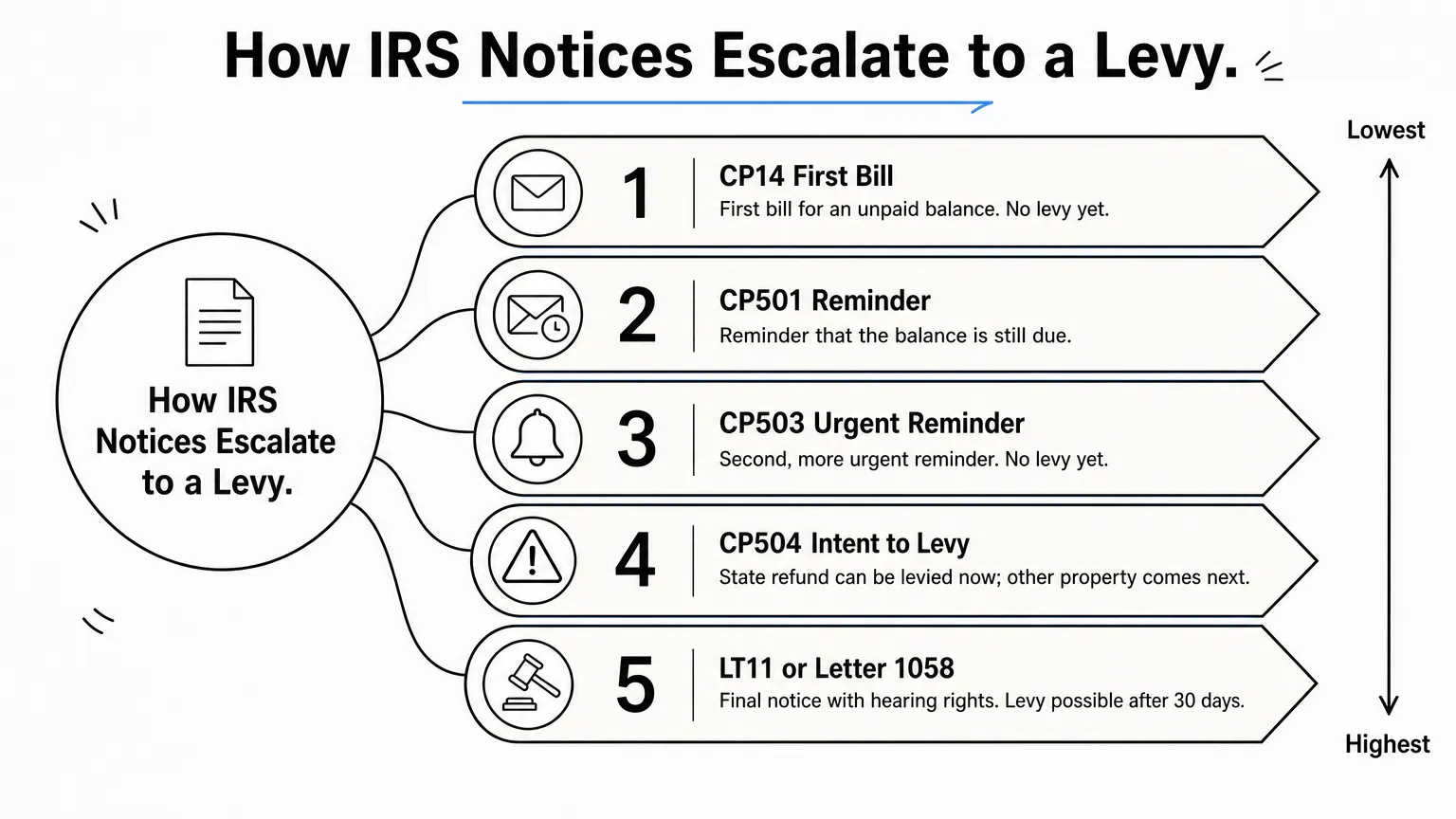
| Notice | What it tells you | Can the IRS levy yet? |
|---|---|---|
| CP14 | First bill for an unpaid balance | No |
| CP501 | Reminder that the balance is still due | No |
| CP503 | Second, more urgent reminder | No |
| CP504 | Notice of intent to levy your state refund and other property | State refund, yes |
| LT11 or Letter 1058 | Final notice of intent to levy and your right to a hearing | Yes, after 30 days |
So CP504 is not the final notice. The LT11 or Letter 1058 is, and it gives you 30 days to request a Collection Due Process hearing. A CP504 does not carry those hearing rights, which is why you should use the time before the final notice arrives.
The CP504 is the warning, and the LT11 or Letter 1058 is the deadline that carries your hearing rights.
What waiting costs you
Delay is expensive. The failure-to-pay penalty runs at 0.5% of the unpaid tax per month. It rises to 1% per month starting 10 days after the IRS issues a notice of intent to levy, and the total is capped at 25% of the unpaid tax. Interest compounds daily on top of that.
Take a $12,000 balance. Before the CP504, the penalty adds $60 a month. After it, the penalty adds $120 a month. Six months of waiting at the higher rate adds $720 in penalties alone, before interest.
How to respond to an IRS CP504 notice
Steps to take this week
Respond by confirming the notice is genuine, checking the balance, and then paying, arranging a plan, or disputing the amount before the response date printed on the notice. Work through these steps in order:
- Confirm the notice is real. The IRS opens collection by mail. Look for "CP504" in the upper right corner, your tax year, and an amount due. Compare them with your IRS online account.
- Check the balance. Match the amount against your return and your payment records. Misapplied payments and mismatched income reports do happen.
- File missing returns. The IRS will not approve a payment plan or an offer while returns are unfiled.
- Pick a resolution. Pay in full, request a payment plan, or dispute the amount. The next section compares your options.
- Act before the date on the notice. Call the number printed on it, keep a record of the call, and save copies of everything you send.
Check the balance first, because paying or arranging a plan on a wrong amount wastes money you can recover only with effort.
How to pay or reach the IRS
You can pay through your IRS online account or Direct Pay on IRS.gov. You can also mail a check payable to "United States Treasury" with the payment voucher from your notice. Use the mailing address and phone number printed on your notice, because they vary by notice and tax type. A CP504B, for example, is a version of the same notice, and you follow the instructions on your copy. Write your taxpayer identification number and the tax year on the check.

Options when you cannot pay the full balance
Compare the four main options
Most people who receive an IRS CP504 cannot write one check, and the IRS has set paths for that. The right one depends on your income, assets, and whether you believe you owe the amount.
| Option | Best when | What to know |
|---|---|---|
| Pay in full | You can cover the balance now | Stops penalties and interest from growing |
| Installment agreement | You can pay monthly | Individuals owing $50,000 or less can apply online for a long-term plan. The penalty rate drops to 0.25% a month if you filed on time |
| Offer in compromise | You cannot pay in full, or you doubt you owe it | The IRS accepts less only in qualifying cases, and all returns must be filed |
| Currently not collectible | Paying would leave you short of basic living expenses | Collection pauses, but interest and penalties keep accruing |
Most people start with an installment agreement. It is the quickest way to stop levy action while you keep paying, and it is easier to get than an offer in compromise.
Request your hearing when the final notice arrives
If the LT11 or Letter 1058 arrives, you have 30 days to request a Collection Due Process hearing on Form 12153. A timely request generally pauses levy action while the hearing runs. It also lets you propose a payment plan or offer and appeal an adverse decision to the U.S. Tax Court.

Miss the 30 days and you can still ask for an equivalent hearing within one year of the notice date. You lose the levy pause, though. Mark the 30-day date on a calendar the day the letter arrives.
A hearing request filed within 30 days of the final notice is the strongest brake you have on a levy.
Mistakes to avoid and when to get help
Mistakes that make a CP504 worse
The costliest error is doing nothing and hoping the notice goes away. These are the other common ones:
- Paying a caller. The IRS does not start collection by phone. A caller demanding gift cards, wire transfers, or payment to a personal account is running a scam.
- Assuming the amount is right. Disputing a wrong balance with documents is cheaper than paying it.
- Missing the final notice deadline. The 30-day hearing window is short and strict.
- Leaving old returns unfiled. An open filing gap blocks most resolutions.
- Agreeing to a plan you cannot keep. A defaulted plan can restart collection.
When a tax professional makes sense
Bring in help when the balance is large, several tax years are involved, you have unfiled returns, or a levy would cause real hardship. A CPA or Enrolled Agent can represent you before the IRS under a power of attorney (Form 2848), speak to the agency for you, and negotiate the plan or offer. If a levy would leave you unable to meet basic needs, the Taxpayer Advocate Service can also help through Form 911.
Tax Experts of OC offers a free 30-minute initial consultation for tax resolution, works with the IRS and state agencies, and offers flexible payment options for qualified clients. The work is done by phone and email, so you can get help wherever you live.
Your next step after a CP504
A CP504 notice means the IRS has moved from billing you to preparing to seize property, and your state refund is already exposed. You still have time. Confirm the balance, file anything missing, and pick a payment route before the response date. Then watch for the LT11 or Letter 1058 and protect your 30-day hearing right.
If the amount is large or the options are unclear, talk to Tax Experts of OC about your CP504 notice. A CPA or Enrolled Agent can review your situation and tell you which path fits before a levy starts.