
An IRS CP59 notice is a letter saying the IRS has no record of a personal income tax return from you for a prior year. You answer it in one of two ways. Either file the missing return, or explain with Form 15103 why you did not need to file or already did. If you filed within the last eight weeks, the IRS says you do not need to do anything.
The notice goes out when third-party records, such as W-2s and 1099s, show income under your Social Security number but no return is on file. It is not a bill and it is not an audit. It is a prompt, and the steps after it get more expensive the longer you wait. It can also be wrong. Returns get rejected, mistyped, or lost in the mail, and a CP59 can reach someone who filed on time.
Tax Experts of OC handles unfiled returns and IRS notices for clients in all 50 states, so this guide follows what we walk people through. You will see why the notice matters, how to respond in each situation, what to send and where, and how to tell a mistaken notice from a real one.
Why you got a CP59 and why it matters
You got a CP59 because the IRS compared the income reported to it under your Social Security number with its return files and found no return for that year. It matters because the notice is the first step in a escalation sequence that ends in a return the IRS prepares for you, with penalties and interest attached.
What triggers the notice
The IRS builds its picture of your income from employers, banks, brokers and payers. When that picture shows taxable income and no matching return, the CP59 goes out. In 2024 the IRS began a push aimed at high-income non-filers and expected to mail roughly 20,000 to 40,000 CP59 notices a week, starting with the highest income groups. It also redesigned the notice with fewer pages and QR codes that point to filing and payment options.

The usual causes are simple:
- You forgot to file, or you assumed you did not have to.
- Your return was rejected and you never fixed it.
- A typo in a Social Security or taxpayer ID number kept the IRS from matching your return.
- A paper return was lost in the mail or is still being processed.
- The IRS sent the notice in error.
A CP59 means the IRS cannot find a return, not that you owe a specific amount.
What ignoring it costs
If you do not respond, more notices follow. Eventually the IRS can file a substitute return for you, built only from the income it has on record. That return may leave out deductions, credits and exemptions you were entitled to. The IRS then sends a notice of deficiency (CP3219N, the 90-day letter). You have 90 days to file your own return or petition Tax Court, and if you do neither, the assessment goes forward.
The penalties grow every month. The failure-to-file penalty is 5% of unpaid tax per month, capped at 25%. The failure-to-pay penalty is 0.5% per month, also capped at 25%. For months when both apply, the filing penalty is reduced by the payment penalty, so the combined rate is about 5% a month. Say you owe $4,000 and file three months late. That is roughly $600 in penalties before interest. Five months late, it is about $1,000.
There are other costs. You can lose a refund if you wait more than three years past the due date to claim it, and the same limit applies to credits such as the Earned Income Credit. A self-employed person who never files also earns no Social Security credits for that income.
How to respond to a CP59 notice
Your response depends on one question: did you file, and did you need to? The answer sorts you into one of four paths. Before you pick one, confirm the notice is actually about you.
Check the notice before you answer
Compare the name, Social Security number (or taxpayer ID) and tax year on the notice with the return you filed or should have filed. A mismatch explains many CP59s. Then check your IRS Online Account or order a transcript to see whether the IRS received your return or rejected it. While you are there, confirm you have filed for every other required year. A CP59 for one year often hides a second gap.

Match your response to your situation
| If you... | Then... |
|---|---|
| Did not file and were required to | File the signed return right away |
| Did not file and were not required to | Explain why on Form 15103 |
| Filed within the last 8 weeks | Do nothing |
| Filed more than 8 weeks ago | Mail a signed, dated copy of your return |
| Think the IRS made a mistake | Send Form 15103 by mail, fax, or your online account |
If you are not required to file, consider filing anyway. Withholding or refundable credits may be owed to you, and the IRS does not send that money unless you file.
Do not wait on the IRS to figure it out: file, send proof, or explain, and do it in writing.
File the missing return the right way
Gather your W-2s, 1099s and other income records first. A wage and income transcript from the IRS shows what it has on file for you. Returns for the last two years can generally be e-filed through a provider that accepts them, though not every preparer does. Older years go on paper. Include your IRS-issued identity protection PIN if you have one, and add each spouse's PIN on a joint return.
If you owe and cannot pay, file anyway. Filing stops the failure-to-file penalty from growing, which is the larger one, and you can ask about a payment plan afterward.
How to send your response to the IRS
Send your response by mail, by fax, or through your IRS Online Account, using the instructions on the notice itself. Whichever route you pick, the package should be complete and traceable.
What goes in the package
Put these items together, in this order:
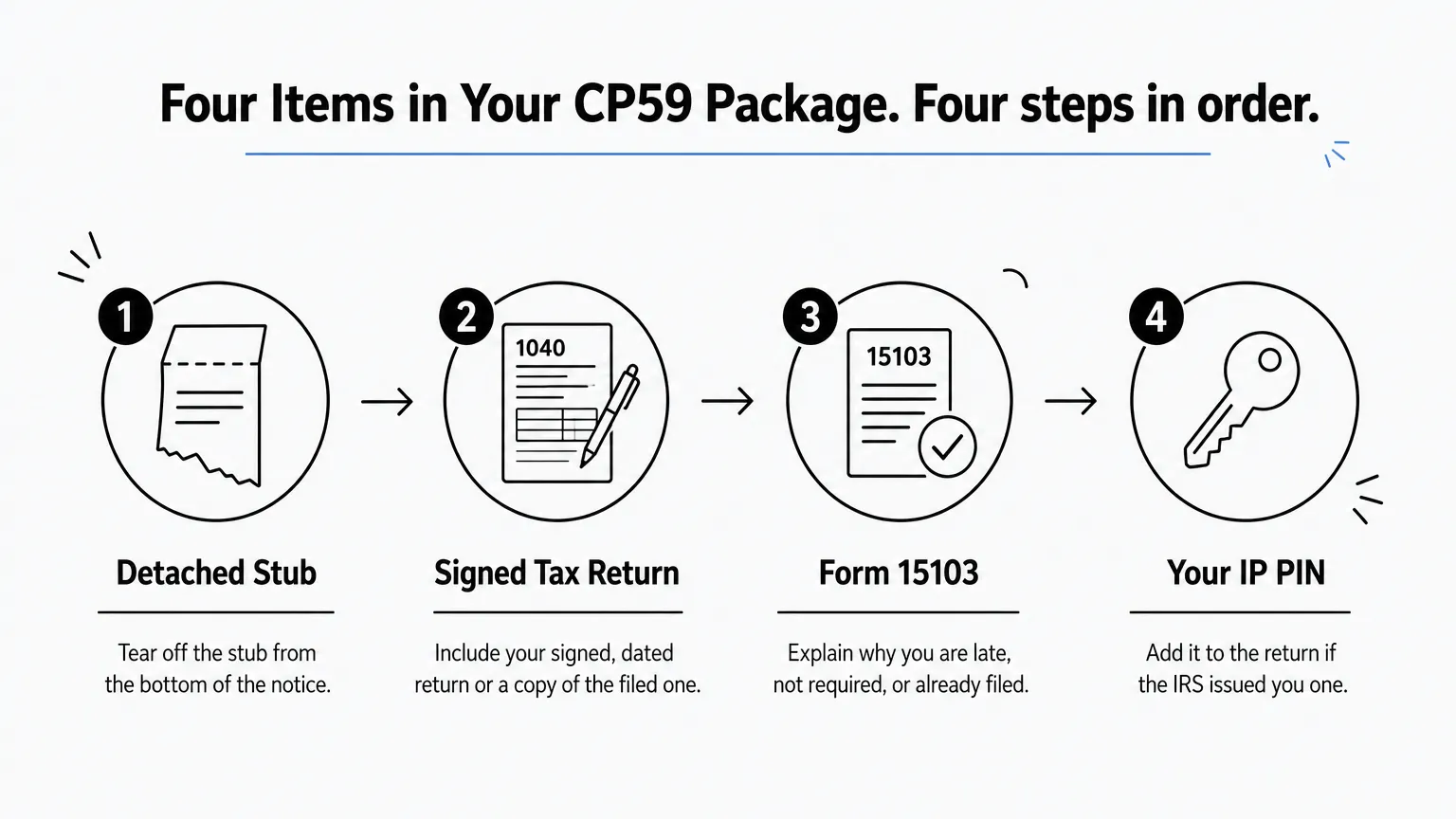
- The detached stub from the bottom of the notice.
- Your signed and dated tax return, or a signed and dated copy of the one you already filed.
- A completed Form 15103, Form 1040 Return Delinquency, which the IRS includes with the notice and also posts on irs.gov.
- Your IP PIN on the return if the IRS issued you one.
Form 15103 asks you to state why you are filing late, why you do not have to file, or that you already filed. Keep the explanation short and factual.
Mail, fax, or online account
The notice comes with a return envelope, and it lists a fax number. If you fax, read the privacy and security policy of any online fax service first, since you are sending a Social Security number. You can also upload documents through your IRS Online Account. If you need to talk to someone, call the phone number printed on your notice. Do not call a number from a search result or an unsolicited message.
Keep proof and watch for follow-up
Send mail with tracking or certified delivery, and save fax confirmations and upload receipts. Then keep an eye on your account transcript. A reply from the IRS can take time, so keep your proof and respond to any further notice immediately. A second letter means the first response did not close the issue.
If you cannot prove you responded, assume you did not.
When a CP59 is a mistake and when to get help
Most CP59 notices are correct, but errors do happen, and some situations are too tangled to handle alone. Knowing which one you are in saves time and money.
Signs the notice is a mistake
Suspect an error if you filed more than eight weeks ago and your software shows the return as accepted, or if you were not required to file. In that case, the IRS directs you to Form 15103, and it is wise to attach a copy of your return and your e-file acceptance record. Also confirm the notice is real. A genuine CP59 arrives by mail and matches what your online account shows. Treat any caller, text or email demanding immediate payment over a CP59 as suspect.
When a professional is worth it
Handle a single missed year yourself if the facts are clean. Bring in help when you have several unfiled years, when you cannot afford what you owe, or when the IRS has already moved to a substitute return or a notice of deficiency. A 90-day deadline is not the time to learn the process. Business owners and high earners should also get help, since the notice may signal gaps beyond one return.
Tax Experts of OC includes a CPA and an Enrolled Agent who work with the IRS on unfiled returns and notices, and the firm offers flexible payment options for qualified clients. The first 30-minute consultation is free. If cost is the barrier, the Taxpayer Advocate Service and Low Income Taxpayer Clinics offer free help to those who qualify.
One missed return is a quick fix. Several, plus a substitute return, is a project.
Answer the notice now
A CP59 says the IRS cannot find your return for a given year. Answer it by filing the missing return, sending proof of the one you filed, or explaining on Form 15103 why none was required. Check your details first, send a complete and traceable package, and keep your records.
The notice is not a final judgment. The costs come from waiting, as penalties and interest accumulate and a substitute return takes shape. If you have more than one year unfiled, or you are unsure which path fits, talk with a CPA or Enrolled Agent about your CP59 before the next deadline arrives.