
Running payroll for churches is not the same as running payroll for a regular small business, and treating it that way is how congregations end up with IRS notices. Clergy have a strange dual tax status: exempt from income tax withholding on housing allowance, yet still on the hook for self-employment tax on ministerial earnings. Add in volunteer stipends, love offerings, and part-time staff, and standard payroll software starts guessing instead of calculating.
This article gives you a straight answer to what church payroll actually involves and how to stay compliant without a finance degree. You'll see exactly how clergy housing allowance gets treated, why W-2s for pastors look different from every other employee's, and what SECA taxes mean for your church's reporting obligations.
We'll walk through the core compliance requirements, the most common mistakes that trigger IRS scrutiny, and when it makes sense to hand payroll off to someone who works with religious organizations every day. Tax Experts of OC handles this exact niche for churches nationwide, so we're writing from cases we've actually fixed, not theory.
Why church payroll is different from standard payroll
Standard payroll software assumes every worker fits one of two boxes: employee or independent contractor, each taxed in a predictable way. Church payroll breaks that assumption at the first paycheck, because ordained clergy occupy a category the IRS treats as neither. A pastor can be a common-law employee for income tax purposes and self-employed for Social Security purposes, on the same paycheck, at the same church. Generic payroll platforms have no field for that, so churches either overwithhold, underwithhold, or misclassify staff entirely.
Clergy hold a dual tax status
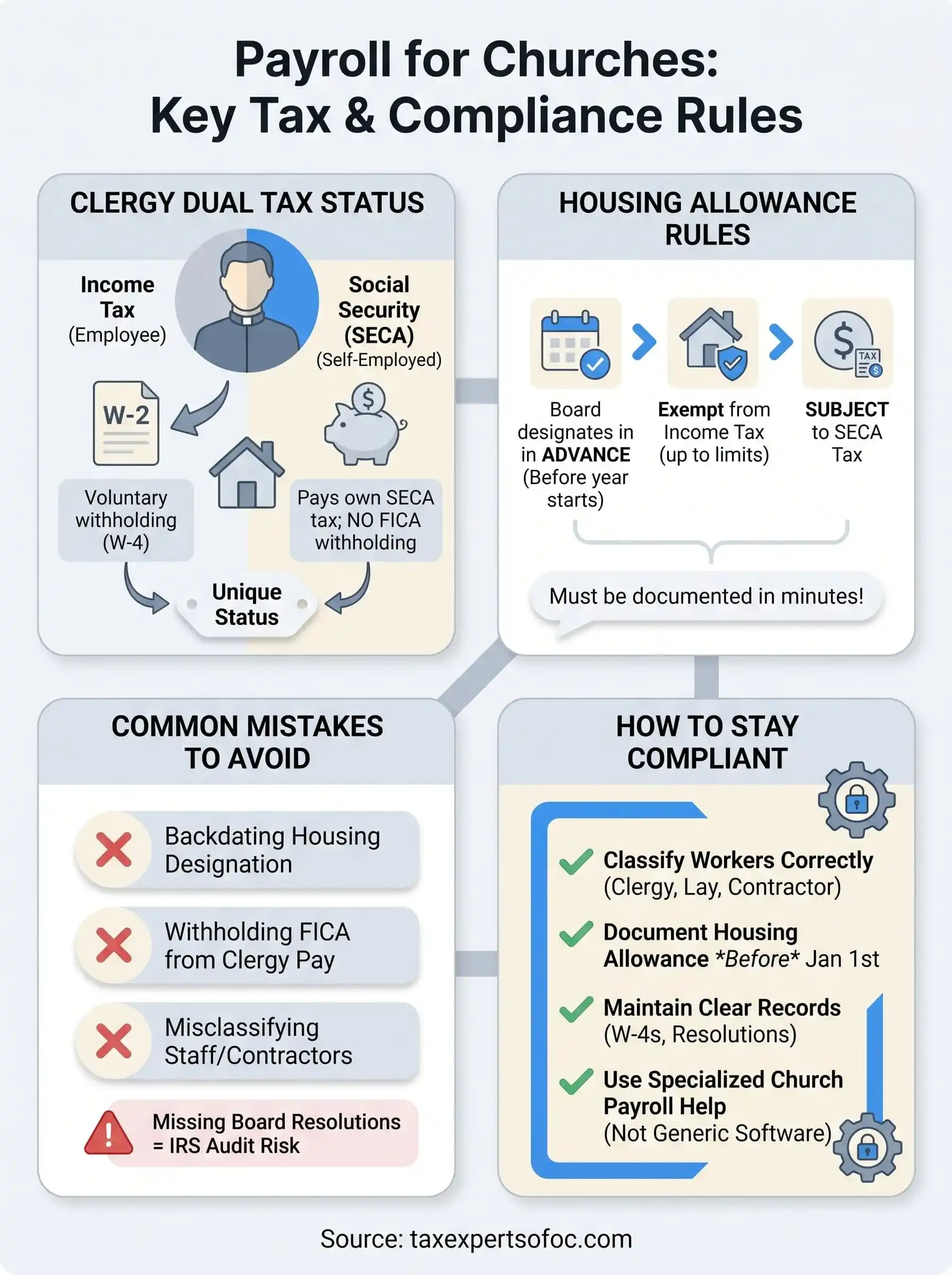
Ordained, licensed, or commissioned ministers are exempt from mandatory income tax withholding under IRC guidance, but they still owe Self-Employment Contributions Act (SECA) tax on their ministerial income, including housing allowance, unless they've filed Form 4361 to opt out for religious reasons. That means a church never withholds Social Security or Medicare tax from a pastor's paycheck the way it would for an office employee, even though the pastor personally owes the equivalent amount come tax season. Most churches either skip this distinction entirely or assume the IRS rules for nonprofits automatically cover it. Neither assumption holds up under an audit.
A pastor's paycheck follows two tax systems at once, and getting either one wrong creates a paper trail the IRS notices fast.
Nonprofit status limits some taxes, not all
Many church boards believe 501(c)(3) status means payroll taxes don't apply. That's only partly true. Churches are generally exempt from paying the employer's share of federal unemployment tax (FUTA), but state unemployment obligations vary, and Social Security and Medicare withholding still apply to non-clergy staff exactly as they would at any secular employer.
| Tax type | Non-clergy church employee | Ordained clergy |
|---|---|---|
| Federal income tax withholding | Standard W-4 withholding | Voluntary, clergy can request withholding |
| Social Security/Medicare (FICA) | Withheld and matched by church | Not withheld, clergy pays SECA instead |
| FUTA (federal unemployment) | Typically exempt for churches | Exempt |
| State unemployment | Varies by state, often exempt | Varies by state, often exempt |
Volunteers, stipends, and love offerings complicate the picture
Small congregations often run cash flows that don't look like payroll at all, but the IRS still expects proper reporting. A love offering collected for a guest speaker, a stipend paid to a part-time worship leader, or a modest gift to a retiring deacon can all trigger 1099 or W-2 reporting depending on the arrangement.
- Regular payments for defined duties (music director, administrator) usually mean W-2 wages.
- One-time gifts tied to no specific service can sometimes stay off payroll, but the line is thin.
- Reimbursed expenses need an accountable plan, or they become taxable income.
- Volunteer honorariums over a nominal amount often require 1099-NEC reporting.
Getting these categories wrong is how a small church accidentally builds a compliance mess that grows every year it goes unaddressed.
How to run payroll for church employees and clergy
Setting up payroll for churches starts with classification, not software. Before you process a single paycheck, sort every person on your roster into a clear category: ordained clergy, licensed or commissioned minister, lay employee, or contractor. Each category triggers a different withholding path, and mixing them up on your payroll system is the single fastest way to generate a mismatched W-2 next January.
Build the setup correctly from day one
Once classification is settled, the actual mechanics follow a predictable sequence. Skipping steps here is how churches end up amending returns two years later.
- Obtain an EIN for the church, separate from any personal identification numbers of staff.
- Classify each worker as clergy, lay employee, or independent contractor, and document the reasoning.
- Set up voluntary withholding for clergy using Form W-4 if the pastor wants income tax withheld, since it's not automatic.
- Calculate housing allowance separately from salary, and get board approval documented in meeting minutes before the tax year starts.
- Run payroll on a regular schedule, withholding FICA for lay staff and skipping it for clergy.
- Issue correct year-end forms: W-2 for clergy and lay staff, 1099-NEC for qualifying contractors.
Payroll for a church runs correctly only when clergy status is documented before the first paycheck, not reconstructed after the fact.
Keep documentation that survives an audit
Every decision about housing allowance, voluntary withholding, and worker classification needs a paper trail. Board resolutions approving housing allowance amounts, signed W-4 or voluntary withholding agreements, and job descriptions that justify employee versus contractor status should all sit in a file the treasurer can pull instantly. The IRS guidance on ministerial tax issues makes clear that documentation, not intent, is what protects a church during examination.
Smaller congregations often run this process through a volunteer treasurer with no payroll background, which works fine until a clergy transition, a new hire, or an IRS letter arrives. At that point, the gap between what's on paper and what actually happened becomes the church's problem to explain, usually with penalties attached.
Clergy pay, housing allowances, and tax exemptions explained
Clergy compensation almost never looks like a single number on a pay stub. It's usually split into base salary, a housing allowance, and sometimes a utilities or furnishings allowance, each with its own tax treatment. Understanding how these pieces interact is the difference between a pastor keeping thousands of dollars tax-free and a church accidentally exposing that same pastor to back taxes.
How housing allowance actually works
A housing allowance isn't a bonus the church decides to hand out after the fact. The board must designate the amount in writing before the tax year begins, and the pastor can only exclude from income tax the lesser of three figures: the amount designated, the amount actually spent on housing, or the fair rental value of the home plus utilities. Anything spent beyond the designated allowance becomes taxable income, and anything designated but unused doesn't roll over.
Housing allowance saves money only when the board approves it in advance and the pastor tracks actual housing costs against it all year.
SECA, Form 4361, and what stays taxable
Housing allowance escapes income tax, but it does not escape self-employment tax. Under SECA, ministers owe Social Security and Medicare tax on their salary plus the full housing allowance amount, calculated on Schedule SE at tax time. The only way around this is Form 4361, which lets ordained ministers opt out of Social Security coverage entirely, but only for genuine religious or conscientious objection to public insurance, not for tax savings. The IRS reviews these applications carefully, and once approved, the exemption is irrevocable in almost all cases.
| Item | Income tax treatment | SECA/Social Security treatment |
|---|---|---|
| Base salary | Taxable | Taxable |
| Housing allowance (within limits) | Excludable | Taxable |
| Utilities allowance | Excludable if designated | Taxable |
| Love offerings tied to services | Usually taxable | Usually taxable |
Getting these distinctions right protects both the church and the pastor. Misapplying them, whether by skipping the board designation or assuming housing allowance is exempt from everything, is one of the most common reasons clergy end up owing penalties they never saw coming.
Common church payroll mistakes and how to avoid them
Most church payroll problems don't come from bad intentions. They come from volunteers and small staff doing their best without training in ministerial tax law. Church payroll mistakes tend to repeat across congregations because the same gaps show up everywhere: no formal housing designation, missing worker classification files, and treasurers who assume nonprofit status covers more than it does.
The errors that show up most often
These patterns come up again and again in the cases we've reviewed, and each one is preventable with a checklist and a little discipline.
- Backdating housing allowance designations instead of approving them before the tax year starts, which invalidates the exclusion.
- Withholding FICA from clergy pay by mistake, treating a pastor like a regular W-2 employee.
- Skipping SECA education for new ministers, leaving them blindsided by a large Schedule SE bill.
- Misclassifying part-time staff as contractors to avoid payroll taxes, which the IRS reclassifies quickly if duties look like employment.
- Failing to track accountable plan reimbursements, turning simple expense repayments into taxable wages.
- Losing board resolution paperwork, leaving no proof that housing allowance or compensation changes were ever approved.
The costliest church payroll mistakes aren't calculation errors, they're missing paperwork that should have existed before the first paycheck went out.
Why these mistakes compound over time
A single missed FICA withholding might cost a few hundred dollars in back taxes. Left uncorrected for three years, it becomes a multi-year amendment project with penalties and interest attached to every quarter. Small errors compound because churches often don't run internal payroll reviews the way a business with an HR department would, so a mistake made in year one quietly repeats every pay period until someone finally audits the books or the IRS does it first.
Regular reconciliation catches most of this early. Comparing W-2s against board-approved compensation packages once a quarter, confirming housing allowance designations exist in writing, and verifying that every 1099 recipient actually meets contractor criteria takes an afternoon. Congregations that build this review into their calendar rarely end up explaining themselves to the IRS. Those that don't usually find out the hard way, right around the time a new treasurer opens the books and asks why nothing matches.
Choosing the right payroll help for your church
Eventually every congregation reaches a point where a volunteer treasurer with a spreadsheet can't keep up. Growth, a clergy change, or a first IRS letter usually forces the question of who should actually run payroll for churches going forward. General bookkeeping software calculates FICA and W-4 withholding fine for a secular business, but it has no logic for housing allowance exclusions or SECA reporting, so someone still has to override every clergy paycheck by hand. That manual patchwork is exactly where errors creep in.
What to look for in a church payroll provider
Not every accountant or payroll company understands ministerial tax rules, so vetting matters more than price here. Ask any provider these questions before signing on:
- Do they have documented experience with clergy housing allowance calculations, not just nonprofit payroll in general?
- Can they show board resolution templates and year-end forms specific to churches?
- Do they handle multi-state filings if your ministry has remote staff or campuses in other states?
- Will a CPA or Enrolled Agent actually review the account, or does it get routed to general support?
A provider who can't explain SECA versus FICA in the first conversation isn't ready to run your church's payroll.
Weighing your options
Small churches sometimes assume a generic payroll subscription is the cheaper route, but the hidden cost shows up later in amended returns and penalty notices.
| Option | Handles clergy tax rules | Typical risk |
|---|---|---|
| Volunteer treasurer, manual | Rarely | High, no documentation trail |
| General payroll software | Partially, requires manual overrides | Moderate, misclassification common |
| Specialized church payroll service | Yes, built for ministerial tax status | Low, with proper documentation |
Specialized help costs more upfront than a spreadsheet, but it catches the housing allowance designation, the SECA distinction, and the board resolution paperwork before the IRS ever asks for it. For congregations juggling clergy transitions, multi-state staff, or a backlog of unfiled forms, working directly with a CPA or Enrolled Agent who handles religious organizations regularly is the difference between a clean filing season and a drawn-out correction process.
Getting church payroll right, once and for all
Church payroll rewards precision, not guesswork. Get the housing allowance designated in writing before the year starts, classify every worker correctly, and keep the board resolutions where your treasurer can find them. Documentation beats good intentions every time the IRS looks closely, and clergy tax status is one area where generic software simply can't keep up.
Do this once, and payroll stops being a source of dread every January. Skip it, and small errors from a busy volunteer season quietly turn into multi-year corrections with penalties attached. Compliance here isn't complicated, it just requires someone who actually works with ministerial tax rules instead of guessing at them.
If your congregation is dealing with a clergy transition, unfiled forms, or an IRS notice that's already landed, don't wait for it to get worse. Schedule a free consultation with Tax Experts of OC and get your church's payroll handled by people who do this every day.