If you own an S corporation, you may have noticed that the entity itself does not write a check to the IRS each quarter the way a C corporation does. That confuses a lot of owners. The rules for quarterly taxes for an S corp depend on who earns the income, and the payments come from several places at once.
Here is the short answer. An S corp passes its profit through to you, so you pay estimated tax personally on Form 1040-ES if you expect to owe $1,000 or more. If you take a salary, the company also deposits payroll taxes with Form 941 each quarter. Your state may require its own estimated payments, and some states tax the S corp directly. Federal due dates fall on April 15, June 15, September 15, and January 15.
Below, we break down who pays what, how to calculate each payment, and how the safe harbor rules protect you from penalties. We also point out common mistakes we see with owners who fall behind, so you can fix them before interest and penalties pile up.
Why S corp quarterly taxes matter for owners
Profit is taxed to you, not the company
Most S corporations pay no federal income tax at the entity level. Instead, all profit passes through to your personal return on a Schedule K-1, and you owe tax on your share whether you withdraw the cash or leave it in the business. A company can show $120,000 of profit, keep most of it in the bank for equipment, and you still owe tax on your slice of it.
Nobody withholds tax from that pass-through income, so the IRS expects you to pay as you earn through estimated payments. Skip them, and the whole bill lands in April, often alongside a penalty.
Where your tax actually comes from
S corp quarterly taxes are not one payment. They are a mix of payments tied to how you take money out of the company, as the table shows.

| Income source | How it is taxed | How it gets paid |
|---|---|---|
| W-2 salary | Income tax, Social Security, Medicare | Payroll withholding and Form 941 deposits |
| Pass-through profit (K-1) | Income tax | Form 1040-ES estimated payments |
| Distributions | Generally not taxed again if within your basis | No separate payment |
Your salary withholding can do double duty. Some owners raise the federal withholding on their own W-2 so it covers the tax on their K-1 profit, which cuts the number of checks they write. That only works if the salary is reasonable for the work you do, because the IRS looks hard at owners who pay themselves very little.
You owe tax on the profit your S corp earns, not on the cash you took out.
What happens when you underpay
Penalties are the real reason these payments matter. The IRS calculates the underpayment penalty by quarter, using an interest rate that resets every three months, and you report it on Form 2210. Paying a large catch-up amount in January does not erase the penalty for the quarters you missed. You can read how the agency explains it in IRS Topic 306.
The good news is that you can avoid the penalty with a safe harbor. You are generally protected if your payments and withholding total at least 90% of this year's tax or 100% of last year's tax. That rises to 110% of last year's tax if your adjusted gross income was above $150,000.
Timing is worth checking right now. The third-quarter deadline was September 15, 2026, so if you missed it, pay as soon as you can to stop the penalty from growing. The next due date is January 15, 2027.
How to figure out what you owe each quarter
Start with the safe harbor method
The easiest way to size S corp quarterly taxes is to work from last year's return. Take the total tax from last year's Form 1040, multiply it by 100% (110% if your AGI topped $150,000), and divide by four.
Say last year's tax was $24,000 and your AGI was above $150,000. Then $24,000 x 1.10 = $26,400, so each payment is $6,600. Pay that on schedule and you owe no underpayment penalty, even if this year's profit jumps.
Divide a safe harbor number by four and you have a defensible payment every quarter.
Use a projection when income changes
When profit is rising or falling fast, a current-year estimate is more accurate than last year's number. Pull a year-to-date profit and loss report from your books, then work through these steps:
- Project your full-year K-1 ordinary income.
- Add your W-2 salary and any other income.
- Subtract deductions, including the qualified business income deduction if you qualify.
- Calculate the income tax, then subtract the withholding already taken from your paycheck.
- Divide what is left by the number of payments remaining.
Keep in mind that K-1 profit is not subject to self-employment tax. Your Form 1040-ES payments cover income tax only, because Social Security and Medicare already come out through your salary.
Seasonal businesses have one more option. The annualized income installment method on Form 2210, Schedule AI, lets you pay less in quarters when you earned less. It takes extra bookkeeping, so ask your CPA before you rely on it. Recalculate after each quarter closes, since a stale estimate is how owners end up short.
How to pay: due dates, forms, and payment methods
Paying quarterly taxes for an S corp owner comes down to hitting four dates and using a payment method you can repeat. Once it is set up, each payment takes about five minutes.
Federal due dates for the 2026 tax year
The IRS does not use calendar quarters. The periods are uneven, so go by the due dates, not the calendar. If a date lands on a weekend or holiday, it moves to the next business day.
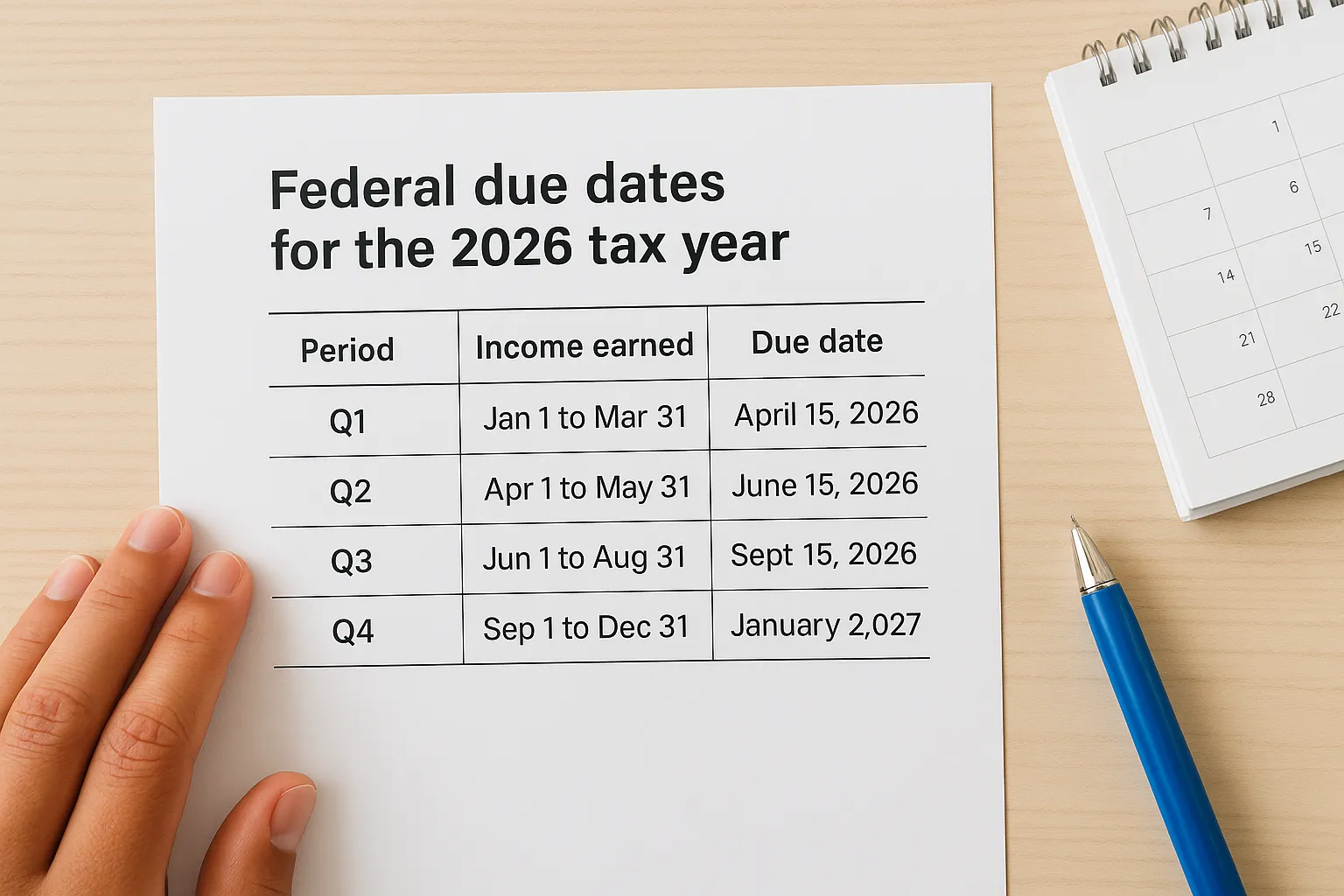
| Period | Income earned | Due date |
|---|---|---|
| Q1 | Jan 1 to Mar 31 | April 15, 2026 |
| Q2 | Apr 1 to May 31 | June 15, 2026 |
| Q3 | Jun 1 to Aug 31 | September 15, 2026 |
| Q4 | Sep 1 to Dec 31 | January 15, 2027 |
The IRS quarters are uneven, so pay by the due date, not the calendar quarter.
The third-quarter date has passed, so send that payment now. The final S corp quarterly taxes payment is due January 15, 2027.
Ways to send the payment
Pick one method and stick with it every quarter. Your options are:
- IRS Direct Pay: free, pulls from a checking or savings account, and needs no enrollment. See IRS Direct Pay.
- EFTPS: free, but you must enroll ahead of time. You can schedule payments weeks in advance.
- IRS online account: lets you pay and view your payment history in one place.
- Debit or credit card: goes through a third-party processor that charges a fee.
- Check or money order: mail it with a Form 1040-ES payment voucher.
Forms and records
Form 1040-ES is mostly a worksheet. You do not file it. You only use its vouchers if you pay by mail. When you pay online, choose "estimated tax" and the correct tax year, since a wrong code can send your money to the wrong account.
Save every confirmation. You will need the dates and amounts when you report payments on your Form 1040, and they are your proof if the IRS says you missed one.
Quarterly payroll taxes and state estimated payments
Payroll deposits and Form 941
Payroll is the second leg of quarterly taxes for an S corp. When you pay yourself a W-2 salary, the company must withhold income tax, Social Security, and Medicare and send it to the IRS. Form 941 reports these amounts each quarter, and most small businesses deposit the money monthly, by the 15th of the following month.
| Quarter | Form 941 due date |
|---|---|
| Q1 (Jan to Mar) | April 30 |
| Q2 (Apr to Jun) | July 31 |
| Q3 (Jul to Sep) | October 31 (November 2 in 2026, since the 31st is a Saturday) |
| Q4 (Oct to Dec) | January 31 |
Missing these costs more than missing a Form 1040-ES payment. Withheld tax is held in trust for the government, so the IRS can assess the trust fund recovery penalty against you personally. Late deposits also carry their own tiered penalties. You also file Form 940 once a year for federal unemployment tax.
Payroll tax is not the company's money, and unpaid withholding can become your personal debt.
State estimated payments
States add a third layer. Many require estimated payments on your share of S corp income, and dates and splits differ from the federal schedule. California's Form 540-ES, for example, splits the year into 30%, 40%, 0%, and 30% payments instead of four equal ones.
Some states also tax the entity itself. California charges S corps 1.5% of net income, with an $800 minimum, and several states let you elect a pass-through entity tax with its own payment schedule. Check the rules in every state where you live or earn income, because S corp quarterly taxes at the state level are where owners most often miss a payment.
Worked example and common mistakes to avoid
A worked example
Consider Maria, the sole shareholder of an S corp. Last year she took an $80,000 W-2 salary and received $90,000 of K-1 profit. Her AGI was $170,000 and her total tax was $28,000. Because her AGI topped $150,000, she uses the 110% safe harbor, and her payments look like this.
| Step | Amount |
|---|---|
| Safe harbor target ($28,000 x 110%) | $30,800 |
| Income tax withheld from her salary | $9,000 |
| Left to cover with Form 1040-ES | $21,800 |
| Each quarterly payment (divided by four) | $5,450 |
Withholding counts as paid evenly across the year, so Maria owes no underpayment penalty if she sends $5,450 by each due date, even if her profit doubles. If you are in her position and missed September 15, pay the missed amount now and send the last payment by January 15, 2027.
Withholding is treated as paid evenly all year, so a higher W-2 withholding is the simplest way to cover K-1 profit.
Mistakes we see most often
Most penalties on S corp quarterly taxes come from a handful of avoidable habits. Watch for these:
- Ignoring K-1 profit. Payroll withholding alone rarely covers the tax on pass-through income, and retained cash is still taxable.
- Paying a token salary. An unreasonably low wage invites IRS scrutiny and can lead to reclassified distributions.
- Following calendar quarters. The IRS periods are uneven, so use the due dates in the table above.
- Skipping the state. Federal payments do not satisfy a state's estimated tax rules.
- Choosing the wrong year or tax type. A payment coded to the wrong period can sit unapplied until you notice it.
Fix the problem early. Recalculate after every quarter closes, keep every confirmation, and ask your CPA to review your numbers before the January deadline.
Staying ahead of your S corp tax deadlines
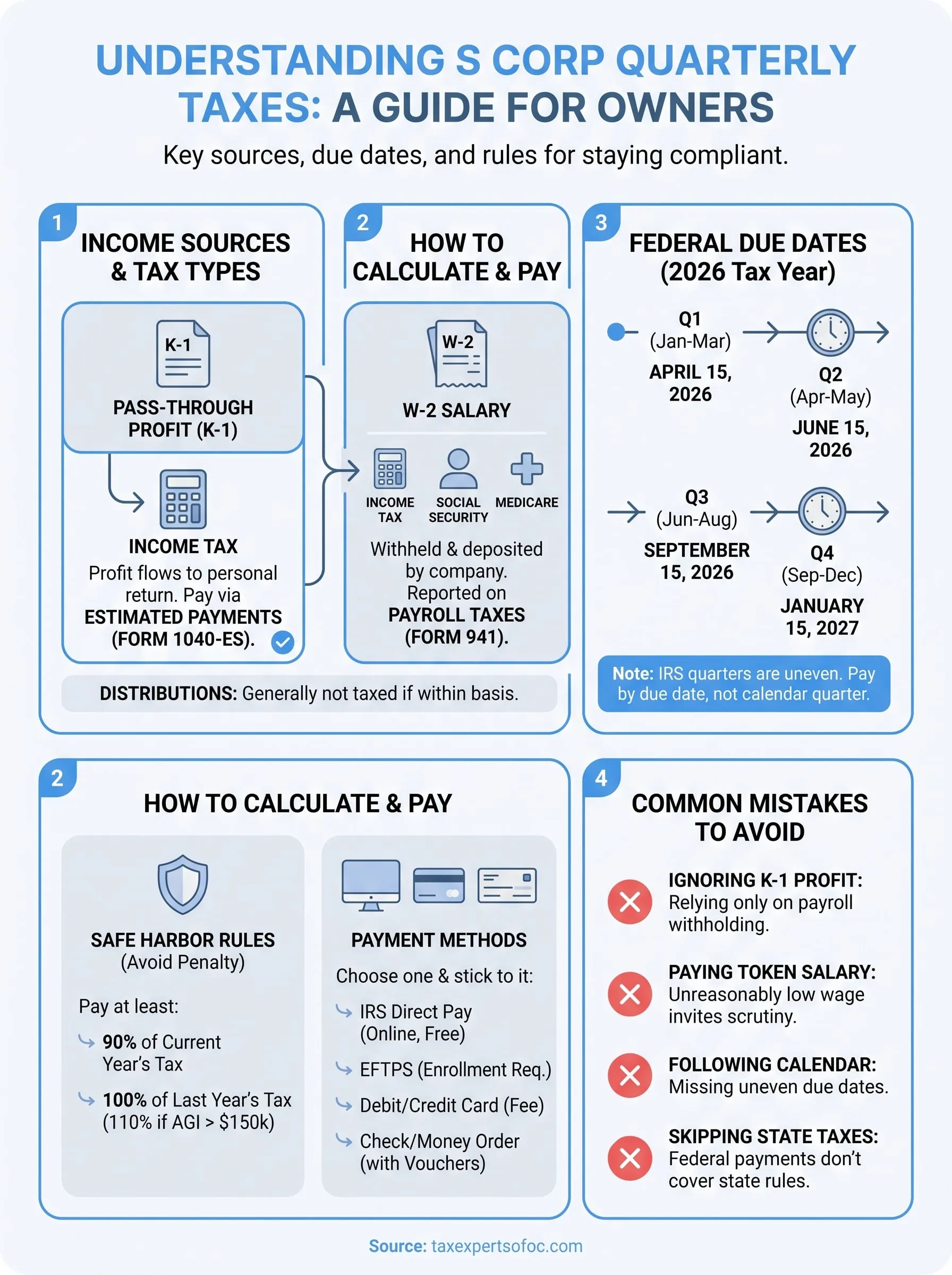
Handling S corp quarterly taxes comes down to three streams: Form 1040-ES payments on your K-1 profit, Form 941 deposits on your salary, and any estimated payments your state requires. Use a safe harbor number, divide it by four, and pay by the due date, not the calendar quarter.
Today is October 4, so the September 15 payment is already behind you. If you missed it, pay it now to stop the penalty from growing, and put January 15, 2027 on your calendar for the final federal payment. Recalculate after each quarter closes and keep every confirmation.
If the numbers still feel tangled, or you already owe back taxes, get help before interest piles up. Our CPA and Enrolled Agent work with S corp owners in all 50 states, and you can book a free 30-minute consultation with Tax Experts of OC to get a clear payment plan for the year.