
The best tax preparation and planning services combine a credentialed professional with year-round contact, not a single filing session in March. If your return is simple, free IRS-backed programs or software are enough. If you have freelance income, rental property, investments, several states or an IRS notice, hire a CPA or enrolled agent who also does planning. Tax Experts of OC fits remote, complex cases, and a local CPA firm fits you if you want face-to-face meetings.
Most people searching for this are caught between two worries. Cheap filing tends to miss deductions and says nothing about next year. Full advisory firms can cost more than your return justifies. On top of that, nearly every provider calls itself an expert, so the credentials behind the name are hard to compare.
This article compares five ways to get personal tax return preparation and planning done. For each one you will see how it works, who it suits and what it costs, followed by a short guide to choosing and a list of red flags. Our own firm is option one, and the others are described on their merits.
What tax preparation and planning services include
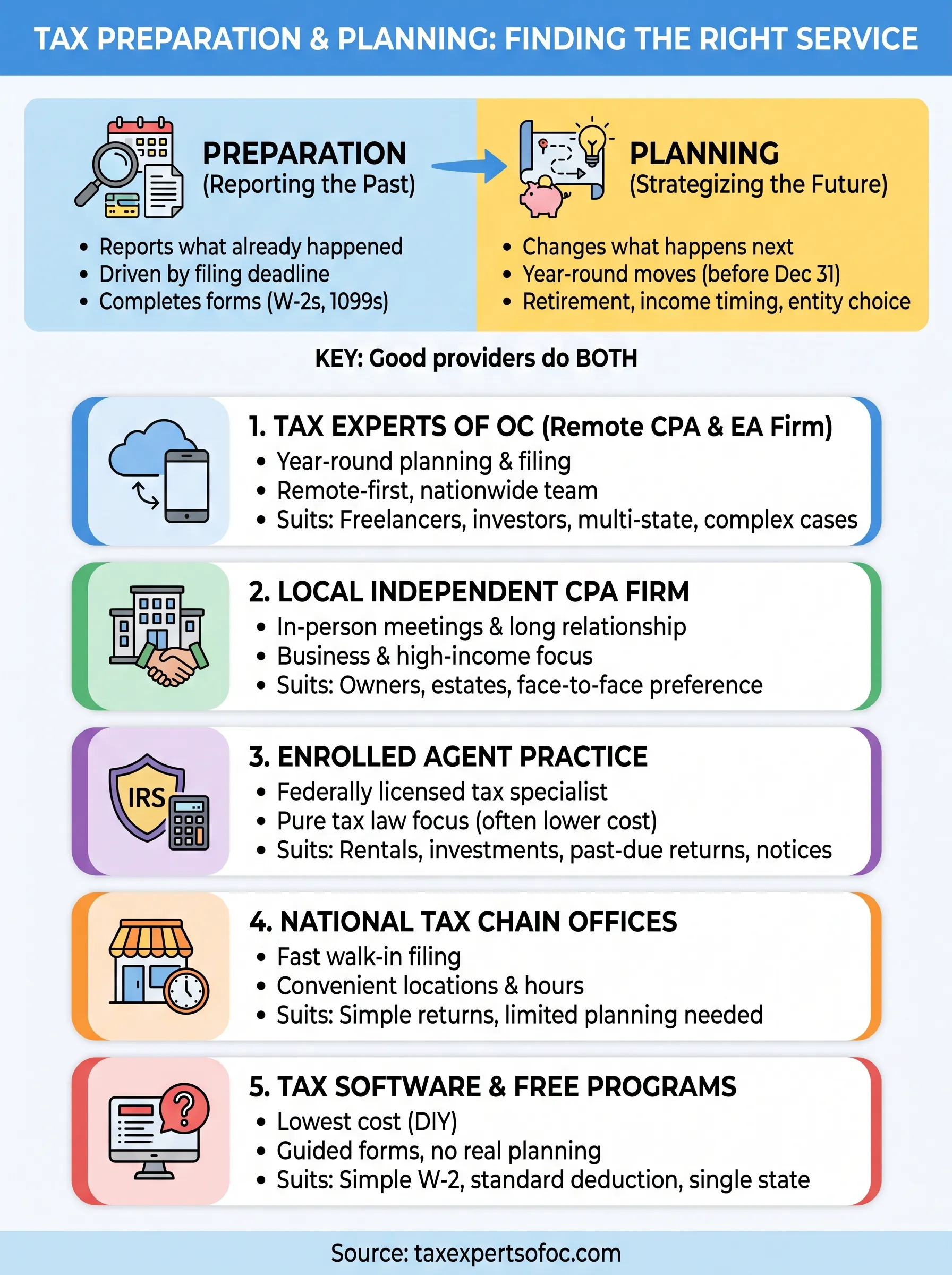
Tax preparation reports what already happened, and tax planning changes what happens next. A good provider does both, and you should know which one you are paying for at any moment.
Preparation versus planning
Preparation means completing and filing your federal and state returns from the documents you hand over, such as W-2s, 1099s and receipts. Planning looks forward: retirement contributions, the timing of income and deductions, estimated payments and, for business owners, entity choice. Preparation is driven by the filing deadline. Most planning moves must happen before December 31 of the tax year.

Here is why that matters in dollars. Say you defer an extra $10,000 into a pre-tax retirement account and your marginal federal rate is 24%. That cuts your federal tax by $2,400. A preparer who first sees your paperwork in March cannot make that move for you.
Preparation tells you what you owe, while planning decides how much you owe.
What a full engagement covers
A complete personal tax relationship usually includes the items below. If a provider offers only the first, you are buying filing, not planning.
- Federal and state return preparation and e-filing
- A review of prior returns for missed carryovers or errors
- Estimated tax calculations for freelance, investment or rental income
- A mid-year projection that shows where you will land
- Advice on retirement, charitable giving and major life events
- Help responding if the IRS or a state sends a notice
1. Tax Experts of OC
Tax Experts of OC is a CPA and enrolled agent firm based in Orange County, California, that prepares and plans personal taxes for clients nationwide, by phone and virtually.
How it works
You begin with a free, confidential consultation of 30 minutes. From there, CPAs prepare your federal and state personal returns around your actual situation, and the same team handles multi-state filings.
Planning runs alongside the return. The firm's Orange County CPAs build legal tax-saving strategies, including entity selection if you are starting a business. That way you leave with a plan for next year, not only a filed return for last year.
Direct access to a CPA and an enrolled agent, rather than general staff, is the main reason to choose a firm like this one.
Who it suits
This option suits freelancers, investors, landlords and families whose returns have outgrown software. It also suits owners who file both personal and business returns. The firm also does tax resolution, so it is practical if you have unfiled returns, back taxes or an IRS notice on top of a return to prepare.
Where you live does not matter, because the firm offers remote tax preparation. If you want to drop off a folder at a nearby office, look at option two.
Cost and trade-offs
Pricing is quoted upfront, and flexible payment options are available for qualified clients. The firm holds a 4.9 Google rating from 51 reviews. The fee depends on the forms in your return, so ask for the quote in writing before you commit.
The trade-off is that the service is remote-first. If face-to-face meetings matter more to you than direct access to credentialed staff, a local firm may feel better.
2. A local independent CPA firm
A local CPA firm is the traditional choice, and it works best if you want in-person meetings and a long relationship with one accountant.
How it works
You usually pay a fee per return based on the forms involved, often after filling out an organizer. Planning is sometimes bundled, but more often it is billed hourly or as a retainer. CPAs are licensed by a state board, and they can act on your behalf before the IRS.
Meetings tend to cluster in two windows, a fall planning review and a winter filing appointment. Ask which of these are included.
Who it suits
Higher-income households, business owners and people with estates or trusts get the most from this model. You benefit when one person knows your whole financial picture year after year. A small firm also gets to know your family, which helps when a life event changes your taxes.
Cost and trade-offs
Costs vary widely by market and by firm size, so collect two or three written quotes. The usual drawback is capacity. Some small firms limit new clients during busy season, and your state's rules are only as good as that firm's experience with them. If you move or earn income in another state, ask whether the firm files there.
A local CPA gives you the closest relationship, but only if the firm has room for you.
3. An enrolled agent practice
An enrolled agent is a federally licensed tax specialist, and this option suits you when your questions are mostly about taxes rather than broader accounting.

How it works
Enrolled agents earn their status from the IRS by passing a three-part exam, or through qualifying past IRS employment, and they complete continuing education every year. Like CPAs, they have unlimited practice rights before the IRS. Many work in solo or small practices and offer both filing and planning.
Who it suits
If you have a rental property, investment income, a freelance business, a past-due return or an open IRS notice, an enrolled agent is a strong fit. Their entire training is tax law, which is the narrow skill you need. Many firms, including ours, pair enrolled agents with CPAs on the same team.
Cost and trade-offs
Fees are often lower than at a large CPA firm, since many enrolled agents run lean practices. The trade-off is scope. An enrolled agent does not perform audits of financial statements and may not offer bookkeeping or payroll. If you need those too, confirm the practice offers them or pair it with a bookkeeper.
For pure tax questions, an enrolled agent gives you CPA-level IRS authority without a CPA-sized scope.
4. National tax chain offices
Seasonal retail tax offices are the fastest walk-in option, and they fit simple returns better than planning-heavy ones.
How it works
You bring your documents to an office, a preparer enters them, and the return is filed the same day or soon after. Preparers range from seasonal staff to credentialed professionals, but every paid preparer must hold a PTIN. Some offices have a CPA or enrolled agent on site for tougher cases, so ask who will actually prepare and review your return.
Who it suits
W-2 earners with straightforward itemized deductions and people who want a nearby storefront do well here. It is less suited to self-employed filers, landlords or anyone who wants year-round planning. Staff turnover can mean a different preparer each year, so keep your own copies of last year's return and your records.
Cost and trade-offs
Pricing is typically based on the forms you file, and add-on products can raise the total. Ask for the all-in price before work starts. The benefit is convenience and accessible hours. The cost is limited planning advice and less continuity from one year to the next.
A chain office is built for filing speed, so ask early whether it also offers planning.
5. Tax software and free IRS-backed programs
Software and free programs cost the least and work well when your return is simple, but they offer no real planning.
How it works
The IRS's Free File program offers guided software free for taxpayers under an income limit that the IRS sets each year. It also offers fillable forms at any income. The Volunteer Income Tax Assistance program gives free in-person tax filing assistance to qualifying taxpayers through IRS-certified volunteers. Paid software has tiers, and some add live expert help or a review for an extra fee.
Who it suits
You are a good fit if you have W-2 income, take the standard deduction and file in one state. Look elsewhere if you have self-employment income, rental property, stock compensation or income in more than one state. Software asks questions but does not tell you what to change for next year.
Cost and trade-offs
The price runs from free to modest. The real cost is the risk of a missed deduction or a wrong entry, because you are responsible for what you file. Software suits a return that gets no help because there is nothing to optimize. If there is room to optimize, a professional pays for themselves quickly.
Software files your return, but only a person plans your next one.
How to choose and what to expect to pay
Choose by complexity first, credentials second and price third, and expect the fee to grow with the number of forms in your return.
What drives the price
Providers price by the work involved, not by your income. Each extra schedule, state return or messy set of records adds time. Planning is quoted separately, usually as a flat fee or hourly rate. Use this table to match your situation to a provider.
| Your situation | What adds work | Best fit |
|---|---|---|
| W-2 income, standard deduction | Form 1040 only | Software, free programs, chain office |
| Freelance or side business | Schedule C, self-employment tax, estimates | CPA or enrolled agent |
| Rental property | Schedule E, depreciation | CPA or enrolled agent |
| Investments or crypto | Schedule D, transaction reporting | CPA or enrolled agent |
| Income in several states | Multiple state returns | Firm with multi-state experience |
| Unfiled returns or IRS notice | Representation and cleanup | Enrolled agent or CPA |
Get quotes in writing. A professional should tell you what the return includes and how planning is billed before you hand over a single document.
CPA, enrolled agent or preparer
If you want planning, pick a CPA or enrolled agent. Both can represent you before the IRS on any matter. A preparer with only a PTIN can file your return but has limited representation rights. Here is the quick comparison.
| Credential | Licensed by | IRS representation |
|---|---|---|
| CPA | State board of accountancy | Unlimited |
| Enrolled agent | IRS | Unlimited |
| Attorney | State bar | Unlimited |
| Preparer with PTIN only | IRS registration, not a license | Limited |
The IRS also publishes guidance on choosing a tax professional, which is worth a read before you sign anything.
For year-round planning, a CPA or enrolled agent beats a seasonal preparer.
Red flags to avoid
Walk away from any preparer who does one of the following:
- Promises a refund amount before seeing your documents
- Charges a fee based on a percentage of your refund
- Refuses to sign your return or give you a PTIN
- Asks you to sign a blank return
- Wants your refund deposited into their account
- Pushes credits or deductions you cannot document
- Gives you no written fee
Pick the help that matches your return
Your return decides the right provider. Simple W-2 filers can use free programs or software, and anyone with business income, rental property, investments, multiple states or an IRS notice should hire a CPA or enrolled agent who also plans. Ask for credentials, get the fee in writing, and look for a provider you can reach before December, not only in March.
If you want to see how this works with a CPA and an enrolled agent on the same team, book a free 30-minute consultation with Tax Experts of OC about personal tax return preparation. You can talk through your return by phone or virtually from any state and leave with a clear next step.