

An IRS notice in your mailbox has a way of making everything else feel less urgent. You search tax resolution services near me at 11 p.m., scrolling through ads and directory listings, trying to find real IRS help fast and figure out who actually handles cases like yours versus who just wants a retainer check. That confusion is normal, and it's exactly why so many people delay calling anyone back.
The right answer isn't always the closest office. What matters is whether a licensed CPA or Enrolled Agent reviews your case personally, whether the pricing is upfront before you sign anything, and whether the firm can actually represent you before the IRS in your state, not just prepare paperwork. Location matters less than it used to, since secure virtual consultations now let qualified professionals work your case from anywhere.
This guide walks through what separates a firm worth hiring from one that will waste your time and money. You'll learn the credentials to check, the red flags in free consultations, the questions to ask before you pay a dime, and how to evaluate options whether you want someone local or prefer working remotely with a licensed team, like ours at Tax Experts of OC, that handles cases nationwide.
1. National tax resolution firms with virtual consultations
A national tax resolution firm handles IRS problems remotely, using phone calls, secure document portals, and video consultations instead of an in-person office visit. These firms often serve clients in all 50 states, which means you get access to a licensed CPA or Enrolled Agent even if nobody with that credential works within driving distance of your zip code. This model has grown fast over the past decade because IRS representation doesn't require a face-to-face meeting. Everything from signing and submitting Form 2848 (Power of Attorney) to a full audit defense can happen through encrypted uploads and scheduled calls.

How it works
Most firms in this category start with a free consultation, usually 20 to 30 minutes, where a case manager or licensed professional reviews your notices and asks about your income, assets, and filing history. From there, they pull your IRS transcripts using their own authorization to see exactly what the agency has on record, which often reveals issues the taxpayer didn't know about, like an unfiled return from three years back. Once they have the full picture, they map out a resolution path, whether that's an Offer in Compromise, an installment agreement, penalty abatement, or currently-not-collectible status, and then handle all communication with the IRS directly so you're not the one on the phone with a revenue officer.
Virtual representation works because the IRS communicates through mail and phone, not house calls, so a remote CPA can defend your case just as effectively as someone sitting across town.
Who it's for
This option suits people dealing with wage garnishments, bank levies, or large back-tax balances who want a dedicated team without limiting themselves to whoever happens to have an office nearby. It also fits business owners juggling multi-state filings, since a firm working nationally already understands how different state tax agencies interact with the IRS. If you travel often, work irregular hours, or simply prefer handling sensitive financial matters from home rather than a waiting room, this route removes the scheduling friction that comes with in-person appointments.
Typical costs
Pricing varies by case complexity, but here's a general range you'll see across national firms:
| Service | Typical Cost Range |
|---|---|
| Initial consultation | Free to $200 |
| Case investigation/transcript review | $500 to $1,500 |
| Offer in Compromise negotiation | $2,500 to $6,000 |
| Installment agreement setup | $750 to $2,000 |
| Audit representation | $1,500 to $5,000+ |
Flat-fee arrangements are common and worth asking for upfront, since hourly billing on a drawn-out IRS case can spiral quickly. A firm that can't give you a number before you sign anything hasn't actually looked at your case yet.
Questions to ask before hiring
Before committing, get straight answers to these questions:
- Will a CPA or Enrolled Agent personally work my case, or will it be handed to unlicensed staff after the sales call?
- Is the fee flat, or could it increase as the case progresses?
- How many similar cases has this person handled, and can they explain the resolution options realistic for my situation?
- What happens if my case doesn't qualify for the program they initially pitched me?
- Who do I contact directly once I'm a client, and how fast do they typically respond?
Watch for firms that guarantee a specific dollar settlement before reviewing your transcripts, and learn how to verify a resolution tax service before you sign. Nobody can promise an Offer in Compromise outcome on a first call, and that promise is one of the clearest signs you're talking to a sales team rather than a licensed professional. At Tax Experts of OC, every case starts with a free 30-minute consultation directly with our CPA and Enrolled Agent, not a call center, and pricing is disclosed before any engagement begins. If you're weighing a national firm against a local office, ask both the same five questions above and compare the answers side by side rather than the marketing.
2. Local CPA firms that offer tax resolution services
Many taxpayers start their search with a local CPA for IRS problems, the same accountant down the street who prepares tax returns and handles bookkeeping for small businesses in town. Some of these firms also take on IRS representation cases, though it's usually a secondary service rather than their main focus. If your CPA already knows your financial history, a face-to-face conversation about a tax debt can feel more comfortable than starting fresh with a stranger over the phone.
How it works
A local CPA typically reviews your notice, requests your prior returns, and either handles the resolution work themselves or refers you to a colleague who specializes in it. Because a CPA's representation rights cover taxpayers before the IRS, they can file a Power of Attorney and negotiate on your behalf, but not every CPA firm does this regularly. Volume of experience matters here: a firm that resolves two or three IRS cases a year handles things differently than one that does it weekly. Ask directly how often they work resolution cases versus standard tax prep, since the answer tells you whether you're getting a specialist or a generalist taking on unfamiliar territory.
A CPA license alone doesn't guarantee IRS resolution experience, so ask how many cases like yours the firm has actually closed.
Who it's for
This path suits people who already have an ongoing relationship with a local CPA and want continuity rather than starting over with a new firm. It also works well for straightforward situations, like a single unfiled return or a small balance that needs a payment plan, where deep negotiation experience matters less. If your case involves a large Offer in Compromise or aggressive IRS collections, a generalist local firm may not have the bandwidth or case history that a CPA who handles offers regularly brings.
Typical costs
Local CPA firms often bill hourly for resolution work rather than offering flat fees, since it's not their core service line. Expect rates between $150 and $400 an hour depending on your region, with simple installment agreements running $500 to $1,500 total and more involved negotiations climbing well past that once the hours add up.
Questions to ask before hiring
Before signing on with your local CPA for a resolution case, ask:
- How many IRS resolution cases have you personally closed in the past two years?
- Do you bill hourly or flat fee for this type of work?
- Will you personally handle calls with the IRS, or does that get outsourced?
- What's your realistic timeline for a case like mine?
One clear red flag: a CPA who agrees to take the case but admits it's their first time filing an Offer in Compromise. Good intentions don't replace experience when a revenue officer is reviewing your file.
3. Tax attorneys for complex IRS disputes
When your tax problem crosses into criminal territory, involves large sums, or requires attorney-client privilege, a tax attorney for IRS disputes becomes the right call instead of a CPA or Enrolled Agent. Attorneys handle cases like unfiled returns spanning many years, allegations of fraud, or disputes headed to U.S. Tax Court. If you searched for tax resolution services near me hoping to find someone who can also shield your communications from being subpoenaed, an attorney is the only professional on this list who offers that protection.

How it works
Generally, a tax attorney starts by reviewing IRS notices and transcripts, much like a CPA would, but their focus shifts quickly toward legal exposure. They'll assess whether the IRS is pursuing civil penalties or building a criminal referral, since those two paths require very different strategies. From there, the attorney may negotiate directly with IRS counsel, file a Tax Court petition, or coordinate with a CPA on the accounting side while managing the legal risk themselves. Attorney-client privilege means anything you tell them stays confidential, which matters enormously if there's a chance the case could escalate.
Attorney-client privilege is the one protection no CPA or Enrolled Agent can offer, and it's the reason to hire a tax attorney the moment fraud enters the conversation.
Who it's for
Hiring an attorney makes sense for taxpayers facing potential criminal exposure, six-figure tax debts tied to a business, or a case already scheduled for Tax Court. It also fits people who received a notice of deficiency and need someone who can litigate if negotiation fails. Someone with a routine wage garnishment or a missed filing rarely needs this level of firepower, and paying attorney rates for a simple installment agreement wastes money better spent elsewhere.
Typical costs
Expect to pay considerably more than other options on this list, since attorneys typically bill by the hour rather than flat fee:
| Service | Typical Cost Range |
|---|---|
| Consultation | $200 to $500 |
| Hourly rate | $300 to $700+ |
| Retainer for ongoing case | $5,000 to $15,000+ |
Some attorneys quote flat fees for narrow tasks, like drafting an Offer in Compromise, but litigation work almost always runs hourly.
Questions to ask before hiring
Before retaining a tax attorney, confirm the following:
- Does your firm handle both civil negotiation and criminal defense, or refer criminal cases elsewhere?
- What's your retainer, and how does it get replenished as hours accrue?
- Have you litigated cases in Tax Court, or does your work stay administrative?
- Will a CPA on your team handle the accounting details, or is that my responsibility?
Few cases actually need an attorney's specific skill set, so if a firm pushes you toward one without clear legal risk, get a second opinion first.
4. Enrolled agents who specialize in IRS representation
An Enrolled Agent (EA) is a federally licensed tax professional who has earned the right to represent taxpayers before the IRS in any state, either by passing a rigorous three-part IRS exam or by working a set number of years as an IRS employee. Unlike CPAs, whose licenses come from state boards and often cover a wide range of financial services, EAs focus almost entirely on tax matters, which is why so many taxpayers searching for tax resolution help near me end up choosing one specifically for IRS negotiation work.
How it works
Working with an EA usually starts the same way as with a CPA: a review of your notices, a transcript pull to see your full IRS history, and a plan for the resolution path that fits your situation. Because representation is their specialty rather than a side service, most EAs who take on resolution cases handle them regularly, not occasionally. They can file the Power of Attorney, negotiate installment agreements, submit an Offer in Compromise, and provide audit representation exactly the way a CPA or attorney would, just without the broader accounting or legal scope those other credentials cover.
An Enrolled Agent's license exists for one purpose: representing taxpayers before the IRS, so ask how many resolution cases they handle each year, not just how long they've been licensed.
Who it's for
This option fits taxpayers whose problem is squarely a tax debt or compliance issue, without the criminal exposure that would call for an attorney or the bookkeeping complexity that might call for a CPA firm. Self-employed individuals, gig workers with unfiled returns, and people facing wage garnishment or a straightforward audit often find that an EA's focused expertise gets the case moving faster than a generalist would. If your situation involves multiple years of back taxes but no legal risk, an EA is frequently the most efficient hire on this list.
Typical costs
EAs tend to price similarly to CPAs but sometimes come in slightly lower since their overhead is often smaller:
| Service | Typical Cost Range |
|---|---|
| Initial consultation | Free to $150 |
| Transcript review and case analysis | $300 to $1,000 |
| Installment agreement | $500 to $1,500 |
| Offer in Compromise | $2,000 to $5,000 |
Questions to ask before hiring
Before signing an engagement letter with an Enrolled Agent, ask these questions directly:
- How many years have you held your EA license, and how many resolution cases do you close annually?
- Will you personally represent me, or does the case get passed to support staff?
- What's your experience with cases similar to mine, whether that's self-employment income or multi-year back filings?
- Is your fee flat or hourly, and what happens if the IRS requests additional documentation later?
A licensed EA who answers these clearly, without vague timelines or pressure to sign immediately, is usually a safe bet for straightforward IRS debt resolution.
5. National tax prep franchises with resolution add-ons
You've seen the storefronts in strip malls every January and February, the big-name tax prep franchises that pop up seasonally and disappear by May. Some of these chains now bundle resolution add-on services onto their core filing business, marketing IRS negotiation help alongside your standard 1040. It's a convenient pitch: the same place that filed your return last year offers to fix the notice you got this year, all under one familiar brand name.
How it works
Generally, the resolution work at these franchises gets routed to a centralized case team, not the seasonal preparer who greeted you at the counter. Your local branch collects your documents and IRS notices, then forwards everything to a regional or national department that specializes in negotiation cases. That team may include CPAs or Enrolled Agents, but you often won't meet them until well after you've signed paperwork and paid an initial fee. The franchise model prioritizes volume, which means your file moves through a queue rather than getting the individualized attention a smaller resolution-focused firm provides.
A recognizable name at tax time doesn't guarantee the person handling your IRS negotiation has resolution experience, so ask who specifically works your file before you sign.
Who it's for
This path suits someone with a minor, well-defined issue, like a small balance that needs a short-term payment plan or a single missing document the IRS wants resubmitted. It also fits people who already trust the brand from years of simple tax prep and prefer sticking with a known name over researching a new firm. If your situation involves wage garnishment, a large Offer in Compromise, or multi-year unfiled returns, the franchise model's handoff process often creates delays you can't afford.
Typical costs
Pricing structures vary widely by franchise and region, but expect the following general ranges:
| Service | Typical Cost Range |
|---|---|
| Case review | $200 to $500 |
| Simple installment agreement | $500 to $1,200 |
| Offer in Compromise | $2,500 to $5,000+ |
| Ongoing monitoring add-on | $20 to $50/month |
Watch for add-on fees that get tacked onto your original filing bill without a clear breakdown upfront.
Questions to ask before hiring
Before agreeing to resolution add-on services, ask these:
- Who exactly handles the resolution work, and is that person a licensed CPA or Enrolled Agent?
- Does my case stay local, or does it transfer to a national processing center?
- What's the total cost, including any monthly monitoring fees added later?
- Can I speak directly with the person negotiating my case, not just the front-desk preparer?
Getting straight answers here separates a genuine specialist from a seasonal upsell.
6. Low-income taxpayer clinics for free or low-cost help
Qualifying taxpayers can get IRS representation without paying a dime through a Low Income Taxpayer Clinic (LITC). These clinics are funded partly by the IRS but operate independently through law schools, nonprofits, and legal aid organizations across the country. If your income falls below a certain threshold and your tax dispute is otherwise straightforward, an LITC can be the most cost-effective answer to searching for tax resolution services near me, since the attorneys, CPAs, and enrolled agents who staff them often work pro bono or for a nominal fee.

How it works
Getting help usually starts with an intake call or application, where the clinic verifies your income against federal poverty guidelines and reviews the basic facts of your IRS problem. Once accepted, a supervising attorney or law student under attorney supervision takes on your case, handling everything from audit representation to Tax Court petitions for disputes under $50,000. Clinics also help with English as a second language cases, since many focus specifically on serving taxpayers who face language barriers when dealing with the IRS directly.
Free representation from a qualified LITC beats a rushed paid consultation, provided your income and case type fall within what the clinic can take on.
Who it's for
This option fits taxpayers whose household income sits at or below 250% of the federal poverty line, a threshold most clinics publish clearly on their intake pages. It also suits people with disputes under the $50,000 Tax Court limit, since that's the ceiling many clinics use to decide which cases they can accept. Business owners with complex multi-entity structures or six-figure liabilities typically fall outside what these clinics are equipped to handle, since staffing and case volume limit how much complexity they can absorb.
Typical costs
Most LITCs charge nothing, though some ask for a small fee, often $10 to $50, to confirm you're serious about the engagement. There's no hourly billing and no retainer, which makes this the cheapest legitimate path on this list for anyone who qualifies financially, much like the other free and low-cost tax filing programs available each year.
Questions to ask before hiring
Before applying to an LITC, confirm these details:
- Does my income qualify under this clinic's published guidelines?
- Does the clinic handle my specific issue, whether that's an audit, collection dispute, or Tax Court case?
- Who supervises the students or volunteers working my file, and are they a licensed attorney or EA?
- What's the expected timeline, given that clinics often carry heavier caseloads than paid firms?
The IRS maintains a directory of LITCs by state, so check there first before assuming you don't qualify. Income limits vary slightly by clinic and household size, and it costs nothing to ask.
7. The IRS Taxpayer Advocate Service
The Taxpayer Advocate Service (TAS) is an independent office inside the IRS itself, created by Congress to step in when the normal IRS process isn't working for you. It's free, staffed by IRS employees who don't report to the same collections or examination divisions causing your headache, and it exists specifically for taxpayers who've tried the regular channels and gotten nowhere. If you've searched for tax resolution help near me and can't afford a paid firm, TAS deserves a look before you assume you're out of options.
How it works
You reach TAS by calling your local advocate office or submitting Form 911 (Request for Taxpayer Advocate Service Assistance), which explains your problem and the hardship it's causing. An advocate reviews your case, and if it qualifies, they're assigned to work directly with the IRS division holding up your refund, release, or resolution. Advocates can issue what's called a Taxpayer Assistance Order, a directive that forces IRS departments to act, something no outside CPA or attorney can do since they're outsiders to the agency. Cases typically qualify when you're facing an immediate financial hardship, like an impending eviction or utility shutoff tied to a levy, or when you've been waiting well beyond normal processing times without a response.
A Taxpayer Assistance Order carries authority that no private firm can match, since it comes from inside the IRS and compels action from other IRS departments.
Who it's for
This route suits taxpayers experiencing genuine financial hardship from IRS action, such as a levy that's about to empty your bank account or a garnishment eating into a paycheck you need for rent. It also fits people stuck in bureaucratic limbo, where a refund, amended return, or penalty abatement request has sat unanswered for months despite following every instructed step. TAS isn't built for negotiating an Offer in Compromise from scratch or handling complex multi-year filings; it's built for unsticking a case that's stalled inside the system, which is the heart of when to call TAS versus a CPA.
Typical costs
TAS charges nothing. There's no consultation fee, no hourly rate, and no retainer, since it's funded as part of the IRS budget rather than operating as a private practice.
Questions to ask before hiring
Before contacting your local advocate office, confirm:
- Does my situation meet TAS's hardship criteria, or is my case better suited to a paid firm?
- What documentation do I need to submit Form 911?
- What's the current average response time at my local office?
- Will TAS coordinate with my existing CPA or Enrolled Agent if I already have one?
Check the IRS Taxpayer Advocate Service page directly to confirm you qualify and to find your local office contact information before filing anything.
8. Independent bookkeeping and accounting firms
Small independent bookkeeping shops handle the day-to-day financial work that leads up to a tax problem, and some take on light resolution tasks once a notice arrives. These firms usually run smaller than a CPA office, often just one or two people managing payroll, monthly reconciliations, and quarterly filings for a handful of local businesses. Searching tax resolution services near me sometimes turns up these smaller shops mixed in with dedicated resolution firms, so it helps to know exactly what they can and can't do before you sign anything.

How it works
Bookkeepers and accountants at these firms typically catch a tax problem early, since they're already looking at your books every month and notice when estimated payments fall short or payroll deposits get missed. When an IRS notice shows up, many will help you gather records and explain what the letter means, but few hold the credentials to file a Power of Attorney or negotiate directly with a revenue officer. Some partner with an outside EA or CPA for the negotiation piece while continuing to handle your ongoing bookkeeping themselves, which keeps your financial records and your resolution case connected without duplicating work.
A bookkeeper can spot a tax problem months before it becomes urgent, but catching the issue early isn't the same as being licensed to negotiate it away.
Who it's for
This option fits small business owners who already outsource monthly bookkeeping and want that same firm to flag issues before they snowball into serious IRS debt. It also suits anyone whose tax problem stems directly from messy records, like years of inconsistent 1099 reporting, where cleaning up the books matters as much as resolving the notice itself. If your case already involves active collections or a large balance, pair this firm with a licensed EA or CPA rather than expecting the bookkeeper alone to carry the negotiation.
Typical costs
Pricing here centers on ongoing service rather than one-time resolution work:
| Service | Typical Cost Range |
|---|---|
| Monthly bookkeeping | $200 to $800/month |
| Payroll processing | $50 to $150/month plus per-employee fees |
| Records cleanup before filing | $500 to $2,500 |
| Referral to outside EA/CPA for negotiation | Billed separately by that professional |
Questions to ask before hiring
Before hiring an independent bookkeeping firm for anything tax-related, ask:
- Are you licensed to represent me before the IRS, or do you refer that work out?
- Who specifically handles negotiations if my case needs an Offer in Compromise or installment agreement?
- How quickly can you clean up my records if unfiled returns are part of the problem?
- Do you charge separately for resolution referrals, or is that bundled into monthly fees?
Treat this option as a support role for the underlying records, not a replacement for licensed representation once the IRS gets seriously involved.
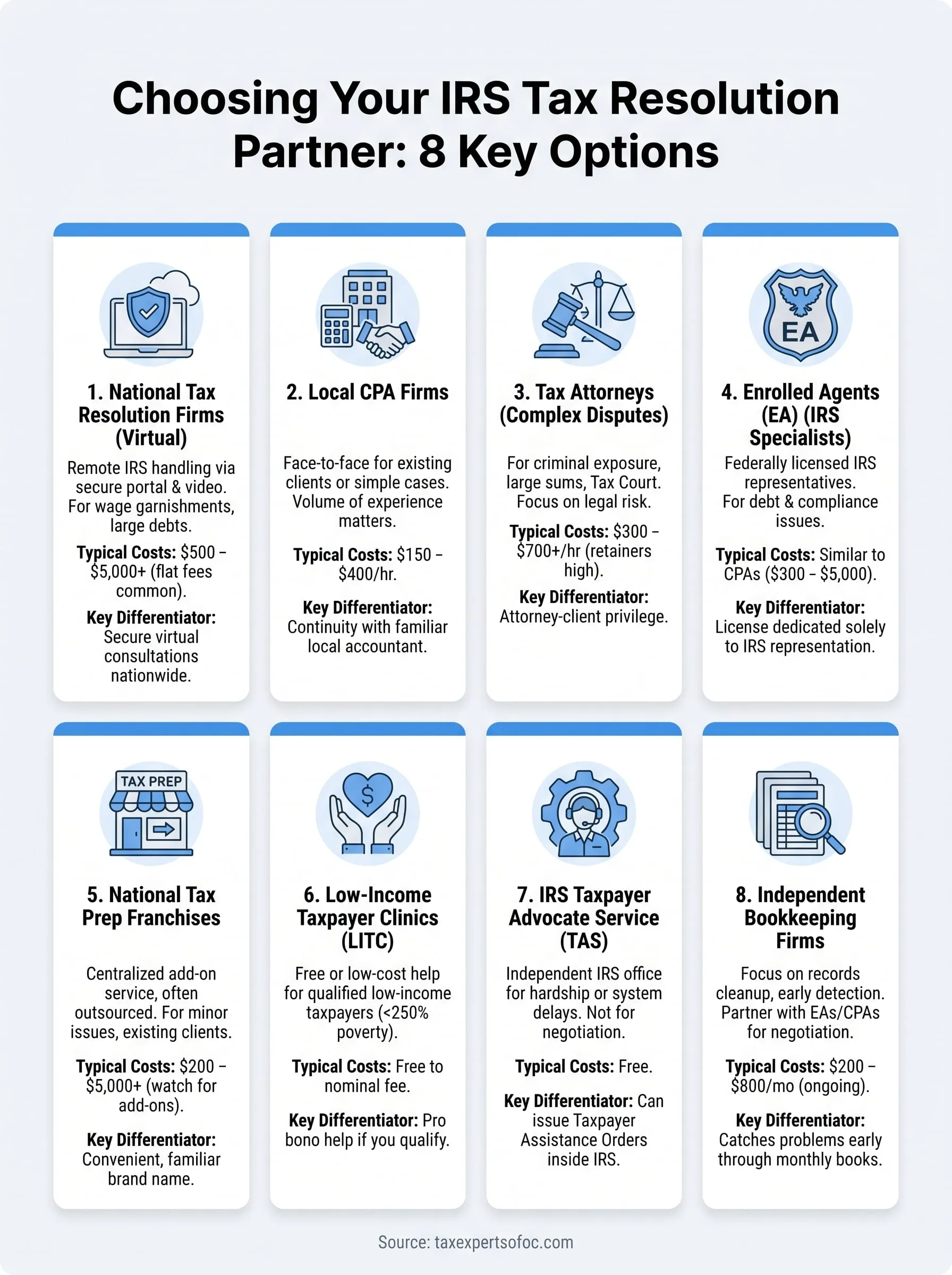
Picking the right tax resolution partner for you
Eight options, one decision: match the credential to the problem, not the ad that caught your eye first. A licensed CPA or Enrolled Agent handles most IRS debt cases well, an attorney steps in only when fraud or Tax Court enters the picture, and free resources like TAS or an LITC deserve a look before you pay anyone. Searching tax resolution services near me will always turn up more choices than you need, so use the questions in each section above to filter out sales pitches fast.
Whatever you choose, get the fee and the credential in writing before you sign. A transparent, upfront quote and direct access to the person working your case matter more than proximity or a familiar logo.
If you'd rather skip the guesswork, see how our tax resolution services stop garnishments, levies, and liens and talk to our CPA and Enrolled Agent directly for a free 30-minute consultation, no call center, no pressure, just a straight answer about your options.