

If you're searching tax debt relief near me at midnight with an IRS notice sitting on your kitchen table, you're not alone. Wage garnishments, bank levies, and stacks of unfiled returns push thousands of people to look for local help every year, and Google's flood of ads and directories doesn't make the choice any clearer. You need to know what these services actually do before you hand over a retainer.
Tax debt relief means working directly with the IRS, through programs like an offer in compromise, installment agreements, or penalty abatement, to reduce or restructure what you owe. It's not a magic eraser, and it's not something a search engine can rank accurately, since the best help isn't always the closest office. What matters is licensed representation, someone who can legally sit across from the IRS on your behalf.
This article breaks down what tax debt relief actually involves, who's qualified to provide it (CPAs, Enrolled Agents, tax attorneys), red flags that separate legitimate firms from scams, and how to evaluate help whether it's down the street or a phone call away.
Why local tax debt relief matters when you owe the IRS
Why urgency drives the search
Most people don't type "tax debt relief near me" out of curiosity. They type it after a wage garnishment hits their paycheck, a bank levy freezes their account, or a certified letter from the IRS arrives with a deadline attached. That urgency makes the nearest office or the first ad in the search results feel like the safest bet, but speed and proximity aren't the same thing as competence. A firm three states away with a licensed Enrolled Agent can often resolve your case faster than a storefront around the corner that outsources the actual IRS negotiation.
State tax debt adds another layer
California residents in particular deal with a two-front problem: the IRS on one side and the Franchise Tax Board on the other. If you owe both agencies, you need someone who understands how California's collection process interacts with federal programs like an installment agreement or currently-not-collectible status. This is where genuine local knowledge earns its keep. A firm based in Orange County that regularly handles California state tax notices alongside IRS cases will spot conflicts a generic national call center might miss, like a state lien that complicates a federal offer in compromise.
What actually matters more than zip code
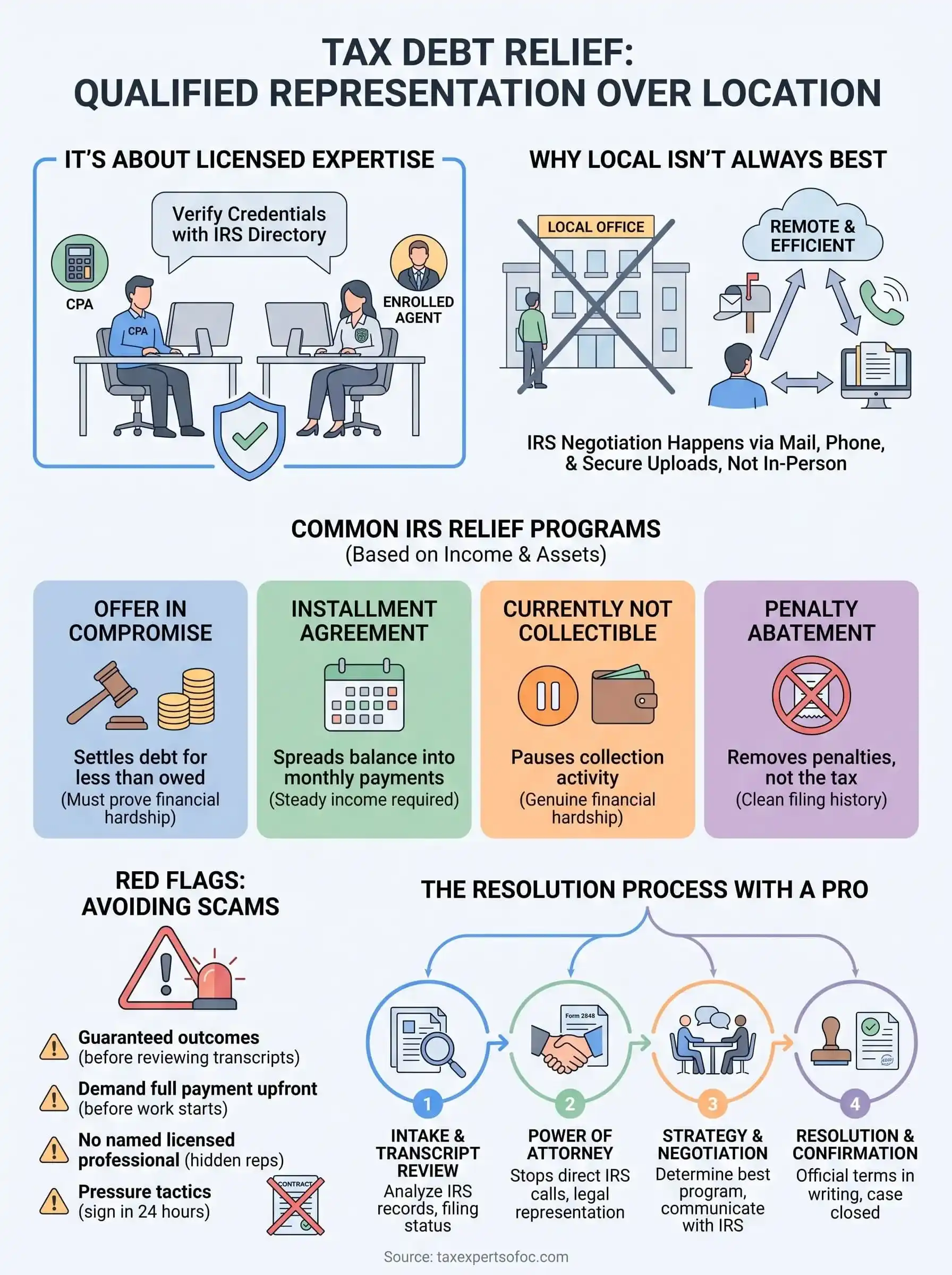
Proximity matters less than most people assume, because almost all IRS tax negotiation happens by mail, phone, and secure document upload, not in person. What you actually need is verifiable credentials and someone who can legally represent you before the IRS.
A firm 2,000 miles away with a licensed Enrolled Agent will do more for your case than a nearby office that just files paperwork.
Before you commit to anyone, local or remote, confirm these basics:
- Credentials on file: Ask for their CPA license number or Enrolled Agent number and verify it independently.
- Direct access: Find out if you'll speak with the licensed professional or get routed through sales staff.
- State-specific experience: If you owe state tax too, ask how many cases they've handled involving your state's agency.
- Multi-state capacity: If you've moved or worked across state lines, confirm they can file in every relevant jurisdiction.
Running through that list takes ten minutes and saves you from signing a retainer with a firm that can't actually stand behind you when the IRS calls.
How to find a trustworthy tax debt relief service near you
Start with licensing, not location
Searching by zip code narrows your options to whoever bought local ads, not whoever can actually help. Instead, search for Enrolled Agents or CPAs who specialize in tax resolution, then check credentials through the IRS's own directory before you call anyone. Every legitimate practitioner should welcome that verification, not dodge it.
A five-minute credential check protects you more than any star rating ever will.
Ask about direct access before you sign anything
Big national chains often route new clients through a sales team that never touches the actual case. Question anyone who won't tell you which licensed professional will handle your file. At Tax Experts of OC, you speak directly with a CPA or Enrolled Agent, not a call center rep reading from a script, starting with a free 30-minute consultation where you get real answers instead of a sales pitch.
Compare pricing structures upfront
Transparent firms quote flat fees or clear ranges tied to your case complexity. Vague quotes or pressure to pay before any review of your transcripts should make you pause. Use this checklist when you call:
- License number: Get it and verify it independently.
- Fee structure: Flat fee, hourly, or percentage of debt reduced.
- Timeline: Realistic estimate based on similar cases, not a guaranteed outcome.
- Point of contact: Name of the specific professional assigned to you.
Read reviews for specifics, not just stars
Generic five-star reviews of tax resolution companies mean little. Look for details: did the reviewer mention an installment agreement being approved, a levy released, or penalties abated? Reviews that name actual IRS resolution outcomes tell you far more than a number out of five, and they're much harder to fake convincingly.
Common IRS tax debt relief options you may qualify for
The IRS runs several structured relief programs, and which one fits your situation depends on your income, assets, and how much you owe. A qualified CPA or Enrolled Agent pulls your IRS transcripts first, then matches you to the program that actually applies, rather than pitching whichever one sounds best in an ad. Here's a quick comparison of the main options:

| Program | Best for | What it does |
|---|---|---|
| Offer in compromise | Taxpayers who can't pay the full balance, ever | Settles debt for less than owed |
| Installment agreement | Taxpayers with steady income | Spreads balance into monthly payments |
| Currently not collectible | Taxpayers facing genuine financial hardship | Pauses IRS collection activity |
| Penalty abatement | Taxpayers with a clean prior filing history | Removes penalties, not the underlying tax |
Offer in compromise
An offer in compromise lets you settle your tax debt for less than the full amount, but the IRS only accepts these when your income and assets genuinely can't cover the balance within its collection statute. Fewer than half of submitted offers get approved, according to IRS data, because most applicants overestimate their eligibility.
An offer in compromise settles debt for less than you owe, but only when the numbers prove you truly can't pay more.
Installment agreements and hardship status
Installment agreements work when you have steady income but need to spread payments over time instead of paying a lump sum, and you can apply for an IRS payment plan online or by mail. If your expenses already outpace your income, currently not collectible status pauses IRS enforcement entirely until your finances improve, buying you breathing room without erasing the debt.
Red flags that signal a tax relief scam
Scammers thrive on the same panic that sends you searching for tax debt relief near me in the first place. They know you're scared of the IRS and short on time, so they lean on pressure instead of credentials. Learning the warning signs takes less time than a single phone call, and it can save you thousands of dollars in fees paid to a company that never files a thing.

Promises no legitimate professional makes
Guarantees are the biggest tell. A licensed CPA or Enrolled Agent knows the IRS decides outcomes, not the preparer, so anyone who promises to "settle your debt for pennies on the dollar" before reviewing your transcripts is guessing or lying. The Federal Trade Commission warns consumers about exactly this pattern in its guidance on tax relief scams.
If someone guarantees your tax debt will disappear before they've even seen your transcripts, walk away.
Payment and contact patterns worth questioning
Watch how a firm handles money and communication, not just what they say on the phone:
- Full payment upfront: Legitimate firms may require a deposit, but demanding the entire fee before any work starts is a warning sign.
- No named professional: If nobody will tell you which licensed person handles your file, that's deliberate vagueness.
- Pressure tactics: Scripts pushing you to sign within 24 hours rely on fear, not facts.
- Unsolicited contact: Cold calls or mass emails claiming to know about your specific IRS debt are almost always fraudulent.
Spotting even one of these should slow you down. Genuine tax resolution firms welcome scrutiny because they have nothing to hide, and they'll happily let you verify their license before you commit to anything.
What to expect when working with a tax resolution professional
Once you've picked a firm, the process follows a predictable pattern that has little in common with the dramatic "we'll wipe out your debt" pitches you see in ads. Knowing the steps ahead of time helps you spot delays or shortcuts before they cost you money.
The intake and transcript review
Every legitimate case starts with pulling your IRS transcripts, the actual record of what you owe, what's been filed, and what deadlines apply. A CPA or Enrolled Agent won't recommend a program until they've seen these numbers, because guessing before that point is how bad advice happens. Expect to hand over recent tax returns, income statements, and a list of assets during this stage.
Power of attorney and direct IRS contact
Your representative files Form 2848, the power of attorney form, which lets them speak to the IRS on your behalf and, often, stops collection calls from reaching you directly. This single step is usually the moment clients feel real relief, since the IRS is now required to route communication through your professional instead of your phone.
The day your representative files power of attorney is usually the day the IRS stops calling you directly.
Realistic timelines and communication
Resolution isn't instant. An offer in compromise can take six months to a year; an installment agreement might be set up in weeks. Ask upfront what communication schedule to expect, since radio silence for months is a common complaint even with legitimate firms. A good practitioner will check in at each IRS response, not just when they need another payment from you.
Here's what a typical engagement includes:
- Transcript pull and financial review
- Power of attorney filing
- Program recommendation based on your numbers
- Ongoing IRS correspondence and negotiation
- Final resolution and written confirmation of terms
Taking the next step toward resolving your tax debt
Finding real tax debt relief near me was never about picking the nearest office. It comes down to verifying credentials, getting direct access to a CPA or Enrolled Agent, and understanding which IRS program actually fits your numbers before anyone promises an outcome. Wage garnishments and IRS letters create urgency, but the firms that help you fastest are the ones that ask for your transcripts before they quote a solution, not after they've collected a retainer.
You don't have to sort through directories and sales scripts alone. Schedule a free 30-minute consultation for professional tax resolution services with Tax Experts of OC and talk directly with a licensed professional who reviews your specific situation, whether you're facing a levy, unfiled returns, or years of back taxes. That conversation costs you nothing, and it's the fastest way to know exactly where you stand with the IRS.