

An IRS letter has a way of ruining your week. Maybe it's a notice about back taxes, a wage garnishment, or an audit that feels impossible to navigate alone. Your first instinct is probably to search for a tax attorney for irs problems, but you're not sure what that person actually does or whether you even need one versus a CPA.
Here's the direct answer: a tax attorney handles the legal side of IRS disputes, negotiating settlements, defending you in tax court, and stopping collections when the stakes involve real legal exposure. But attorneys aren't your only option, and for many cases, an Enrolled Agent or CPA with resolution experience can resolve things faster and for less money.
This article breaks down exactly what tax attorneys do, when you genuinely need one versus when other representation makes more sense, and how to evaluate IRS representation near me so you hire the right professional the first time. At Tax Experts of OC, we work these cases daily, so we'll show you how to tell which situations call for legal firepower and which don't.
Why you might need a tax attorney for IRS problems
Not every IRS notice requires a lawyer. Simple back tax debt, a missing-document request, or a routine audit often gets resolved by a CPA or Enrolled Agent for a fraction of what legal fees cost, so it helps to understand how IRS representation works and who qualifies to provide it. The calculus changes once you're facing potential criminal exposure, a tax court case, or a balance so large that one wrong move costs tens of thousands of dollars. That's the line most people miss when they start searching for a tax attorney for irs help: the title doesn't automatically mean you need one, but certain situations make hiring one non-negotiable.
When the IRS suspects fraud or criminal activity
If you've received a summons, a visit from an IRS Criminal Investigation agent, or a letter referencing potential fraud, stop talking to the IRS and call an attorney before you say anything else. Attorney-client privilege protects what you tell your lawyer in a way that accountant-client conversations generally don't once criminal exposure is on the table. An Enrolled Agent or CPA can be compelled to testify against you in some circumstances; an attorney cannot. This is the single clearest scenario where hiring a tax attorney isn't optional.
If the IRS is investigating you criminally, only an attorney's advice is legally shielded from being used against you later.
When your case is headed to tax court
Disputes that can't be settled through the appeals process sometimes end up in U.S. Tax Court, where litigating a case requires someone who understands court procedure, evidentiary rules, and how judges weigh tax law arguments. Few CPAs or EAs are equipped to argue there, and mistakes made without proper legal representation are nearly impossible to undo once a judgment is entered. If your notice mentions a court date or a right to petition, that's your cue to bring in an attorney rather than handle it solo.
When the debt or the facts are genuinely complex
Once a case involves more than a straightforward payment plan, the risk of a costly misstep rises fast. Watch for these signs that legal help matters:
- Six-figure or larger tax debt spanning multiple years
- Trust fund recovery penalty exposure tied to a business you ran or owned
- Offshore accounts or unreported foreign assets
- Active liens or levies threatening your home, bank accounts, or business equipment
- A prior resolution attempt that fell apart or was rejected
Searching for irs representation near me after any of these situations show up is a smart move, and pairing that search with a firm that has both attorneys and enrolled agents on staff, like Tax Experts of OC's team, means you get the right professional assigned to your actual risk level instead of guessing about what tax resolution services actually do.
How to choose the right tax attorney for IRS issues
Finding a tax attorney for irs matters shouldn't feel like a gamble. The title "tax attorney" isn't regulated the way "CPA" or "Enrolled Agent" is, so anyone with a law degree can technically claim it even without real IRS experience. Before you sign a retainer, take the time to verify a resolution tax service and confirm the attorney actually practices tax resolution regularly, not just estate planning or general litigation with a tax case mixed in.
Check licensing and specialization
Start by confirming the attorney is licensed in good standing through your state bar association, then ask specifically how many IRS collection or audit cases they've handled in the past year. General practice attorneys sometimes take tax cases they aren't equipped for, and you'll pay the price in delays or a weaker outcome.
A law degree alone doesn't mean IRS experience; ask for case specifics, not just credentials.
Get fee structure and pricing in writing
Upfront pricing separates trustworthy firms from ones that pad hours or surprise you later. Push for these details before committing:
- Flat fee versus hourly billing, and what triggers additional charges
- Whether the free consultation is truly free or a sales pitch in disguise
- What happens if your case escalates from a simple notice to a full audit
- Payment plan options if you're already dealing with financial hardship
Tax Experts of OC offers a 30-minute free consultation with transparent pricing spelled out before any work begins, which is the standard you should expect from anyone you're considering.
Confirm who handles your case day to day
Larger firms sometimes hand your file to a junior associate after the partner closes the sale. Nail down, in writing if possible, exactly who will communicate with the IRS on your behalf and how often you'll get updates. If a firm can't answer that clearly during your first call, treat it as a warning sign rather than a detail to sort out later.
Searching for irs representation near me gets you a list of names offering help with audits and notices, but the vetting above is what actually protects you from hiring the wrong one.
Tax attorney vs. CPA vs. enrolled agent for IRS issues
People often assume a tax attorney for irs cases is always the strongest choice, but that's not true for most taxpayers. Each of the three credentials solves a different problem, and picking based on title alone instead of the actual issue wastes money. Understanding the split before you call anyone saves you a wrong hire and a second retainer fee down the line.

What each professional actually does
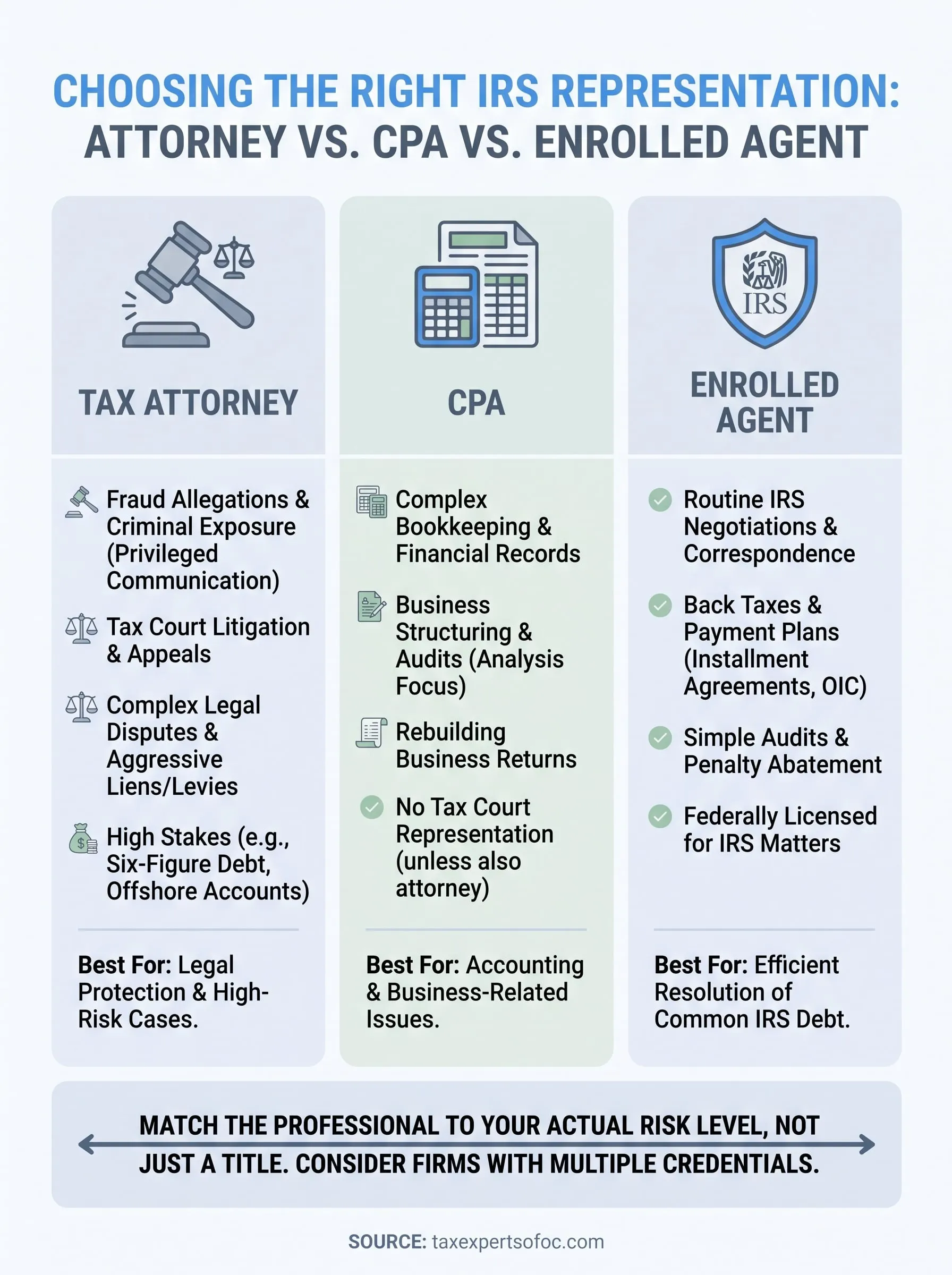
Generally, attorneys handle legal disputes and privileged communication, CPAs handle complex financial records and tax strategy, and Enrolled Agents specialize almost exclusively in IRS representation and negotiation. Here's how the three stack up:
| Credential | Best for | Can represent you in tax court | Communications privileged |
|---|---|---|---|
| Tax Attorney | Fraud allegations, litigation, criminal exposure | Yes | Yes |
| CPA | Complex bookkeeping, business structuring, audits | No (unless also an attorney) | No |
| Enrolled Agent | IRS negotiations, back taxes, payment plans | No | No |
Choose the credential that matches your risk, not the one that sounds most impressive on a business card.
Which one fits your situation
Often, a straightforward back tax balance or an installment agreement request is exactly the kind of case an Enrolled Agent resolves efficiently, since Enrolled Agents are federally licensed specifically for IRS matters and typically charge less than attorneys. Meanwhile, a CPA earns their fee when your situation involves messy books, missed deductions across several years, or a business return that needs rebuilding before the IRS will even negotiate, and it's worth knowing what a CPA is allowed to do on your behalf before the IRS. Reserve the attorney for cases where legal representation carries real weight, meaning fraud, criminal referrals, or a court filing.
Ultimately, the smartest move is working with a firm that keeps both credentials in-house, so your case gets routed to the right professional instead of being forced into whichever specialty the office happens to offer.
What to expect during the IRS resolution process
Hiring a tax attorney for irs issues doesn't mean an instant fix. Resolution follows a fairly predictable sequence, and knowing the stages ahead of time keeps you from panicking when things take longer than a week or two. Most cases move through investigation, negotiation, and then a formal resolution, with the IRS setting the pace far more than your attorney does.
Investigation and case review
First, your representative pulls your IRS transcripts to see exactly what the agency has on file, including unfiled years, penalties, and any active collection actions. This step matters because taxpayers often misremember what they filed or assume a debt is smaller than it actually is. Expect this phase to take one to three weeks depending on how quickly the IRS responds to a power of attorney request.
Negotiation with the IRS
Next comes the actual negotiation, where your attorney or Enrolled Agent proposes a resolution path based on what your transcripts and financials support. Common outcomes include:
- Installment agreements spreading payments over time, which you can estimate with a payment plan calculator
- Offers in compromise settling the debt for less than owed
- Currently non-collectible status if you genuinely can't pay
- Penalty abatement requests to reduce what's owed
- Litigation or appeals if the IRS rejects a reasonable proposal
The negotiation phase is where experience matters most, since the IRS rarely offers its best terms to an unrepresented taxpayer.
Resolution and ongoing compliance
Once the IRS approves a path forward, your case isn't fully closed. You'll need to stay current on all future filings and payments, because falling behind again can void an installment agreement or offer in compromise almost immediately. Plan on a check-in with your representative at least once a year, and keep in mind that a case involving multiple tax years or a business entity can stretch resolution timelines to several months rather than weeks. Patience here pays off far more than trying to rush the IRS into a faster answer.
Common IRS problems a tax attorney can resolve
A tax attorney for irs cases earns their fee on specific problem types, not on every notice that lands in your mailbox. Knowing which situations fall into their lane helps you avoid overpaying for legal muscle you don't need, and it helps you recognize the moment a case has crossed into territory where you genuinely do.
Audits with legal exposure
Routine correspondence audits rarely need an attorney, but knowing what your IRS audit letter means matters, because field audits that uncover unreported income or questionable deductions can escalate fast. Once an examiner starts asking about intent rather than just numbers, audit representation from an attorney protects you from statements that could later support a fraud referral.
Liens, levies, and collection actions
Aggressive collection activity is where legal intervention often changes the outcome entirely. Attorneys can file for emergency relief, negotiate a release, or challenge the underlying assessment when the IRS has moved to seize assets. Cases that typically call for this level of help include:
- Bank levies freezing your account, where stopping the levy fast is what unfreezes your funds
- Wage garnishments cutting into your paycheck, which you can stop and protect your income from
- Federal tax liens attached to your home or property
- Passport revocation notices tied to seriously delinquent debt
Once the IRS starts seizing assets, the speed of legal intervention matters as much as the strategy behind it.
Unfiled returns and trust fund penalties
Multiple years of unfiled returns create both a financial and legal problem, since willful failure to file can carry criminal penalties in extreme cases, so the steps to file back taxes with the IRS should start immediately. Similarly, business owners facing a trust fund recovery penalty for unpaid payroll taxes face personal liability that an attorney is better equipped to negotiate down or dispute. Business owners in particular should treat this scenario seriously, because personal assets can be pursued even after the company closes. Tax Experts of OC's tax resolution services coordinate attorneys and Enrolled Agents on exactly these cases, so the right professional handles the legal risk while the rest of the case moves forward without unnecessary delay or added cost.
Moving forward with your tax situation
Most IRS problems don't need a courtroom, but some absolutely do, and the difference comes down to what's actually at stake in your case. A tax attorney for irs matters involving fraud, litigation, or aggressive collections earns their cost fast, while simpler back tax and audit cases usually resolve faster and cheaper with an Enrolled Agent or CPA. The mistake isn't picking the wrong credential, it's guessing instead of matching the professional to your actual risk.
You don't have to figure that out alone. If you're staring at a notice right now and unsure which lane your situation falls into, that uncertainty is exactly what a real consultation should clear up before you spend a dollar. Schedule your free consultation and see how our IRS tax problem resolution services can stop collections and get you a straight answer on what your case needs, not what sounds impressive on a business card.