
Running payroll yourself eats hours you don't have, and one missed deposit deadline can trigger IRS penalties that snowball fast. If you're a small business owner juggling employee paychecks, tax withholdings, and filing deadlines on top of actually running your company, you've probably wondered whether there's a better way. Outsourced payroll services are that better way for most growing businesses.
In plain terms, outsourcing payroll means handing off wage calculations, tax withholdings, direct deposits, and compliance filings to a third-party provider or accounting firm instead of managing them in-house or through basic software. The right partner doesn't just cut checks; they track changing tax rates across states, file your payroll tax returns on time, and catch errors before the IRS does.
This article breaks down exactly what outsourced payroll services include, how the process actually works month to month, what you should expect to pay, and what separates a solid provider from one that leaves you exposed. Whether you're comparing payroll outsourcing options for the first time or switching providers after a bad experience, you'll walk away knowing what to look for and what questions to ask.
Why businesses outsource payroll services
Most owners don't wake up wanting to hand payroll to someone else. They get there after a scare: a missed federal deposit, a state unemployment filing that slipped through the cracks, or a new hire whose W-4 got entered wrong for three pay periods straight. Outsourced payroll services solve a problem that in-house teams often don't see coming until it's expensive. Below are the reasons business owners actually make the switch.
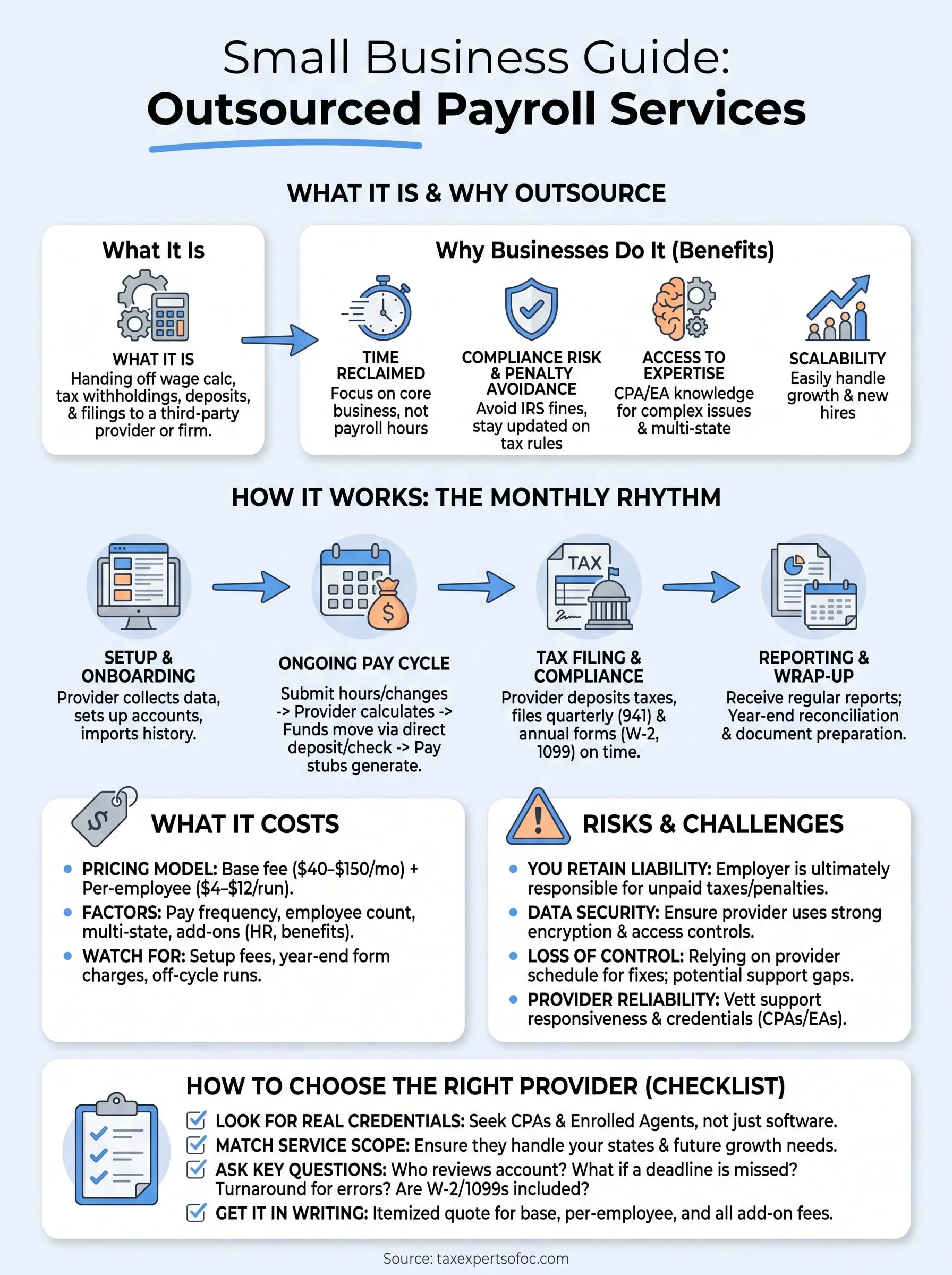
Compliance risk and penalty avoidance
Every pay run touches federal withholding, Social Security, Medicare, and often state and local tax rules that change year to year. Get the math or the timing wrong and the IRS penalty clock starts immediately, sometimes as much as 2% to 15% of the unpaid amount depending on how late the deposit is, according to the IRS. A dedicated payroll provider builds payroll compliance into the process instead of hoping someone remembers the deadline.
A single missed payroll tax deposit can cost more than a year of outsourcing fees.
Time reclaimed for running the business
Owners who process payroll themselves routinely lose several hours a week to it, and that number climbs whenever someone gets hired, fired, or moves to a different state. Reclaiming that time matters more than it sounds like it should, because those are the same hours you'd otherwise spend on sales calls, client work, or actually growing the company. Handing off wage calculations, direct deposits, and quarterly filings to a third-party payroll service frees that time without asking you to learn tax code in your spare hours.
Access to expertise you don't have in-house
Small businesses rarely have a payroll specialist on staff, so the job falls to whoever's available, often an office manager or the owner. That works fine until a multi-state employee, a garnishment order, or a benefits deduction shows up and nobody knows the correct treatment. Working with CPAs and Enrolled Agents who handle payroll daily means those edge cases get resolved correctly the first time instead of becoming a costly guessing game.
Scalability as your team grows
| Business stage | In-house payroll challenge | What outsourcing solves |
|---|---|---|
| 1-5 employees | Owner does it manually, high error risk | Automated calculations, filed on schedule |
| 5-25 employees | Multi-state hires, benefits complexity | Correct withholding across jurisdictions |
| 25+ employees | Full HR/payroll staff needed | Scalable service without new headcount |

Growth exposes weaknesses that a spreadsheet-based system was never built to handle. Scaling a team from five people to twenty five shouldn't require hiring a full payroll department, and it doesn't have to when an outside provider absorbs the added complexity. That flexibility is exactly why payroll outsourcing tends to pay for itself the moment a business crosses into multi-state hiring or rapid headcount growth.
How outsourced payroll services work
Once you sign on with a provider, the process follows a predictable rhythm that replaces the guesswork of doing it yourself. Understanding that rhythm helps you know what to expect before you commit, and it explains why outsourced payroll services feel so different from software you manage alone.

Setup and onboarding
First, the provider collects your employee data, tax IDs, banking information, and pay schedule. They set up payroll for your business, configuring direct deposit accounts, state and local tax registrations, and importing any historical payroll records if you're switching mid-year. Expect this phase to take one to two pay cycles before everything runs smoothly.
The ongoing pay cycle
Once setup is complete, each pay period follows the same basic sequence:
- You submit hours, salary changes, or bonuses to the provider by a set deadline
- The provider calculates gross pay, withholdings, and deductions
- Funds move via direct deposit payroll or paper check on payday
- Pay stubs and reports generate automatically for your records
The value of outsourcing isn't the paycheck itself, it's everything happening behind it that you never have to think about.
Tax filing and compliance handling
Behind every pay run, the provider deposits federal and state payroll taxes on the correct schedule and files quarterly forms like the 941 and annual forms like W-2s and 1099s. This is where a third-party payroll service earns its fee, because these filings carry real deadlines and real penalties when missed. A firm staffed by CPAs and Enrolled Agents, like the payroll team at Tax Experts of OC, also flags unusual withholding patterns or workers misclassified as contractors instead of employees before they become an audit trigger.
Reporting and year-end wrap-up
Throughout the year, you should receive regular reports covering labor costs, tax liabilities, and headcount changes so you're never guessing where things stand. Year-end brings W-2 and 1099 preparation, along with a reconciliation that confirms every deposit matched what was actually owed. Good providers hand you these documents well ahead of filing deadlines instead of scrambling in late January.
What outsourced payroll services cost
Pricing for outsourced payroll services usually breaks down into a base fee plus a per-employee charge, though some providers bundle everything into a flat monthly rate. Expect a base fee somewhere between $40 and $150 a month, plus $4 to $12 per employee per pay run, depending on how many extras you need. Businesses running payroll biweekly or semimonthly pay less per cycle than those running weekly, simply because there are fewer pay runs to process each month.
What drives the price up or down
Several factors push your quote higher or lower, and it helps to know them before you compare providers:
| Factor | Impact on cost |
|---|---|
| Number of employees | More employees, higher per-run total |
| Pay frequency | Weekly costs more than biweekly or monthly |
| Multi-state employees | Adds tax registration and filing fees |
| Add-ons (HR, benefits admin) | Increases the base or bundled rate |
| Year-end tax forms (W-2, 1099) | Sometimes included, sometimes billed separately |
Quoted rates rarely tell the whole story until you see what's bundled in versus billed as an extra.
The cheapest quote often turns into the most expensive option once you count the add-on fees.
Hidden fees to watch for
Setup fees, year-end tax form charges, and off-cycle payroll runs (correcting a missed hire or an emergency bonus check) catch a lot of business owners off guard after they've already signed a contract. Reading the fine print on contract terms before signing saves you from a surprise invoice three months in. Ask specifically whether W-2 and 1099 preparation is included, because some providers treat that as a separate line item every January.
Comparing cost to in-house payroll
Running payroll in-house isn't free either. Software subscriptions, the hours an owner or office manager spends processing pay, and the penalty risk from a missed deposit all add real cost that doesn't show up on an invoice. Weighing payroll outsourcing pricing against the true cost of doing it yourself, including your own time, usually tips the scale toward outsourcing once you cross five or ten employees. A firm like Tax Experts of OC offers upfront pricing during a free consultation, so you know the real number before committing.
Risks and challenges to weigh before outsourcing
Outsourcing payroll removes plenty of headaches, but it doesn't erase your responsibility. Business owners remain legally liable for payroll tax deposits even when a provider handles the paperwork, so picking the wrong partner can leave you holding the bag for someone else's mistake. Before you sign a contract, it helps to know exactly where the risk still sits with you and what to check ahead of time.
You still own the liability
Even with a solid third-party payroll service, the IRS treats the employer as the responsible party for unpaid trust fund taxes, not the payroll company. If a provider misses a deposit or files late, you're the one facing the payroll tax penalty rates and triggers while you sort out the dispute with them. This is exactly the kind of situation firms specializing in IRS tax problem resolution get called in to fix, often months after the damage is already done.
Outsourcing payroll shifts the workload, not the legal responsibility.
Data security and access concerns
Handing over Social Security numbers, bank account details, and wage data means trusting a vendor's security practices with information that's valuable to identity thieves. Ask any provider you're considering how they encrypt data, who has internal access, and what happens if there's a breach. A provider without a clear answer to those questions is a red flag worth walking away from.
Loss of direct control
Submitting hours through a portal and waiting on a provider's schedule feels different from running payroll yourself, especially when an employee needs an off-cycle check fixed fast. Correcting an error on your own timeline is faster than routing it through customer support, and some providers charge extra for rush corrections. Ask about turnaround time for fixes before you commit, not after you need one.
Provider reliability and support gaps
Not every payroll vendor staffs actual accountants who understand your industry's quirks, and some rely heavily on automated systems with thin human backup when something goes wrong. Vetting a provider's support responsiveness matters as much as comparing price sheets, since a cheap service that leaves you on hold during a tax notice isn't actually saving you money. Working with a firm staffed by CPAs and Enrolled Agents closes that gap, because someone with real tax expertise is reachable when the automated system can't answer your question.
How to choose the right payroll outsourcing provider
Picking a provider comes down to matching their expertise to your actual risk, not just comparing sticker prices. Small business owners comparing payroll options side by side often default to the cheapest one and later discover the support they needed during a tax notice simply wasn't there. Before signing anything, run the provider through a short checklist so you know exactly what you're getting.
Look for real credentials, not just software
Starting your search with credentials narrows the field fast. A provider staffed by CPAs and Enrolled Agents brings tax expertise that a purely software-driven vendor can't match, especially when a multi-state employee or a garnishment order complicates a pay run. Ask directly who reviews your account: a licensed professional or a rotating support queue.
The provider you want is the one you'd trust to answer an IRS notice, not just process a paycheck.
Match service scope to your business stage
Think about where your company is headed, not just where it stands today. A firm offering outsourced payroll services alongside bookkeeping, tax planning, and a fractional CFO and controllership option scales with you, so you're not switching vendors every time you cross a headcount milestone. Confirm the provider handles the states you operate in now and the ones you're likely to expand into next year, since California payroll rules alone add filings many vendors skip.
Questions to ask before signing
Use this list during your first call with any provider:
- Who is personally responsible for my account, and are they a CPA or Enrolled Agent?
- What happens, and who pays, if a deposit or filing deadline is missed on your end?
- Are W-2, 1099, and year-end filings included in the quoted price?
- How fast can you correct an off-cycle payroll error?
- Can you handle multi-state tax registrations if I hire outside my home state?
Get pricing and terms in writing
Verbal assurances don't hold up months later when a dispute over fees comes up. Request a written quote that itemizes the base fee, per-employee cost, and every add-on before you sign a contract. Tax Experts of OC offers a free 30-minute consultation with transparent upfront pricing, so you can compare the real numbers before committing to anyone.
The bottom line on outsourced payroll
Outsourced payroll services save you time, cut compliance risk, and give you access to expertise most small businesses can't justify hiring full-time. But the fit only works when you pick a provider who treats your account like more than a monthly invoice. Credentials matter more than price, and a firm staffed by CPAs and Enrolled Agents catches the edge cases that a software-only vendor misses until you're facing an IRS notice.
Before you sign with anyone, get pricing in writing, confirm who's actually reviewing your account, and ask what happens if they miss a deadline. Those answers tell you more than any sales pitch. If you'd rather skip the guesswork, talk to Tax Experts of OC about CPA-led payroll services for small businesses in a free 30-minute consultation, and see exactly what a payroll partnership built around real tax expertise looks like.