

Hiring your first 1099 worker feels simple until you realize contractors don't go through standard payroll at all. There's no tax withholding, no W-2, and one wrong move can trigger IRS penalties or a worker misclassification audit. If you're trying to figure out payroll for independent contractors without a finance background, you're not alone, and getting it wrong costs more than getting it right the first time.
Setting up contractor pay correctly means nailing three things: collecting a W-9 before the first payment, tracking totals so you issue 1099-NEC forms on time, and choosing a payment method that keeps records clean for tax season. Skip any of these and you're looking at scrambling every January, or worse, a compliance letter from the IRS.
In this guide, we walk through the actual setup process step by step, from classifying workers correctly to picking software that automates payments and tax form generation. We'll also cover the deadlines that trip up most small business owners and when it makes sense to bring in a CPA instead of handling it yourself. By the end, you'll have a repeatable process for paying contractors without the year-end headache.
Why contractor payroll is different from employee payroll
Running payroll for a contractor isn't payroll at all in the traditional sense. When you pay a W-2 employee, you withhold federal income tax, Social Security, Medicare, and often state tax, then match a chunk of it as the employer. With a 1099 contractor, none of that happens. You agree on a rate, you pay the invoice, and the contractor handles their own tax obligations through quarterly estimated payments to the IRS.
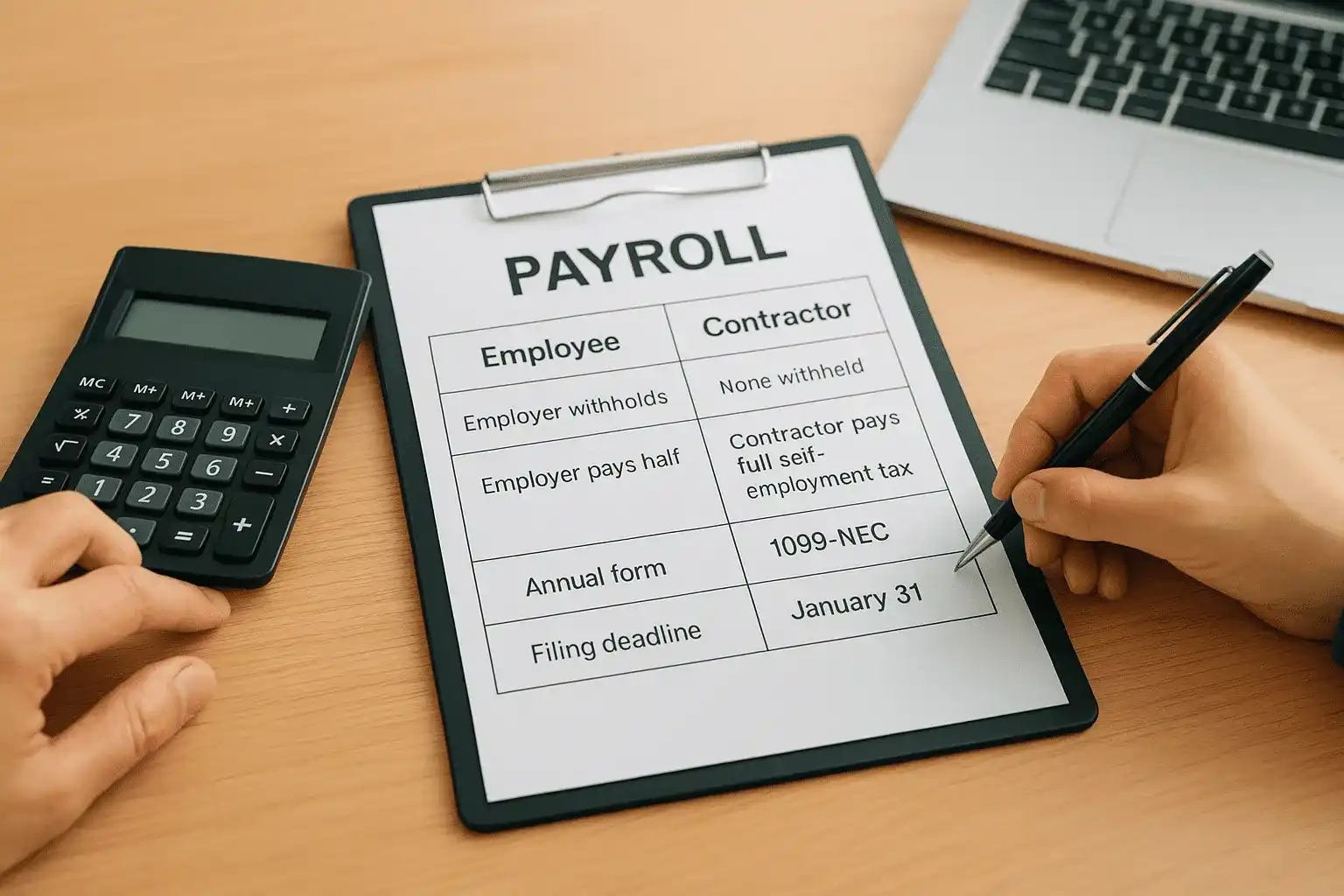
The withholding gap
That missing withholding is the biggest source of confusion for new business owners. You're not required to pull taxes from a contractor's check, and doing so anyway can actually work against you, since it starts to look like you're treating them as an employee. Independent contractors are responsible for their own self-employment tax, which covers both the employee and employer portions of Social Security and Medicare, roughly 15.3% before income tax on top of it. Your job is simpler on paper but riskier if you get the classification wrong.
Pay a contractor like an employee on paper, and the IRS may decide they are one.
Different forms, different deadlines
Instead of a W-2, contractors who earn $600 or more from you in a calendar year get a Form 1099-NEC. There's no quarterly payroll tax filing on your end, no state unemployment insurance contribution, and no workers' comp requirement in most states. The tradeoff is that you still need airtight recordkeeping, because the IRS expects consistent numbers between what you report and what the contractor claims.
| Factor | Employee (W-2) | Contractor (1099) |
|---|---|---|
| Tax withholding | Employer withholds | None withheld |
| Payroll taxes | Employer pays half | Contractor pays full self-employment tax |
| Annual form | W-2 | 1099-NEC |
| Benefits eligibility | Often required | Not required |
| Filing deadline | January 31 | January 31 |
Once you see the two systems side by side, it's clear why treating contractor payments like a scaled-down version of employee payroll leads to mistakes. Understanding this distinction upfront is what makes the rest of the setup process, starting with proper classification, actually stick.
Step 1. Confirm the worker's classification
Before you set up payroll for independent contractors, verify that the worker actually qualifies as a contractor and not an employee in disguise. The IRS looks at three broad categories to decide: behavioral control, financial control, and the type of relationship you have with the worker. Misclassify someone and you could owe back payroll taxes, penalties, and interest, even if the mistake was unintentional.
The IRS test in practice
Ask yourself who sets the schedule, who supplies the tools, and whether the work is core to your ongoing operations. A contractor should control how and when they get the job done, use their own equipment, and typically work with other clients besides you.
- Behavioral control: Do you dictate hours, methods, or require training? That points toward employee status.
- Financial control: Does the worker invoice you, cover their own expenses, and risk profit or loss? That points toward contractor status.
- Relationship type: Is there a written contract, and is the work project-based rather than indefinite?
If you control how the work gets done, the IRS may see an employee, not a contractor.
When to get a second opinion
Some working arrangements sit in a gray zone, especially long-term contractors who work full-time hours for a single client. In those cases, don't guess. File Form SS-8 with the IRS for an official determination, or run the scenario by a CPA or Enrolled Agent who handles worker classification regularly. Getting this step wrong early is far more expensive to fix later than it is to confirm upfront, since audits often reach back multiple tax years and compound penalties fast.
Step 2. Collect a signed W-9 and payment agreement
Get the paperwork signed before the first dollar changes hands. A signed W-9 gives you the contractor's legal name, business type, and taxpayer ID number, which you'll need to file an accurate 1099-NEC later. Chasing this form down in January, after the work is done, is how businesses end up with missing information and late filing penalties.
Why the W-9 comes first
Request the W-9 form directly from the IRS site and send it to every contractor before onboarding, not after their first invoice. Without a valid taxpayer ID on file, you're required to withhold 24% in backup withholding from their payments, which almost no contractor wants and almost no business owner remembers to do correctly.
No W-9 on file means backup withholding, and nobody wants that surprise in January.
What the payment agreement should cover
Pair the W-9 with a written payment agreement that spells out scope, rate, and payment terms. This protects you if the IRS or a court ever questions the working relationship, and it keeps disputes over money out of your inbox later.
- Payment amount and schedule: hourly, flat fee, or milestone-based, and how often you'll pay
- Invoice requirements: what the contractor needs to submit before you release payment
- Independent contractor clause: language confirming no employee benefits or tax withholding
- Termination terms: how either party can end the arrangement
Keep both documents in a shared folder or your accounting software so they're easy to pull up when tax season or an audit request arrives.
Step 3. Choose how and when you'll pay contractors
Once the paperwork is signed, decide on a payment method that keeps a clean paper trail. Bank transfers, ACH, and payment platforms all generate records automatically, which matters if you ever need to prove payment dates and amounts during an audit. Paying cash or writing personal checks without documentation is the fastest way to lose track of what you owe a contractor at year-end.

Match the payment method to your volume
If you work with one or two contractors, a simple bank transfer or check might be enough, as long as you log every payment in a spreadsheet or your accounting software. Once you're paying five or more contractors regularly, manual tracking starts to break down, and that's when dedicated contractor payment tools earn their cost by consolidating everything in one place.
- Bank transfer or ACH: low cost, but you need to log dates and amounts yourself
- Payment platforms: built-in invoicing and payment history, easier to reconcile at tax time
- Payroll software with contractor modules: automates 1099 tracking alongside employee payroll
The payment method matters less than whether it leaves a clean, dated record you can pull up in seconds.
Set a payment schedule and stick to it
Decide upfront whether you'll pay weekly, biweekly, or on invoice receipt, and put that schedule in the payment agreement from Step 2. Consistent timing reduces disputes and makes it easier to reconcile your books monthly instead of scrambling every December to figure out what you actually paid each contractor over the year.
Step 4. Report payments with Form 1099-NEC
Once the year wraps up, total what you paid each contractor and file Form 1099-NEC for anyone who received $600 or more. This form replaced the old 1099-MISC reporting for nonemployee compensation back in 2020, and the IRS treats the deadline seriously. Miss it and penalties stack up fast, starting around $60 per form if you're late by 30 days and climbing well past $300 per form if you never file at all.
Deadlines you can't push back
Mark January 31 on your calendar now, because that's when copies go to both the contractor and the IRS. There's no grace period tied to weekends or holidays that extends this in most years, so build the reporting task into your December closing checklist instead of waiting for January to remind you.
- To the contractor: mail or deliver electronically by January 31
- To the IRS: file by January 31, whether on paper or through the IRS FIRE system
- State copies: check your state's separate 1099 filing requirement, since several states require their own submission
File Form 1099-NEC by January 31, or the penalties start compounding immediately.
Reconcile before you file
Compare your total payments against invoices and bank records before submitting anything. A mismatch between what you report and what the contractor claims on their own return is one of the fastest ways to trigger an IRS inquiry, so run that reconciliation every quarter instead of waiting until the deadline is staring back at you.
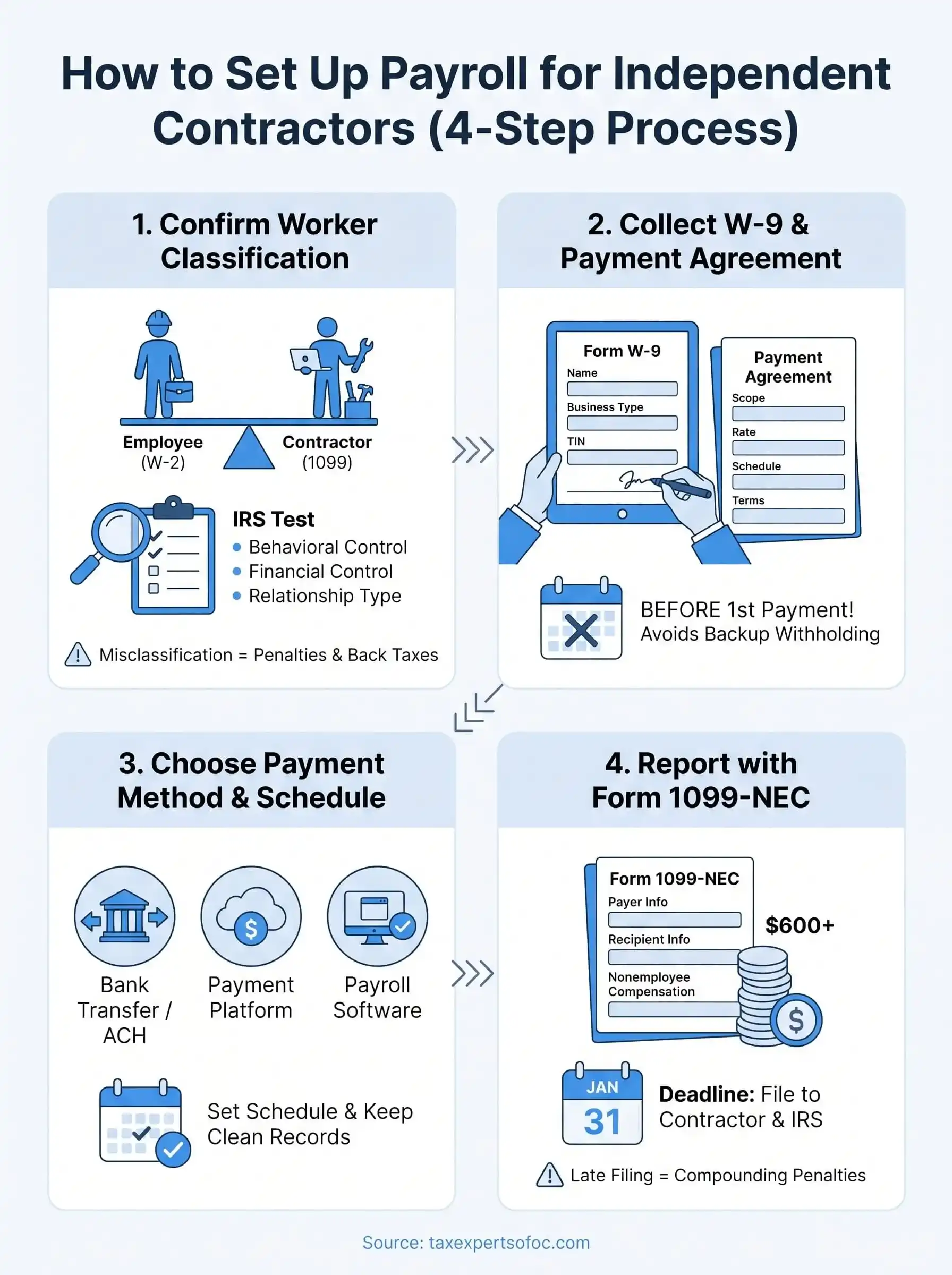
Keeping contractor payments compliant year after year
Set up the process once and repeat it every year: verify classification, collect the signed W-9, pick a payment method that leaves a paper trail, and file Form 1099-NEC on time. Businesses that treat this as a one-time task usually end up redoing it under pressure every January, chasing missing taxpayer IDs and scrambling to reconcile numbers before the deadline hits.
Treat contractor compliance as an ongoing habit, not a seasonal scramble. Review your contractor list each quarter, confirm nothing has changed in the working relationship, and keep your records current so year-end reporting takes an hour instead of a week.
If you'd rather hand this off to someone who handles it daily, that's exactly where a CPA or Enrolled Agent earns their fee. Schedule a free consultation with Tax Experts of OC and get your contractor payroll set up correctly from the start, so tax season stops being a source of dread.