Small business taxes for beginners work like this: you pay income tax on your business profit, you pay self-employment tax on that same profit if you work for yourself, and you send estimated payments to the IRS every quarter instead of waiting for one annual bill. The return you file, and its due date, depend on your legal structure. Set things up correctly once and the process repeats each year.
This guide shows you how to do small business taxes from your first day in business. You will learn why the rules matter, which steps to follow, which taxes and forms apply to your structure, which deductions to claim, and when it makes sense to bring in a professional.
Tax Experts of OC is a tax resolution and accounting firm in Orange County that serves business owners in all 50 states. Our CPA and Enrolled Agents spend a lot of time repairing first-year mistakes, so the advice below focuses on the habits that prevent them.
Why small business taxes matter from day one
Small business taxes matter because nobody withholds them for you, and every missed step adds penalties and interest to a bill you already owe. The earlier you build a system, the cheaper your first year becomes.
You are now the withholding department
When you work for an employer, payroll takes out income tax, Social Security, and Medicare before you see a paycheck. As an owner, you receive the full amount and owe the tax yourself. That includes self-employment tax of 15.3% on net earnings, made up of 12.4% for Social Security and 2.9% for Medicare. It applies once your net earnings reach $400 for the year.

On $40,000 of net profit, self-employment tax alone is about $5,650, before any federal or state income tax. This number catches many first-year owners off guard, especially those who spent the cash as it came in.
Your profit is taxed whether or not you set the money aside, so reserve it as you earn it.
What mistakes cost you
Late filing is the expensive error. The IRS charges a failure-to-file penalty of 5% of the unpaid tax for each month, up to 25%. The failure-to-pay penalty is 0.5% per month. File on time even if you cannot pay in full, because the filing penalty is ten times larger than the payment penalty.
Skipping quarterly payments can also bring an underpayment penalty. As a starting rule of thumb, many owners move 25% to 30% of each payment into a separate tax savings account, then adjust once they see real numbers.
How to do small business taxes step by step
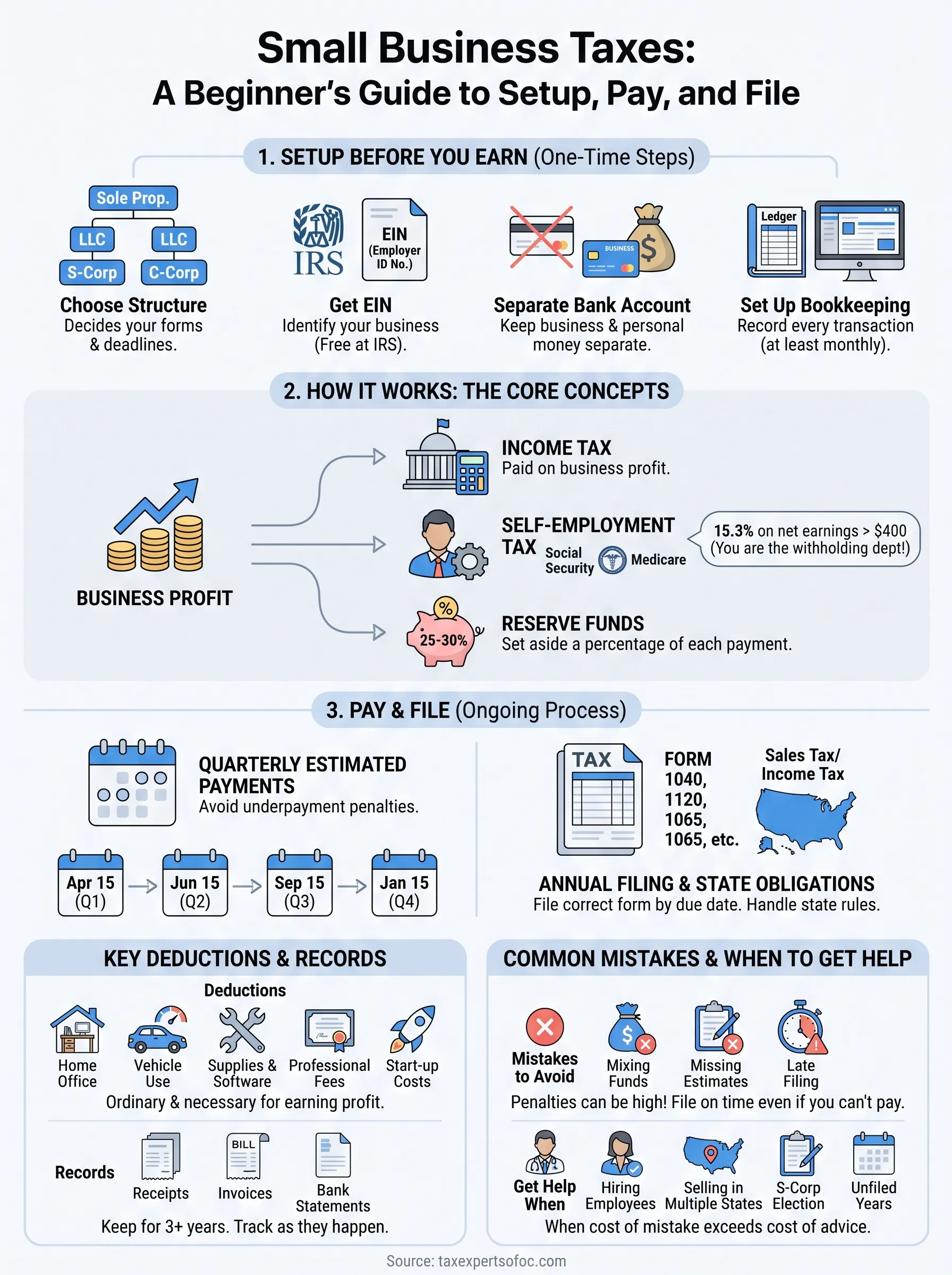
To do small business taxes, work through seven steps: choose a structure, get an EIN, separate your money, track every transaction, pay estimates quarterly, file an annual return, and handle state obligations. The first four happen before your tax bill exists.
Steps one to four: set up before you earn
Setup decisions are hard to undo later, so make them early.
- Choose a legal structure. A solo owner is a sole proprietor by default. You can also form an LLC, partnership, S corporation, or C corporation. Your structure decides which forms you file.
- Get an EIN. An Employer Identification Number identifies your business to the IRS. You can apply for an EIN on the IRS website at no cost. Never pay a third party for one.
- Open a business bank account. Run all business income and spending through it so your records stay clean.
- Set up bookkeeping. Record every sale and expense at least monthly, using software or a bookkeeper.
Separate accounts and monthly records make tax season a filing job instead of a rescue job.
Steps five to seven: pay and file
The IRS expects tax as you earn income, so you make estimated quarterly payments. These are the usual due dates for a calendar-year business:
| Income earned | Payment due |
|---|---|
| January 1 to March 31 | April 15 |
| April 1 to May 31 | June 15 |
| June 1 to August 31 | September 15 |
| September 1 to December 31 | January 15 |
When a date lands on a weekend or holiday, it moves to the next business day. You generally avoid the underpayment penalty by paying at least 90% of this year's tax or 100% of last year's tax. That second figure rises to 110% if your adjusted gross income was over $150,000.
After year-end, file your annual return and handle state and local obligations, such as state income tax and sales tax. Rates and rules vary by state, so check with your state's tax agency.
Which taxes and forms apply to your structure
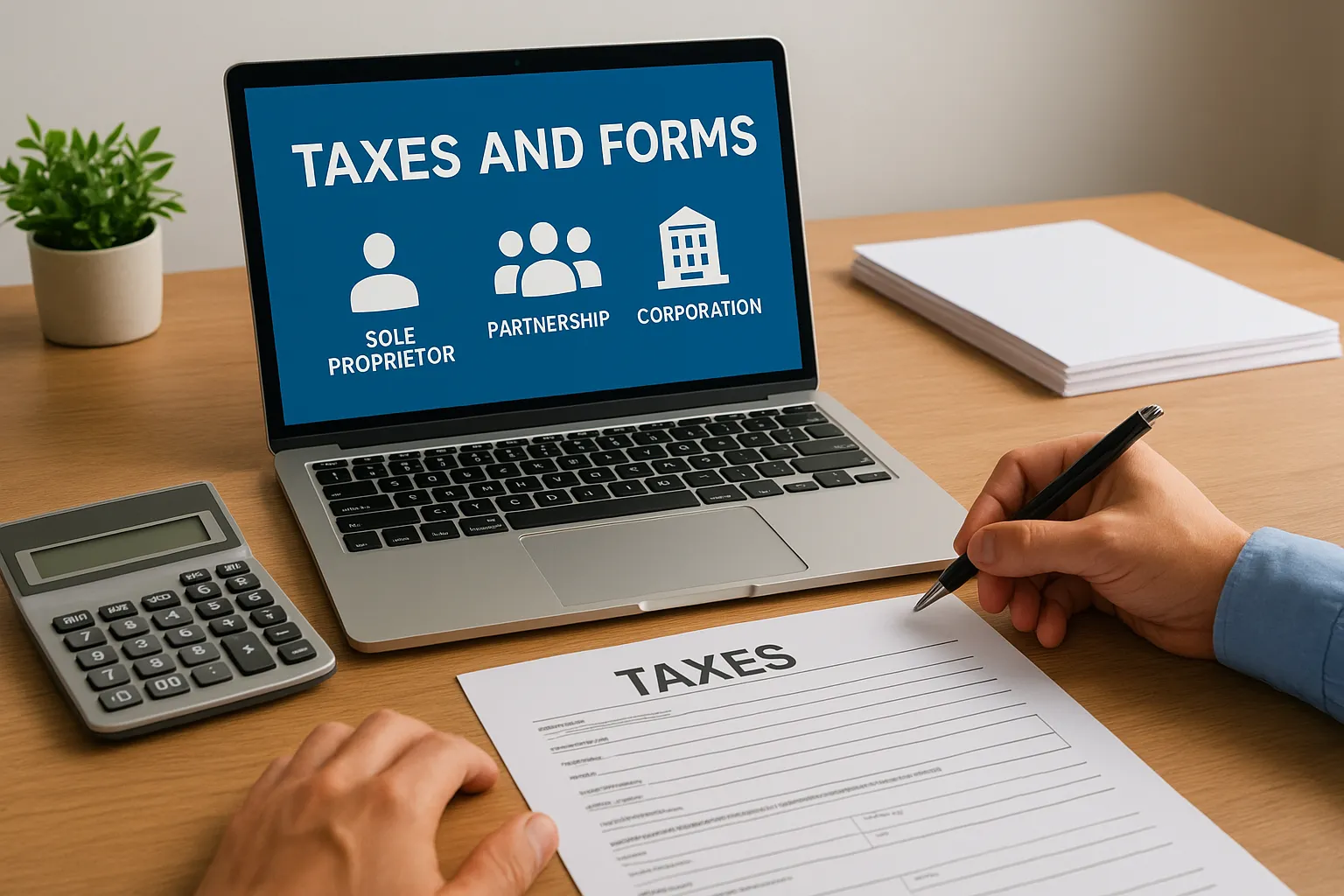
Your business structure decides which taxes you pay and which forms you file. Small business taxes for beginners look very different for a freelancer than for an S corporation with employees.
The tax types you may meet
Most new owners face some mix of these:
- Income tax: on business profit, reported on your own return or a separate business return.
- Self-employment tax: Social Security and Medicare for owners who work for themselves.
- Employment taxes: withholding, matching Social Security and Medicare, and federal unemployment tax once you hire employees. These are reported on Form 941 and Form 940.
- Sales and use tax: collected from customers on taxable sales, set by each state and sometimes by city or county.
- Excise tax: applies only to certain products and activities.
Forms by business structure
Each structure has a standard federal filing path:
| Structure | How profit is taxed | Main federal form | Usual due date |
|---|---|---|---|
| Sole proprietorship | On your personal return | Schedule C and Schedule SE with Form 1040 | April 15 |
| Single-member LLC | Same as sole proprietor by default | Schedule C with Form 1040 | April 15 |
| Partnership or multi-member LLC | Passes through to partners | Form 1065 and Schedule K-1s | March 15 |
| S corporation | Passes through to shareholders | Form 1120-S | March 15 |
| C corporation | Taxed at the corporate level | Form 1120 | April 15 |
An LLC is a legal structure, not a tax class, so its owners choose how it is taxed. Note that partnerships and S corporations file earlier than sole proprietors, which surprises many first-timers.
Know your structure and you know your form, your deadline, and which taxes you owe.
Deductions and records that cut your tax bill
Deductions reduce the income you pay tax on, and a business can usually deduct expenses that are ordinary and necessary for earning a profit. Good records are what make those deductions hold up.
Deductions beginners often miss
A deduction lowers your taxable income, while a credit reduces your tax bill directly. Common deductions include:
- Home office: space used regularly and exclusively for business.
- Vehicle use: business mileage or actual vehicle costs, backed by a log.
- Software, supplies, and equipment: including subscriptions and tools.
- Professional fees and training: accounting, legal, and courses that relate to your work.
- Start-up costs: up to $5,000 can be deducted in the first year, and the rest is spread over time. The $5,000 amount shrinks once start-up costs pass $50,000.
Many pass-through owners can also claim the qualified business income deduction, worth up to 20% of eligible income. Eligibility has limits, so confirm it before you count on it.
Records that back them up
Keep receipts, invoices, bank statements, and mileage logs. The IRS generally expects you to keep records for at least three years from filing, and longer in some situations. Track expenses as they happen, because rebuilding a year of receipts in April costs time and missed deductions. Keep business and personal spending separate, so every deduction has a clear paper trail.
Common beginner mistakes and when to get help
The most common beginner mistakes are mixing personal and business money, missing quarterly payments, and ignoring state rules. Many new owners can file simple returns with good software, but certain situations justify a professional.
Mistakes that trigger notices
Watch for these errors:
- Missing estimates and then paying a large bill with penalties in April.
- Misclassifying workers. Treating an employee as an independent contractor can create payroll tax debt.
- Ignoring other states. Selling or working across state lines can create filing duties beyond your home state.
- Skipping returns. Not filing because you owe money only makes the debt bigger.
When a professional pays for itself
Consider help once you hire employees, sell in several states, consider an S corporation election, or have unfiled years behind you. A CPA or Enrolled Agent can also pick your structure before you commit to one, which is easier than changing it later. If a notice from the IRS has already arrived, respond before the deadline and get representation instead of guessing. Our small business tax preparation and IRS resolution work covers both situations.
Hire help when the cost of a mistake exceeds the cost of advice.
Start your first filing with a plan
Small business taxes feel manageable once you reduce them to a routine: choose your structure, get an EIN, separate your money, track every transaction, pay quarterly, and file the right form on time. Add the deductions you qualify for and keep your records, and most first-year problems never happen.
If you want a second set of eyes on your setup, our CPA and Enrolled Agents can review your situation and tell you exactly what to file and when. You can book a free 30-minute consultation with Tax Experts of OC and leave with a clear plan for your first year.