

Most business owners find out they overpaid the IRS after it's too late to fix it. You filed your return, the CPA did the math, and the number was higher than you expected. That's not tax preparation failing you, it's the absence of strategic tax planning. Filing a return only records what already happened. Planning changes what happens next.
Strategic tax planning is the year-round process of structuring your income, entity type, retirement contributions, and expenses before December 31, not after. It means choosing an S-corp election that cuts self-employment tax, timing equipment purchases for depreciation, or shifting income between years to stay in a lower bracket. Done right, it's the difference between reacting to a tax bill and controlling it.
This article breaks down exactly what strategic tax planning includes, who benefits most from it (business owners, high earners, and anyone with multiple income sources), and the specific proactive strategies our CPAs and Enrolled Agents at Tax Experts of OC use to lower client tax bills. You'll walk away knowing what a real tax plan looks like and how to start building one, whether you run an LLC or manage significant personal wealth.
Why strategic tax planning matters for your finances
Taxes are usually the single largest expense a business owner or high earner faces each year, bigger than payroll, rent, or marketing combined. Yet most people spend more time picking a health insurance plan than deciding how to structure their income. Tax liability isn't fixed. It moves based on decisions you make months before you ever sit down to file, and those decisions compound year after year.
The real cost of skipping the plan
Consider a small business netting $150,000 a year as a sole proprietor. Without planning, that owner pays self-employment tax on the full amount, roughly 15.3% before income tax even applies. An S-corp election paired with a reasonable salary structure can shave thousands off that bill, but only if it's set up before year-end, not discovered in April, which is why it pays to know whether an S corp or an LLC saves you more. Waiting until tax season means the opportunity is already gone for that filing year.
A tax return only reports the past. A tax plan controls the future.
Where the savings actually show up
Strategic tax planning touches nearly every part of your financial life, not just your business return. Here's where clients typically see measurable impact:

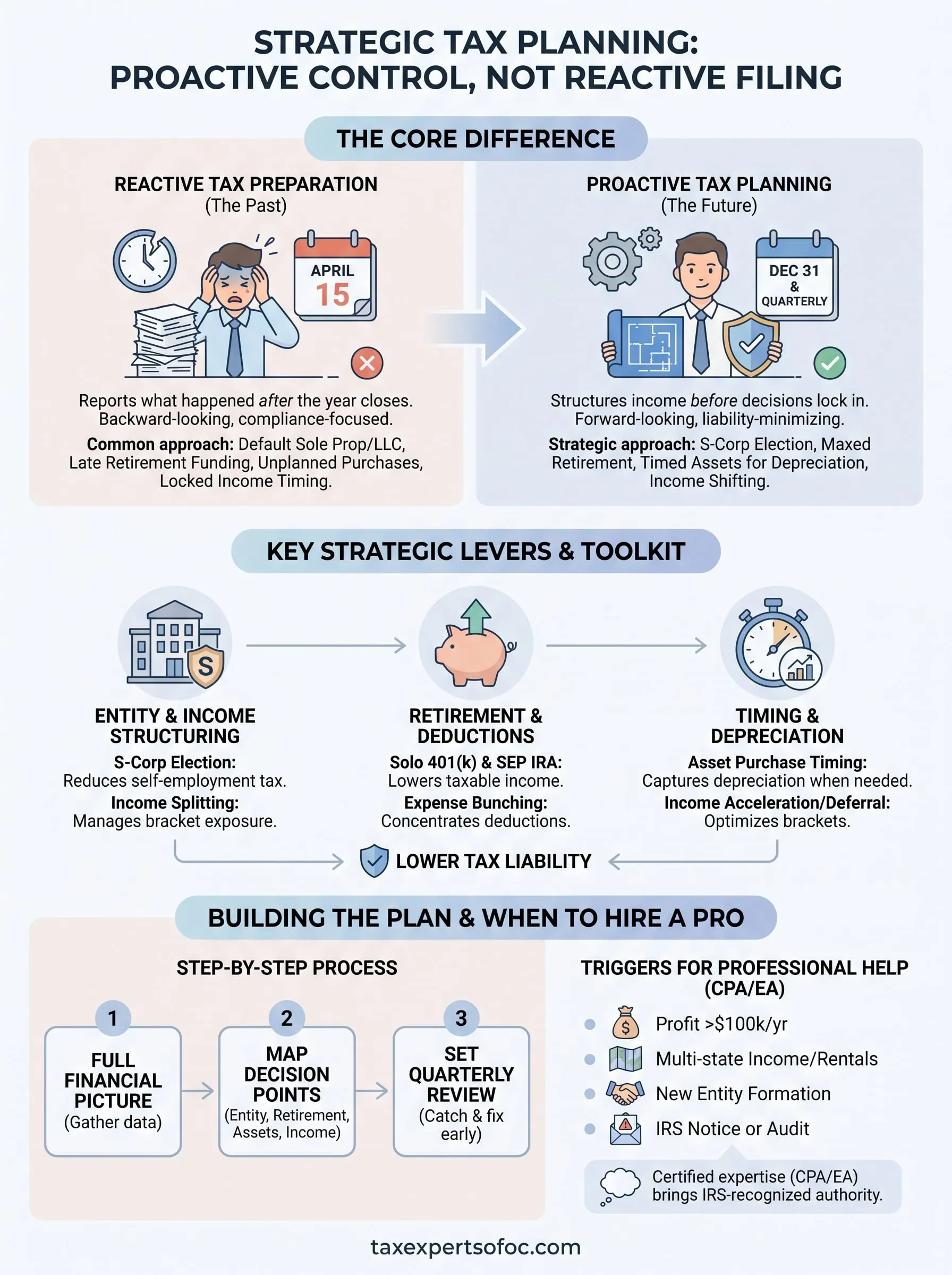
| Area | Reactive Approach | Proactive Planning |
|---|---|---|
| Business structure | Default sole prop or single-member LLC | S-corp or entity election to cut self-employment tax |
| Retirement contributions | Made after the year closes, if at all | Maxed out before deadlines, reducing taxable income |
| Equipment and asset purchases | Bought without a tax strategy in mind | Timed to capture depreciation in the right year |
| Income timing | Locked in by when clients pay you | Shifted between years to manage bracket exposure |
Each row represents money that's either kept or handed to the IRS unnecessarily.
Financial stability beyond the tax bill
Beyond the direct savings, proactive tax strategies give you predictability. You stop getting surprised by a five-figure bill in March, and you start making business decisions, like hiring or buying equipment, with a clear picture of the tax consequences attached. That stability matters just as much as the dollars saved, especially for business owners managing cash flow month to month.
How to build a strategic tax plan step by step
Building a real plan isn't complicated, but it does require sitting down before the year ends, not after. Strategic tax planning follows a repeatable sequence, and skipping steps is usually why business owners end up back in reactive mode.
Start with a full financial picture
Gathering last year's return, current profit and loss statement, and a projection for the rest of the year comes first. You can't plan around numbers you haven't looked at, and guessing at your income leads to bad decisions on entity structure and retirement contributions alike.
Map out the decision points
Once you know where you stand, work through the choices that actually move the needle:
- Entity structure: confirm whether an S-corp election still makes sense at your income level
- Retirement accounts: decide how much to fund a SEP IRA, Solo 401(k), or defined benefit plan
- Asset purchases: time equipment buys to capture depreciation in the year you need it most
- Income timing: decide whether to accelerate or defer income based on projected brackets
A tax plan is only as good as the decisions you make before December 31.
Set a review cadence
Quarterly check-ins catch problems while there's still time to fix them. Reviewing only once a year, especially in December, leaves no room to correct course if income comes in higher or lower than expected.
Common strategies used in strategic tax planning
Every client situation differs, but the toolkit our CPAs and Enrolled Agents pull from stays fairly consistent, and most of it overlaps with the core tax planning strategies for small businesses. Strategic tax planning works because it combines several levers at once instead of relying on one big move to save the year.
Entity and income structuring
Switching a sole proprietorship to an S-corp remains one of the most reliable ways to cut self-employment tax, since only your reasonable salary gets hit with payroll tax, not the full net profit. Income splitting between spouses or shifting income into a lower-earning year also reduces bracket exposure without changing how much you actually earn, one of several strategies that work for high income earners.
Retirement and deduction strategies
Funding a SEP IRA or Solo 401(k) before the deadline lowers taxable income immediately, often by tens of thousands of dollars for a profitable owner, depending on how much of a Solo 401(k) you can deduct. Bunching deductible expenses, like prepaying business costs or accelerating equipment purchases, into a high-income year works the same way.
The best tax strategies don't chase loopholes, they use the rules already built into the code.
A quick-reference list
- S-corp election: reduces self-employment tax on active business income
- Retirement contributions: SEP IRA, Solo 401(k), or defined benefit plans lower taxable income
- Depreciation timing: Section 179 and bonus depreciation move deductions into the year you need them
- Charitable and expense bunching: concentrates deductions into higher-earning years
Combining these strategies through tax planning services usually produces more savings than any single tactic applied alone.
Strategic tax planning vs. tax preparation
Confusing these two services costs people money every year. Tax preparation is the annual act of reporting what already happened: you hand over your documents, a preparer fills out the forms, and you sign a return that reflects decisions made months earlier, which is the key difference between planning and preparation. Strategic tax planning happens before that return exists, shaping the numbers a preparer will eventually report.
Preparation reports the past. Planning shapes what gets reported.
Here's the distinction laid out plainly:
| Tax Preparation | Strategic Tax Planning |
|---|---|
| Happens once a year, after the fact | Happens year-round, before decisions lock in |
| Reports income and deductions as they occurred | Structures income and deductions before they occur |
| Focused on compliance and filing accuracy | Focused on minimizing future liability |
| Backward-looking | Forward-looking |
Many firms only offer the left column. They'll file an accurate return, but accuracy isn't the same as savings. A preparer working from historical data can't retroactively make you elect S-corp status or fund a retirement account that's already past its deadline.
Good firms do both, and the order matters. At Tax Experts of OC, our CPA-led tax filing for individuals and businesses reflects the planning decisions made earlier in the year, not the other way around. Skipping planning and going straight to preparation means you're accepting whatever tax bill your unstructured decisions produced, rather than one you actually chose.
When to bring in a tax professional
Some situations outgrow DIY software fast, and knowing when that happens saves you real money. Running a business with more than one employee, hitting six figures in net profit, or juggling income across multiple states are all times to hire a CPA instead of filing it yourself, because a tax professional pays for themselves several times over. Software can file a return, but it can't tell you whether an S-corp election makes sense for your specific numbers or catch a deduction you didn't know existed.
Watch for these specific triggers:
- You received an IRS notice, audit letter, or collections warning
- Your net business profit exceeds $80,000 to $100,000 a year
- You're forming a new LLC, corporation, or partnership
- You have income from rental property, investments, or multiple states
- You're unsure whether your current entity structure still fits your income
The cost of a professional is small compared to the cost of a decision made without one.
Certified expertise matters here too. A CPA or Enrolled Agent brings authority the IRS itself recognizes, unlike a seasonal preparer working from a checklist. According to the IRS, Enrolled Agents hold federal authorization to represent taxpayers directly before the agency, which matters if a notice ever shows up in your mailbox.
Waiting until a problem appears is the most expensive way to get help. Scheduling a free consultation before year-end, while decisions can still be made, is what actually changes your outcome.
Turning tax planning into a year-round habit
Treat strategic tax planning like maintenance, not a once-a-year scramble. The owners who save the most money follow year-round tax planning habits: quarterly check-ins, entity structure adjustments when income shifts, and retirement accounts funded on schedule instead of scrambled together in December. Waiting for tax season means the year's decisions are already locked in, and no amount of paperwork fixes that after the fact.
Every strategy covered here, S-corp elections, retirement contributions, depreciation timing, income shifting, only works if someone reviews your numbers before deadlines pass. That's the entire point of building a plan instead of just filing a return.
If you're netting six figures, running a growing LLC, or juggling income across states, don't wait for a notice to force the conversation. Book a free consultation for CPA-led tax planning services in Orange County now, while there's still time this year to act on what you learn.