

Every year, the IRS processes over 150 million individual returns, and millions of those come back with errors that trigger delays, penalties, or unwanted audits. The frustrating part? Most tax filing mistakes are completely preventable. A wrong Social Security number, a missed deduction, or a simple math error can cost you hundreds (sometimes thousands) of dollars and months of back-and-forth with the IRS.
If you've already filed an incorrect return, don't panic, there are steps you can take to fix it. And if you haven't hit submit yet, you're in the perfect position to get it right the first time. Either way, knowing what to watch for puts you back in control.
At Tax Experts of OC, our CPAs and Enrolled Agents resolve tax problems for individuals and businesses across all 50 states. We've seen firsthand how small oversights snowball into serious tax issues. That's exactly why we put this guide together. Below, we break down seven of the most common tax filing mistakes people make, and what you can do right now to avoid each one before your 2026 return is locked in.
1. Trying to handle a complex return or IRS issue alone
Tax software works well for straightforward returns, but it has real limits. When your situation involves self-employment income, rental properties, multiple states, or an active IRS notice, the software won't flag what it doesn't know to look for. Going it alone in these cases is one of the costliest tax filing mistakes you can make, and many people don't realize it until the IRS sends a letter.
Why this mistake happens
Most people underestimate how complicated their return actually is. You might assume that because you filed on your own last year without issues, this year is the same. But life changes fast, and a new side business, a divorce, an inheritance, or a home sale can turn a simple return into something that requires professional knowledge to handle correctly. Tax law also shifts every year, and missing a single update can mean leaving money on the table or triggering a penalty you had no idea was coming.
How to avoid it before you file
Before you start your return, take stock of what changed in your financial life over the past year. If anything feels unfamiliar or complicated, that's your signal to bring in a professional. A CPA or Enrolled Agent can review your full situation, catch issues before you file, and make sure you're claiming every deduction and credit you actually qualify for rather than guessing.
Working with a licensed tax professional isn't just about accuracy. It's about having someone legally authorized to represent you if the IRS ever comes back with questions.
What to do if you already filed
If you filed on your own and something feels off, don't ignore it. The IRS has up to three years to audit a return, and longer in cases involving significant underreporting. You can correct errors by filing an amended return using Form 1040-X. A CPA or Enrolled Agent can review what you originally submitted, identify exactly what went wrong, and manage both the amendment and any IRS communication on your behalf.
2. Filing before you have every tax document you need
Rushing to file early is one of the most common tax filing mistakes people make, especially when a refund is on the line. The problem is that not all tax documents arrive at the same time, and submitting your return before everything is in hand almost guarantees an incomplete or inaccurate filing.

Why this mistake happens
Employers must send W-2s by January 31, but 1099s, K-1s, brokerage statements, and mortgage interest forms can keep arriving well into February or even March. Many people file the moment their W-2 shows up, not realizing other forms are still on the way.
That timing gap catches a lot of filers off guard, particularly those with multiple income streams, investment accounts, or business partnerships that each generate their own separate documents.
How to avoid it before you file
Before you open your tax software, build a checklist of every income source you had during the year. Common forms to track include:
- W-2s from all employers
- 1099-NEC or 1099-K for freelance or gig work
- 1099-DIV, 1099-INT, and 1099-B for investments
- Schedule K-1 if you're part of a partnership or S-corp
Filing an accurate return on time is always better than filing an incomplete one a few weeks early.
What to do if you already filed
If a missing document surfaces after you've already submitted, you'll need to correct the record using Form 1040-X. File the amendment as quickly as possible once you spot the gap. Acting fast limits any penalties or interest that can build on additional tax owed.
3. Entering the wrong personal or banking information
A typo in your Social Security number or a single transposed digit in your bank account number can bring your entire return to a halt. These are some of the most avoidable tax filing mistakes around, yet they show up in thousands of returns every year because filers are moving too fast and not double-checking the basics.
Why this mistake happens
Speed is usually the culprit. When you're eager to get your refund, manually entering your SSN, your spouse's SSN, or your dependent's SSN without a second look creates real room for error. The same goes for direct deposit details, where one wrong routing or account number sends your refund to the wrong place or bounces it back to the IRS entirely.
How to avoid it before you file
Before you submit, pull out your Social Security card and a voided check and verify every digit against what you typed. Cross-check your name exactly as it appears on your Social Security card, since mismatches with IRS records trigger immediate processing errors.
A two-minute review of your personal and banking information before you file can save you weeks of waiting.
What to do if you already filed
If your refund didn't arrive or was rejected, check the IRS "Where's My Refund?" tool at IRS.gov to identify the problem. Banking errors often require you to wait for the IRS to mail a paper check or, in some cases, file an amended return to correct the underlying data.
4. Choosing the wrong filing status or claiming the wrong dependents
Your filing status and dependent claims directly determine your tax bracket, standard deduction, and which credits you qualify for. Getting either one wrong is a tax filing mistake that ripples through your entire return until the IRS flags the discrepancy.

Why this mistake happens
Status confusion is most common after major life changes like marriage, divorce, or losing a spouse. Many people default to whatever they filed last year without checking if it still applies to their current situation.
Dependent errors frequently surface in shared custody arrangements, where both parents claim the same child. The IRS catches these through duplicate SSN matching on submitted returns.
How to avoid it before you file
Confirm your marital status as of December 31 before selecting a status. The IRS outlines all five filing options at IRS.gov:
- Single
- Married Filing Jointly
- Married Filing Separately
- Head of Household
- Qualifying Surviving Spouse
Incorrectly claiming "Head of Household" is one of the most frequently audited filing status errors the IRS flags each year.
What to do if you already filed
If you used the wrong status or claimed an ineligible dependent, file Form 1040-X to correct the return. Act quickly to limit any penalties building on additional tax owed.
Incorrect dependent claims often trigger IRS notices that delay your refund or require extra documentation before the agency processes your correction.
5. Leaving out income or reporting it in the wrong place
The IRS receives copies of nearly every income document sent to you, which means omitting income isn't just a tax filing mistake, it's a mismatch the IRS will catch when it cross-references its records against your return. Underreporting income is one of the most common triggers for an IRS notice or audit.
Why this mistake happens
Most filers remember their W-2, but freelance income, rental payments, interest earnings, and gig platform payouts are easy to overlook. The 1099 landscape has expanded significantly, and platforms like PayPal and Venmo now issue 1099-Ks for payments above $5,000, catching many casual sellers and side-hustlers off guard.
How to avoid it before you file
Go through every account that paid you money during the year, not just your main employer. This includes savings account interest, stock dividends, crypto transactions, and any cash income from services you provided. Match each payment against a form before you file.
If you received income from a source and didn't get a 1099, that income is still taxable and still belongs on your return.
What to do if you already filed
If you left out income after submitting, file Form 1040-X to correct your return before the IRS contacts you. Proactively amending your return typically results in lower penalties and interest compared to waiting for the IRS to identify the discrepancy on its own.
6. Misclaiming deductions and credits or missing ones you qualify for
Deductions and credits are where most filers leave real money behind, and they're also where overconfidence creates problems. Claiming something you don't actually qualify for is just as damaging as overlooking something you do, and both are common tax filing mistakes that directly affect what you owe or what you get back.
Why this mistake happens
Deduction rules change frequently, and eligibility requirements are often more specific than people assume. The home office deduction, for example, requires exclusive and regular use of a dedicated space, not just occasional remote work. On the other side, credits like the Earned Income Tax Credit or the Child and Dependent Care Credit go unclaimed every year simply because filers don't know they qualify.
How to avoid it before you file
Review the IRS's current list of credits and deductions at IRS.gov before you finalize anything. Pay particular attention to income thresholds, qualifying expenses, and documentation requirements, since each credit and deduction has its own set of rules that must be met independently.
A CPA or Enrolled Agent can identify deductions and credits specific to your situation that tax software often misses entirely.
What to do if you already filed
If you overlooked a deduction or claimed one incorrectly, Form 1040-X lets you correct the return. File it promptly to either recover money you left on the table or resolve the overclaim before the IRS flags it.
7. Missing signatures, attachments, or deadlines
A return without a signature is legally considered unfiled by the IRS. Forgetting to sign, skipping a required attachment, or missing the April deadline by even one day can turn an otherwise accurate return into a tax filing mistake that costs you real money in penalties and interest.
Why this mistake happens
Most filers focus so heavily on the numbers that procedural requirements become an afterthought. Paper returns require a physical signature from every person listed, and electronic returns require a PIN that many people overlook at the final step. Required attachments like Form 8962 for premium tax credits also get skipped when filers rush through the final screens without reviewing what the IRS actually needs alongside the main form.
How to avoid it before you file
Set your submission deadline on your calendar well before April 15 so you have enough time to gather final attachments. Run through the IRS checklist at IRS.gov to confirm every required form and signature is in place before you hit submit.
Filing for an extension using Form 4868 gives you until October to file, but it does not extend your time to pay any tax owed.
What to do if you already filed
If you missed the deadline without an extension, file your return immediately to stop the failure-to-file penalty from growing. The IRS charges 5% of unpaid tax per month, up to 25%, so acting fast directly reduces what you owe.
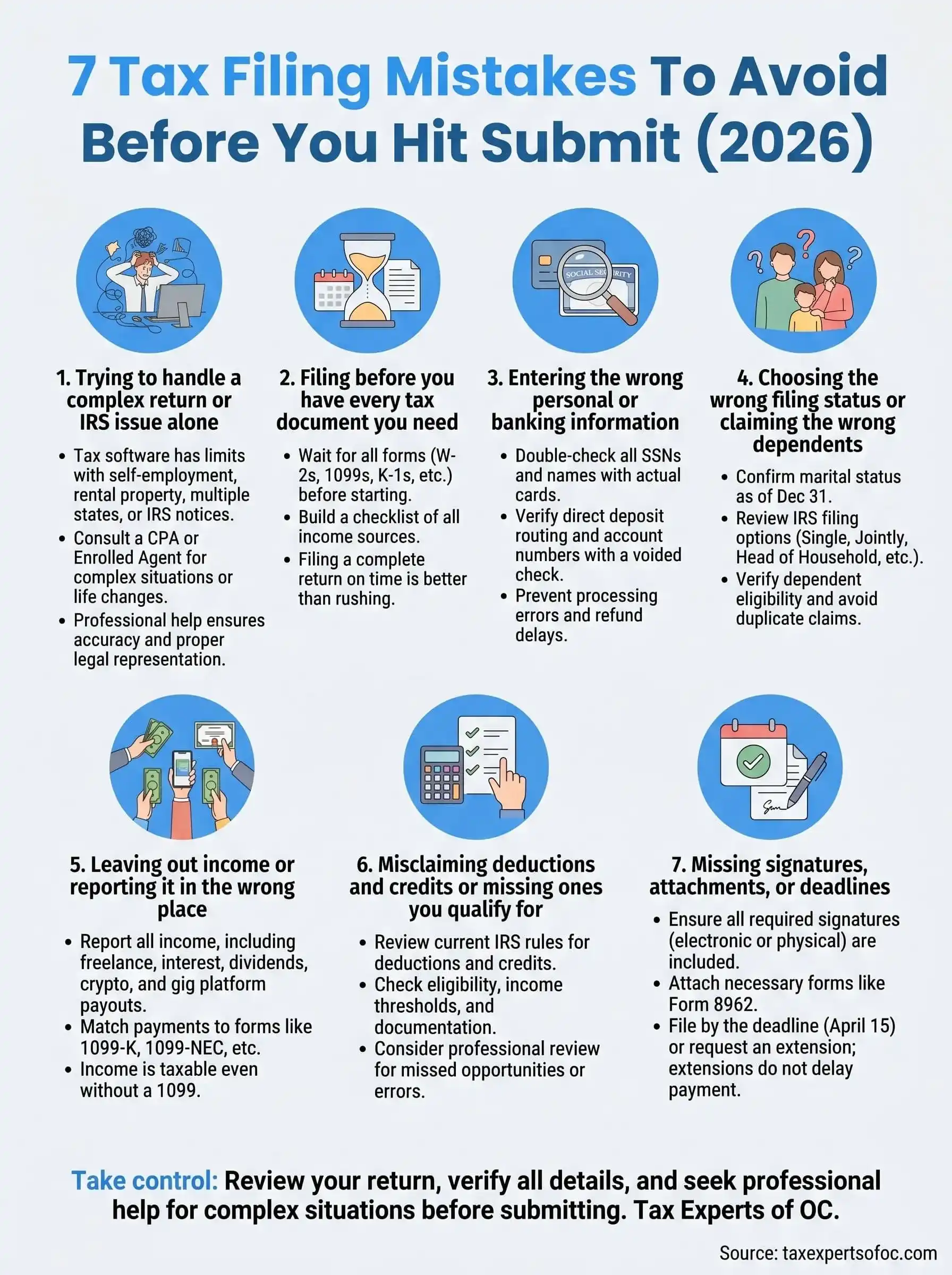
Next steps before you hit submit
The seven tax filing mistakes covered in this guide share one thing in common: they're all preventable with the right preparation and the right support. Before you finalize your return, slow down and run through each one. Confirm you have every document, verify your personal and banking details, check your filing status, and make sure every income source is accounted for. If anything feels unclear, that uncertainty is a signal to get a professional involved before you submit, not after.
Working with a licensed CPA or Enrolled Agent gives you more than accuracy. It gives you someone qualified to represent you if the IRS has follow-up questions down the line. Whether you're filing for the first time with a complicated situation or dealing with an IRS notice from a prior year, the team at Tax Experts of OC is ready to help you get it right.