
Most people treat taxes as a once-a-year scramble: gather receipts, file by the deadline, forget about it until next spring. That mindset costs you money. Tax preparation planning actually covers two distinct disciplines that work together, and understanding the difference is the first step toward paying less to the IRS and avoiding surprises.
Tax preparation is the backward-looking part: compiling your income, deductions, and paperwork to file an accurate return for the year that already happened. Tax planning is forward-looking: strategic decisions made throughout the year that shape what that return looks like before you ever file it. One reacts to your financial history, the other actively reduces your future tax liability. Confusing the two, or only doing one, is why so many taxpayers overpay or get blindsided by a bill they didn't see coming.
In this article, we break down exactly what each service involves, how they differ in practice, and what a coordinated year-round strategy looks like for individuals, families, and business owners. We'll also cover how to recognize when your situation calls for a CPA or Enrolled Agent rather than software, and what to expect from professional guidance that goes beyond a simple filing appointment.
Why tax preparation planning matters for your finances
Skipping ahead to April with no strategy almost always means leaving money on the table. Tax preparation planning isn't a luxury reserved for wealthy business owners; it's the difference between reacting to a tax bill and controlling it. When you only think about taxes once a year, you lose the ability to shift income, time deductions, or restructure a business before the window closes. By the time your CPA sits down to prepare your return, most of the decisions that could have lowered your bill are already locked in.
The real cost of reactive filing
Consider a small business owner who waits until January to think about equipment purchases, retirement contributions, or entity structure. Every one of those choices had a deadline that passed months earlier. The same goes for individuals who get hit with an unexpected capital gain, a bonus, or a side income stream and only discover the tax impact when their return is filed. Reactive filing turns tax season into damage control instead of a routine formality.
Proactive tax planning turns April from a surprise into a formality.
The upside of planning ahead
Households and businesses that pair preparation with ongoing planning typically see three concrete benefits:
- Lower effective tax rates through timed income and deductions
- Fewer estimated-payment penalties from accurate quarterly projections
- Better cash flow visibility for major purchases or hiring decisions
These aren't abstract advantages. They show up as real dollars saved and fewer letters from the IRS. Working with professionals who understand both year-round tax strategy and accurate filing gives you a financial advantage that a once-a-year appointment simply can't match.
Tax preparation vs. tax planning: what sets them apart
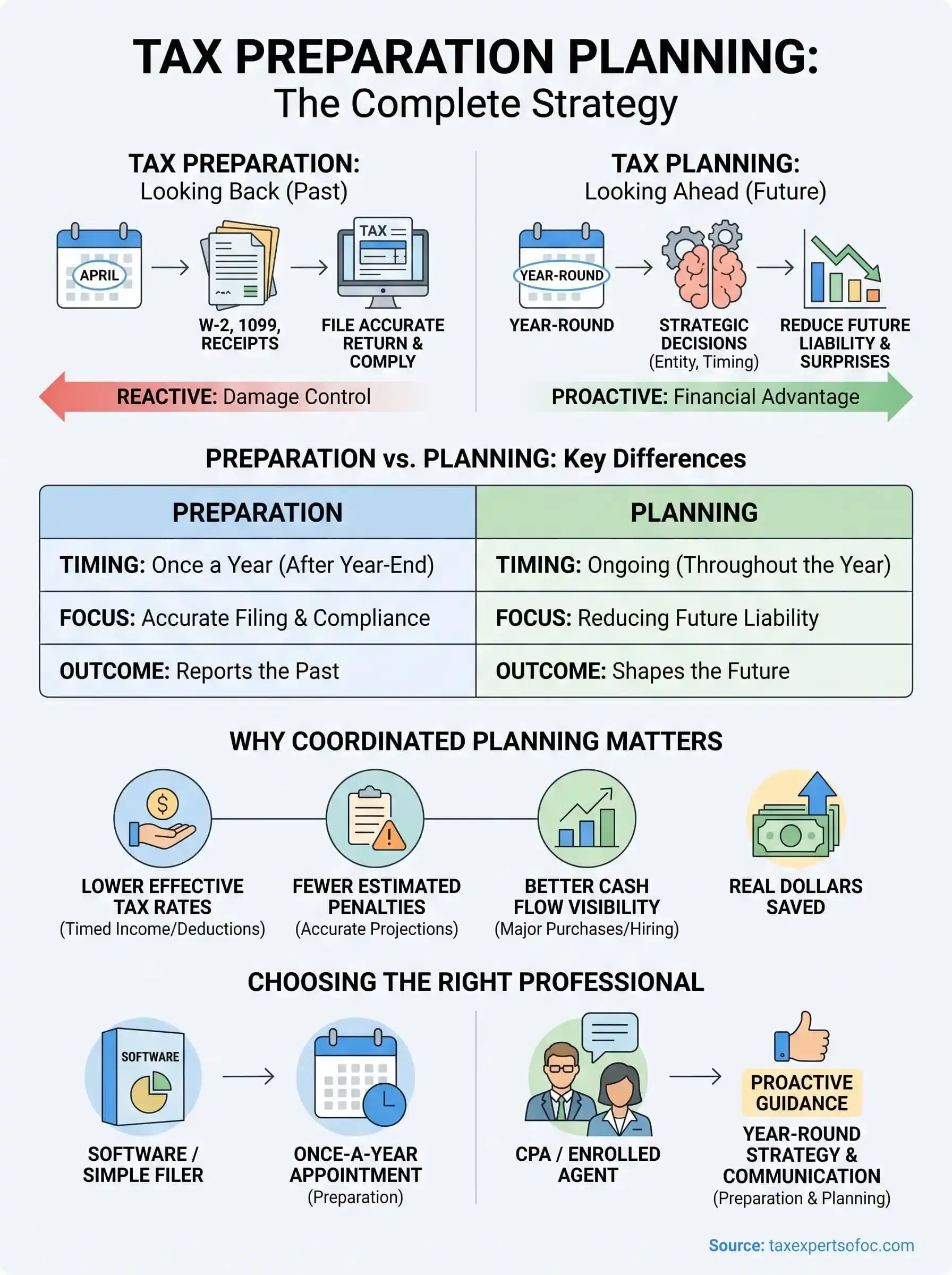
People often use these terms interchangeably, but tax preparation and tax planning solve different problems, and the key differences between tax preparation and tax planning are worth understanding. Preparation is compliance work: gathering W-2s, 1099s, and receipts, then filing an accurate return that matches what already happened. Planning is strategy work: deciding, before the year ends, how to structure income, expenses, and investments so the eventual return looks better.
Timing is the clearest way to tell them apart. A preparer asks what happened last year. A planner asks what should happen next quarter, next purchase, or next hire. That distinction matters because effective tax planning strategies only work if you act before deadlines pass, not after your documents land on someone's desk in March.
Preparation reports the past. Planning shapes the future.
Here's a quick side-by-side:
| Aspect | Tax Preparation | Tax Planning |
|---|---|---|
| Timing | Once a year, after year-end | Ongoing, throughout the year |
| Focus | Accurate filing and compliance | Reducing future liability |
| Typical work | Forms, deductions claimed, submission | Entity structure, timing, projections |
Both matter, but neither replaces the other.
How to build a year-round tax planning strategy
Good planning isn't a once-a-year meeting in December. It's a rhythm of check-ins tied to real financial events, not the calendar. Building a tax strategy means reviewing your numbers at set intervals and adjusting before deadlines close, not after, which is exactly what year-round tax planning tips are designed to do.
Quarterly check-ins that actually matter
Here's a simple cadence that works for most individuals and small business owners:
- Q1: Review last year's return for missed deductions and set this year's baseline
- Q2: Project income and adjust quarterly tax payments for the self-employed if you work for yourself
- Q3: Revisit retirement contributions, entity structure, and major purchases
- Q4: Finalize year-end moves like charitable giving, equipment purchases, or income deferral
A tax plan reviewed once a year isn't a plan, it's a guess.
Connecting planning to life events
Marriage, a new business, a home sale, or a job change all shift your tax picture instantly. Waiting until filing season to address them means the window for strategic tax planning has already closed. Notify your tax professional as soon as these events happen, not months later. Ongoing communication, paired with the quarterly rhythm above, is what separates a real strategy from a filing appointment you happen to schedule every spring.
Common tax planning strategies worth knowing
Deductions and credits only get you so far if you never look at the bigger levers available to you. The tax planning strategies for individuals that actually move the needle usually involve timing, structure, or account selection rather than chasing another receipt. Retirement accounts are the easiest starting point: maxing out a 401(k), SEP IRA, or Solo 401(k) lowers taxable income today while building your future nest egg.
Entity structure is the next big one. A sole proprietor paying self-employment tax on every dollar of profit might save thousands by electing S-corp status once income crosses a certain threshold, so it pays to compare S corp vs LLC taxes before you decide. Depreciation and Section 179 deductions let business owners write off equipment purchases immediately instead of spreading them over years, which changes when you buy, not just what you buy.
The right entity structure can save more than any single deduction ever will.
Other strategies worth reviewing every year include:
- Harvesting capital losses to offset gains
- Bunching charitable donations into a single tax year
- Using Health Savings Accounts for triple tax advantages
- Timing income and expenses around bracket thresholds
None of these work as one-time fixes. They require ongoing tax planning built into your financial calendar, not a scramble in December.
How to choose the right tax professional
Not every preparer offers real planning, and that gap matters more than most people realize when you hire a tax preparer. Software can file a return, but it can't tell you when to restructure your business or flag a deduction you're about to miss. Look for a CPA or Enrolled Agent who asks about your goals, not just your documents from last year, since that question separates a filer from a strategist.
If your tax professional only talks to you once a year, you're paying for preparation, not planning.
A few things worth checking before you commit:
- Do they offer a free consultation to assess your situation before you pay anything?
- If the IRS ever sends a notice, can a CPA represent you before the IRS on your behalf?
- Do they handle both filing services and ongoing strategy, or only one?
- Are they upfront about pricing before work begins?
Firms like Tax Experts of OC build their model around this combination, pairing licensed professionals with year-round communication instead of a single spring appointment. That structure is what makes choosing a tax professional worth the extra scrutiny.
Bringing planning and preparation together
Tax preparation and tax planning aren't competing tasks, they're two halves of the same job. Preparation gets your past year filed accurately. Planning shapes what next year's return looks like before it's too late to change anything. Treat them as one continuous process, and you stop reacting to tax bills and start controlling them.
Skipping the planning half is the single biggest reason taxpayers overpay year after year. Coordinated tax preparation planning means someone is watching your numbers in June, not just in April, catching the entity change, the retirement contribution, or the estimated payment adjustment before the deadline passes.
If you've been doing taxes the reactive way, this is the year to stop. Book the free consultation and get CPA-led tax planning services in Orange County looking at your full picture, not just last year's forms.