

If you own even one rental property, you already know the paperwork adds up fast. Mortgage statements, repair invoices, tenant deposits, and property tax bills all pile into a spreadsheet that never quite balances. Bookkeeping for real estate investors isn't the same as bookkeeping for a regular small business, and treating it that way is how landlords end up missing deductions or scrambling at tax time.
This guide walks you through setting up your books correctly from day one, whether you own a single duplex or manage a growing portfolio of rentals. You'll learn how to separate income and expenses by property, track depreciation, handle security deposits properly, and choose the right accounting method for your situation. We'll also cover the software and account structures that make monthly reconciliation painless instead of a monthly headache.
By the end, you'll have a clear, repeatable system you can run yourself or hand off to a professional. And if the numbers get complicated, especially with multiple entities or out-of-state properties, our CPAs and Enrolled Agents at Tax Experts of OC handle real estate bookkeeping and tax planning for investors nationwide, so you're never guessing at tax season.
Why bookkeeping matters for real estate investors
Rental property income looks simple until you try to file taxes on it. The IRS treats real estate differently than a typical business, with rules around depreciation, passive activity losses, and repair versus improvement classifications that only make sense if your records are clean from month one. Sloppy books don't just cost you time, they cost you money in missed deductions and, in the worst cases, penalties when the IRS questions a return that doesn't match your bank statements.
Deductions disappear without documentation
Every rental property generates dozens of deductible expenses: mortgage interest, property management fees, HOA dues, landscaping, insurance, travel to inspect the property, and even a portion of your home office if you self-manage. Without a system to capture these as they happen, most investors reconstruct expenses from memory at tax time and leave real money on the table. According to the IRS guidance on rental property expenses, you can deduct "ordinary and necessary" costs of managing and maintaining a rental, but you need records that substantiate each claim if you're ever asked to prove it.
Clean books turn tax season from a scramble into a five-minute export.
Depreciation is the deduction most investors get wrong
Depreciation shelters a big chunk of rental income from taxes, but only if you track the property's basis, improvements, and depreciable life correctly from the day you close. Mixing this into a general ledger with your personal accounts makes it nearly impossible to calculate accurately, and errors here often trigger amended returns or IRS correspondence. The IRS Publication 946 on depreciation spells out the recovery periods and methods, but applying them correctly requires bookkeeping that isolates each property's basis from the start.
Audits favor the prepared
Real estate investors face more IRS scrutiny than the average W-2 filer, especially once you claim passive losses or the real estate professional status. Auditors ask for bank statements, receipts, and mileage logs going back years. Investors who keep monthly books with supporting documentation close these audits quickly. Those who don't often end up owing back taxes, interest, and penalties simply because they can't produce proof of expenses they legitimately incurred.
Portfolio decisions depend on accurate numbers
Good bookkeeping isn't only about the IRS. It's how you decide whether a property is actually profitable, whether to refinance, or whether it's time to sell. Here's what accurate, property-level books typically reveal that a single combined bank account never will:
| Metric tracked | Why it matters |
|---|---|
| Net operating income per property | Shows which units actually pay for themselves |
| Cash-on-cash return | Compares performance across your whole portfolio |
| Maintenance costs over time | Flags properties draining cash before they become emergencies |
| Depreciation schedule | Confirms you're claiming the full deduction you're entitled to |
| Security deposit liability | Keeps tenant funds separate from operating cash you can spend |
Few landlords calculate these numbers because their books aren't structured to produce them. Getting the foundation right, which is what the rest of this guide covers, means you can pull any of these figures in minutes instead of rebuilding them from scratch every time you need a decision made.
Step 1. Separate your personal and business finances
Nothing sabotages bookkeeping for real estate investors faster than a shared bank account. If you pay a plumber from the same checking account you use for groceries, you've already made your books unreliable before you've entered a single transaction. The fix costs nothing but a little discipline: give every property, or at minimum every legal entity, its own dedicated accounts from day one.
Open dedicated bank accounts for every property or entity
Start with a checking account for rent deposits and operating expenses, and a separate savings account to hold security deposits, since many states legally require you to keep tenant funds apart from cash you can spend. If you own properties under an LLC, this separation also protects your liability shield; commingling funds is one of the fastest ways courts pierce that protection. A simple setup looks like this:

- One operating checking account per LLC or per property if you self-manage a handful of units
- One trust or savings account exclusively for security deposits
- One reserve account funded monthly for capital expenses like roofs and HVAC replacements
Get a business credit card before you swipe your personal one
Grab a dedicated credit card for the property before you buy your first box of nails. Every swipe becomes a line item you can categorize later, and most card issuers export transactions directly into accounting software, cutting your manual data entry in half. Reward points on a card used strictly for repairs and supplies add up fast too, so you're not leaving cash back on the table by charging expenses to a personal card out of habit.
Why mixing funds destroys your audit trail
However tempting it feels to use whatever account has the balance, mixing funds forces you to reconstruct months of transactions by memory when the IRS or a lender asks for documentation. Once personal and rental money sit in the same account, you lose the ability to prove which expenses were ordinary and necessary for the property, which is the exact language the IRS uses to test deductions.
Separate accounts aren't a nicety, they're the paper trail that keeps your deductions and your LLC protection intact.
Set this up before you close on your next property, not after your first tax return raises questions.
Step 2. Choose your accounting method: cash vs. accrual
Once your accounts are separate, you need to decide how you'll actually record transactions. Most real estate investors default to cash basis accounting without realizing there's a choice, but picking the wrong method can distort how profitable a property looks on paper and complicate a future sale or refinance.
Cash basis is simpler for most landlords
Cash accounting records income when rent hits your bank account and expenses when you actually pay them. Small investors with a handful of doors almost always prefer this method because it mirrors your actual cash flow and requires far less bookkeeping overhead. If a tenant pays January's rent in December, cash basis books show that income in December, period. The IRS allows most rental property owners to use cash basis unless you're operating as a larger business entity, and details are outlined in IRS Publication 538 on accounting periods and methods.
Accrual basis matches income to the period it's earned
Accrual accounting records income when it's earned and expenses when they're incurred, regardless of when cash actually changes hands. This method gives a more accurate picture of a property's true performance over time, which matters if you're syndicating deals, reporting to investors, or running multiple entities that need consistent financial statements. Larger portfolios and anyone raising capital from partners should lean toward accrual, since lenders and investors expect financials that reflect obligations, not just bank balances.
| Factor | Cash Basis | Accrual Basis |
|---|---|---|
| Best for | 1-5 properties, self-managed | Syndications, multiple entities, investor reporting |
| Complexity | Low | Higher, needs more disciplined tracking |
| IRS eligibility | Most individual landlords | Required above certain revenue thresholds |
| Accuracy of profitability | Reflects cash flow, not always true performance | Matches income and expenses to the correct period |
Pick one method and stay consistent
Switching methods midyear creates a mess that even a good accountant struggles to untangle, so decide early and stick with it across every property you own. The IRS generally requires you to file Form 3115 if you want to change your accounting method after you've already filed a return using one, so this isn't a decision to revisit casually.
Choose cash or accrual once, then apply it consistently across every property you own.
Most single-property owners never need to touch accrual accounting, but knowing the difference now saves you a costly restructure later if your portfolio grows.
Step 3. Set up a chart of accounts and bookkeeping software
Your chart of accounts is the skeleton of your books, and a generic small-business template won't cut it for rental property accounting. Real estate needs categories that separate rent roll income from late fees, and expenses that split routine repairs from capital improvements, because the IRS treats those two very differently at tax time.
Build a chart of accounts around real estate categories
Start with a structure that mirrors Schedule E if you're an individual investor, since that's the form your tax preparer will eventually fill out. A workable starting chart of accounts looks like this:

Income
  4000 Rental Income
  4010 Late Fees
  4020 Application Fees

Expenses
  5000 Mortgage Interest
  5010 Property Taxes
  5020 Insurance
  5030 Repairs and Maintenance
  5040 Capital Improvements
  5050 Property Management Fees
  5060 Utilities
  5070 HOA Dues
  5080 Legal and Professional Fees

Liabilities
  2000 Security Deposits Held
Assign each property its own class or tag inside this structure rather than building a separate chart of accounts for every address, which keeps reporting consistent as your portfolio grows.
Choose software built for landlords, not just small business owners
Generic bookkeeping software works, but platforms designed specifically for real estate investors save hours by letting you tag transactions by property and generate Schedule E-ready reports automatically. Look for software that supports bank feed imports, property-level profit and loss statements, and a mobile app for photographing receipts on the spot, since most missed deductions come from receipts that never make it into the system.
A chart of accounts built for real estate turns tax prep into a report you export, not a project you dread.
Match the setup to your entity structure
However you organize ownership, whether everything sits under one LLC or you've split properties across several entities, your chart of accounts and software setup should mirror that structure exactly. Mismatched entity and account structures are one of the most common reasons investors need a bookkeeping cleanup before their CPA can even start their return.
Step 4. Track income and expenses by property
Once your chart of accounts exists, the real work starts: tagging every transaction to the specific property it belongs to. Property-level tracking is what separates real estate bookkeeping from generic small-business bookkeeping, and skipping it means you can never answer the simplest question an investor asks: is this property actually making money?
Tag every transaction as it happens
Don't batch this work for month-end. Categorize rent deposits, repair invoices, and utility bills as they hit your bank feed, using the class or location tag you set up for each address. A rule of thumb that keeps investors consistent:
- Record rent the day it clears, not when it's due
- Log repair invoices with the vendor name and property tag before you pay them
- Photograph every receipt immediately and attach it to the transaction in your software
- Split shared expenses, like a handyman who worked on two properties in one visit, proportionally between the properties involved
A transaction without a property tag is a deduction you'll have to reconstruct from memory later.
Separate repairs from capital improvements
The IRS draws a hard line between a repair, which you deduct in full the year you pay it, and a capital improvement, which you depreciate over years. Fixing a leaking pipe is a repair. Replacing the entire plumbing system is an improvement. Get this classification wrong and you either overstate your deductions or leave depreciation on the table. The IRS guidance on improvements versus repairs lays out the distinction, but the practical fix is building the habit of asking "did this restore the property or upgrade it" every time you code an expense.
Track mileage and time if you self-manage
If you drive to inspect units, meet contractors, or handle tenant issues yourself, log the mileage. The standard mileage deduction adds up fast across a portfolio, but only if you keep a contemporaneous log with dates, destinations, and purpose, not a rough estimate typed in April. A simple spreadsheet or a mileage-tracking app synced to your bookkeeping software works fine, as long as you update it the same week the trip happens.
Reconcile property-level reports monthly
Run a profit and loss statement for each property every month, not just at tax time. This habit surfaces problems, like a maintenance bill posted to the wrong address, while they're still easy to fix instead of buried under a year of transactions.
Step 5. Reconcile accounts and generate financial reports
Bookkeeping isn't finished until you've confirmed your records match reality. Reconciliation means comparing every transaction in your books against your bank and credit card statements, catching duplicate entries, missed deposits, or fees your software never saw. Skip this step and small errors compound month after month until your year-end numbers don't resemble your actual cash flow at all.
Reconcile every account monthly, not quarterly
Set a recurring date, the first week of each month works well, to pull statements for every checking, savings, and credit card account tied to your properties. Match each line item to a transaction in your software and flag anything that doesn't line up right away, while you can still remember what it was. Waiting until tax season to reconcile a full year of activity turns a fifteen-minute monthly task into a multi-day forensic project.
A reconciled account is proof your books are true, not just tidy.
Generate the reports that actually run your portfolio
Once accounts are reconciled, pull reports that tell you something useful, not just numbers for the sake of having them. Effective bookkeeping for real estate investors produces these on a schedule, so you're never starting from zero when a lender or your CPA asks for documentation:

| Report | Frequency | What it tells you |
|---|---|---|
| Profit and loss by property | Monthly | Which units are profitable, which are draining cash |
| Balance sheet | Monthly | Equity, liabilities, and security deposit balances |
| Cash flow statement | Monthly | Whether operations actually generate spendable cash |
| Rent roll | Monthly | Occupancy, delinquencies, and upcoming lease expirations |
| Depreciation schedule | Annually | Confirms you're claiming the full allowable deduction |
Watch for what reconciliation reveals
Discrepancies rarely fix themselves, and a mismatch usually points to something worth investigating, like a bounced rent payment, a double-billed vendor invoice, or a security deposit accidentally spent as operating cash. Investors who reconcile monthly catch these issues within weeks. Those who wait until April often discover the problem only after filing a return that no longer matches the bank records the IRS can pull independently.
Step 6. Know when to bring in a professional
Even the most disciplined DIY bookkeeper hits a point where the spreadsheet stops being enough. Maybe you closed on a third property this year, refinanced two others, or formed a new LLC to hold a partnership deal. Bookkeeping for real estate investors gets exponentially harder with every entity, state, and partner you add, and trying to keep up with all of it solo usually means something slips through the cracks right before tax season.
Signs your books have outgrown you
A few warning signs mean it's time to call in a CPA or Enrolled Agent instead of muscling through another quarter alone:
- You own properties in more than one state and now face multi-state filing requirements
- You've formed a new LLC, partnership, or S-corp and aren't sure how to structure intercompany transactions
- You received an IRS notice questioning depreciation, passive losses, or a Schedule E entry
- Monthly reconciliation now takes hours instead of minutes because transaction volume has grown
- You're preparing to sell a property and need accurate basis and depreciation recapture numbers before you list it
The moment your portfolio crosses state lines or adds an entity, DIY bookkeeping stops scaling.
What a real estate-focused firm actually does for you
A generalist bookkeeper can enter transactions, but a firm that understands real estate tax planning catches things a template never will, like structuring a cost segregation study to accelerate depreciation, or timing a 1031 exchange so you don't trigger an unexpected tax bill. At Tax Experts of OC, our CPAs and Enrolled Agents handle exactly this kind of work for investors nationwide, reviewing your books, cleaning up misclassified transactions, and building a chart of accounts that holds up under audit scrutiny.
Weigh the cost against the risk
Hiring a professional costs money every month, but so does a missed deduction, a misclassified capital improvement, or an IRS notice that drags out for a year. Run the math on what your time is worth against what a cleanup or an amended return costs, and the decision usually makes itself once your portfolio passes two or three properties. Waiting until the IRS sends a letter is the most expensive time to make the call.
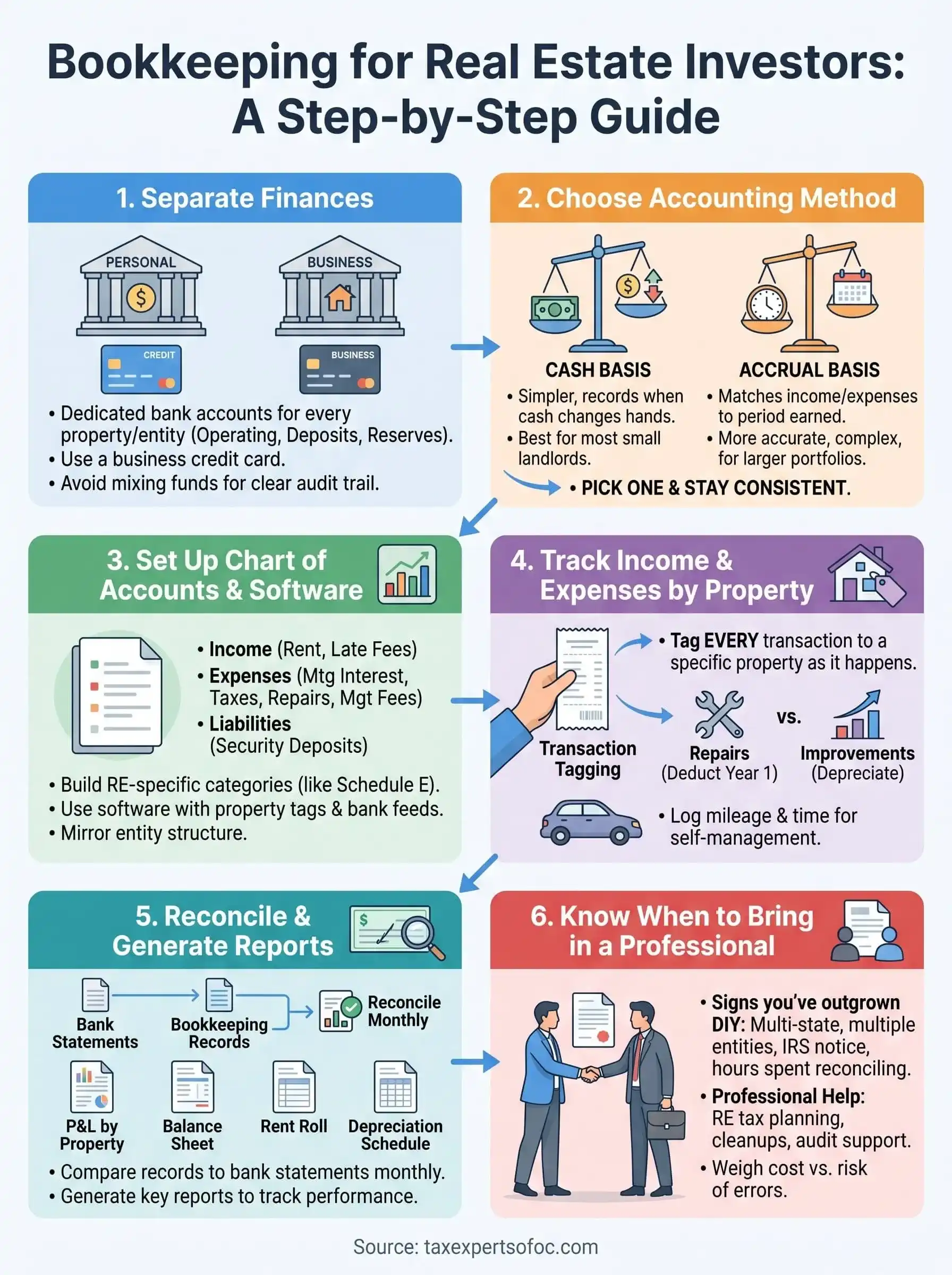
Building bookkeeping habits that scale with your portfolio
One rental property or twenty, the fundamentals never change: separate your accounts, pick an accounting method and stick with it, tag every transaction to a property, reconcile monthly, and read your reports instead of just filing them away. Bookkeeping for real estate investors rewards consistency far more than it rewards fancy software or a perfect spreadsheet template. Build the habit now, while your portfolio is small enough to fix mistakes cheaply, and you'll never face the scramble that catches so many landlords every April.
Growth exposes gaps in a system that worked fine for one duplex but buckles under three properties and an LLC. Watching for those warning signs, and acting on them before the IRS does, is what separates investors who keep more of their profit from those who lose it to penalties and missed deductions. If your books already feel past the point of a quick cleanup, schedule a free consultation with Tax Experts of OC and let a CPA or Enrolled Agent take it from here.