

You run your S corporation, the cash sits in the business account, and your personal tax bill is due. It is tempting to write one check from the company and move on. But can my S-corp pay my personal taxes without creating a bigger problem? The answer matters, because the wrong move can turn a routine payment into an IRS issue.
Short answer: not directly, not as a business expense. Your personal income tax is your debt, not the corporation's. If the S corp pays it and books it as an expense, the IRS can reclassify that payment as wages or a distribution. What you can do is pay yourself through salary or distributions, then use that money to cover your own taxes, including quarterly estimates. You can also have the company withhold tax from your W-2 pay.
Below, we explain how each method works, how to record it correctly, and the mistakes we see most often when owners mix business and personal funds. At Tax Experts of OC, our CPA and Enrolled Agent help S-corp owners get this right before it becomes a notice.
Why paying personal taxes from your S-corp matters
Your profit is taxed on your return, not the company's
An S corporation is a pass-through entity. The company generally pays no federal income tax itself. Instead, profit flows through to your Form 1040 on a Schedule K-1, and you owe tax on your share whether or not the company ever sent you the cash. If the business earned $150,000 and you left $60,000 of it in the account, you still report the full $150,000.
That gap is exactly why owners ask, can my s corp pay my personal taxes? The money sits in the business, but the bill lands on your personal return. The IRS treats you and the corporation as two separate taxpayers, so any dollar moving from one to the other needs a label that matches what it really is.
What the IRS does with a mislabeled payment
Suppose the company sends a check to the IRS for your 1040 balance and the bookkeeper codes it as "taxes" or "office expense." That deduction does not hold up. On review, the IRS can recharacterize the payment as wages or as a distribution, and each label carries its own cost, as the table shows.

| How the payment was booked | What the IRS may do | What it costs you |
|---|---|---|
| Business expense | Disallow the deduction and treat it as pay or a distribution | Higher K-1 income, plus possible payroll tax |
| Wages with no payroll reporting | Reclassify and assess unpaid payroll tax | Up to 15.3% combined Social Security and Medicare tax (the Social Security part stops at the annual wage base), plus penalties |
| Distribution larger than your basis | Tax the excess as capital gain | Extra tax you did not plan for |
| Distribution paid to you but not other shareholders | Question the one-class-of-stock rule | Risk to S status in serious cases |
Every dollar that pays your personal taxes must first be either wages or a distribution, never a company expense.
That single rule is the core of this whole topic. The rest of the article is about applying it cleanly.
Where the real costs show up
The tax itself is rarely the worst part. Penalties and interest usually are. An understated return can trigger a 20% accuracy-related penalty under the Internal Revenue Code, and unpaid payroll tax draws its own failure-to-deposit penalties. You can read how the IRS describes S corporation rules on its S corporations page.
Messy books also make every later question harder. If personal tax payments are buried in expense accounts, an examiner has to question your reasonable compensation and your basis, not just one check. Clean records shrink that conversation to a few minutes. We see owners spend months untangling a single mislabeled year.
One legitimate exception: pass-through entity tax
Some states let an S corporation elect to pay state income tax at the entity level. This is often called a pass-through entity tax, or PTET. Because the company pays it, the payment can be deducted at the entity level, which may soften the federal cap on state and local tax deductions for owners.
This is not the same as the company paying your 1040. It is a formal state election with its own rules, deadlines, and credits that flow back to you. If your state offers it, ask your CPA whether it fits before you assume it does.
How to pay your personal taxes through your S-corp
Think of the S corp as a funding source, not a payer. So when you ask, can my s-corp pay my personal taxes, the practical answer is that the company pays you first, and then you pay the IRS. Three clean routes exist, and most owners use a mix of them.
The three approved routes
Each route gives the money a label the IRS recognizes. The table shows what each one does and which part of your tax bill it covers.
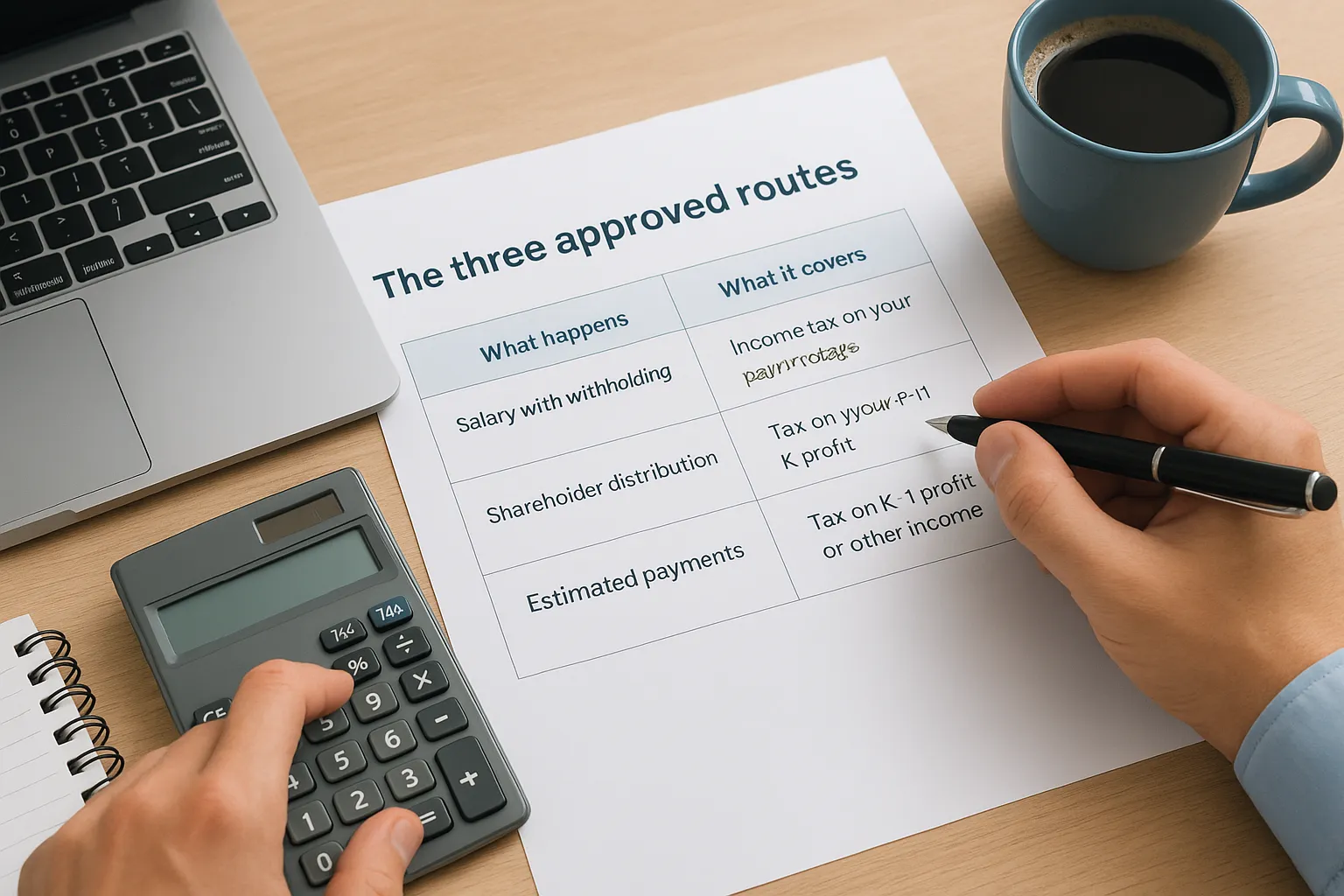
| Route | What happens | What it covers |
|---|---|---|
| Salary with withholding | The company withholds federal income tax from your W-2 paycheck and deposits it | Income tax on your wages, plus payroll tax |
| Shareholder distribution | The company pays you cash from profit, and you decide where it goes | Tax on your K-1 profit |
| Estimated payments | You send quarterly payments from your personal account, funded by distributions or salary | Tax on K-1 profit and other income not withheld |
Withholding happens inside the payroll system, so the IRS sees it as tax you paid through your employer. Distributions and estimates happen on your side of the line, which is why they work for the profit that never shows up on a paycheck.
How to decide which one to use
Start with salary. The IRS expects an owner who works in the business to take reasonable compensation before taking distributions. That paycheck is also the easiest place to cover a chunk of your income tax, because you can raise your Form W-4 withholding and let payroll do the depositing.
The S corp funds you, and you fund the IRS.
Then handle the K-1 profit that withholding does not reach. Move cash out as a distribution, keep it in a personal account earmarked for taxes, and send quarterly estimated payments on the four due dates each year. The IRS explains the mechanics on its Form 1040-ES page.
One caution applies to every route. Distributions must follow ownership percentages, so a payment to one shareholder needs matching payments to the others. Skip that, and you invite questions about your one-class-of-stock status. The next sections walk through each route step by step.
Paying through salary and payroll withholding
Salary is the cleanest answer when you wonder, can my s-corp pay my personal taxes, because the company never pays your bill. It withholds tax from your W-2 paycheck and deposits it with the IRS on your behalf. The IRS sees that money as tax you paid through an employer, so there is nothing to recharacterize.
How withholding works for an owner-employee
Every paycheck has two layers. The first is federal income tax withholding, which is credited against your Form 1040. The second is FICA, 7.65% from you and 7.65% from the company, which funds Social Security and Medicare. The payroll system deposits both and reports them on Form 941.
Withholding also has a timing advantage. The IRS generally treats withheld tax as paid evenly across the year, no matter when it came out of your check. If you realize in November that you are behind, a bigger withholding amount in your last paychecks can erase an underpayment penalty that a late estimated payment would not.
Withholding is treated as paid evenly through the year, even when you increase it late.
Steps to set it up
You control the amount through your Form W-4. Here is the process we walk S-corp owners through:
- Estimate your total tax for the year, including salary, K-1 profit, and any other income.
- Subtract what has already been withheld or paid in estimates.
- Fill out a new Form W-4 and enter the shortfall divided by remaining pay periods on Step 4(c), extra withholding.
- Give it to your payroll provider, so deposits and Form 941 filings stay on schedule.
- Check year-to-date figures each quarter and adjust.
Aim to owe nothing more than the lesser of 90% of this year's tax or 100% of last year's (110% if your adjusted gross income was over $150,000). That is the usual safe harbor against underpayment penalties.
Limits to know
Salary cannot cover everything. Extra wages cost you payroll tax of up to 15.3%, and your pay must stay within reasonable compensation for the work you do. Raising salary just to fund withholding can backfire. Use the W-4 as a dial on a defensible salary, not as a reason to inflate it.
Withholding also cannot reach your K-1 profit directly. Tax on that profit usually needs distributions and estimated payments, which the next sections cover. And never send the IRS a check from the company for your personal tax outside payroll. Withholding only counts when it runs through payroll, with a pay stub and a W-2 to match.
Paying through shareholder distributions and basis
Distributions cover the part of your bill that salary cannot reach, which is the profit on your K-1. The company sends you cash, and you pay the IRS from your personal account. So can my s-corp pay my personal taxes this way? The cash comes from the company, but the payment to the IRS is yours. Whether that cash is tax-free depends on your basis.
Why distributions are usually tax-free
You already paid tax on the profit when it hit your K-1, so the IRS generally does not tax the cash again. A distribution is tax-free up to your stock basis. Basis is a running balance that you track every year, and it moves like this:
| Basis goes up with | Basis goes down with |
|---|---|
| Money you contribute | Distributions you take |
| Your share of business income | Your share of losses and deductions |
| Loans you make to the company (debt basis) | Nondeductible expenses |
Basis can never drop below zero. Loans you personally make to the company create separate debt basis, which helps with losses but not with distributions.
What happens when distributions exceed basis
Take out more than your basis and the excess is taxed as capital gain. Say your basis is $40,000 and you pull out $55,000 to cover taxes. You owe tax on the extra $15,000. This surprises owners whose company has lost money, took large distributions in earlier years, or carries little contributed capital.
A distribution is tax-free only while it stays within your basis.
The IRS wants this tracked on Form 7203, which you generally file in any year you take a distribution or claim a loss. Start the schedule early. Rebuilding basis from old returns is slow and expensive.
How to use distributions to fund your taxes
Distributions work best as a planned transfer, not a last-minute check. Here is the sequence we use with clients:
- Pay yourself reasonable compensation through payroll first.
- Check your basis balance before moving cash.
- Pay the same per-share amount to every shareholder, so the distribution stays pro rata.
- Deposit the money in your personal account and label it for taxes.
- Send the payment to the IRS from there, not from the company.
Some operating agreements include a tax distribution clause that sets a regular percentage of profit for this purpose. If yours does not, ask your CPA to add one. It keeps the timing and the amounts consistent, and it keeps every shareholder on equal footing.
Using the S-corp to make estimated tax payments
Estimated payments are where the question "can my s corp pay my personal taxes" comes up most often. Nobody withholds tax from your K-1 profit, so you have to send in estimated tax payments yourself during the year. The company supplies the cash, but you make the payment from your personal account. That keeps the money trail honest and the IRS focused on the right taxpayer.
Who needs to pay and when
Any owner who expects to owe $1,000 or more after withholding and credits generally has to pay estimates. Most S-corp owners with real profit clear that bar easily. The IRS spreads the year across four due dates, and they are not evenly spaced.
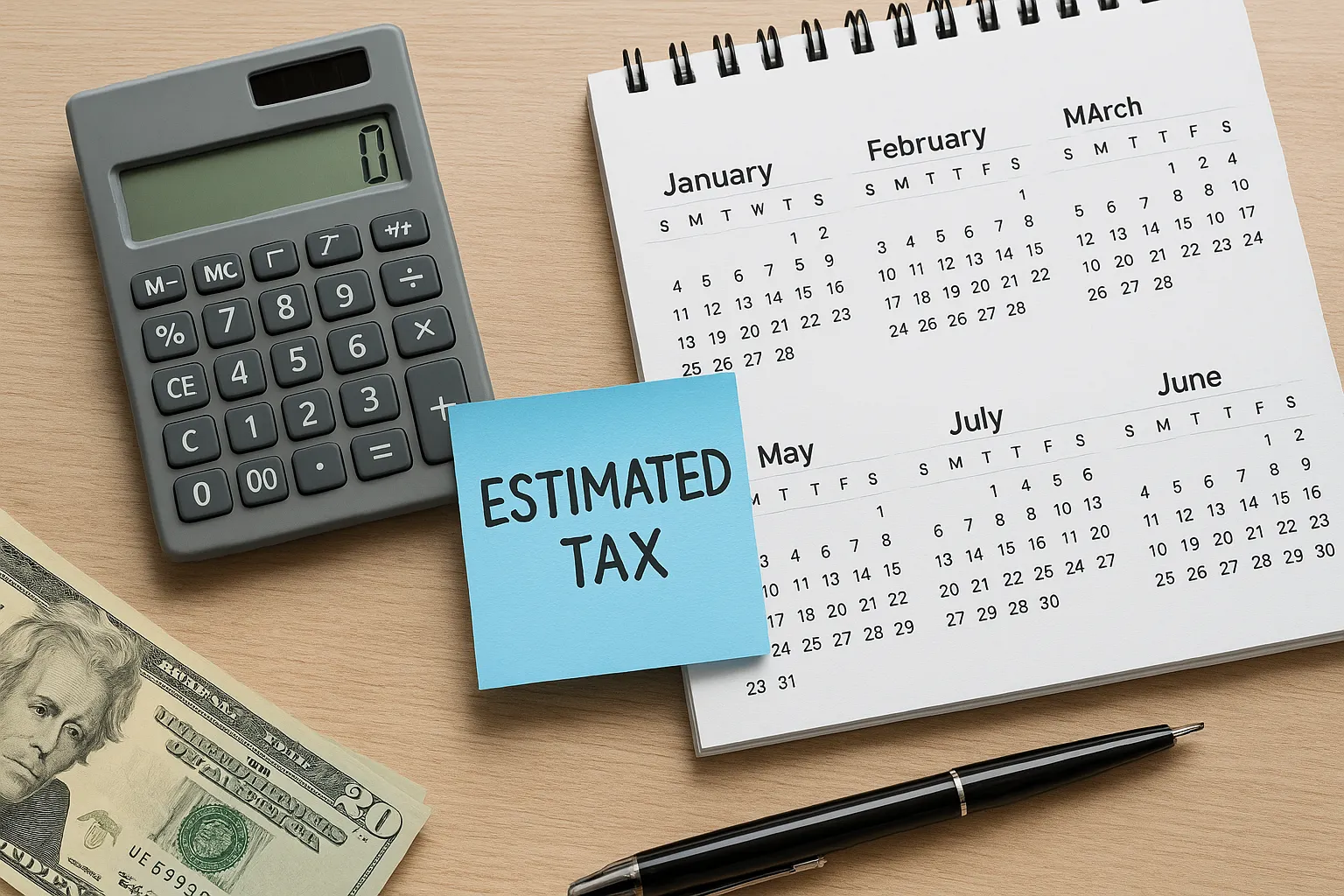
| Payment | Income earned | Due date (2026 tax year) |
|---|---|---|
| Q1 | Jan 1 to Mar 31 | April 15, 2026 |
| Q2 | Apr 1 to May 31 | June 15, 2026 |
| Q3 | Jun 1 to Aug 31 | September 15, 2026 |
| Q4 | Sep 1 to Dec 31 | January 15, 2027 |
The September deadline has already passed, so your next date is January 15, 2027. If you missed one, pay now. The underpayment penalty runs by the day, so a late payment still costs less than no payment.
How to fund and send each payment
Here is the routine we set up for clients:
- Take a pro rata distribution, or run extra salary through payroll, and deposit it in your personal account.
- Calculate the amount with the Form 1040-ES worksheet, or divide your safe harbor figure by four.
- Pay through IRS Direct Pay or your IRS online account, and save the confirmation.
- Make a separate state estimated payment if your state has an income tax.
- Tell your bookkeeper, so the transfer is coded as a distribution or wages.
Estimated taxes are paid by you, from money the S corp already sent you.
Timing matters here. Moving the cash a few days before each due date keeps your personal account from running short, and it gives your bookkeeper a clean paper trail to match.
If the company sends the payment
Should the company ever pay the IRS directly for your estimate, treat it as a distribution. Book it as a distribution to you, and make sure it stays within your basis. Other shareholders must receive matching amounts, or the payment breaks the pro rata rule. For an owner of a single-member S corp that is simple. With partners, it is easier to avoid the issue and route every payment through personal accounts.
Mistakes that turn tax payments into IRS problems
Most S-corp tax trouble does not come from the payment itself. It comes from how the payment was labeled and documented. Owners who ask, can my s corp pay my personal taxes, often find a shortcut that looks harmless and then spend months explaining it. These are the errors we fix most often.
Errors in how you pay
Direct company payments cause the most damage. Paying your 1040 balance from the business account and coding it as an expense invites reclassification. The table shows the common patterns and the repair for each.
| Mistake | Why it becomes a problem | Fix |
|---|---|---|
| Company pays your 1040 and books it as an expense | Deduction disallowed, payment recharacterized | Book it as a distribution or wages |
| Tax paid for you with no payroll reporting | Unreported wages, payroll tax, penalties | Run it through payroll with a W-2 |
| Distribution to you only | Breaks the pro rata rule, risks S status | Pay every shareholder by ownership percentage |
| Distribution beyond basis | Excess taxed as capital gain | Check basis on Form 7203 first |
| Skipping estimates because the company has cash | Underpayment penalty | Pay quarterly from your personal account |
If the label on a payment does not match what it really is, the IRS will relabel it for you.
Errors in what you pay yourself
Low salary is the quiet one. Taking $20,000 in wages from a business that nets $200,000, then pulling the rest as distributions, saves payroll tax. That is exactly why the IRS looks at it. It can reclassify distributions as wages and assess the tax plus penalties. Your reasonable salary for an S corp owner should match what you would pay someone else to do your job.
Undocumented personal spending is the other trap. Paying your mortgage or credit card from the company and calling it a loan, with no note, interest, or repayment schedule, rarely survives review. Treat personal spending as a distribution or a documented loan, and record it that way the day it happens.
A simple safeguard
Before any money moves, run a quick check. If you cannot answer all three questions below, pause the transfer and call your CPA. A ten-minute call costs far less than an amended return, and it keeps your records ready for an exam.
- Is this wages, a distribution, or a documented loan?
- Does my stock basis support it?
- Are the other shareholders receiving their share?
How to record personal tax payments in your books
Clean bookkeeping is what makes the answer to "can my s-corp pay my personal taxes" hold up in an exam. The books must show wages or a distribution, never a tax expense. Set up the accounts once and the payroll bookkeeping coding becomes routine.
The accounts and entries you need
Keep three accounts separate: Shareholder Distributions (equity), Officer Compensation (expense), and Payroll Tax Liabilities. Never route anything personal through a general "Taxes" expense account. The table shows the entry for each situation.
| What happened | Debit | Credit |
|---|---|---|
| Company sends you a distribution to fund taxes | Shareholder Distributions | Cash |
| Payroll runs with income tax withheld | Officer Compensation (gross pay) | Cash (net pay), Payroll Tax Liabilities (withholding) |
| Company deposits the withholding with the IRS | Payroll Tax Liabilities | Cash |
| Company paid your 1040 directly | Shareholder Distributions | Cash |
| Fixing a payment coded as an expense | Shareholder Distributions | Taxes expense |
Employer FICA is a separate company expense. It never counts as your personal tax.
A personal tax payment is never a company expense, it is always wages or a distribution.
Fixing and documenting what already happened
Found a personal payment sitting in an expense account? Post a correcting journal entry instead of deleting the original. The entry in the last table row moves it into distributions and leaves an audit trail. Tell your preparer too, so the year-end return shows it correctly.
Those distributions then appear on Schedule K-1, box 16, code D, and they reduce your basis on Form 7203. If the books and the return disagree, the mismatch is what draws questions. Keep the IRS payment confirmation and a short memo explaining what each transfer was for.
A monthly checklist
A few minutes each month prevents most cleanup. Run through this list when you reconcile:
- Match every transfer to your personal account to a distribution or a payroll run.
- Confirm each shareholder received the same per-share amount.
- Compare year-to-date distributions with your estimated basis.
- Reconcile Payroll Tax Liabilities to your Form 941 deposits.
- Search the expense accounts for your name, the IRS, or your state tax agency.
Worked example: paying a $120,000 profit owner's taxes
Numbers make the rules easier to see. Picture a single-owner S corp that earns $120,000 before paying the owner. You file as single, take the standard deduction, and have no other income. These figures are illustrative, so your own numbers will differ, but the labeling logic is the same for every owner.
Setting up the numbers
Start with reasonable compensation. Your CPA sets your salary at $60,000, which matches what the company would pay someone else to do your job. The company also owes $4,590 in employer FICA (7.65%), which leaves $55,410 of K-1 profit that you owe tax on whether or not you withdraw it. After the standard deduction and the qualified business income deduction, your federal income tax comes to about $14,100.
| Item | Amount | How it is handled |
|---|---|---|
| W-2 salary | $60,000 | Officer Compensation, run through payroll |
| Employer FICA | $4,590 | Company payroll tax expense |
| K-1 profit | $55,410 | Reported on your Form 1040 |
| Estimated federal income tax | About $14,100 | Your personal liability |
| Covered by W-4 withholding | $6,000 | Deposited by payroll |
| Covered by estimated payments | $8,100 | Four payments of $2,025 |
Your own 7.65% FICA share comes out of your paycheck on top of the income tax withholding.
Funding each piece
Withholding comes first. Enter $500 on Form W-4, Step 4(c), for each monthly payroll. Payroll deposits it, and your W-2 shows $6,000 of federal tax withheld. Because the money moved through payroll, there is nothing for the IRS to recharacterize.

Then handle the remaining $8,100. Before each due date, the company sends you a $2,025 distribution. You deposit it in your personal account and pay IRS Direct Pay from there. So can my s-corp pay my personal taxes in this case? It funds them, and you make the payment.
Salary withholding covers part of the bill, distributions fund the rest, and every dollar carries a label.
Checking basis and the books
Basis is the last check. Your K-1 profit of $55,410 raises your stock basis, so $8,100 of distributions sits well within your basis even if you started the year at zero. The other $47,310 of profit can stay in the company or come out later as further distributions.
Your bookkeeper then records each transfer as a debit to Shareholder Distributions and a credit to Cash. The payroll withholding sits in Payroll Tax Liabilities until it is deposited. Nothing touches a tax expense account, and the books match what your Form 1040, Schedule K-1, and Form 7203 will show.
Business expenses an S-corp can pay for you
Some owners who ask, can my s corp pay my personal taxes, really want a smaller tax bill. The legitimate route is to let the company pay real business costs as small business tax deductions. Those deductible expenses shrink your K-1 profit, which shrinks the tax you owe on your own return. The test is that each cost must be ordinary and necessary for the business, a standard the IRS explains in Publication 535.
Expenses that lower your taxable profit
The company can pay these costs directly or reimburse you for them. Each one reduces profit before it reaches your Form 1040, so you pay less tax without moving money to the IRS.
| Expense | How the S corp handles it | Watch for |
|---|---|---|
| Home office | Reimburse under an accountable plan | Written plan and records of space and costs |
| Business vehicle | Reimburse mileage at the IRS rate | A mileage log for every trip |
| Health insurance (owner with more than 2%) | Company pays premiums and adds them to your W-2 wages | You deduct them on Form 1040 |
| Retirement plan | Employer contribution to a SEP or solo 401(k) | Annual limits and plan deadlines |
| Travel and meals | Company pays directly | Receipts and business purpose, meals generally 50% |
| Business tax prep | Company deducts the business share | Your personal 1040 prep is not deductible |
Use an accountable plan for reimbursements
An accountable plan lets the company repay your business costs without treating the money as wages. It only works if you meet three rules:
- The expense has a clear business connection.
- You substantiate it with receipts or logs within a reasonable time.
- You return any advance that exceeds the actual cost.
Put the plan in writing and keep the records. Without them, the IRS can treat reimbursements as taxable pay.
A business expense lowers your tax bill, while a personal expense paid by the company is only wages or a distribution.
What the company cannot pay
Personal costs stay personal, even when the company has the cash. Your income tax, mortgage, groceries, and family vacations are not business expenses. If the company pays one, book it as a distribution or wages and keep it within your basis. Better yet, pay it from your own account after a properly labeled transfer, so your books match what really happened.
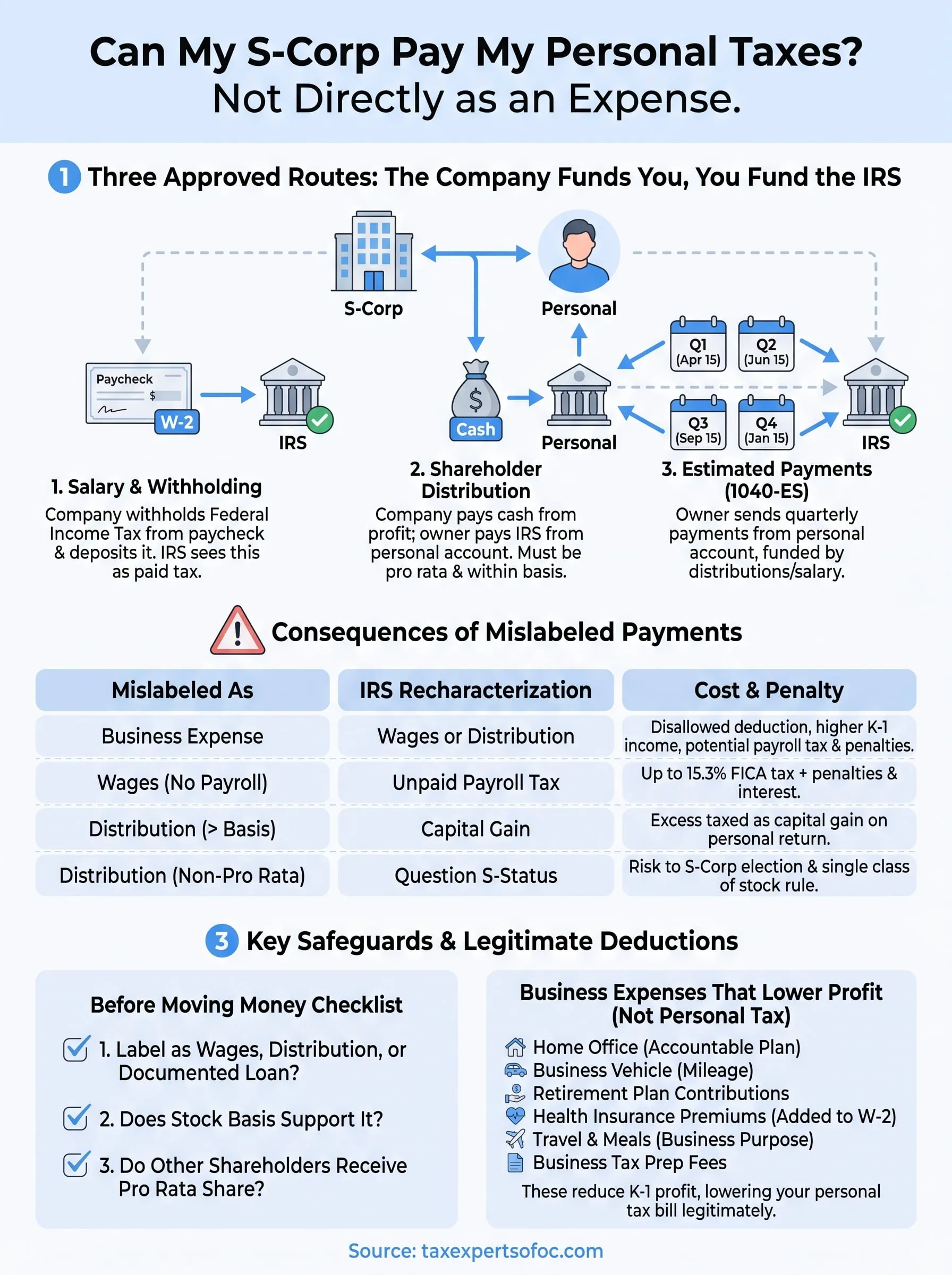
Keeping your S-corp and personal taxes in order
So, can my S-corp pay my personal taxes? Not as a business expense. The company funds you, and you pay the IRS. Every dollar must be labeled as wages or a distribution, and each route has its own rules: reasonable compensation for salary, basis and pro rata payments for distributions, and quarterly estimates from your personal account.
Good habits keep this simple. Move money on a schedule, check basis before you take cash, and record each transfer the day it happens. Let the company pay real business costs through an accountable plan, and leave personal bills to your own account.
If your books already mix the two, or an IRS notice has landed, get help before it grows. Talk with the CPA and Enrolled Agent at Tax Experts of OC and use the free 30-minute consultation to set up your S-corp payments the right way.