

You owe the IRS money, you're getting letters, and now you're staring at ads promising to settle your debt for pennies on the dollar. Before you hand over a credit card number, you need real numbers. How much do tax resolution services cost varies a lot depending on who you hire and how messy your situation is, and that range is exactly what trips people up.
Most individual cases run somewhere between $1,500 and $10,000, though a straightforward payment plan negotiation costs far less than a full audit defense with years of unfiled returns behind it. National tax relief companies often quote flat fees upfront without ever reviewing your transcripts, while a local firm with a CPA or Enrolled Agent typically prices based on the actual scope of your case after looking at your IRS file.
In this article, we break down the tax resolution services fees you'll actually encounter, from initial investigation costs to resolution and ongoing compliance work. You'll see what drives the price up, what a fair quote looks like, and how to avoid paying for services you don't need.
Why tax resolution costs vary so much
Complexity, not luck, sets the cost of tax relief services. A taxpayer who owes $8,000 and just needs a payment plan pays far less than someone with $120,000 in back taxes, a wage garnishment, and six years of unfiled returns. The more moving parts in your IRS file, the more hours a licensed professional has to spend resolving them, and hours are what you're actually paying for.
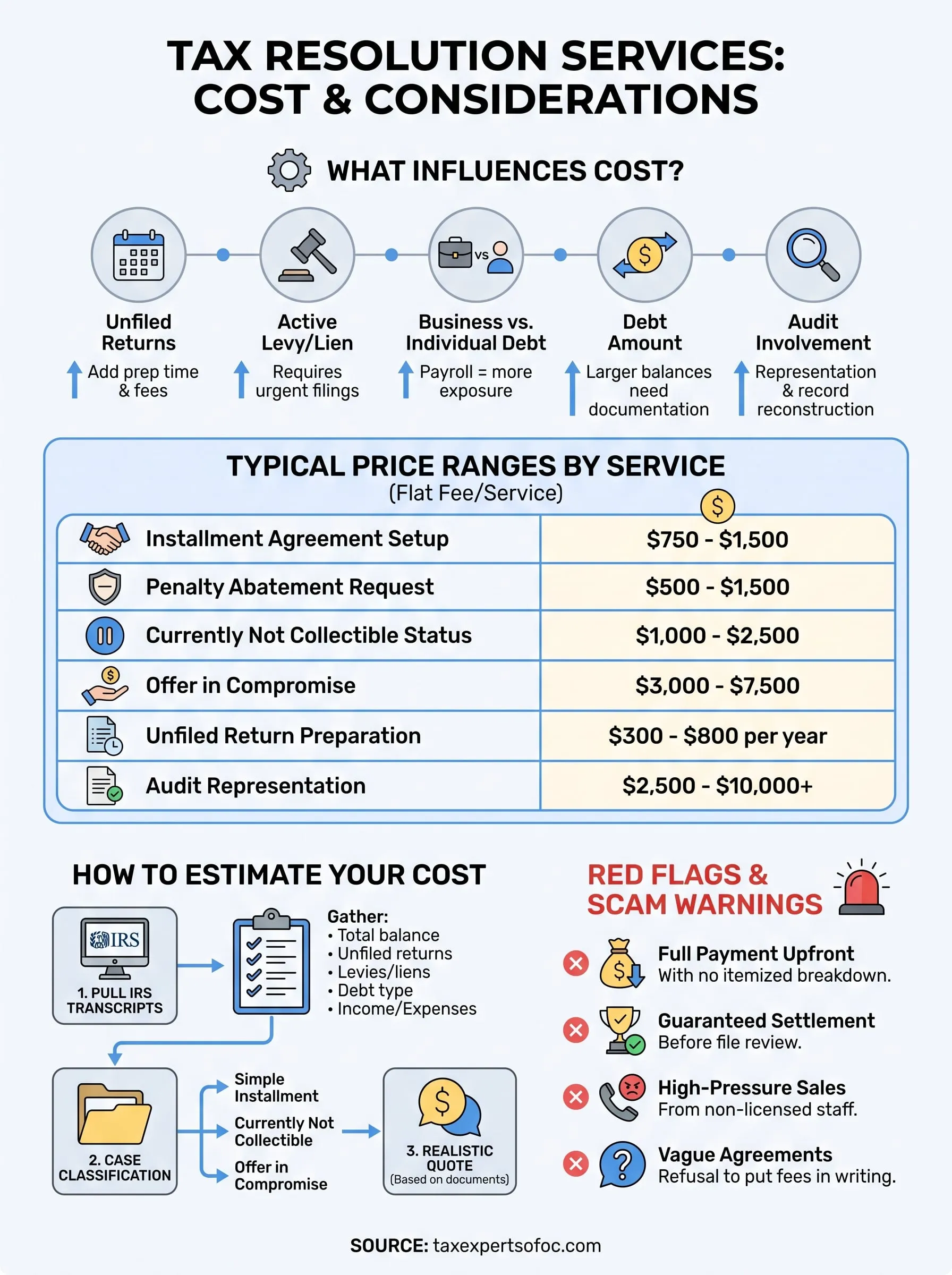
Case complexity drives the price
Several factors push a quote up or down, and you can usually spot them before you ever sign an agreement.
| Factor | Impact on cost |
|---|---|
| Unfiled returns | Each year adds prep time and fees |
| Active levy or lien | Requires urgent, often same-week filings |
| Business vs. individual debt | Payroll tax cases involve more exposure |
| Debt amount | Larger balances need stronger financial documentation |
| Audit involvement | Requires representation and record reconstruction |
The size of your tax problem, not a sales pitch, should set the price you pay.
Who does the work changes the number too
Genuinely, the credentials of the professional handling your case matter as much as what your case involves. A firm staffed mainly by call-center closers can quote a low number because they're not the ones negotiating with the IRS, that gets handed off later, often to a different person entirely. A CPA or Enrolled Agent who reviews your transcripts personally before quoting you tends to price higher per hour but needs fewer hours overall, because they know exactly which forms and arguments apply to your situation.
Ultimately, geography and firm overhead play a role as well. A boutique practice with low overhead can charge less than a national brand running television ads, even when the quality of representation is identical or better. That's part of why tax resolution services fees can range from under $2,000 for a simple installment agreement to well over $10,000 for a multi-year offer in compromise with business entanglements.
What you'll pay for common tax resolution services
Every service under the umbrella of what tax resolution covers has its own typical price band, and knowing them helps you spot a quote that's out of line. A firm quoting a flat $500 for an offer in compromise, for example, is either cutting corners or padding the bill later with "unexpected" fees.
Typical price ranges by service
Here's what you should expect to see on a real invoice, based on standard tax resolution services prices across the industry:
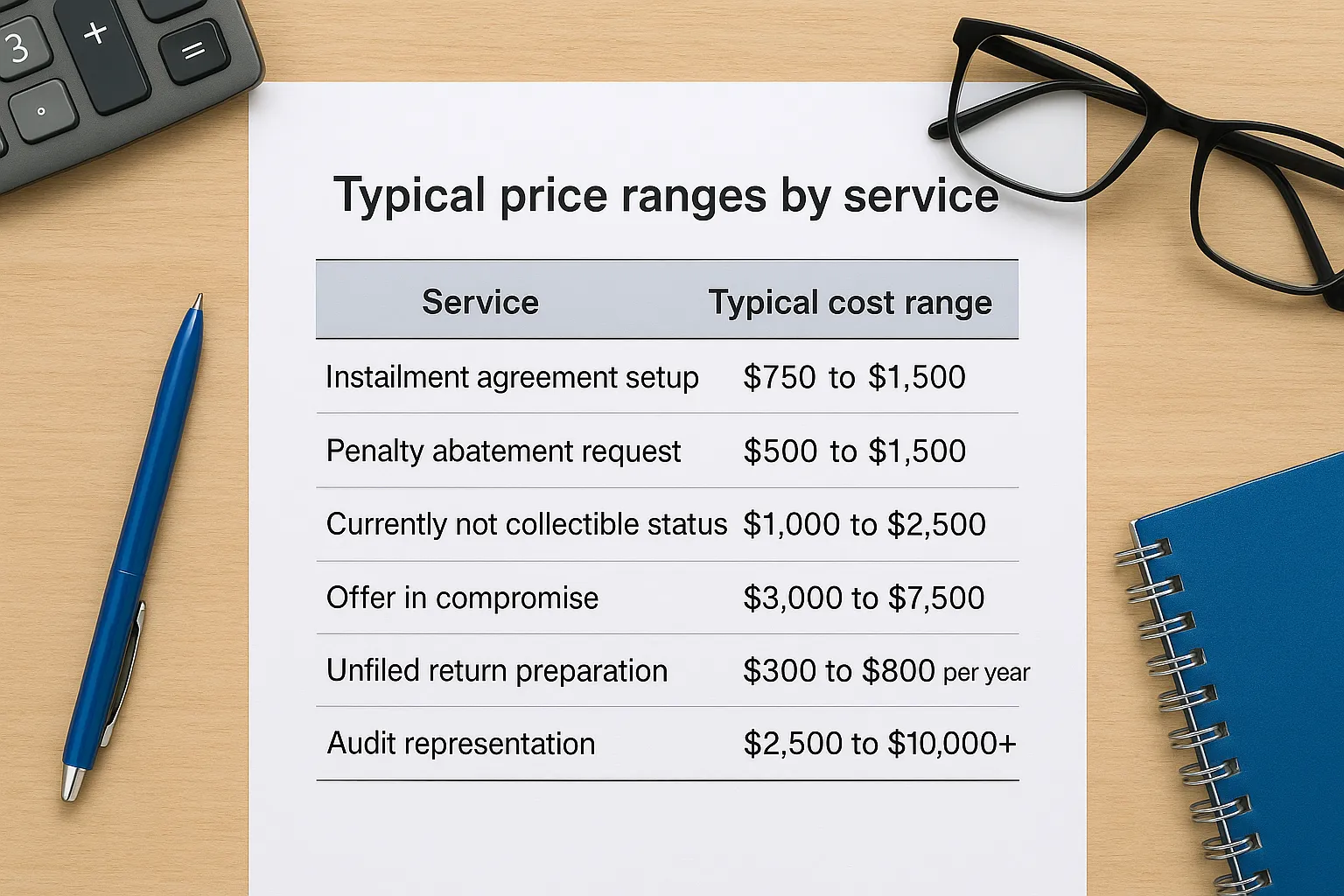
| Service | Typical cost range |
|---|---|
| Installment agreement setup | $750 to $1,500 |
| Penalty abatement request | $500 to $1,500 |
| Currently not collectible status | $1,000 to $2,500 |
| Offer in compromise | $3,000 to $7,500 |
| Unfiled return preparation | $300 to $800 per year |
| Audit representation | $2,500 to $10,000+ |
A quote that ignores which of these services you actually need is a red flag, not a bargain.
Generally, most cases combine two or three of these services rather than just one. Someone facing a levy usually needs years of unfiled returns filed first, then a resolution option negotiated second, so the total climbs accordingly. Look for firms who at Tax Experts of OC break the invoice into these discrete pieces instead of one vague lump sum, since itemized pricing tells you exactly what you're funding and makes comparing quotes across firms much easier.
How to estimate the cost of your own case
Start by pulling your IRS transcripts before you call anyone. You can request wage and income transcripts, account transcripts, and a record of account directly through the IRS's own transcript tool at irs.gov, and having these in hand lets a professional give you a real number instead of a guess. Without transcripts, any firm quoting how much does it cost to get tax relief is working blind, and so are you.
Gather these before your first consultation:
- Total balance owed, by year
- Number of unfiled returns, if any
- Any notices of levy, lien, or wage garnishment
- Whether the debt is personal, business, or payroll-related
- Your current monthly income and expenses
You can't price a tax problem you haven't fully documented yet.
Using this list, a firm should be able to sort your case into a rough category, simple installment agreement, currently not collectible, or offer in compromise, and quote accordingly. Reputable shops offer a free consultation specifically to do this sorting before asking for a dime, which is why a real tax resolution quote almost always comes after a document review, not before. Vague upfront numbers based only on your balance, with no mention of your filing history or collection status, usually mean the firm hasn't actually looked at your file yet.
How to avoid overpriced or scam tax relief firms
Scam operators thrive on panic. They promise to settle your debt for pennies on the dollar before they've even pulled your transcripts, and that promise alone should send you looking elsewhere. Knowing how to choose a tax resolution company you can trust, and spotting the tax relief companies cost structures built to trap you, matters more than any single price number.
Red flags worth walking away from
Running through a short checklist before you sign anything protects you from the worst offenders:

- Full payment demanded upfront, with no itemized breakdown of services
- Guarantees of a specific settlement amount before your file has been reviewed
- High-pressure sales calls from staff who never mention a CPA or Enrolled Agent
- No physical address or verifiable license listed anywhere on their site
- Refusal to put fees in writing before you commit
If a firm won't itemize the bill, they're not planning to earn it.
What a trustworthy firm looks like instead
Legitimate firms welcome scrutiny. They'll tell you plainly who's licensed, show you their fee structure before you pay anything, and let you speak directly with the person handling your case rather than a rotating call center. The Federal Trade Commission has published guidance on tax relief cost scams specifically because so many taxpayers get burned by lump-sum upfront charges tied to vague promises. Before hiring anyone, verify their credentials, read tax resolution services reviews and ask for references, and confirm the fee covers a defined scope of work, not an open-ended retainer that grows every time you call for an update.
Is paying for tax resolution worth it
Asking how much does tax resolution cost only matters if you compare it against what you'd lose by doing nothing. An IRS wage garnishment can take 25% or more of your paycheck every pay period, and a bank levy can drain your account in a single day. Weighed against a $2,500 installment agreement fee, professional help often pays for itself within the first month.
Paying a few thousand dollars to stop a levy is cheaper than losing that much to one anyway.
When DIY negotiation makes sense
Simpler cases don't always need a paid firm. If you owe under $10,000, have all your returns filed, and just need a standard payment plan, you can often set that up yourself through the IRS's own online payment agreement tool at no cost.
- Balance under $10,000
- All returns filed and current
- No active levy or lien
- No business or payroll tax involved
When professional representation pays for itself
Complex cases flip that math entirely. Once penalties, unfiled years, or an active collection action enter the picture, an Enrolled Agent or CPA can often negotiate penalty abatement, correct misapplied payments, or qualify you for currently not collectible status, savings that regularly exceed the fee itself. Representation also protects you from costly missteps, like agreeing to a payment plan you can't actually afford.
Finding the right fit for your situation
Pricing tax resolution comes down to matching the fee to the actual work, not the panic you feel when a notice arrives. Simple cases deserve simple, low-cost fixes, sometimes even a free IRS payment plan you set up yourself. Complicated cases, with liens, unfiled years, or payroll exposure, justify paying a licensed professional who can document the full scope before quoting you a number.
What separates a fair price from a scam isn't the dollar amount, it's whether someone reviewed your transcripts before naming that figure. Ask for an itemized quote, confirm who's licensed, and never pay a lump sum for promises no one can guarantee.
If you're ready to get a real number instead of a guess, look at our tax resolution services and schedule a free consultation so a CPA or Enrolled Agent can review your file before you commit to anything.