

You owe the IRS money, you're scared, and you just typed tax resolution services reviews into Google because you don't know who to trust. Fair enough. This industry is loaded with companies that charge $5,000 upfront, promise to settle your debt for pennies, then disappear or do nothing while penalties keep piling up. The reviews you find online are often either fake five-star testimonials bought by the company or one-star horror stories from people who got burned.
Here's the direct answer: legitimate firms are transparent about who works your case, quote realistic outcomes, and never guarantee an Offer in Compromise before reviewing your financials. Scam operations do the opposite. They pressure you into signing same-day, hide their fee structure, and pass your file to unlicensed sales reps instead of a CPA or Enrolled Agent.
In this article, we'll walk through the exact red flags that separate real tax resolution help from a rip-off: how to verify credentials, what a legitimate consultation actually sounds like, and which promises should make you hang up the phone immediately. We'll also show you how honest firms structure pricing so you know what fair looks like before you ever sign a contract.
Why tax resolution reviews matter before you hire anyone
The tax resolution industry has a trust problem

Every year, the IRS publishes its Dirty Dozen list of tax scams, and Offer in Compromise mills show up almost annually. These are companies that blanket late-night TV and radio with ads promising to settle your debt for a fraction of what you owe, no matter your actual financial situation. The IRS calls them out by name because the damage is widespread enough to warrant a federal warning, not a one-off complaint. That alone should tell you the risk isn't hypothetical.
Because tax resolution isn't regulated the same way banking or insurance is, and because what tax resolution actually involves is poorly understood, almost anyone can open a call center, hire commission-based sales reps, and call themselves a tax relief specialist. Some of these operations never let you talk to a CPA or Enrolled Agent at all. You speak to a closer whose only job is to get your card number, then your file gets handed off to a junior processor or sits untouched for months. The lack of licensing oversight is exactly why so many people end up searching for reviews after the fact, once the damage is already done.
What a bad hire actually costs you
Money is only part of it. The bigger risk is time, and time is not free when the IRS is involved. Penalties and interest keep accruing on your balance every single day your case sits unresolved, and a scam firm that stalls for six or eight months while collecting a retainer can add thousands of dollars to what you owe before they've done a single piece of real work.
A scam tax resolution firm doesn't just take your fee, it lets the IRS keep charging you while you wait for help that never comes.
Consider a realistic scenario: someone owes $40,000, pays a $6,000 upfront retainer to a firm they found through a flashy ad, and hears nothing for eight months except vague status updates. During that stretch, penalties and interest add another $2,500 to $3,500 to the balance, a wage garnishment that a proper collection hold could have stopped continues eating into their paycheck, and the statute of limitations clock, which matters for negotiating settlements, keeps ticking without anyone tracking it. That's the real cost of picking wrong, and it's why checking reviews and credentials before you sign anything matters far more than finding the lowest quoted fee.
Where to actually check reviews, and where not to
Star ratings on a company's own website tell you almost nothing, since nothing stops a firm from only publishing the glowing ones. You need sources the company can't fully control, and you need more than one of them before you draw a conclusion, including independently compiled side-by-side reviews of tax resolution firms.
- Better Business Bureau (BBB): Look past the letter grade and read the actual complaint narratives and how the firm responded to each one.
- Google Business Profile: Check whether the owner or a named staff member replies to negative reviews with specifics, not generic apologies.
- State CPA board or IRS Enrolled Agent directory: Verify that the credentialed professional named in your contract is actually licensed and in good standing.
- Consumer Financial Protection Bureau complaint database: Search the company name to see if a pattern of billing or service complaints exists.
Gathering reviews this way, cross-referenced across multiple independent sources, is how firms like Tax Experts of OC earn trust with prospective clients: by encouraging you to verify credentials and read feedback wherever it lives, not just on a curated testimonials page. A single glowing review means little. A pattern across BBB, Google, and licensing boards means something. That pattern is what the rest of this article will help you read correctly.
How to evaluate tax resolution service reviews
Look for patterns, not single reviews
Reading one glowing testimonial or one furious rant tells you almost nothing about a firm's actual track record. What matters is the pattern across dozens of reviews over several years. If you see the same complaint repeated by different people, missed callbacks, unexplained fee increases, months of silence, that pattern is the real signal, not any single five-star post a company might have paid for. Treat isolated reviews as anecdotes and treat repeated themes as verified evidence of how a firm actually operates.
One review is an opinion. Twenty reviews with the same complaint is a pattern you should believe.
Check the dates and volume
Spacing tells you almost as much as content. A firm with 400 reviews posted over six years, spread out fairly evenly, looks organic. A firm with 300 five-star reviews all posted within a two-week window looks bought, and that's a common tactic among Offer in Compromise mills trying to bury a wave of recent complaints. Cross-check the review count against how long the company has actually been in business; a firm claiming a decade of experience with only 12 total reviews across every platform hasn't been reviewed enough to trust either way.
Watch the language reviewers use
Generic praise like "great service, highly recommend" with no specifics is nearly worthless, and vague complaints without details deserve some skepticism too. What you want are reviews that mention names, dollar amounts, or specific outcomes, phrases like "my Enrolled Agent got my penalty abatement approved in 90 days" or "they never disclosed the $500 monthly maintenance fee until after I signed." Specificity is what separates a real client experience from a fabricated post written to pad a rating average. When you're scanning tax resolution services reviews, treat vague enthusiasm as noise and treat concrete detail as signal.
Verify the reviewer exists
Cross-reference names or details across platforms when you can. If a five-star Google review and a BBB complaint describe wildly different experiences with the same firm in the same month, that inconsistency is worth noting, though it doesn't automatically mean fraud since experiences genuinely vary by case complexity and assigned staff. What should worry you more is a cluster of reviews with no profile photo, no other review history, and posted the same week as several similar-sounding posts. That combination is a common footprint of purchased or incentivized reviews rather than real client feedback.
A quick evaluation checklist
- Do complaints repeat the same specific issue across multiple platforms?
- Are reviews spread naturally over years, or clustered in short bursts?
- Do positive reviews name a specific outcome, dollar figure, or timeline?
- Does the firm respond to negative reviews with details, or generic apologies?
- Can you find the same reviewer's name or story on more than one site?
Running a firm through this checklist takes maybe fifteen minutes, and it will tell you more than any single star rating ever could, whether you're vetting a local practice or a nationwide tax resolution company.
Red flags that signal a tax resolution scam
Before you sign anything, know the specific tactics that separate a legitimate firm from an IRS tax relief scam, starting with the unsolicited tax debt relief calls that often open the pitch. These aren't vague warning signs, they're patterns the Federal Trade Commission and state attorneys general have documented repeatedly in enforcement actions against tax debt relief companies. If you spot even two or three of these during a sales call, walk away and keep reading tax resolution services reviews until you find a firm that doesn't do any of them.

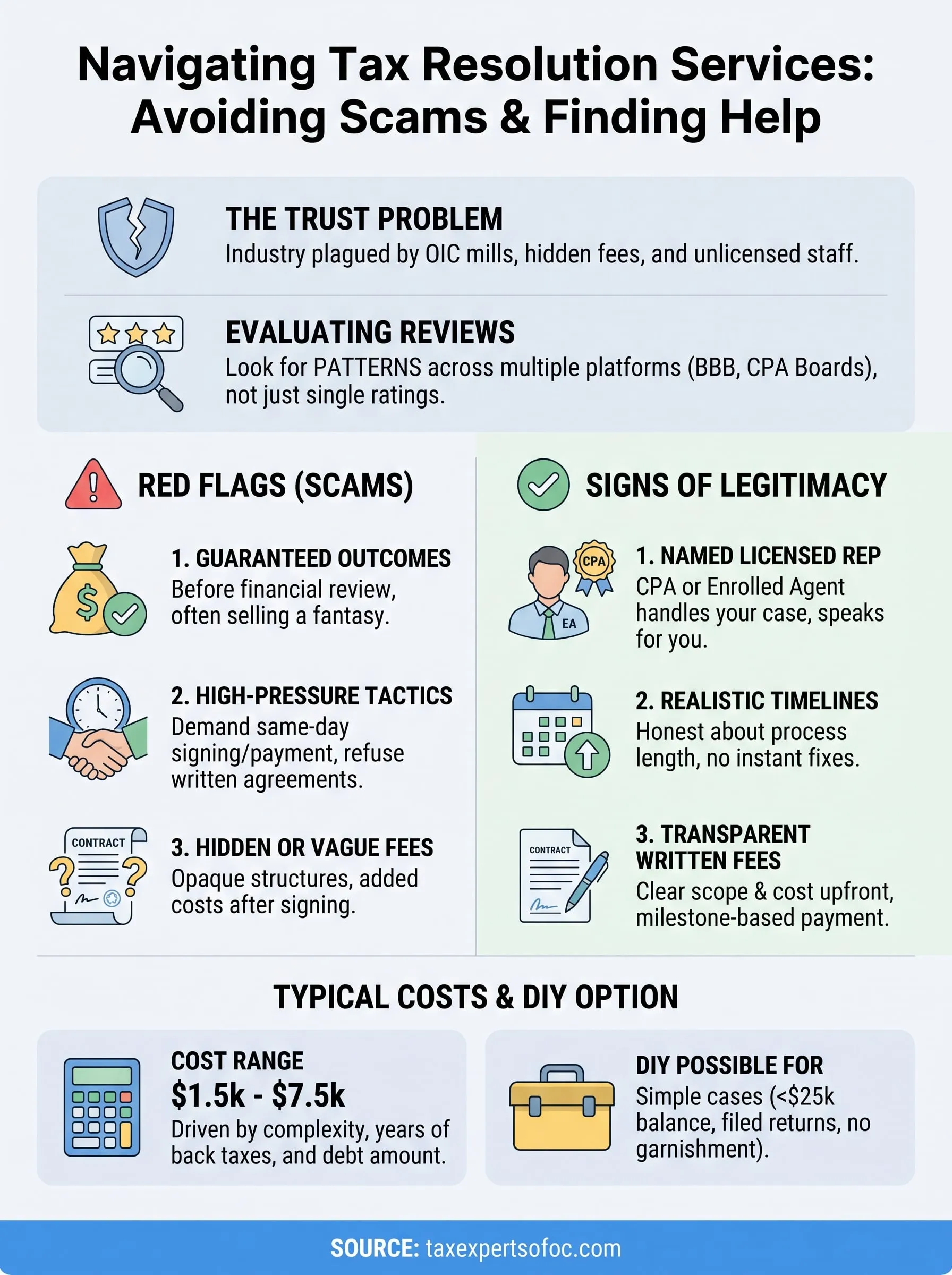
Guaranteed settlements before reviewing your finances
No honest firm can promise an Offer in Compromise acceptance, a penalty abatement, or a specific settlement dollar amount before pulling your IRS transcripts and reviewing your full financial picture. The IRS's own Offer in Compromise pre-qualifier tool exists precisely because eligibility depends on income, assets, and expenses that vary case by case. A salesperson who quotes you a settlement figure in the first phone call, before seeing a single document, is selling a fantasy, not a service.
If a company promises a settlement amount before reviewing your tax transcripts, they're guessing, not evaluating.
Pressure to sign and pay the same day
Scam operations rely on urgency because urgency stops you from checking credentials or reading reviews first. Watch for these specific pressure tactics:
- Demanding a decision "before the offer expires today"
- Refusing to send a written engagement letter until after payment clears
- Asking for full payment upfront with no milestone-based structure
- Discouraging you from "wasting time" researching the company online
A firm confident in its own reputation has no reason to rush you. Pressure is the tell.
Vague or hidden fee structures
Opaque pricing is one of the clearest signs you're dealing with an OIC mill rather than a real accounting practice. Reputable firms quote a flat fee or a clear fee range tied to the specific service, penalty abatement, installment agreement, or an OIC filing, and put it in writing before you pay anything. Scam firms often quote one number verbally, then add "case complexity fees," "maintenance fees," or "filing fees" after you've already committed. According to the FTC's guidance on tax relief companies, unclear or shifting fee structures are among the most common complaints consumers file.
No licensed professional actually reviews your case
Another major warning sign is a firm that never names the CPA or Enrolled Agent handling your file, or one where every call routes you to a different salesperson instead of the person representing you before the IRS. Only CPAs, Enrolled Agents, and tax attorneys can legally represent you in front of the IRS under a Power of Attorney, so it helps to know which credentials carry IRS representation rights. If nobody with one of those credentials is named in your paperwork, you're paying for a middleman, not representation.
The full red-flag checklist
- Guarantees a specific settlement before reviewing documents
- Pushes same-day signing or payment
- Won't put fees in writing upfront
- Can't name the licensed professional on your case
- Has no verifiable Power of Attorney filing (IRS Form 2848)
Any single item here deserves a follow-up question. Three or more together mean it's time to call someone else.
Signs of a legitimate, trustworthy tax resolution firm
Legitimate firms look almost boring compared to the flashy ads promising pennies-on-the-dollar settlements, and that's exactly the point. A real accounting practice built on licensed representation doesn't need theatrics because its results speak through documented casework, not marketing copy. Once you know what steady, professional service actually looks like, spotting the imitators gets a lot easier.
A named CPA or Enrolled Agent handles your case
You should be able to name the specific person representing you before the IRS, not just the company. Reputable firms introduce you to the CPA or Enrolled Agent who will file your Power of Attorney (IRS Form 2848) and speak on your behalf during collections calls or negotiations. If that person answers your questions directly during the consultation instead of routing you back to a sales rep, that's a strong sign the firm invests in real staff rather than a call center script.
A legitimate firm lets you talk to the person actually representing you, not just the person selling you.
Realistic timelines and honest expectations
Honest firms tell you upfront that an Offer in Compromise can take four to twelve months to process, that not everyone qualifies for an Offer in Compromise, and that an installment agreement or currently-not-collectible status might be the more realistic outcome for your situation. That kind of candor costs them nothing but trust, and it's rare enough that when you hear it, take it as a good sign rather than a disappointment. Firms like Tax Experts of OC build their reputation on this exact honesty during a free 30-minute consultation, laying out what's realistically achievable before asking for a signature.
Written fee agreements and transparent pricing
Written engagement letters that spell out the scope of work, the total fee, and what happens if your case gets more complex than expected are standard practice at any credible firm. Fee structures tied to milestones, an initial retainer for investigation, then a separate fee once a resolution strategy is confirmed, are far more trustworthy than a single lump sum demanded before any work begins.
| Trait | Legitimate firm | Scam operation |
|---|---|---|
| Case handler | Named CPA or EA | Rotating sales reps |
| Fee structure | Written, milestone-based | Verbal, lump sum upfront |
| Timeline claims | Realistic, case-dependent | Guaranteed, fast |
| Power of Attorney | Filed and verifiable | Rarely mentioned |
Verifiable licensing and clean disciplinary history
Every credentialed professional carries a license number you can check against your state CPA board or the IRS Enrolled Agent directory, and a trustworthy firm won't hesitate when you ask for it. That verification takes five minutes and confirms the person on your file is actually authorized to represent you, which is the single most reliable signal you can check before signing anything.
Questions to ask before signing with a tax firm
A free consultation is your best chance to separate a real firm from a sales pitch, but only if you ask questions that force specific answers instead of marketing language. Bring a short list with you, either on paper or in your phone, and pay attention to whether the person on the call answers directly or dodges into generalities. The right questions turn a vague sales conversation into a genuine credential check, and they take less time to ask than most people spend reading tax resolution services reviews in the first place.
Ask about the person, not just the company
Start by asking who will actually handle your file day to day, and get a name, not a department. Follow up by asking whether that person is a CPA, an Enrolled Agent, or a tax attorney, and ask for their license or enrollment number so you can verify it yourself after the call, the same way you'd vet a CPA for IRS problems near you. A firm with nothing to hide answers this in under a minute. A firm that says "you'll be assigned a case manager" without naming anyone is telling you, without saying so, that you're talking to a call center.
If a firm can't name who's representing you to the IRS, you're not hiring representation, you're hiring a phone line.
Ask about the process and the paperwork
Request a written explanation of what happens after you sign, not a verbal summary. Specifically, ask whether the firm will file IRS Form 2848 before doing anything else, since completing and submitting the Power of Attorney form is what actually lets a CPA or Enrolled Agent talk to the IRS on your behalf. Ask how long the investigation phase takes, what documents they need from you, and how often you'll get status updates. Vague answers here, "we'll keep you posted," with no specifics, usually mean nobody has a real process to describe.
Ask about fees before you ask about outcomes
Get the total cost in writing before you discuss what result they think you'll get. Ask whether the fee is a flat rate, milestone-based, or open-ended, and ask what happens if your case turns out to be more complex than initially estimated. Reputable firms answer this without flinching because their pricing was never designed to surprise you later.
Here's a short list worth bringing to any consultation:
- What is your name, license number, and credential (CPA, EA, or attorney)?
- Will you file Form 2848 before requesting any additional payment?
- What is the total fee, and is it milestone-based or a flat lump sum?
- What outcome is realistic for my specific situation, based on what you know so far?
- Can I get this fee structure and scope of work in writing before I pay anything?
- How will you communicate updates, and how often?
Listen for what they don't say
Sometimes the most useful information comes from what a firm avoids answering. If a rep talks around the license question, changes the subject when you ask about fees in writing, or promises a specific settlement number before requesting a single document, treat that as your answer. A firm that welcomes hard questions, and answers them plainly during a free consultation, is showing you exactly how they'll behave once you're a paying client, not just before.
How much tax resolution services typically cost
Cost is usually the first question people ask, but it's the wrong first question if you ask it before checking credentials. Still, you deserve real numbers instead of vague ranges buried in a sales pitch. Most legitimate firms charge somewhere between $1,500 and $7,500 for a full resolution case, depending on how complicated your situation is and how many years of unfiled returns or IRS notices are involved. That range holds up whether you're reading tax resolution services reviews for a national call center or a local CPA practice, and IRS tax resolution costs in Orange County land in the same band, so treat any quote far outside it as worth a second look.

What actually drives the price
Several factors push a quote up or down, and a firm that can't explain which ones apply to your case is skipping a step it shouldn't skip. The number of tax years involved matters most, since resolving three years of back taxes takes far less work than untangling a decade of unfiled returns. Whether you owe $8,000 or $180,000 changes the strategy entirely, and cases involving business payroll tax debt or multiple entities cost more than a straightforward individual case. The specific resolution being pursued, an installment agreement, a penalty abatement, or a full Offer in Compromise, also carries a different price tag because each requires a different amount of documentation and negotiation time.
Typical fee ranges by service
| Service | Typical fee range | What drives the cost |
|---|---|---|
| Penalty abatement | $500 - $1,500 | Number of penalty periods, complexity of reasonable cause argument |
| Installment agreement setup | $750 - $2,000 | Balance owed, whether financial disclosure is required |
| Offer in Compromise | $2,500 - $6,500 | Full financial analysis, asset review, negotiation time |
| Unfiled return preparation | $300 - $800 per year | Number of years, availability of records |
| Full case investigation and resolution | $1,500 - $7,500 | Combination of the above, plus IRS collections status |
These ranges reflect what a licensed CPA or Enrolled Agent typically charges for real casework, not what a call center quotes to get your card number on a first call.
Why the cheapest quote isn't the safest one
A rock-bottom quote from a firm you found through a late-night ad usually means one of two things: they're planning to add hidden fees later, or they never intend to do the deep financial analysis a real Offer in Compromise requires. Firms that offer transparent, upfront pricing, like the structure Tax Experts of OC lays out during a free 30-minute consultation, tell you the total cost and what it covers before you sign anything, which is exactly what a written engagement letter should do.
The lowest quote often costs the most once hidden fees and stalled cases are factored in.
Payment structure matters as much as the total number. Ask whether the fee is milestone-based, part paid at investigation, part paid once a resolution strategy is confirmed, since that structure protects you if the case turns out simpler than expected, and it gives the firm less incentive to drag things out.
Can you resolve tax debt without hiring a service
Yes, in plenty of cases you can handle this yourself, and pretending otherwise would be dishonest. If you owe a modest balance, have all your returns filed, and just need a payment plan, the IRS lets you set up a streamlined installment agreement yourself online in about fifteen minutes for balances under $50,000. No firm, no fee, no consultation required. People searching tax resolution services reviews often assume every situation needs professional help, but a straightforward case with clean records rarely does.
When the do-it-yourself route actually works
Simple situations are where self-filing shines. If you owe less than $10,000, have no unfiled returns, and aren't facing a levy or garnishment, the IRS Online Payment Agreement tool can set up a monthly plan without you paying anyone a cent. Penalty abatement for a first-time late filing is another case you can often handle solo by calling the IRS directly and requesting first-time abatement relief, one of several penalty relief options for IRS back taxes, which is granted based on a clean three-year compliance history rather than complicated negotiation.
When the case is too complex to handle alone
Complexity changes the math fast. Once you need help catching up on years of unfiled returns, or you're facing a balance over $50,000, an active wage garnishment, or a business with payroll tax debt, the paperwork and negotiation strategy get harder to manage without someone who reads IRS transcripts for a living. An Offer in Compromise in particular requires a detailed financial disclosure (Form 433-A or 433-B) that the IRS scrutinizes closely, and OIC eligibility rules are strict enough that a single miscalculated allowable expense can sink an otherwise strong case.
The line between DIY and hiring help isn't your debt amount, it's how much paperwork and negotiation the situation actually demands.
A quick self-check before you decide
Run through this list honestly before deciding which path fits your situation:
- All your tax returns are filed and up to date
- Your balance is under roughly $25,000
- No active levy, garnishment, or lien is in place
- You're comfortable reading IRS notices and calling the IRS directly
- You don't own a business with payroll tax exposure
If you checked every box, the IRS's own payment tools will likely get you where you need to go. If you checked even two or three "no" answers, that's your signal to bring in a CPA or Enrolled Agent rather than risk a mistake that costs more than the professional fee would have.
Why some people hire help even for simple cases
Even straightforward cases sometimes benefit from a second set of eyes, mainly for peace of mind rather than necessity. Talking through your situation during a free consultation, like the one Tax Experts of OC offers, costs nothing and tells you within thirty minutes whether your case is simple enough to handle yourself or complicated enough to need representation. That answer alone is often worth more than the time it takes to ask.
Choosing your next step with confidence
Reading tax resolution services reviews isn't about finding a perfect five-star firm, since no company has a spotless record. It's about spotting patterns of honesty: named professionals, written fees, realistic timelines, and a willingness to answer hard questions without flinching. Scam operations rely on urgency and vague promises because scrutiny is what kills their business model. Legitimate firms welcome scrutiny because they have nothing to hide.
Before you sign anything, run the firm through the checklists in this article. Verify the license. Read the fee agreement twice. Ask who's actually representing you to the IRS. That homework takes less than an hour and can save you thousands.
If you'd rather skip the guesswork entirely, talk to people who welcome the questions instead of dodging them. Schedule a free consultation for IRS tax help and back tax relief with Tax Experts of OC and find out, with no pressure and no obligation, exactly where your case stands.