

An IRS notice in your mailbox can push you straight into panic mode, and that panic makes you an easy target. The tax resolution industry is full of firms that promise to erase your debt for pennies on the dollar, collect a big upfront fee, and then disappear. Knowing how to choose a tax resolution company is the difference between actually fixing your tax problem and losing thousands to a company that never intended to help you.
The short answer: work with a firm that gives you direct access to a CPA or Enrolled Agent, explains your options in plain language during a free consultation, and puts pricing in writing before you sign anything. Anyone who guarantees a specific settlement amount before reviewing your case is telling you what you want to hear, not what's true.
This guide walks through the exact criteria to check before you hire anyone, from verifying credentials with the IRS and your state board to spotting the red flags that separate legitimate representation from a sales pitch. By the end, you'll know exactly what questions to ask and what answers should make you walk away.
Why choosing the right tax resolution company matters
When you owe the IRS money, every week you wait adds penalties and interest to the balance. That pressure makes it tempting to hire the first company that answers the phone and promises relief. But the tax resolution industry has almost no barrier to entry, so it helps to know what tax resolution actually involves before you hire anyone. Anyone can rent a call center, hire a few salespeople, and start collecting retainers from scared taxpayers. Some of these operations never file the paperwork they promise. Others file it late, badly, or not at all, leaving you further behind than when you started.
The financial stakes of a bad choice
Bad tax resolution firms don't just fail to help, they actively make your situation worse. A common pattern looks like this: the firm collects $3,000 to $10,000 upfront, tells you to stop paying the IRS directly, then does little to no actual work on your case. Meanwhile, the IRS keeps adding penalties and interest, and in some cases moves forward with a levy or garnishment because no one filed a collection due process request or responded to a deadline. You end up owing more than when you started, plus you've lost the money you paid the firm.
A tax resolution firm that takes your money and misses your deadlines can cost you more than the IRS ever would.
How the scam pattern usually plays out
Most of these firms follow a recognizable script, and knowing it helps you spot trouble before you sign a contract:

- The pitch: A salesperson, not a CPA or Enrolled Agent, promises you'll settle for "pennies on the dollar" before reviewing a single document.
- The retainer: You're asked to pay a large flat fee upfront, often with pressure to decide the same day.
- The silence: After payment, calls go unreturned for weeks, and your assigned representative changes without notice.
- The stall: Deadlines pass, IRS notices keep arriving at your house because the firm never filed a power of attorney, and your case sits untouched.
- The disappearance: The company closes, rebrands under a new name, or simply stops responding once complaints pile up.
The Federal Trade Commission has taken action against several firms that followed exactly this pattern, collecting millions from taxpayers before shutting down (FTC.gov). This isn't a rare occurrence. It's a business model.
What's actually at risk beyond the money
Hiring the wrong firm doesn't just cost you fees, it costs you time you don't have. The IRS operates on strict statutory deadlines: 30 days to appeal after a final notice of intent to levy, 90 days to petition Tax Court after a notice of deficiency, two years to request innocent spouse relief in some circumstances. Once these windows close, your options narrow considerably, sometimes permanently. A firm that sits on your case for months while collecting installment payments can push you past deadlines that a competent representative would have flagged on day one.
Owning your finances also means understanding what qualified representation actually looks like versus what a sales pitch dressed up as one looks like. A licensed CPA or Enrolled Agent has legal authority to act as your IRS representative, is bound by professional ethics rules, and has continuing education requirements that keep their knowledge current. A commissioned salesperson has none of that. Learning how to choose a tax resolution company starts with understanding this distinction, because it shapes every other decision you'll make in the process, from who signs your power of attorney to who actually shows up when the IRS calls.
Step 1. Verify credentials and licensing
Before you hand over a single document, find out exactly who will work your case. Only three types of professionals hold the right to argue your case with the IRS: Enrolled Agents (EAs), CPAs, and tax attorneys. Anyone else on the call, a "tax consultant," a "case manager," or a "resolution specialist," is a sales title, not a license. If a firm won't name the credentialed professional assigned to your case before you sign a contract, that's your first warning sign.
Ask for the license number and check it yourself
Don't take a firm's word for it. Every credential can be verified independently, and doing so takes about five minutes.
- Enrolled Agents: Search the IRS Directory of Federal Tax Return Preparers to confirm the EA's status is active, not expired or revoked.
- CPAs: Look up the license through your state's Board of Accountancy website. California residents can use the California Board of Accountancy license search.
- Tax attorneys: Confirm bar membership and standing through your state bar association's website.
- Enrolled Agent number: A legitimate EA can give you their unique enrollment number on request, since it's public information tied to their IRS authorization.
If a firm hesitates to give you a name and license number you can verify, that hesitation tells you everything you need to know.
Confirm they'll actually file power of attorney
Credentials only matter if the firm uses them on your behalf. Ask directly whether they'll file IRS Form 2848, Power of Attorney and Declaration of Representative, and how soon after you sign. A properly filed 2848 is what allows your representative to speak with the IRS directly, pull your transcripts, and respond to notices without routing everything through you first. Firms that stall on filing this form, sometimes for weeks, often do so because the person assigned to your file isn't actually authorized to represent you yet, or because no one with the right credentials is available to sign it.
Watch for shared or recycled credentials
Some larger call-center operations list one or two licensed professionals on their website but assign dozens of cases to unlicensed staff who operate under that person's name. Ask how many active cases the specific CPA or Enrolled Agent handles and whether they'll be the one signing your documents and speaking with the IRS. A firm built around direct access to a CPA or Enrolled Agent, rather than a rotating cast of sales reps, is the one worth trusting with your case.
Step 2. Confirm they investigate before promising results
No legitimate firm can tell you what your final settlement will look like before they've pulled your IRS transcripts and reviewed your full financial picture. If a salesperson quotes you a settlement number, or a percentage discount, during the very first call, walk away. Every real resolution case starts with an investigation phase, not a promise. This step exists because the IRS bases programs like an Offer in Compromise on strict qualification math, your actual income, expenses, assets, and equity, not on how badly you want to settle.

What a real investigation actually includes
A thorough investigation phase, sometimes called a compliance check or case analysis, should cover several specific items before anyone discusses strategy:
- Transcript pull: Requesting your IRS wage and income transcripts, account transcripts, and record of account to confirm exactly what the IRS has on file.
- Filing compliance review: Checking whether all required returns have been filed, since the IRS won't consider most resolution options until you're current.
- Financial disclosure: Reviewing your income, monthly expenses, bank statements, and asset equity to calculate your realistic collection potential.
- Statute of limitations check: Confirming the Collection Statute Expiration Date (CSED) for each tax year, since some debts may already be close to expiring.
- Program eligibility: Matching your specific numbers against IRS guidelines for an installment agreement, Offer in Compromise, Currently Not Collectible status, or penalty abatement.
If a firm skips straight to a settlement number without pulling your transcripts first, they're guessing, not analyzing.
Ask what happens if the numbers don't support a big reduction
Honest firms will tell you upfront that not everyone qualifies for pennies-on-the-dollar settlements. The IRS accepted roughly 12,000 Offers in Compromise out of about 30,000 filed in a recent year, according to IRS collection statistics (IRS.gov), and eligibility depends heavily on your specific finances rather than negotiating skill. A firm that promises a specific outcome before running your numbers is either inexperienced or dishonest.
Getting a straight answer here also tells you how the firm operates day to day. Practicing tax resolution correctly means presenting you with a range of realistic outcomes, an installment plan, a partial-pay agreement, or hardship status that pauses collections, rather than a single guaranteed number. Trusting a firm that resists this step usually means trusting a sales pitch dressed up as expertise.
Step 3. Get fees and services in writing
Verbal promises evaporate the moment a dispute starts, so every fee and every deliverable needs to be on paper before you pay a dollar. A written engagement letter should spell out exactly what the firm will do, what it costs, and what happens if your case turns out to be more complicated than expected. Reputable firms welcome this request because they know the numbers hold up; firms running a script tend to hedge, saying the contract will follow "after we get started." That hesitation is the tell.
What the engagement letter should spell out
Don't sign anything until the document answers these questions in writing:
- Total cost and payment schedule: a flat fee or capped range, not an open-ended hourly arrangement with no ceiling.
- Scope of services: exactly which forms get filed, which IRS programs will be pursued, and what's excluded.
- Milestones tied to payment: fees released as work is completed, not one lump sum collected on day one.
- Refund policy: what happens if the firm can't deliver, or if you cancel before work is finished.
- Named representative: the specific CPA or Enrolled Agent responsible for your case, matching who you verified in Step 1.
A fee agreement that doesn't name a task, a deadline, or a dollar amount isn't a contract, it's a placeholder.
Compare how firms typically structure fees
Fee structures vary across the industry, and knowing the common models, along with what professional tax services typically cost, helps you judge whether a quote is reasonable for your situation.
| Fee model | How it works | What to watch for |
|---|---|---|
| Flat fee by phase | Set price for investigation, then a set price for resolution | Clear milestones tied to each payment |
| Hourly billing | Rate charged per hour worked | No cap can mean runaway costs on complex cases |
| Percentage of savings | Fee tied to the amount "saved" | Hard to verify, easy to inflate the baseline |
Getting an itemized quote upfront, one of the questions worth asking any tax resolution company you're considering, lets you compare offers on equal footing instead of guessing at what a "total resolution package" actually includes. Tax Experts of OC provides transparent upfront pricing during the free consultation for exactly this reason: you should know your total cost before committing to anything.
Holding out for a written agreement also protects you if the relationship goes wrong. Without a signed scope of work, you have no documented basis to dispute a bill or demand a refund if the firm fails to deliver what was promised on the phone.
Step 4. Check reputation, reviews, and track record
Anyone can post glowing testimonials on their own homepage, so treat a firm's website reviews as marketing, not proof. Real due diligence means checking sources the company doesn't control, the same way you'd verify a resolution tax service before signing. Before you sign anything, spend twenty minutes cross-checking a firm's reputation across independent platforms and side-by-side reviews of national tax resolution firms, because a pattern of complaints tells you far more than a handful of five-star reviews ever will.

Where to actually look
Check these sources in order, since each one reveals something the others miss:
- Better Business Bureau (BBB): Search for the firm's accreditation status and read the complaint history, not just the letter grade. Look specifically at how the company responded to complaints, since a pattern of ignored disputes matters more than the total count.
- Consumer Financial Protection Bureau (CFPB): Search the CFPB complaint database for the firm's name, since taxpayers often file formal complaints there after a firm goes silent.
- State Attorney General: A quick search for "[firm name] + attorney general" surfaces any consumer protection actions or settlements tied to deceptive practices.
- Google Business Profile and third-party review sites: Read the one- and two-star reviews first. Look for recurring complaints about missed deadlines, unreturned calls, or representatives who changed mid-case.
A single bad review is normal. A repeated complaint about the same broken promise is a pattern.
Ask for verifiable references, not just testimonials
A firm confident in its work will connect you with a past client willing to describe their experience directly, not just point you to a curated quote on a landing page. Asking how long that client's case took from start to resolution, and whether the timeline matched what was promised, tells you more than any star rating. Firms that hesitate or claim client confidentiality prevents any reference at all are usually protecting a thin track record, not their clients' privacy.
Look at how long the firm has actually operated
Some low-quality operations close down after complaints pile up, then reopen under a new name with a fresh reputation. Check how long the business has held its current name and address, and whether its licensed professionals show continuous standing over that same period. A firm with years of consistent local presence and a named, verifiable CPA or Enrolled Agent behind it gives you far more assurance than a call center with a six-month-old domain and no traceable history.
Step 5. Clarify communication and ongoing support
Once you've verified credentials, confirmed an investigation phase, and gotten fees in writing, the last piece to nail down is how the firm actually communicates once you're a paying client. Ongoing communication is where a lot of tax resolution companies quietly fail their clients, not because they can't do the work, but because they never built a system to keep you informed while it happens. Ask about this before you sign, because the answer tells you what your next six to twelve months will actually feel like.
Ask who you'll actually talk to
Find out whether you'll have a single point of contact or get routed to whoever picks up the phone that day. A firm that assigns a dedicated case manager or the credentialed professional handling your file gives you continuity; a firm that shuffles you between departments gives you a game of telephone every time the IRS sends a new notice. Before signing, ask these questions directly:
- Who is my main point of contact, and is that person the same CPA or Enrolled Agent working my case?
- How do I reach them if I get a new IRS letter?
- What's the typical response time for phone calls and emails?
- Will I get updates even when there's no news, or only when something changes?
If a firm can't tell you who answers your calls, they haven't decided how they'll treat you once you've paid.
Set expectations for response times
Response time matters more than it sounds like it should, because IRS deadlines don't pause while you wait for a callback. Ask for a specific commitment, such as a 24 to 48 hour response window for calls and emails, and get it added to your engagement letter alongside the fee schedule from Step 3. Firms offering virtual consultations and remote case management should have this dialed in already, since serving clients across multiple states depends on reliable, documented communication rather than in-person drop-ins.
Confirm ongoing support after resolution
Resolution isn't the finish line if you owe taxes again next year. Ask whether the firm offers continued support, quarterly check-ins, year-round tax planning for individuals, or bookkeeping, to keep you compliant going forward, or whether the relationship ends the moment your case closes. Firms built for long-term client relationships, rather than one-time settlements, tend to prevent the next tax problem instead of just cleaning up the last one.
Step 6. Watch for red flags and empty guarantees
By the time you reach this step, you've already filtered out most bad actors just by asking the questions in Steps 1 through 5. But some red flags deserve their own spotlight, because they show up specifically when a salesperson senses you're close to signing. Recognizing these tactics in the moment, whether they come by phone in one of those unsolicited tax debt relief calls or in person, protects you from a decision you'll regret for years, not just months.
Phrases that should end the call
Certain promises are simply impossible to make honestly before a firm has reviewed your case. Treat any of the following as a reason to hang up:
- "We can settle your debt for pennies on the dollar" before pulling a single transcript or reviewing your finances.
- "Everyone qualifies" for an Offer in Compromise, when IRS acceptance depends entirely on individual income, expenses, and asset equity.
- "Act today or lose this rate" pressure tactics that push you to sign before you've had time to verify credentials or read the contract.
- "Don't worry about calling the IRS yourself" paired with a refusal to explain what the firm has actually filed so far.
- "Our attorneys will handle everything" when no attorney, CPA, or Enrolled Agent is ever named or introduced.
A company that guarantees your outcome before reviewing your case is selling confidence, not results.
Structural red flags beyond the sales pitch
Beyond scripted phrases, watch for patterns in how a firm operates. A large upfront fee with no milestone breakdown is one of the clearest warning signs, since it removes any incentive for the firm to keep working once you've paid. Similarly, be wary of firms that refuse to put a named CPA or Enrolled Agent on your engagement letter, since that omission usually means unlicensed staff will handle your file. Watch also for firms with no verifiable physical address, a domain registered only a few months ago, or reviews that read like they were written by the same person under different names.
Trust your own instincts alongside the paperwork
Documentation and license checks matter, but so does how a firm makes you feel during that first consultation. Genuine professionals answer direct questions with direct answers, even uncomfortable ones like "what if my numbers don't support a big settlement." Watching for hesitation, vague deflection, or pressure to decide immediately gives you information the paperwork alone won't. If something feels off after you've verified every credential and read every clause, that instinct is worth listening to before you sign.
Putting these steps into practice
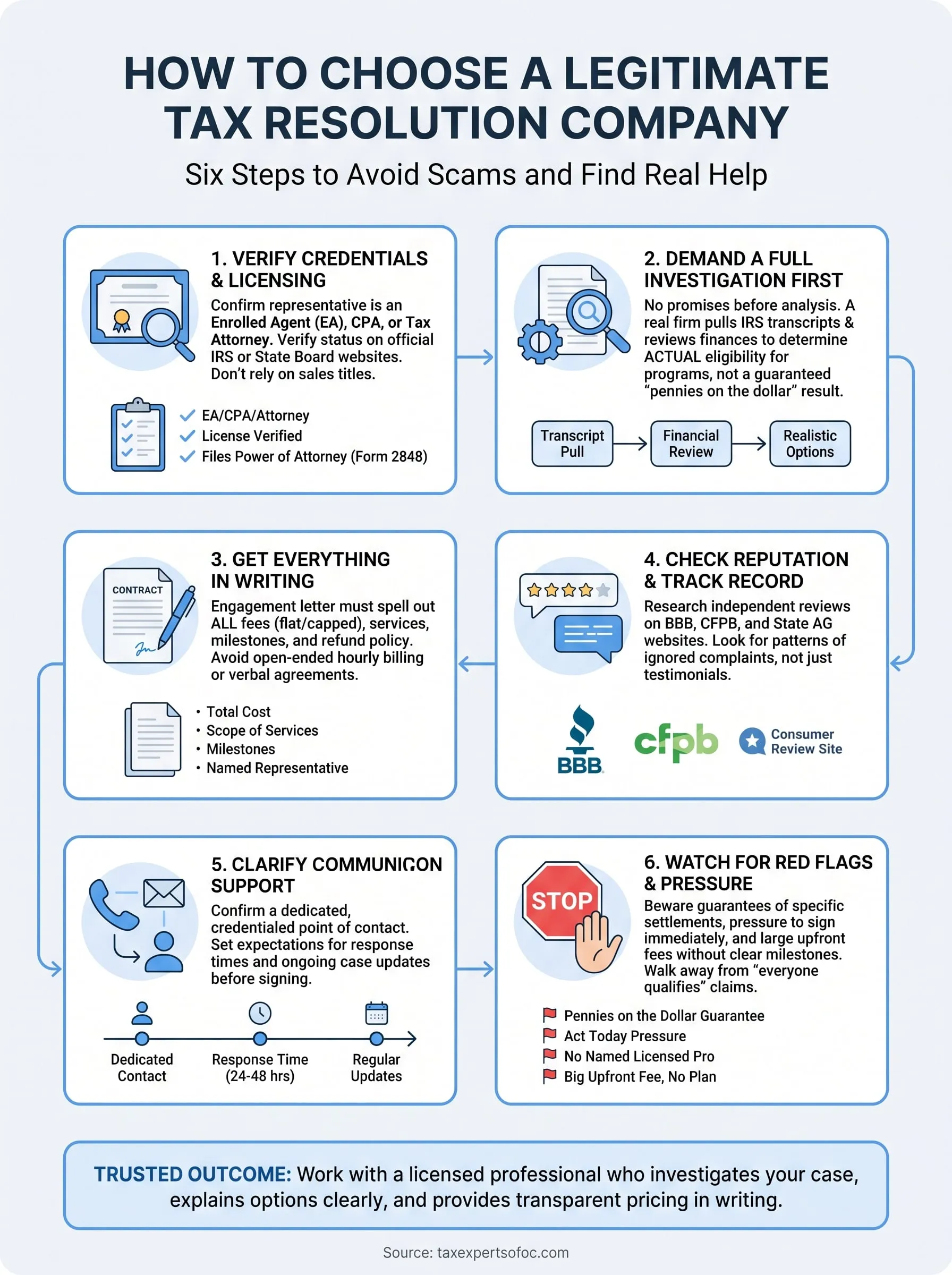
Choosing a tax resolution company doesn't require special expertise, just a willingness to ask direct questions and verify the answers instead of taking a sales pitch at face value. Run through the six steps: verify credentials, confirm a real investigation happens before any promises, get fees in writing, check independent reviews, clarify communication, and watch for the phrases that signal pressure rather than professionalism. Together they filter out nearly every firm that isn't built to actually help you.
Getting this decision right matters more than almost any other financial call you'll make this year, because the wrong firm costs you money and time you can't get back from the IRS. If you're ready to work with a firm that puts a licensed CPA or Enrolled Agent on your case, explains your options in writing, and offers a free consultation before you commit to anything, see how our IRS tax problem resolution service works and get a straight answer about where you actually stand.