
Searching for an individual tax preparer near me usually turns up a long list of storefronts, software ads, and sponsored listings. Few of them tell you who will actually prepare your return, what it will cost, or whether that person can represent you if the IRS writes back. That gap is where people overpay or end up with a return nobody stands behind.
Here is the short answer. If your income is under roughly $67,000, start with free options like VITA and Tax Counseling for the Elderly. If your return has self-employment income, multiple states, investments, or old IRS problems, pay for a CPA or Enrolled Agent. Both can offer IRS representation on your behalf. A seasonal storefront preparer often cannot do the same.
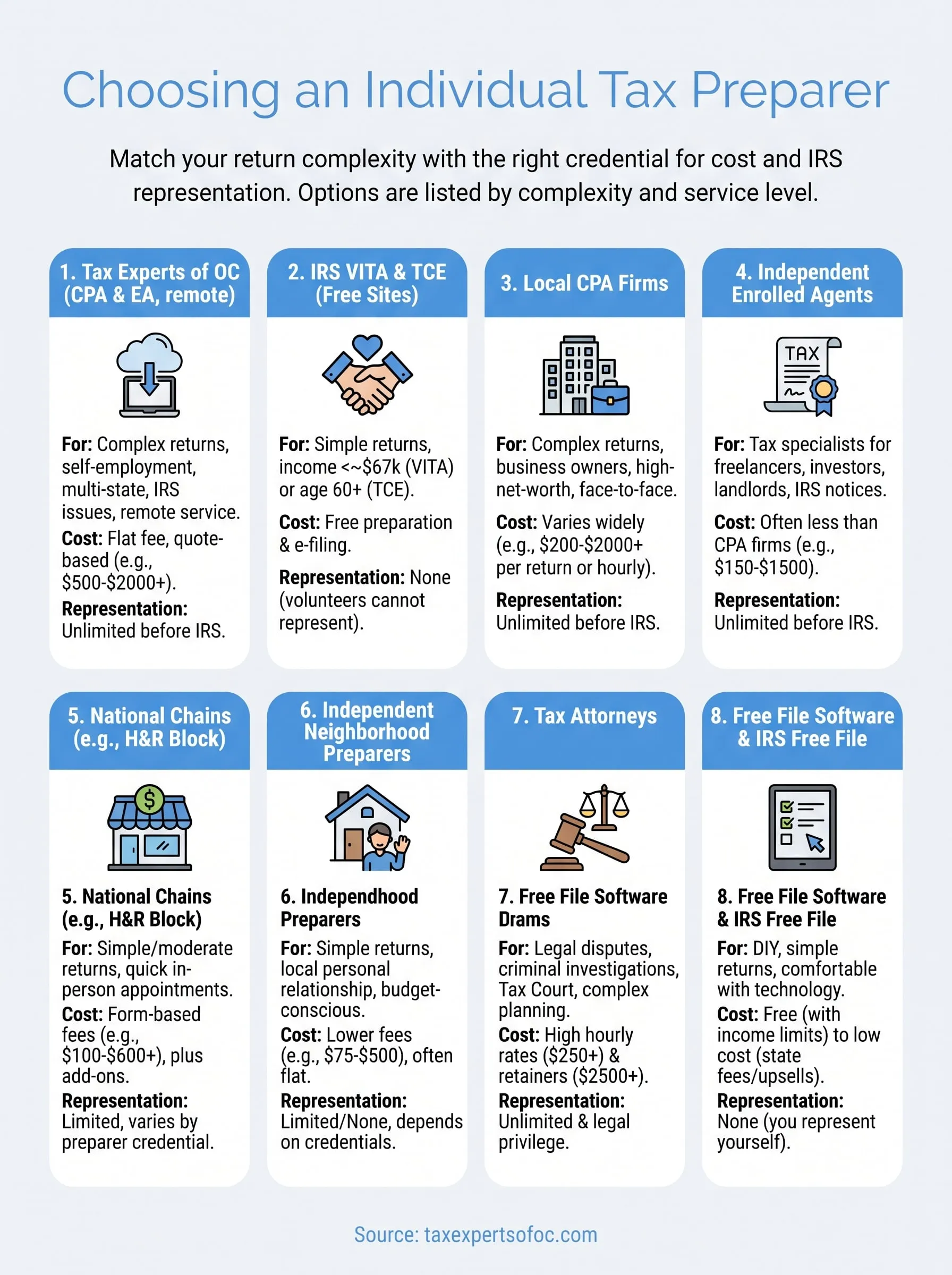
Below, you will find eight free and paid options, from IRS-backed volunteer sites to national chains, online software with human review, and independent professionals. For each one, we cover typical cost, credentials, and who it fits best. We are a CPA and Enrolled Agent firm in Orange County that works with clients in all 50 states, so we also flag where remote service makes "near me" less important.
1. Tax Experts of OC (CPA and enrolled agent, remote)
How it works
Tax Experts of OC is our firm, so weigh this entry with that in mind. We are based in Orange County, California, but we offer virtual tax preparation by phone, email, and secure document upload. That means clients in all 50 states get the same service, and you do not need an individual tax preparer near me within driving distance.

The process is short:
- Book the free 30-minute consultation and tell us what your year looked like.
- Upload last year's return and this year's tax documents through a secure channel.
- A CPA or Enrolled Agent prepares the return and asks follow-up questions by phone or email.
- You review the draft, approve it, and we e-file.
- If the IRS or a state agency sends a notice later, the same professionals respond.
Because you deal directly with the credentialed professional, not a seasonal hire, questions get answered by the person who signs the return. That matters most when your situation has moving parts.
Who it is for
This option suits taxpayers whose returns go beyond a single W-2. If any of the situations below sound familiar, you are in the sweet spot for a CPA and Enrolled Agent team:
- Self-employment, freelance, or side-business income
- Owners of LLCs, S corporations, or partnerships who also need a personal return
- Income earned in more than one state
- Rental property, investments, or trust income
- Unfiled prior-year returns, IRS notices, or back taxes
It also fits busy people who simply prefer a remote, no-waiting-room experience. If you already have an open IRS problem, the preparer and the tax resolution team sit under one roof, so nobody has to relearn your file.
Typical cost
We quote a flat fee upfront, after we see which forms and schedules your return needs. We do not post a single price, because a W-2 return with the standard deduction and a return with a Schedule C and two states are different amounts of work. Several factors move the price:
| Factor | Why it adds time |
|---|---|
| Self-employment or business income | Needs income and expense review, plus Schedule C or K-1 handling |
| Itemized deductions | Requires documenting and testing each deduction |
| Investments and crypto | Many transactions, basis tracking, extra forms |
| Multiple states | Separate returns and allocation of income |
| Prior-year unfiled returns | Each year is a full return, often with missing records |
The consultation costs nothing, so you can get a written quote before you commit. If money is tight, ask about flexible payment options. We offer them for clients facing financial hardship.
Pros and limitations
The main advantage is credentials plus continuity. CPAs and Enrolled Agents have unlimited rights to represent you before the IRS, which means they can handle an audit or notice on your behalf.
A cheap return is not cheap if nobody is allowed to defend it.
Here is how the trade-offs stack up:
Pros
- Direct access to a CPA and Enrolled Agent, not general staff
- Upfront pricing and a free first conversation
- Handles multi-state filings, business returns, and IRS resolution in one place
- Works the same way whether you live in Irvine or Indiana
Limitations
- It is not free. If your income qualifies for VITA, that route costs less.
- There is no walk-in storefront for drop-off, since service is remote.
- A simple W-2 return with the standard deduction may not need this level of expertise, and you could pay less elsewhere.
- Capacity tightens near the April and October deadlines, so reach out early.
2. IRS VITA and TCE free tax preparation sites
How it works

The IRS sponsors two free tax filing assistance programs. Volunteer Income Tax Assistance (VITA) serves people who earn roughly $67,000 or less, people with disabilities, and limited English speakers. Tax Counseling for the Elderly (TCE) helps anyone, with a focus on those 60 and older. Its largest provider is AARP Foundation Tax-Aide. Volunteers must pass IRS certification before they touch a return, and a second person reviews it before e-filing.
Find a location with the IRS free tax preparation locator. Most sites run from late January to mid-April in libraries, community centers, and colleges. Many take appointments only, so call ahead. Bring these items:
- Photo ID for you and your spouse
- Social Security cards or ITIN letters for everyone on the return
- All W-2, 1099, and 1095-A forms
- Last year's return
- Bank routing and account numbers for direct deposit
Who it is for
This route fits straightforward returns: wages, pensions, Social Security, unemployment, and common credits like the Earned Income Tax Credit and Child Tax Credit. Retirees with pension and IRA questions often do especially well at TCE sites.
Timing matters. Today is October, and most sites are closed until the next season. If you filed an extension and need help before the October deadline, a paid option on this list is the realistic choice.
Typical cost
VITA and TCE are completely free, including e-filing. Volunteers cannot charge you or accept tips. If a site asks for payment or wants a cut of your refund, walk away, because it is not an IRS-certified program.
Pros and limitations
You get certified help at no cost, and many sites will also explain credits you did not know you qualified for. The catch is scope. Sites turn away complicated returns, and they are built for volume, not for ongoing advice.
Free help is only a bargain when your return fits what volunteers are allowed to prepare.
Pros
- No cost for preparation or e-filing
- IRS-trained volunteers with quality review
- Good fit for first-time filers and retirees
- Community locations in most areas
Limitations
- Income limits apply for VITA
- Many sites decline complex self-employment, rental, multi-state, or heavy investment returns
- Volunteers do not represent you in an audit
- Short season, limited appointments, and possible waitlists
- Preparers vary in experience from site to site
3. Local CPA firms
How it works
A local CPA is licensed by your state board of accountancy and usually works by appointment. You meet in person or send documents ahead, and the CPA or a staff accountant prepares the return. The CPA then reviews and signs it. Ask who actually prepares your return, because at larger firms a junior staffer often does the first pass. Most firms also take clients year-round, which helps if you are searching for an individual tax preparer near me in October with an extension pending.
Before you hire, run through this quick check:
- Confirm the license on your state board of accountancy website.
- Ask who prepares the return and who signs it.
- Ask whether the firm accepts new individual clients, since some only serve businesses.
- Get the fee in writing before you hand over documents.
Who it is for
Local CPAs fit people with layered finances who want a face-to-face relationship and tax preparation by a CPA. Think business owners, real estate investors, people with stock options or large capital gains, and anyone dealing with an estate or trust. Year-round planning is a real draw, since a CPA can adjust your estimated payments or withholding in June instead of explaining a surprise in April.
Skip this route if your return is one W-2 and the standard deduction. Many firms set minimum fees or decline small individual returns, and you would pay for expertise you do not need.
Typical cost
Tax preparation costs vary by city and firm size, but these ranges are common for individual returns. Big metro areas run higher.
| Return type | Typical range |
|---|---|
| W-2 with standard deduction | $200 to $400 |
| Itemized deductions | $350 to $700 |
| Self-employment (Schedule C) | $500 to $1,200 |
| Rentals, investments, or multiple states | $800 to $2,000+ |
Some firms bill hourly, often $150 to $400 per hour. Ask for a flat quote after they see last year's return, and confirm whether audit support is included or billed separately.
Pros and limitations
The biggest advantage is credentials with accountability. CPAs have unlimited representation rights before the IRS, and a good one catches planning opportunities, not just errors.
A CPA earns the fee with the questions asked before you file, not the form filled out after.
Pros
- Unlimited IRS representation rights
- Strong fit for business, investment, and multi-year issues
- In-person meetings and year-round availability
- Planning advice included or easy to add
Limitations
- Usually the most expensive in-person option for a basic return
- Some firms refuse simple or first-time individual clients
- Slower turnaround during peak weeks
- Quality depends on who at the firm touches your file
4. Independent enrolled agents
How it works
An enrolled agent (EA) is a tax specialist licensed by the IRS itself, not by a state. To earn the title, an EA passes a three-part Special Enrollment Examination covering individual tax, business tax, and representation. A former IRS employee with five years of technical tax experience can qualify instead. EAs must then complete 72 hours of continuing education every three years.
Many EAs run solo practices. Most take documents by email or portal and meet by phone or video, so your search for an individual tax preparer near me can stretch well past your zip code. Before you hire anyone, confirm the credential through the IRS enrolled agent resources and the IRS preparer directory.
Who it is for
Enrolled agents suit people who want a tax-only specialist without paying CPA firm rates. They handle freelancers, landlords, investors, and taxpayers with prior-year returns or IRS notices. Because EAs focus on tax law all year, they often know the fine print of credits and deductions well.
Look elsewhere in these cases:
- You need audited or reviewed financial statements, which only a CPA can issue
- You want bookkeeping, payroll, and tax under one roof
- Your return is a single W-2 and you qualify for free VITA help
Typical cost
Solo practitioners carry less overhead than large firms, so fees often land a bit below comparable CPA pricing. These ranges are common for individual returns. Your area and return complexity will shift them.
| Return type | Typical range |
|---|---|
| W-2 with standard deduction | $150 to $350 |
| Itemized deductions | $300 to $600 |
| Self-employment (Schedule C) | $400 to $1,000 |
| Rentals, investments, or multiple states | $600 to $1,500 |
Some EAs bill hourly, usually $100 to $300 per hour. Ask for a flat quote after they review last year's return, and get it in writing.
Pros and limitations
The key advantage is unlimited representation rights. An EA can speak for you before the IRS on any tax matter, in any state, which puts the credential on equal footing with a CPA for audits and collection notices.
An enrolled agent does one job, and the license proves it.
Pros
- Federal credential built entirely around taxes
- Full IRS representation rights
- Direct access to the person who signs your return
- Often cheaper than a CPA firm for the same return
Limitations
- Solo practices can have limited capacity, so spring slots fill fast
- Quality varies, and an EA's real-world experience matters as much as the title
- No attest services, and bookkeeping or payroll may need a second provider
- Coverage can vanish if a one-person office closes or the EA retires
5. National chains like H&R Block and Jackson Hewitt
How it works

National chains run thousands of storefronts, so they are the easiest answer when you search for an individual tax preparer near me on a map app. You book or walk in, hand over your documents, and a preparer enters your return into the firm's software. Most chains also offer a drop-off or virtual option.
Preparer credentials vary widely. Every paid preparer needs an IRS PTIN, but many seasonal staff are not CPAs or enrolled agents. Ask about credentials before you sit down, and ask whether a credentialed professional is on site for harder questions.
Who it is for
Chains fit people with a W-2, a few 1099s, or a standard itemized return who want an in-person, same-day appointment. They also suit anyone who would rather not wrestle with software or uploads.
Skip the chain in these cases:
- You run a business or have significant self-employment income
- You earned income in several states
- You have unfiled years, a balance due, or an open IRS notice
Timing matters too. It is October, and many offices run reduced hours outside filing season. Call first to confirm someone can handle an extension.
Typical cost
Prices usually depend on the forms your return needs, not on your time. These ranges are common for individual returns, though your location and the specific office will shift them.
| Return type | Typical range |
|---|---|
| W-2 with standard deduction | $100 to $250 |
| Itemized deductions | $200 to $400 |
| Self-employment (Schedule C) | $300 to $600+ |
Extras can raise the total. Refund transfer fees, refund advances, and paid audit assistance are common add-ons. Ask for the all-in price before preparation starts, and decline anything you do not need.
Pros and limitations
Convenience is the main draw. You get a nearby office, familiar brand, and quick turnaround for routine returns. Many chains also publish an audit support option, though you should read exactly what it covers.
At a chain, you are buying the storefront and the software, so check who stands behind the signature.
Pros
- Offices in almost every city
- Walk-in and virtual options
- Fast for simple returns
- Established firms with set procedures
Limitations
- Preparer experience and credentials differ from office to office
- Add-on fees can inflate the final bill
- Not ideal for complex or multi-state returns
- You may not get the same preparer next year, since seasonal staff turn over
- Representation rights depend on the preparer's credential, so confirm before relying on it
6. Independent neighborhood tax preparers
How it works
These are the small shops and home-office preparers you find in strip malls, on community bulletin boards, and through word of mouth. You drop off documents or sit down for a short meeting, the preparer enters your return into professional software, and they e-file it. Every paid preparer needs an IRS PTIN, but a PTIN is not a credential. It only proves they registered.
Vetting your tax preparer matters more here than anywhere else on this list. Use the IRS guide to choosing a tax professional and its public directory, then ask these questions:
- Do you hold a CPA, EA, or attorney license, or the IRS Annual Filing Season Program certificate?
- Will you sign the return and include your PTIN?
- Will you still be here if the IRS writes me next year?
Who it is for
This route suits people with a straightforward return who want a local, personal relationship, such as a W-2 earner with a mortgage, a retiree with a pension, or a family with a few dependents. Good neighborhood preparers offer affordable tax preparation, often charging less than chains and remembering your history from year to year.
Skip it if you have a business, rental properties, foreign income, or an open IRS notice. Without a license, a preparer may have limited or no right to represent you before the IRS. That gap matters most when something goes wrong.
Typical cost
Prices vary widely because there is no set standard. These ranges are common for individual returns, and your city and the preparer's experience will shift them.
| Return type | Typical range |
|---|---|
| W-2 with standard deduction | $75 to $200 |
| Itemized deductions | $150 to $350 |
| Self-employment (Schedule C) | $250 to $500 |
Be wary of anyone who charges a percentage of your refund or promises a bigger refund than other preparers. Ask for a flat fee before you hand over documents.
Pros and limitations
The appeal is personal service at a modest price. You often deal with the owner, and you can sometimes reach them in July with a quick question. The risk is that quality depends entirely on one person.
A friendly preparer is not the same as a qualified one, so check the credential before you check the price.
Pros
- Lower fees than most chains and CPA firms
- Personal attention and flexible scheduling
- Easy to build a long-term relationship
- Convenient if the office is close to home
Limitations
- Credentials and training vary from none to excellent
- Limited or no IRS representation for unlicensed preparers
- Weak on complex, multi-state, or business returns
- Some operators disappear after filing season, leaving you without support
7. Tax attorneys
How it works

A tax attorney is a lawyer licensed by a state bar who focuses on tax law. Most do not prepare routine returns. They step in when a legal question or dispute sits on top of your taxes, such as an audit that could turn criminal, a large unpaid balance, or a petition to U.S. Tax Court.
Conversations with an attorney about legal advice are generally covered by attorney-client privilege, which matters if the facts are sensitive. Attorneys can also practice in Tax Court and federal court. Many hire a CPA to handle the number work under their direction, so that work stays inside the privilege.
Who it is for
Consider an attorney when the stakes go beyond a normal filing. Typical triggers include:
- An IRS criminal investigation, or letters that mention fraud
- Unreported foreign accounts or income
- A dispute headed to Tax Court
- Estate, trust, or business-sale planning with legal structuring
- Years of unfiled returns where the IRS could allege willful non-filing
Most people searching for an individual tax preparer near me do not need this level of help. A CPA or Enrolled Agent covers ordinary audits and collection notices for far less, and can refer you to an attorney if the case turns legal.
Typical cost
Attorneys bill hourly, and their rates run higher than any other professional on this list. Disputes usually start with a retainer, which is an upfront deposit against future hours. These ranges are common, though your city and the attorney's experience will move them.
| Service | Typical range |
|---|---|
| Hourly rate | $250 to $600+ |
| Initial consultation | Free to $500 |
| Retainer for audit or collection work | $2,500 to $10,000+ |
| Tax Court case | $10,000 and up |
If you only need a return prepared, ask whether a CPA at the firm can do it at a lower hourly rate. Get the fee structure in writing before you sign.
Pros and limitations
The strength here is legal protection. An attorney can defend you in any forum, advise on exposure you may not see, and shield communications that other preparers cannot.
Hire an attorney for the legal fight, not for the form.
Pros
- Unlimited IRS representation rights, plus court access
- Attorney-client privilege on legal advice
- Best option when criminal exposure is possible
- Strong on complex estate and business-structure questions
Limitations
- The most expensive option on this list
- Many attorneys do not prepare returns at all
- Overkill for a typical W-2 or self-employment return
- Billing by the hour makes the final cost hard to predict
8. Free file software and IRS Free File
How it works
Free file software replaces the preparer with a guided interview. You answer questions about income, dependents, and deductions, and the program fills in the forms and e-files for you. The IRS Free File program, found at IRS.gov/freefile, has paired taxpayers with partner software that is free up to an adjusted gross income limit. Free File Fillable Forms are the no-limit alternative. They are electronic versions of IRS paper forms with basic math checks and no guidance.
Participating companies and IRS Free File income limits change from year to year, so confirm current rules on the IRS site before you start. Always begin at IRS.gov, not a search ad, or you may land on a paid tier.
Who it is for
Software fits people who know their own numbers and have a simple return: wages, a bit of interest, the standard deduction, and common credits. If you only searched for an individual tax preparer near me because filing sounded intimidating, try software first. It also helps this month, since an extended return is due October 15 and you can still e-file it from your couch.
Skip it if you have self-employment income, rentals, several states, or an open IRS notice. Software only answers the questions it asks, and it cannot tell you what you forgot to mention.
Typical cost
Federal filing is free for many people, but state returns and upgrades are where the bill grows. These are common ranges, and prices shift each year.
| Option | Federal | State |
|---|---|---|
| IRS Free File partner software | $0 under the income limit | Often free, varies by partner |
| Free File Fillable Forms | $0, no income limit | Not included, file separately |
| Commercial paid editions | About $30 to $120 | About $0 to $60 per state |
Watch for upsells to paid tiers when you enter a 1099 or itemized deductions. Check the price before you enter any data.
Pros and limitations
Software is the cheapest way to file, and you control the timing. The trade-off is that nobody reviews your judgment calls. If the IRS questions the return, you answer alone unless you pay for an add-on or hire a professional.
Software costs the least, but it cannot stand behind the return it helped you file.
Pros
- Free federal filing for many taxpayers
- Available any hour, including before the October 15 extension deadline
- Fast for simple returns, with built-in error checks
- No appointment or documents to drop off
Limitations
- Income limits and eligibility rules apply to Free File
- No human review of deductions or credits
- No representation if you get a notice or audit
- Fillable Forms offer almost no guidance
- Upsells and state fees can erase the savings
Choosing the right preparer for your return
The right choice comes down to your return and your risk. A simple W-2 return fits free help, whether that is VITA, TCE, or IRS Free File. Once you have business income, several states, investments, or an IRS notice, a CPA, Enrolled Agent, or tax attorney is worth the fee because they can represent you.
Before you hire anyone, ask who signs the return, get a flat price in writing, and confirm the license. A search for an individual tax preparer near me will surface plenty of names. Credentials and accountability are what separate them. Extended returns are due October 15, so move now if yours is still open.
If your situation has moving parts, talk to a professional who can handle both the return and any IRS follow-up. You can book a free 30-minute consultation with Tax Experts of OC and get a written quote, wherever you live.