

Your books are a mess, your bank feeds haven't been reconciled since spring, and you're paying more attention to invoices than the work that actually grows your business. That's the exact problem virtual assistant bookkeeping services solve, and it's why so many owners compare virtual bookkeeping services before hiring anyone. Instead of hiring a full-time bookkeeper or drowning in spreadsheets yourself, you bring in a remote professional (or a team) who handles the ledgers, categorizes transactions, and keeps you audit-ready, all for a fraction of an in-house salary.
This list answers the question small business owners actually ask: which providers are worth your money in 2026, and what should you expect to pay. We compared pricing structures, service scope, and who each option fits best, from budget-friendly virtual assistants to firms staffed by licensed CPAs and Enrolled Agents who can also handle tax filings and IRS issues if your books have gotten seriously behind.
Below, you'll find ten vetted services, what makes each one stand out, and honest notes on where they fall short. Whether you're a solo founder needing basic monthly reconciliation or a growing LLC that needs bookkeeping tied directly to tax strategy, one of these ten will fit your budget and your books.
1. Tax Experts of OC: CPA-backed bookkeeping and tax expertise
Tax Experts of OC stands apart from a typical remote bookkeeping shop because you're not just getting a data-entry assistant. You're getting virtual assistant bookkeeping services backed by actual CPAs and Enrolled Agents who can step in the moment your books reveal a tax problem. Based in Orange County but serving clients in all 50 states, the firm built its practice around distressed taxpayers and small business owners who need more than reconciled bank feeds. They need someone who understands what the IRS will ask about those numbers later.
How it works
Onboarding starts with a 30-minute free consultation where a professional reviews your current books, flags gaps, and scopes out a monthly or quarterly plan. From there, your dedicated bookkeeper handles transaction categorization, bank and credit card reconciliation, and financial statement prep, all delivered remotely through secure file sharing and phone or video check-ins. Because the firm also runs CPA-led tax preparation and tax resolution practices under one roof, your bookkeeping data flows directly into your tax filings instead of getting handed off to a separate firm that has to relearn your history every quarter.
When your bookkeeper and your tax preparer are the same team, nothing gets lost in translation come filing season.
Who it's best for
This service fits small business owners who've fallen behind on filings, individuals facing IRS notices tied to unreported income, and LLCs or corporations that want their bookkeeping tied directly to strategic tax planning rather than treated as a separate chore. It's also a strong match for anyone who's tried a bargain-bin bookkeeping app and ended up with numbers no accountant wants to touch.
Pricing
Tax Experts of OC offers transparent, upfront quotes after your free consultation rather than a flat public rate card, since bookkeeping scope varies with transaction volume and entity type. Expect monthly plans scaled to your business size, with flexible payment arrangements available for clients facing financial hardship. This differs from software-driven competitors that lock you into a fixed tier regardless of your books' actual complexity.
Pros and cons
- Pro: Direct access to a CPA or Enrolled Agent, not a rotating support queue
- Pro: Bookkeeping integrates with IRS tax problem resolution if you owe back taxes or face an audit
- Pro: Free consultation and flexible payment options for cash-strapped owners
- Pro: Nationwide remote service with multi-state filing experience
- Con: No published flat-rate pricing tiers, so you'll need the consultation to get a number
- Con: Best suited to owners who want a full-service relationship, not just a low-cost transaction categorizer
If your bookkeeping mess is tangled up with an IRS notice or years of unfiled returns, this is the one provider on this list built specifically to untangle both at once.
2. Bench: fully outsourced bookkeeping for hands-off owners
Bench built its reputation on one promise: you never touch your books again. This virtual assistant bookkeeping service pairs you with a small team of in-house bookkeepers who log into your accounts, categorize every transaction, and hand you finished financial statements each month. No spreadsheets, no software logins to manage yourself, no chasing a freelancer for updates.

How it works
Bench assigns you a dedicated bookkeeping team that connects to your bank, credit cards, and payment processors through read-only access. They reconcile transactions monthly and deliver a profit-and-loss statement and balance sheet through Bench's own proprietary platform rather than QuickBooks or Xero. If you need historical cleanup, Bench also offers catch-up bookkeeping as an add-on for businesses that haven't reconciled in months or years.
Hands-off bookkeeping only works if you trust the platform behind it, and Bench's proprietary software is the tradeoff you accept for that convenience.
Who it's best for
Owners who want zero involvement in day-to-day bookkeeping tasks fit Bench best, which is the same reason many small businesses decide to outsource their books entirely. It suits solo founders, freelancers, and small teams running straightforward operations without complex inventory, multi-entity structures, or heavy payroll needs. Businesses that already rely on QuickBooks integrations elsewhere may find the proprietary platform a friction point.
Pricing
Bench's Essential plan starts around $299 per month for cash-basis bookkeeping, with a Premium tier near $499 per month adding accrual-basis reporting and income tax filing support. Annual billing typically shaves a bit off the monthly rate.
Pros and cons
- Pro: Fully outsourced, hands-off monthly bookkeeping
- Pro: Dedicated team plus optional tax filing bundle
- Pro: Clear, published pricing tiers
- Con: Locked into Bench's proprietary software, not QuickBooks or Xero
- Con: No direct CPA representation if IRS issues surface
People who want bookkeeping fully off their plate, and don't mind a closed platform, will find Bench a solid fit.
3. Bookkeeper360: flexible hourly bookkeeping support
Bookkeeper360 takes a different approach than Bench: instead of a flat monthly package, you pay for the actual hours your business needs. This virtual assistant bookkeeping service connects you with a real bookkeeper who works inside your existing QuickBooks or Xero account, so you're not forced onto proprietary software. It's built for owners who want a human bookkeeper without committing to a rigid tier that may not match their transaction volume.
How it works
Bookkeeper360 pairs you with a dedicated bookkeeper who logs directly into your QuickBooks Online or Xero account, reconciles transactions, and produces monthly financial reports. You can also add on payroll, tax filing, or fractional CFO advising as separate modules rather than a bundled package, which keeps costs tied to what you actually use. The platform integrates with apps like Gusto and Bill.com, so if your stack already runs through those tools, onboarding tends to be fast.
Paying for hours instead of a flat tier only saves money if you actually track how many hours your books require each month.
Who it's best for
This service suits small businesses with fluctuating transaction volume, seasonal revenue, or owners who already use QuickBooks or Xero and don't want to migrate to a closed platform. It's also a fit for businesses that want to add services piecemeal, starting with bookkeeping and layering in payroll or advisory work later as the business grows.
Pricing
Bookkeeper360 offers both flat monthly plans starting around $399 and an hourly, pay-as-you-go option near $125 per hour for businesses with lighter or irregular bookkeeping needs, which sits in line with typical monthly and hourly bookkeeping rates. The hourly model gives smaller operations more control over spend than a fixed subscription.
Pros and cons
- Pro: Works inside your existing QuickBooks or Xero account
- Pro: Hourly pricing option for irregular bookkeeping needs
- Pro: Add-on payroll, tax, and CFO advisory modules
- Con: Hourly costs can climb fast if your books are genuinely messy
- Con: No IRS representation if a tax dispute arises
Owners who want flexibility over a fixed monthly bill, and who already run their books on QuickBooks or Xero, will find Bookkeeper360's model easier to control.
4. QuickBooks Live: expert help to clean up messy books
QuickBooks Live is Intuit's own bookkeeping add-on, built for anyone who already runs QuickBooks Online and wants a human to actually manage it. This virtual assistant bookkeeping service pairs you with a QuickBooks-certified bookkeeper who works directly inside the software you're probably already paying for, so there's no new platform to learn and no data migration to worry about.
How it works
Your assigned bookkeeper connects to your existing QuickBooks Online account, categorizes transactions, reconciles accounts monthly, and closes your books at month-end. During your first month, they focus on cleanup work, fixing miscategorized transactions and untangling prior bookkeeping mistakes, before shifting to ongoing maintenance, which is roughly what a bookkeeping cleanup includes anywhere. You can message your bookkeeper anytime through the QuickBooks app, and video calls are available for anything that needs a real conversation.
A bookkeeper who lives inside the same software you already use removes the biggest friction point most owners hit when outsourcing.
Who it's best for
QuickBooks Live fits business owners already committed to QuickBooks Online who want expert oversight without switching tools. It's a strong match for anyone whose books have drifted out of order over the past year and needs a structured cleanup rather than just ongoing categorization. It's less useful if you're not using QuickBooks or have no plans to.
Pricing
Plans run on a tiered monthly structure based on average monthly expenses, starting around $200 per month for businesses with lower expense volume and climbing toward $400 or more for higher-volume operations. QuickBooks Online subscription costs are separate and billed on top.
Pros and cons
- Pro: Works directly inside QuickBooks Online, no new software
- Pro: Structured first-month cleanup included
- Pro: Backed by Intuit's own support infrastructure
- Con: Requires an active QuickBooks Online subscription
- Con: No tax filing or IRS representation included
If you're already paying for QuickBooks and just need someone qualified running it, this option removes the guesswork without adding a new tool to your stack.
5. Merritt Bookkeeping: flat-rate plans for tight budgets
Merritt Bookkeeping built its whole pitch around simplicity: one flat price, no tiers, no surprise invoices. This virtual assistant bookkeeping service strips out the add-ons and advisory upsells that pad other providers' bills, targeting small business owners who just need clean, reconciled books every month without paying for extras they'll never use.
How it works
After you sign up, Merritt connects to your bank and credit card accounts through read-only access and assigns a bookkeeper to categorize transactions and reconcile everything monthly inside QuickBooks Online. Reports land in your inbox by the middle of the following month, and if your books need historical cleanup, Merritt handles backdated bookkeeping as a separate service rather than folding it into the monthly fee. Communication happens mostly by email, so don't expect scheduled video calls as part of the standard plan.
Who it's best for
Solo owners, freelancers, and very small businesses with straightforward transactions fit Merritt best, especially those already following a basic small business bookkeeping routine. It suits anyone who wants predictable flat-rate pricing over a customized service relationship, and who doesn't need payroll, CFO advising, or tax filing bundled in. Businesses with multiple entities, heavy inventory, or complex revenue streams will likely outgrow it fast.
Flat pricing works in your favor only when your books stay simple enough to fit the plan Merritt built.
Pricing
Merritt charges a single flat rate of $190 per month regardless of transaction volume, with no tiered plans to navigate. Catch-up or backdated bookkeeping is billed separately, calculated by the number of months of cleanup required.
Pros and cons
- Pro: Simple, predictable flat-rate pricing
- Pro: Works inside QuickBooks Online
- Pro: Affordable for very small operations
- Con: Limited communication, mostly email-based
- Con: No payroll, CFO, or tax filing services included
Tight-budget owners with simple books will appreciate not having to guess what next month's invoice looks like.
6. Xendoo: weekly bookkeeping for e-commerce sellers
Xendoo built its service around businesses that move fast, especially online sellers juggling multiple sales channels and payment processors. This virtual assistant bookkeeping service updates your books weekly instead of waiting until month-end, so you're never staring at a two-month-old snapshot when you need to make a real-time decision about inventory or ad spend.

How it works
Your dedicated bookkeeping team connects to your bank accounts, Shopify, Amazon, Stripe, and other sales channels, then categorizes transactions and reconciles your books on a weekly cadence rather than monthly. You get access to a live dashboard showing profit and loss, cash flow, and balance sheet data updated in near real time, plus a mobile app for checking numbers on the go, so the usual month-end close tasks get spread across the month. Xendoo also bundles optional tax filing and catch-up bookkeeping for sellers who've fallen behind before switching over.
Weekly updates matter most when your cash position changes daily, which is exactly the reality for most e-commerce sellers.
Who it's best for
Online sellers running Shopify or Amazon stores, subscription businesses, and any owner who needs to check numbers more often than once a month fit Xendoo well. It also suits businesses juggling multiple payment processors that need to reconcile against several sales channels simultaneously rather than one simple bank feed.
Pricing
Xendoo runs tiered monthly plans starting around $395 for lower transaction volume, scaling up toward $995 or more for higher-volume sellers needing catch-up work or tax filing bundled in. Pricing depends heavily on monthly expenses and the number of connected accounts.
Pros and cons
- Pro: Weekly bookkeeping updates instead of monthly
- Pro: Deep integrations with Shopify, Amazon, and Stripe
- Pro: Mobile app for on-the-go financial visibility
- Con: Pricier than flat-rate competitors for higher transaction volume
- Con: No direct CPA representation for IRS disputes
Sellers who need fresher numbers than a monthly close provides will get real value out of Xendoo's faster reporting rhythm.
7. Pilot: scalable bookkeeping built for startups
Pilot built its practice around venture-backed startups and fast-growing companies, not the solo freelancer market most other providers chase. This virtual assistant bookkeeping service pairs you with a dedicated bookkeeper and accrual-basis accounting from day one, which matters if you're preparing for a fundraising round or an eventual acquisition and need books that hold up under investor scrutiny.

How it works
Pilot connects to your bank accounts, credit cards, and payroll system, then closes your books monthly using accrual-basis accounting rather than the cash-basis method most budget bookkeepers default to. Your finance team communicates through a dedicated Slack channel and a web dashboard showing burn rate, runway, and monthly financials in real time. Pilot also integrates directly with tools like Gusto, Brex, and Rippling, which most startups already run.
Startups preparing for a fundraising round need accrual-basis books that survive due diligence, not a cash-basis ledger built for a corner shop.
Who it's best for
Venture-backed startups setting up startup bookkeeping that scales, companies planning to raise a Series A or later, and businesses that need investor-ready financials fit Pilot best. It also suits growing companies that will eventually need fractional CFO and controllership support or a full finance team but aren't there yet. Bootstrapped solo owners with simple cash-basis needs will find Pilot's scope and pricing overkill.
Pricing
Pilot's Core plan starts around $599 per month for bookkeeping, with CFO advisory and tax filing bundles pushing costs into the low thousands monthly for growth-stage companies. Pricing scales with monthly expenses, so a company burning through significant capital each month should expect a higher tier than the entry rate.
Pros and cons
- Pro: Accrual-basis accounting built for investor due diligence
- Pro: Deep integrations with startup-standard tools like Gusto and Brex
- Pro: Dedicated Slack channel for fast communication
- Con: Pricing runs high for pre-revenue or bootstrapped businesses
- Con: Overkill for owners who just need simple cash-basis bookkeeping
Companies with fundraising ambitions get more value here than owners running a lean, self-funded operation.
8. InDinero: bookkeeping plus CFO-level guidance
InDinero positions itself as a full finance department in a box, combining virtual assistant bookkeeping services with tax filing and CFO-level strategy under one contract. Growing companies that need more than a monthly reconciliation but aren't ready to hire an in-house controller tend to land here, since the platform scales from basic bookkeeping into forecasting and board-ready reporting without switching providers.
How it works
Onboarding starts with a review of your current financial stack, then InDinero assigns a bookkeeping team that reconciles accounts monthly inside its proprietary software or your existing QuickBooks setup. Beyond the ledgers, the platform layers in tax preparation and CFO advisory as bundled add-ons, so forecasting, budgeting, and cash flow modeling come from the same team that already understands your books. Dashboards update in real time, and you get a dedicated account manager rather than a rotating support queue.
Combining bookkeeping and CFO strategy under one provider only pays off once your business has outgrown basic reconciliation.
Who it's best for
Companies past the startup stage that need forecasting, budget variance analysis, or investor reporting alongside clean books fit InDinero well. It also suits businesses juggling multiple entities or preparing for a funding round who want tax filing bundled into the same relationship instead of hiring a separate CPA firm. Solo owners with simple, low-volume books will likely pay for capability they never use.
Pricing
InDinero doesn't publish flat rates; pricing depends on transaction volume, entity structure, and which advisory services you add. Expect monthly bookkeeping plans to start in the mid-$900s, with CFO and tax bundles pushing costs into the low thousands for growth-stage businesses.
Pros and cons
- Pro: Bookkeeping, tax, and CFO advisory under one contract
- Pro: Dedicated account manager instead of a support queue
- Pro: Scales with company growth and multi-entity complexity
- Con: No published pricing, so budgeting requires a sales call
- Con: Overkill and overpriced for simple, low-volume bookkeeping needs
Businesses ready to pair bookkeeping with real financial strategy will get the most mileage out of InDinero's bundled approach.
9. Ignite Spot Accounting: certified bookkeepers on call
Ignite Spot Accounting targets small businesses that want a certified bookkeeping team paired with outcome-based reporting, not just a monthly statement dump. This virtual assistant bookkeeping service leans on profit-focused financial reviews, so you get more than reconciled accounts. You get commentary on where your business is bleeding money.
How it works
Ignite Spot assigns a team of certified bookkeepers and accountants who connect to your bank feeds, categorize transactions, and close your books monthly inside QuickBooks Online. Beyond basic reconciliation, the team produces a profit-first financial review each quarter, flagging spending trends and cash flow risks before they become emergencies. Optional add-ons cover payroll processing, tax filing, and outsourced CFO consulting for businesses ready to scale past simple bookkeeping.
A quarterly financial review only matters if someone actually reads it and changes how the business spends money.
Who it's best for
Small to mid-sized businesses that want proactive financial insight, not just historical record-keeping, fit Ignite Spot well. It suits owners who've outgrown a bargain bookkeeper but aren't ready for a full CFO engagement, plus businesses that want payroll and tax filing available under the same roof without hiring separate vendors. Solo freelancers with simple, low-volume books will likely find the service more robust than they need.
Pricing
Ignite Spot runs tiered monthly plans starting around $575, scaling upward based on transaction volume and which add-on services you bundle in. Custom quotes apply for businesses needing payroll, tax filing, or CFO advisory layered on top of core bookkeeping.
Pros and cons
- Pro: Certified bookkeeping team with quarterly profit-focused reviews
- Pro: Payroll, tax, and CFO add-ons available under one provider
- Pro: Works inside QuickBooks Online
- Con: Pricing sits higher than flat-rate competitors for basic needs
- Con: No direct IRS representation if a tax dispute surfaces
Owners who want more than a rearview mirror on their finances will get real value from Ignite Spot's proactive reporting style.
10. Wing Assistant: a dedicated virtual bookkeeping hire
Wing Assistant takes a different route than the other nine providers on this list. Instead of assigning you a bookkeeping firm's team, it places a dedicated virtual bookkeeper on your payroll-style, working solely for your business the way an in-house hire would. This virtual assistant bookkeeping service suits owners who want the control of managing a direct employee without the overhead of recruiting, benefits, or office space.

How it works
You start by describing your bookkeeping needs and software stack, and Wing matches you with a vetted, trained virtual bookkeeper who works exclusively on your account during agreed hours. Your bookkeeper logs into your existing QuickBooks or Xero setup, handles transaction categorization, reconciliation, and reporting, and reports directly to you rather than a rotating support team. Wing also offers broader virtual assistant support, so the same hire (or a teammate) can take on admin, customer service, or scheduling tasks alongside the books.
A dedicated hire gives you direct oversight that pooled bookkeeping teams can't match, but you inherit the management responsibility that comes with it.
Who it's best for
Business owners who want a consistent, single point of contact for bookkeeping, and who are comfortable managing that person's workload directly, fit Wing best. It also suits businesses that want to combine bookkeeping with other outsourced admin tasks under one hire rather than juggling separate vendors for each function.
Pricing
Wing Assistant's bookkeeping plans start around $2,090 per month for a full-time dedicated bookkeeper, with part-time arrangements available at a lower monthly rate depending on hours needed.
Pros and cons
- Pro: Dedicated, single-employee relationship instead of a shared team
- Pro: Can combine bookkeeping with other virtual assistant tasks
- Pro: Works inside your existing software, no migration required
- Con: Requires more direct management than a full-service firm
- Con: No built-in tax filing or CPA representation
Owners who want the feel of hiring an in-house bookkeeper without the payroll overhead will find Wing's model worth the extra oversight.
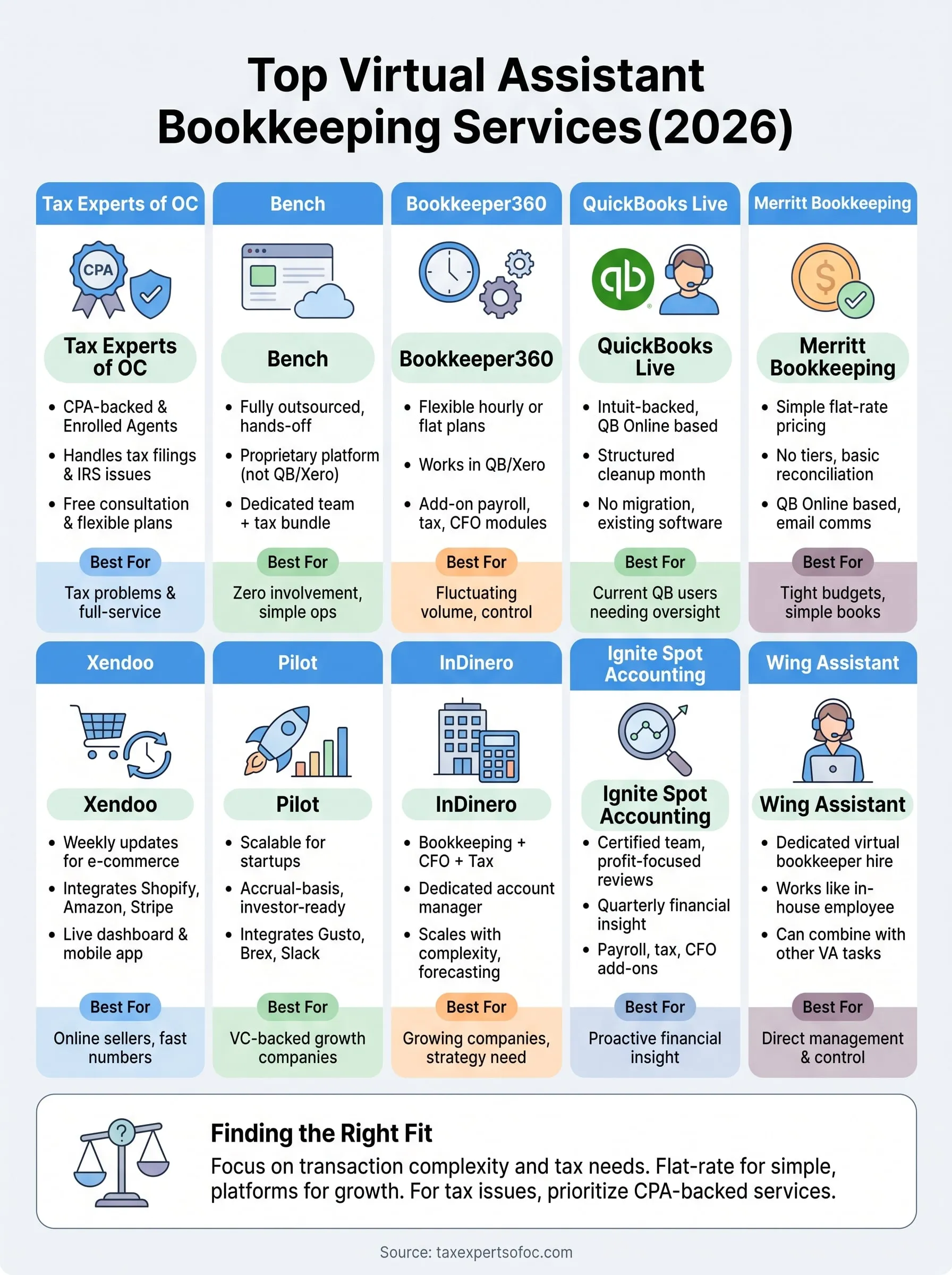
Finding the right fit for your books
Every provider on this list solves a different version of the same problem: your books need attention you either don't have time for or don't trust yourself to give. Flat-rate services like Merritt work if your transactions stay simple, while platforms like Pilot or InDinero make sense once you're juggling investors or multi-entity complexity. The real question isn't which one has the flashiest dashboard. It's whether the provider can handle what happens when your books reveal a bigger problem, like unfiled returns or an IRS notice sitting in a drawer.
That's where most virtual assistant bookkeeping services fall short. They categorize transactions but can't represent you if the IRS comes calling. If your bookkeeping mess is tangled up with tax debt, missed filings, or an audit letter, you need a team that handles both under one roof. Book a free consultation for CPA-led bookkeeping and accounting with Tax Experts of OC and get your books and your tax situation sorted by the same people.