
Missing a filing deadline costs you money fast. The IRS charges a failure-to-file penalty of 5% of unpaid taxes per month, and that stacks on top of interest that keeps accruing until you pay in full. If you're wondering when is the corporate tax filing deadline, the answer depends entirely on how your business is structured, and that's where most owners get tripped up.
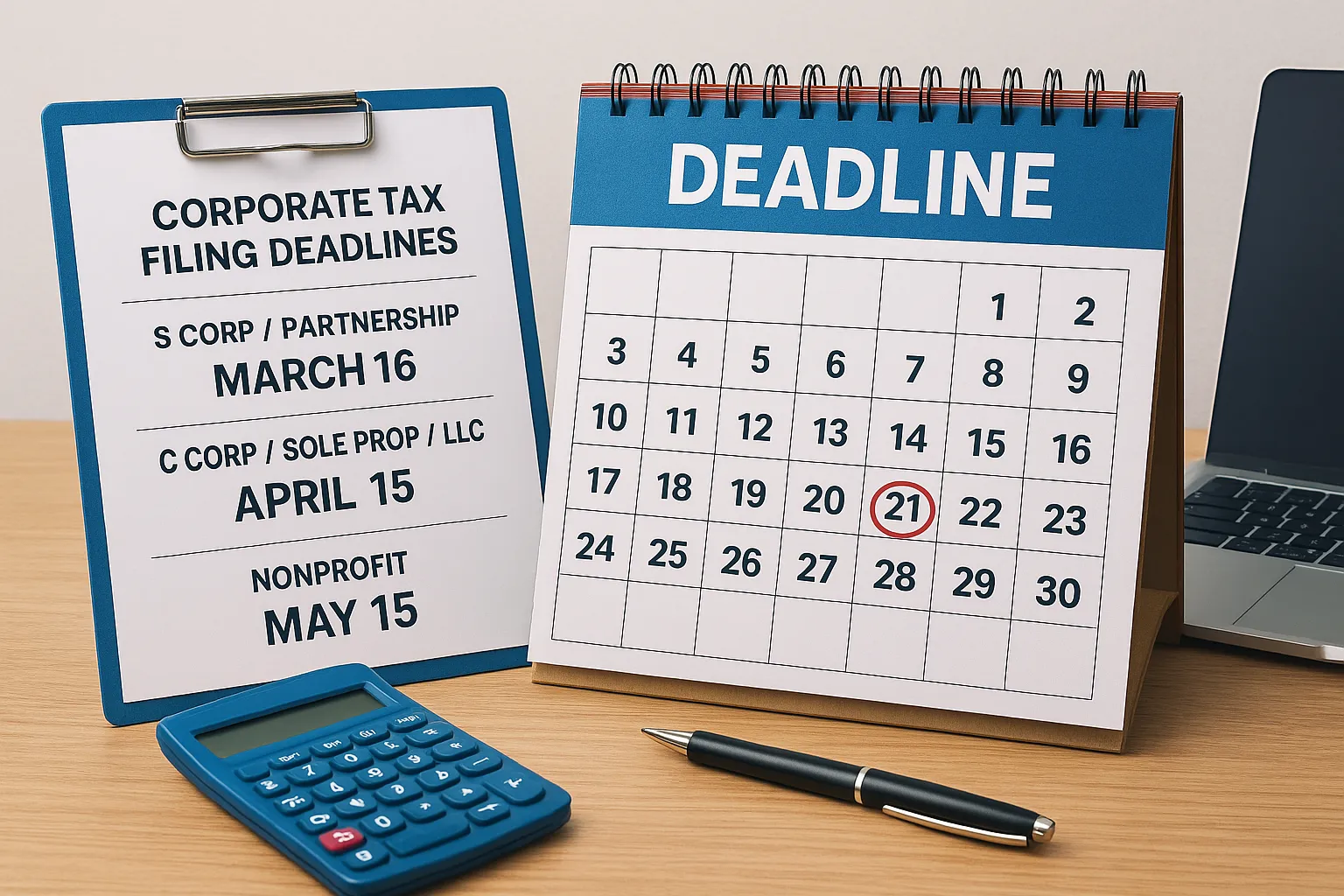
Here's the short version: S corporations and partnerships file by March 15, while C corporations have until April 15 for calendar-year filers. Miss either date and you can request an extension, but that only buys you more time to file, not more time to pay what you owe. The corporate tax filing deadline with extension pushes S corps and partnerships to September 15, and C corps to October 15.
Below, we break down the exact corporate tax filing due date for every entity type, including LLCs taxed as sole proprietorships, plus how extensions work and what happens if you file late. We handle these deadlines for clients across all 50 states, so we know exactly where owners run into trouble and how to fix it before the IRS gets involved.
Why corporate tax filing deadlines matter
A missed deadline isn't just a paperwork slip. It triggers an automatic chain of penalties and interest that grows every single day you wait, and it can flag your business for closer IRS scrutiny down the road. Corporate tax filing deadlines exist to keep the government's revenue cycle predictable, but for you, they're the line between a routine filing season and a financial mess that takes months to untangle. Understanding when are taxes due for small business owners isn't optional knowledge, it's the foundation of running a compliant, financially healthy company.
Penalties stack fast
Once you miss the deadline for corporate tax filing, the IRS starts charging a failure-to-file penalty of 5% of your unpaid tax for every month or partial month the return is late, capped at 25% of the balance. If you also failed to pay, a separate failure-to-pay penalty of 0.5% per month applies on top of that, plus interest that compounds daily. Here's how the numbers typically break down for a business owing $20,000 in unpaid taxes:
- Month 1 late: roughly $1,100 in combined penalties
- Month 3 late: over $3,000, plus accruing interest
- Month 5+ late: penalties cap near $5,000, and interest keeps climbing indefinitely
A single missed deadline can turn a manageable tax bill into a five-figure problem within months.
Deadlines protect your standing with the IRS
Consistently filing on time keeps your business in good standing, which matters more than most owners realize. Late filings can trigger automated notices, increase your odds of an audit, and complicate future loan applications since lenders often request your last few years of returns. Repeated late filings also make it harder to negotiate if you ever do fall behind, since the IRS is less likely to waive penalties for a business with a spotty compliance history. If your company has already received a notice or you're behind on prior years, understanding what tax resolution services do can help you get current before the situation escalates further.
Missing a date affects more than your bottom line
Beyond the direct financial hit, a missed deadline eats into time you should be spending running your business. Owners end up scrambling to gather records, calculate estimated payments, and respond to IRS correspondence instead of focusing on operations or growth. Knowing your exact corporate tax filing date in advance lets you plan cash flow, coordinate with your bookkeeper, and avoid the scramble entirely. That's the real value of tracking these dates closely: it's not about the calendar, it's about protecting your time, your finances, and your standing with the IRS all at once.
Corporate tax filing deadlines by entity type for 2026
Every business entity has its own corporate tax filing due date and its own form, from the C-corp return on Form 1120 to Schedule C, and mixing them up is the fastest way to end up with a late-filing penalty you didn't see coming. The dates below assume a calendar-year business, meaning your fiscal year runs January 1 through December 31, which covers the vast majority of small businesses and corporations we work with.
Your entity type determines your deadline, not your revenue, your industry, or how long you've been in business.
2026 filing dates at a glance
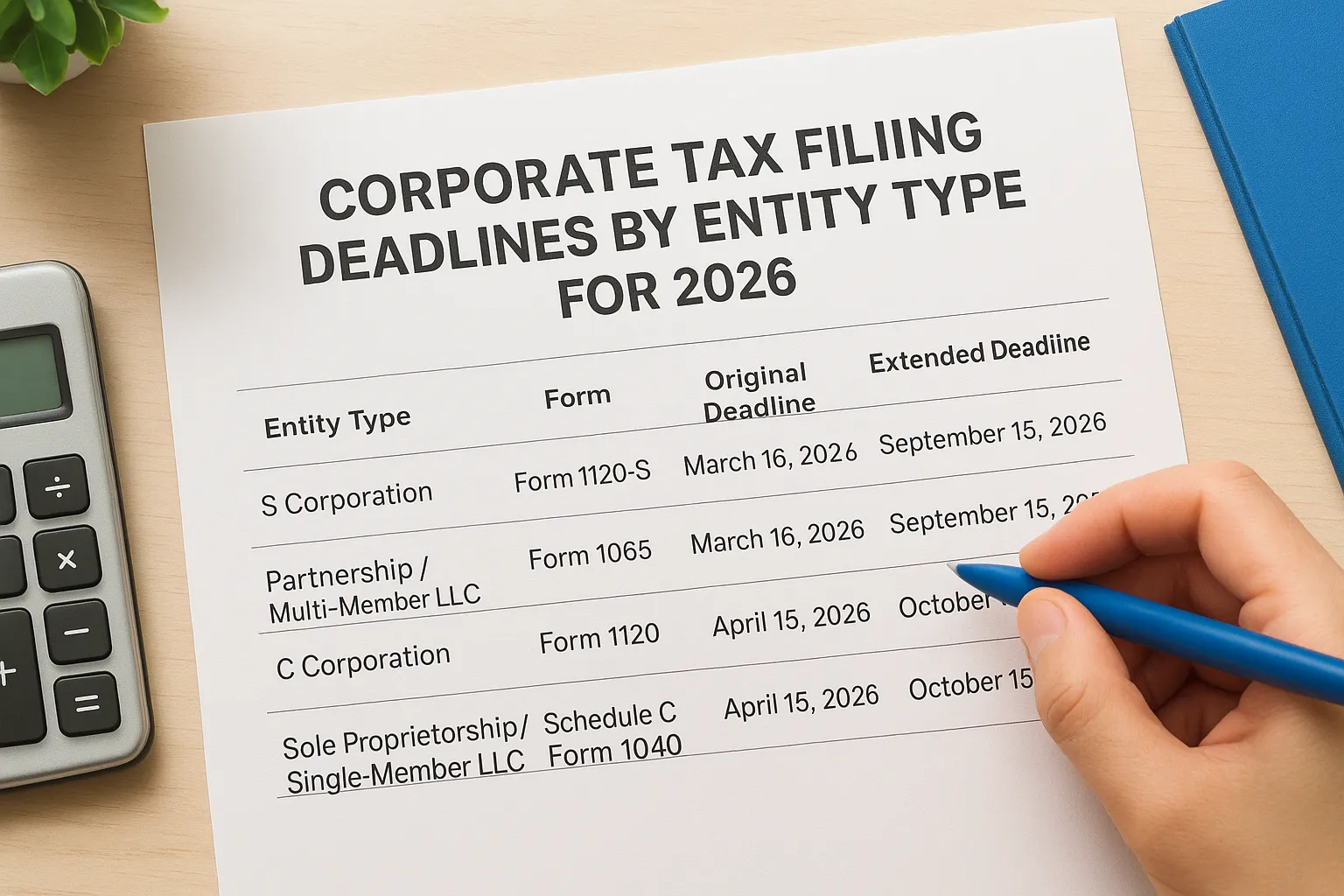
Here's the corporate tax filing deadline 2026 breakdown for tax year 2025 returns, filed in early 2026:
| Entity Type | Form | Original Deadline | Extended Deadline |
|---|---|---|---|
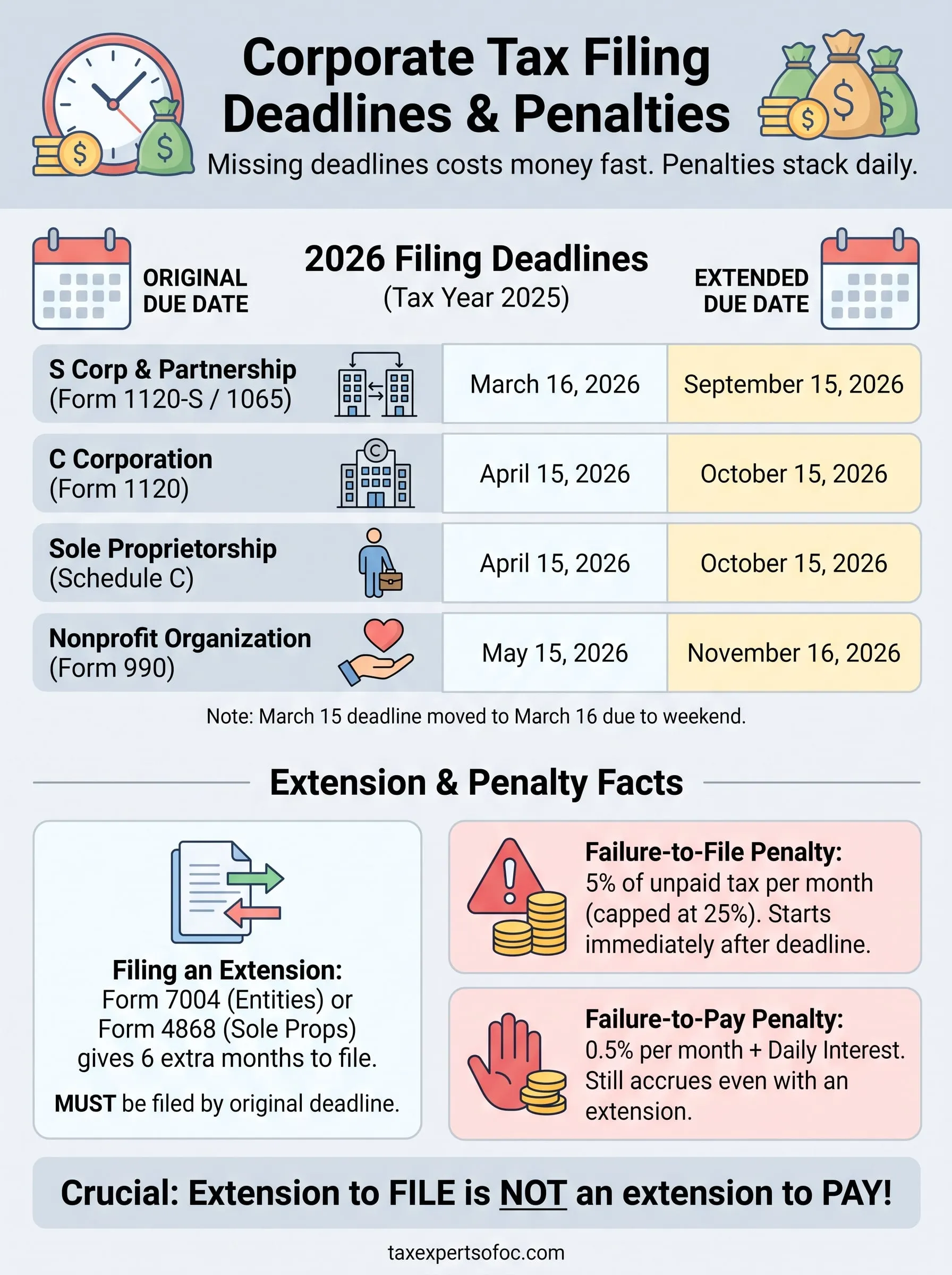
| S Corporation | Form 1120-S | March 16, 2026 | September 15, 2026 |
| Partnership / Multi-Member LLC | Form 1065 | March 16, 2026 | September 15, 2026 |
| C Corporation | Form 1120 | April 15, 2026 | October 15, 2026 |
| Sole Proprietorship / Single-Member LLC | Schedule C with Form 1040 | April 15, 2026 | October 15, 2026 |
| Nonprofit Organization | Form 990 | May 15, 2026 | November 16, 2026 |
Note that March 15 falls on a Sunday in 2026, so the IRS pushes the deadlines for filing an S corp return and a partnership return to the next business day, March 16. That single-day shift trips up a surprising number of owners who circle the wrong date on their calendar every year.
Why LLCs don't have one single date
If you're asking when are small business taxes due for your LLC specifically, the honest answer is: it depends on your tax election. A single-member LLC taxed as a disregarded entity follows the April 15 personal filing deadline. A multi-member LLC taxed as a partnership follows the March 16 deadline. And an LLC that elected S corp or C corp status follows that entity's schedule instead. Check your election on file with the IRS, and review the IRS forms and steps for filing an LLC return, before assuming which date applies to you, since guessing wrong here is one of the most common (and costly) mistakes we see.
How to file a corporate tax extension
Requesting more time to file is straightforward, but it only works if you act before the original deadline passes. Filing a tax extension gives you an extra six months to submit your return, and it's the right move if you're waiting on K-1s, missing records, or still reconciling books. Businesses that needed the corporate tax filing extension deadline 2025 learned this the hard way last spring: the extension request has to be postmarked or e-filed by the original due date, not after.
Filing the right extension form
Which form you file depends entirely on your entity type. Corporations, partnerships, and multi-member LLCs use Form 7004, while sole proprietors and single-member LLCs follow the Form 4868 extension rules alongside their personal return. Here's the general process:
- Estimate your total tax liability for the year as accurately as possible
- Submit the correct extension form (7004 or 4868) by your original deadline
- Pay any estimated tax owed at the same time you file the extension
- Mark your new extended deadline and file the complete return before it arrives
Getting this wrong, like submitting the individual form for a partnership, voids the extension entirely and leaves you exposed to late-filing penalties.
Extensions don't extend your payment deadline
Here's the part that catches almost every first-time filer off guard: an extension to file is not an extension to pay. The IRS still expects your estimated tax payment by the original due date, and interest starts accruing on any unpaid balance immediately after that date, extension or not.
An extension buys you time to file paperwork, never time to pay what you owe.
If you're unsure how much to estimate, working with a CPA or Enrolled Agent before the deadline hits is far cheaper than guessing wrong and facing penalties later.
What happens if you miss the filing deadline
Missing the deadline for corporate tax filing doesn't mean the IRS quietly waits for you to catch up, and the penalties and interest for filing taxes late start on their own schedule. The moment the clock runs out, penalties start accruing automatically, no warning letter required, and interest compounds daily on any unpaid balance. Even if you file the very next day, you're already on the hook for a full month's worth of failure-to-file penalty, since the IRS calculates by month or partial month, not by the day.

The penalty clock starts immediately
Once your corporate tax filing date passes without a return or an approved extension on file, the failure-to-file penalty kicks in at 5% of unpaid taxes per month, capped at 25%. Owe money on top of that unfiled return, and a separate failure-to-pay penalty of 0.5% per month stacks alongside it. Here's what typically happens in the weeks after a missed deadline:
- Automated notice generated within 4 to 8 weeks flagging the unfiled return
- Penalty and interest calculations applied retroactively to the original due date
- Increased likelihood of your return being selected for closer review
- Compounding interest that continues even after you eventually file
The longer you wait to file, the more expensive doing nothing becomes, every single day.
Filing late is still better than not filing at all
Businesses that assume skipping a return entirely is less risky than filing late are wrong, and there are clear steps for filing back taxes with the IRS. The failure-to-file penalty is ten times steeper than the failure-to-pay penalty, so submitting your return even without full payment stops the bigger penalty from growing. Reaching out to the IRS directly or working with a tax resolution firm to negotiate a payment plan almost always beats letting the return sit unfiled while penalties accumulate unchecked in the background.
Tips to stay ahead of your business tax deadlines
Staying compliant isn't about memorizing dates once a year, it's about building habits that make the corporate tax filing due date a non-event rather than a fire drill. Owners who never scramble in March or April tend to share the same few practices, and none of them require accounting expertise, just consistency.
Build a deadline calendar early
Set reminders 60, 30, and 10 days before your entity's filing date, not just the day itself. That buffer gives you enough runway to gather missing records, chase down K-1s, or file an extension if something's genuinely incomplete. A simple checklist keeps this manageable:
- Confirm your entity type and its correct filing date for the current year
- Schedule quarterly check-ins with your bookkeeper, not just an annual one
- Set calendar alerts at 60, 30, and 10 days out
- Reconcile books monthly so nothing piles up before filing season
The businesses that never miss a deadline aren't lucky, they just plan earlier than everyone else.
Keep your books current all year
Waiting until January to reconstruct twelve months of transactions is how owners end up filing extensions out of necessity instead of choice. Monthly bookkeeping means your numbers are ready the moment tax season opens, and it also gives you accurate financials for loan applications or investor conversations year-round. This is exactly why bookkeeping and accounting support for small businesses pays for itself, since a professional catching a coding error in June is far cheaper than one untangling it in April.
Loop in a professional before problems start
Getting a CPA or Enrolled Agent involved before you're behind, not after, is the single biggest factor separating owners who file on time from those who don't. Professionals catch entity election issues, estimated payment shortfalls, and missing documentation months before they become deadline emergencies. Whether you're tracking the 2025 corporate tax filing deadline or planning ahead for next year with year-round tax planning tips, a quick consultation now beats a penalty notice later.
Keeping your business on track year-round
Knowing when is the corporate tax filing deadline for your entity type is only half the battle. The other half is building habits that keep you ahead of that date instead of racing toward it every spring. S corps and partnerships file by March 15, C corps and sole proprietors by April 15, and extensions push those dates six months further, but none of that matters if your books aren't ready when the deadline arrives. Missing it costs real money through penalties and interest that compound daily, while filing on time keeps your standing with the IRS clean and your cash flow predictable. Treat your corporate tax filing due date as a year-round commitment, not a once-a-year scramble, and you'll never face an avoidable penalty again. If you want that kind of certainty for your business, talk to our team at Tax Experts of OC about business tax return preparation before your next deadline sneaks up on you.