
You searched virtual bookkeeping services pricing because a quote came back higher than expected, or a provider's website only says "contact us for a custom quote." Either way, you want real numbers before you commit your business's books to someone you've never met in person.
Here's the short answer: most small businesses pay somewhere between $150 and $900 per month for virtual bookkeeping, depending on transaction volume, number of accounts, and whether payroll or tax filing gets bundled in. Businesses with messy books or multiple entities can push past that range, while a simple LLC with low transaction counts often lands at the lower end. What actually moves the price isn't the
Why virtual bookkeeping pricing varies so much
Ask five virtual bookkeeping firms for a quote and you'll get five different numbers, sometimes for the exact same business. That's not because someone is padding the bill. Bookkeeping pricing depends on a mix of variables that don't show up on a website's pricing page, the same ones behind monthly and hourly bookkeeping rates: how many bank and credit card accounts you run, how many transactions hit those accounts each month, whether you sell in multiple states, and how clean your books were before you called for help. A landscaping company with one checking account and 40 transactions a month costs far less to service than an e-commerce brand with three sales channels, inventory tracking, and 600 transactions.

Transaction volume drives the base rate
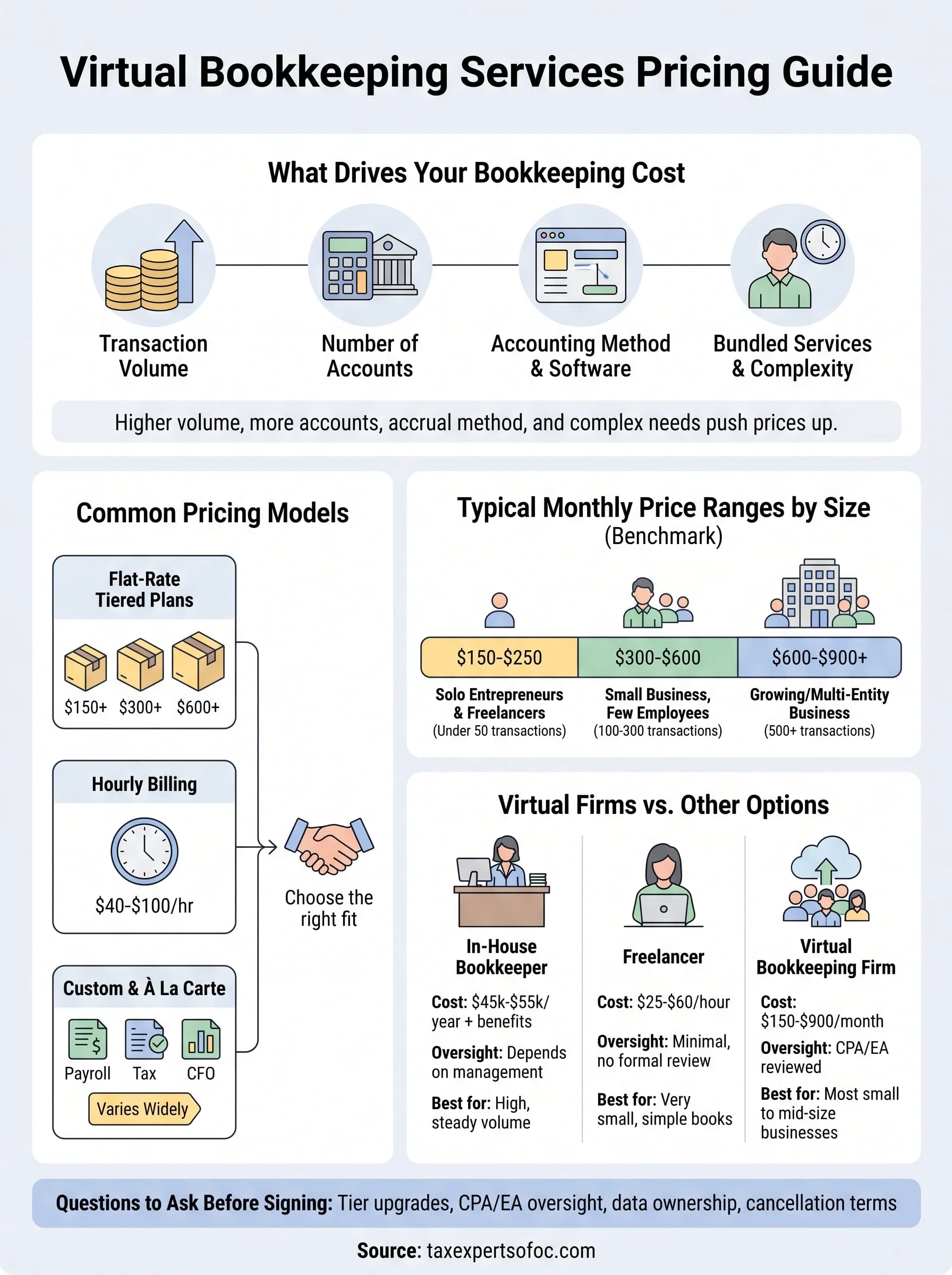
Virtually every provider prices around transaction volume because it's the closest proxy for the hours a bookkeeper actually spends categorizing entries, reconciling accounts, and catching errors. A business with under 100 monthly transactions might sit comfortably in a $150 to $250 tier. Push past 500 transactions and you're often looking at $500 or more, regardless of your industry. This is why two businesses with identical revenue can pay wildly different amounts. Revenue tells you almost nothing about how much bookkeeping work is involved. Transaction count tells you almost everything.
The number of transactions you generate each month, not your revenue, is the single biggest driver of your bookkeeping bill.
What's bundled changes the total
Some quotes cover categorization and reconciliation only. Others fold in payroll processing, sales tax filing, accounts payable and receivable management, or monthly financial statements with a short call to walk through them. When a provider's number looks unusually low, check what's excluded before you get excited. A $99 plan that doesn't include payroll or year-end tax prep isn't cheaper than a $400 plan that does. It just moves the missing pieces to a separate invoice you'll pay anyway. Ask for a line-item breakdown so you're comparing the same scope of work across quotes.
Cash versus accrual and industry complexity
Accounting method matters more than most business owners realize when they're shopping for pricing. Cash-basis accounting is simpler and cheaper to maintain because you record income and expenses when money actually moves. Accrual accounting, which the IRS requires for many corporations and businesses carrying inventory over $30 million in gross receipts, involves tracking receivables, payables, and adjusting entries, which takes more time and expertise. You can review the IRS's own accounting method rules directly on irs.gov if you're unsure which method applies to your business.
Industry adds another layer. A restaurant with daily cash deposits, tip reporting, and vendor invoices needs more hands-on attention than a solo consultant billing four clients a month. Non-profits bring fund accounting requirements. Multi-entity businesses need consolidated reporting across separate books. All of this gets baked into the quote whether or not the provider explains it upfront.
A quick snapshot of what moves your price
| Factor | Lower cost impact | Higher cost impact |
|---|---|---|
| Monthly transactions | Under 100 | 500+ |
| Number of accounts | 1-2 accounts | Multiple bank, credit, and merchant accounts |
| Accounting method | Cash-basis | Accrual |
| Services included | Categorization only | Payroll, AP/AR, tax filing bundled |
| Books at handoff | Clean, up to date | Backlogged or needing catch-up work |
| Industry | Simple service business | Inventory, restaurants, non-profits |
Once you understand these levers, a quote stops looking arbitrary. It starts looking like a reflection of the actual work your books require. That's the frame to keep in mind as we break down how providers structure their fees, because the pricing model itself, flat rate, hourly, or tiered, changes how these same factors show up on your invoice.
How virtual bookkeeping services structure their fees
Providers generally settle on one of three pricing models, and knowing which one you're being quoted matters just as much as the dollar figure itself. Flat-rate tiers, hourly billing, and custom quotes each shift risk differently between you and the bookkeeper, so the same underlying work can look cheap or expensive depending on the structure alone.

Flat-rate tiered plans
Most of the best virtual bookkeeping services for small businesses now sell tiered subscription plans, similar to how software companies price their products. You pick a tier based on transaction volume or account count, and the monthly fee stays fixed as long as you don't outgrow the tier. This model works in your favor because you can budget precisely and never get surprised by a bill that spikes after a busy sales month. It works against you if your business grows fast, because you'll get bumped to the next tier the moment you cross a transaction threshold, sometimes mid-month.
- Starter tier: low transaction count, categorization and reconciliation only
- Growth tier: adds financial statements, higher transaction limits, occasional check-ins
- Premium tier: adds payroll, AP/AR management, and a dedicated bookkeeper with regular calls
Hourly billing
Hourly rates show up most often with independent bookkeepers or firms handling irregular, one-off work like catch-up bookkeeping after months of neglected records. Rates typically run $40 to $100 per hour depending on experience and whether a CPA or Enrolled Agent reviews the work. Hourly billing suits businesses with unpredictable, low-volume needs, but it punishes anyone whose books are a mess, since disorganized records simply take more hours to untangle. If you go this route, ask for an estimated hour range before work starts, not just a rate.
A fixed monthly fee protects your budget, but only an hourly rate rewards you for keeping clean records in the first place.
Custom and à la carte pricing
Larger businesses, multi-entity structures, and companies needing an outsourced CFO and controllership layer on top of basic bookkeeping usually get custom quotes built from a menu of add-on services rather than a preset tier. This approach fits complexity that doesn't map cleanly to a standard package, but it also makes shopping around harder, since no two custom quotes list services the same way. When you get a custom quote, ask the provider to itemize each service separately so you can compare it against a competitor's tiered plan.
| Pricing model | Best fit | Typical range |
|---|---|---|
| Flat-rate tiered | Predictable volume, steady growth | $150-$900/month |
| Hourly | Catch-up work, irregular needs | $40-$100/hour |
| Custom/à la carte | Multi-entity, complex add-ons | Varies widely |
None of these structures is inherently better. The right one depends on how predictable your transaction volume is and whether you'd rather trade budgeting certainty for pay-as-you-go flexibility.
What factors push your bookkeeping costs up or down
Every quote you receive is really a bet on how many hours your books will require each month, and several factors outside pure transaction volume shift that bet up or down. Understanding these variables before you talk to a provider lets you push back on a quote that seems inflated, and it explains why two businesses in the same industry sometimes pay very different amounts for what looks like the same service.
Cleanup work and how messy your books are
Most providers charge separately for catch up bookkeeping services, the work of reconstructing months or years of neglected records before ongoing service can even begin. If you haven't reconciled your accounts in six months, expect a one-time fee on top of your regular monthly rate, often calculated hourly since the scope is hard to predict in advance. Businesses that hand over clean, current books at onboarding skip this cost entirely and start their monthly plan immediately.
Clean books at handoff can save you hundreds of dollars in cleanup fees before your monthly plan even starts.
Software and integration requirements
Which accounting platform you use, and how many other tools it needs to talk to, also moves the price. A straightforward QuickBooks Online setup costs less to manage than a business running Xero alongside a separate inventory system, a payroll platform, and a point-of-sale integration that all need to sync correctly each month. Every integration is a potential failure point a bookkeeper has to check, and that checking time gets billed somewhere. If your business relies on several connected tools, ask upfront whether integration troubleshooting is included or billed separately.
Payroll headcount and employee complexity
Payroll services for small businesses usually scale with employee count rather than charging a flat fee, so a business with three employees pays noticeably less than one with thirty. Multi-state payroll adds another layer of payroll compliance, since each state carries its own withholding and unemployment insurance rules that a bookkeeper or payroll specialist has to track. You can confirm state-specific payroll tax obligations directly through the IRS employment tax page if you're setting up payroll for the first time.
Reporting frequency and turnaround expectations
How often you want reports, and how fast you expect answers to questions, also factors into cost. A plan with month-end close tasks handled monthly and a quarterly check-in costs less than one promising weekly reports and a dedicated bookkeeper answering emails within a few hours. Faster turnaround and more frequent reporting mean a provider staffs your account more heavily, and that staffing cost shows up in your invoice.
A quick checklist to lower your bill
- Reconcile accounts monthly so cleanup fees never accumulate
- Consolidate accounts and tools where possible to reduce integration overhead
- Confirm exactly what's bundled before comparing two quotes
- Ask whether quarterly reporting instead of weekly reporting lowers the tier
- Keep employee headcount and payroll structure documented and current
Typical monthly price ranges by business size
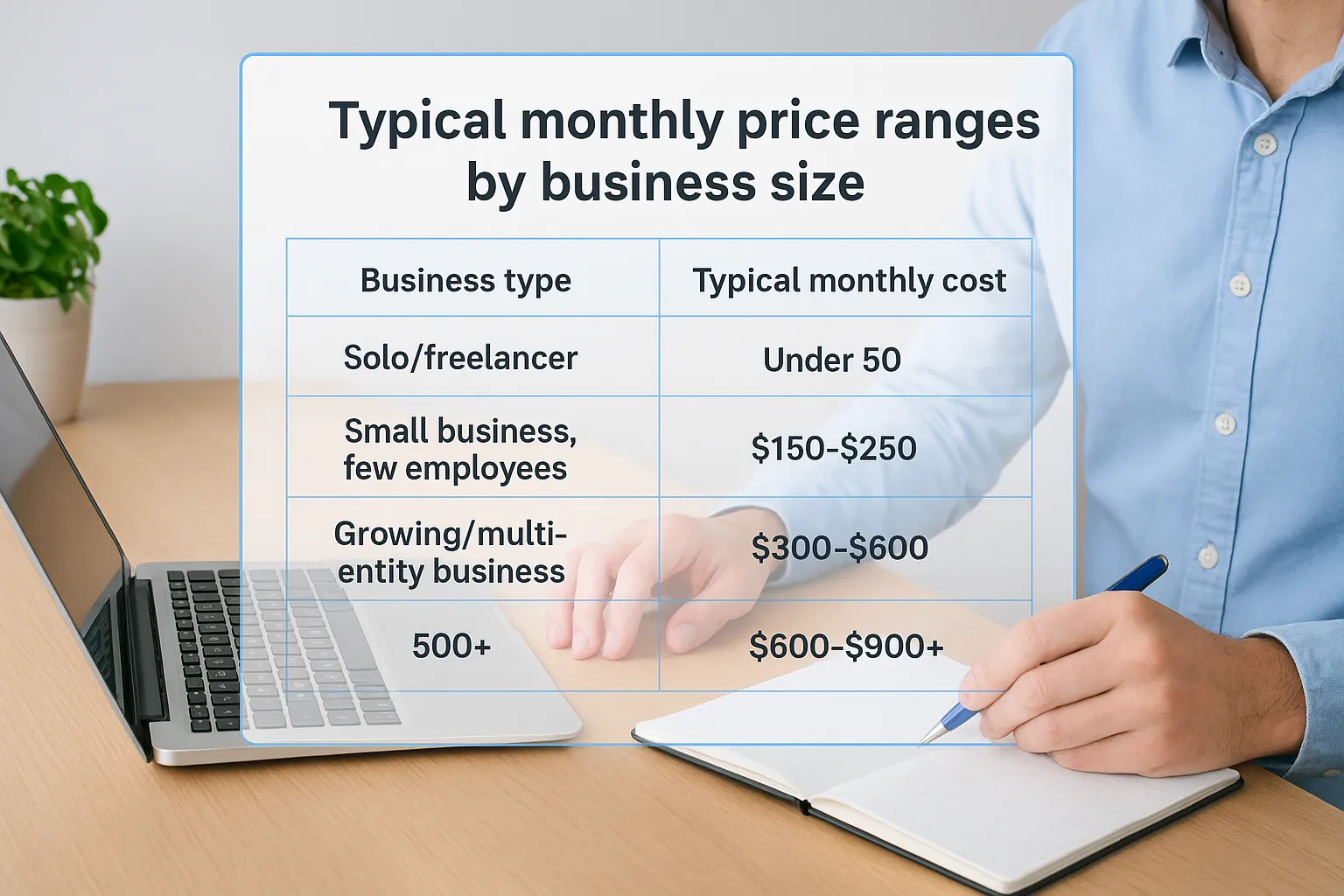
Business size gives you a rough starting point before you even talk to a provider, since revenue and headcount tend to correlate with transaction volume even though they don't guarantee it. Solo entrepreneurs and freelancers with a single bank account and light monthly activity typically land at the bottom of the range, while a company with employees, inventory, or multiple sales channels needs a heavier tier. Treat these numbers as a benchmark, not a quote, since your actual virtual bookkeeping services pricing still depends on the factors covered earlier in this article.
Solo entrepreneurs and freelancers
Sole proprietors and single-member LLCs with under 50 monthly transactions usually pay between $150 and $250 a month for basic categorization and reconciliation. Most of these businesses run cash-basis accounting with no payroll, which keeps the scope narrow. If you're a consultant billing a handful of clients or a freelancer invoicing through one platform, expect to sit at this end unless you also want tax filing bundled in, and see our guide to bookkeeping for independent contractors for what that scope looks like.
Small businesses with a few employees
Small businesses running 100 to 300 transactions a month, often with two to ten employees on payroll, typically pay $300 to $600 monthly. This tier usually includes financial statements and a check-in call, and payroll processing gets added as a separate line item scaled to headcount. A retail shop, small law firm, or local service business with a modest team commonly falls here, which is the typical profile for outsourced bookkeeping for small business plans.
Growing companies and multi-entity businesses
Companies pushing past 500 transactions a month, running accrual accounting, or managing more than one legal entity typically pay $600 to $900 or more. This range often includes AP/AR management, dedicated bookkeeper access, and sometimes light CFO-level reporting for owners who need more than a monthly statement to make decisions. Businesses at this stage benefit from full-service support like the bookkeeping and accounting services offered by Tax Experts of OC, where pricing scales with the actual complexity of the books rather than a one-size-fits-all tier.
A solo freelancer and a ten-employee company should never expect the same quote, and if they get one, something in the scope doesn't match the price.
Price ranges at a glance
| Business type | Monthly transactions | Typical monthly cost |
|---|---|---|
| Solo/freelancer | Under 50 | $150-$250 |
| Small business, few employees | 100-300 | $300-$600 |
| Growing/multi-entity business | 500+ | $600-$900+ |
Remember that these figures assume reasonably clean books at signup. Yet a growing company with backlogged records or a solo freelancer who hasn't reconciled in a year can easily push above these ranges until the catch-up work is done. Size gets you in the right neighborhood, but the specifics still decide the final number on your invoice.
Virtual bookkeeping vs in-house staff vs freelancers
Once you know your rough price range, the next question is what you're actually comparing it against. Virtual bookkeeping services aren't competing only with each other. They're competing with hiring an in-house bookkeeper or handing the work to an independent freelancer, and the total cost picture looks different once you understand how outsourced bookkeeping works beyond the invoice line.

Hiring an in-house bookkeeper
Budget-wise, an in-house hire looks expensive fast. A part-time bookkeeper typically costs $20 to $30 an hour before payroll taxes, benefits, workers' comp, and the software licenses you'll need to buy separately. A full-time bookkeeper's salary often runs $45,000 to $55,000 a year in most markets, and that figure doesn't include the time you'll spend managing them, covering for sick days, or finding a replacement when they leave. In-house makes sense when your transaction volume is high enough and steady enough that one dedicated person stays busy full time, but for most small businesses, that threshold never gets reached.
Working with an independent freelancer
Freelance bookkeepers usually charge less per hour than a firm, often $25 to $60 an hour, which makes them attractive for lean budgets. The tradeoff is oversight. A solo freelancer has no CPA reviewing their work, no backup if they get sick or disappear mid-tax-season, and often no formal process for catching errors before they compound. Quality varies enormously from one freelancer to the next, and you're rarely paying for the layered review a firm builds into its process.
Cheaper per hour doesn't mean cheaper overall if nobody is checking the freelancer's work before it reaches your tax return.
Where virtual bookkeeping firms fit
A firm like Tax Experts of OC sits between these two extremes. You get fixed monthly pricing instead of an hourly guessing game, plus the built-in oversight of a CPA and Enrolled Agent reviewing the books rather than one person working in isolation. That combination matters most once tax season arrives, since a firm handling both bookkeeping and tax preparation can catch discrepancies before they turn into an IRS notice, something a standalone freelancer rarely offers.
Comparing the three options
| Option | Typical cost | Oversight | Best fit | |---|---|---| | In-house bookkeeper | $45k-$55k/year plus benefits | Depends on management | High, steady transaction volume | | Freelancer | $25-$60/hour | Minimal, no formal review | Very small, simple books | | Virtual bookkeeping firm | $150-$900/month | CPA/EA reviewed | Most small to mid-size businesses |
Ultimately, the right choice depends less on which option is cheapest per hour and more on what happens when something goes wrong. Firms build redundancy and review into the price. In-house and freelance arrangements usually leave that gap for you to fill yourself.
How to choose the right pricing plan for your business
Picking a plan comes down to matching the tier to your actual books, not to what sounds impressive or what a sales rep pushes hardest. Start with your last three months of bank and credit card statements and count the transactions yourself before you ever call a provider. That number, not your revenue or your ambitions for next year, should drive which tier you request a quote for.
Match the plan to your current volume, not your goals
It's tempting to sign up for a higher tier because you expect to grow into it, but that just means paying for capacity you're not using yet. Right-sizing your plan to today's transaction count keeps your monthly cost honest, and most reputable firms let you upgrade with a phone call once you actually cross a threshold. If a provider insists you commit to a premium tier before your books justify it, treat that as a red flag rather than good advice.
Pay for the bookkeeping your business needs today, not the bookkeeping you hope to need in two years.
Decide what actually needs to be bundled
Before comparing prices, list the services you genuinely need this year: payroll, sales tax filing, AP/AR management, or tax preparation alongside your bookkeeping. Bundling tax preparation services and bookkeeping with one firm, the way Tax Experts of OC structures its services, often costs less overall than paying separate providers for each piece, and it means one team already understands your books when filing season arrives. If you don't need payroll support yet, don't pay for a tier that assumes you do.
Weigh flexibility against predictability
Some businesses value knowing their bill won't change from month to month. Others have seasonal swings, like a landscaping company slow in winter and slammed in summer, and would rather pay for actual volume than lock into a flat rate sized for their busiest month. Ask providers directly whether their tiers adjust downward in slow months, not just upward in busy ones.
A short checklist before you pick a tier
- Count your actual monthly transactions across all accounts, not an estimate
- List which add-on services (payroll, AP/AR, tax filing) you need this year, not eventually
- Ask whether the plan adjusts if your volume drops in slower months
- Confirm whether a CPA or Enrolled Agent reviews the work, or just a bookkeeper
- Request the tier's transaction ceiling in writing so you know exactly when you'll get bumped up
Once you've matched a tier to your real numbers and confirmed what's included, you're in a much stronger position to negotiate or walk away from a mismatched quote. The next step is making sure the contract itself protects you once you've picked a plan, which is where a short list of direct questions before signing pays off.
Questions to ask before you sign a contract
A contract locks in more than a price. It locks in what happens when your business changes, when a mistake gets made, or when you want out. Before you sign anything, read the fine print on scope, cancellation, and accountability, not just the monthly number at the top of the page. Most disputes over virtual bookkeeping services pricing trace back to a term nobody asked about upfront, not to the provider acting in bad faith.
What happens when you outgrow your tier
Growth should feel like good news, not a billing surprise. Ask exactly how many transactions trigger an upgrade, whether the change happens automatically or only after a conversation, and whether you get notice before the higher rate hits your card. Automatic tier changes without warning are the single most common complaint clients have about subscription-style bookkeeping plans, so get the trigger point and the notice period in writing before you sign.
Who actually touches your books
Catch this before you commit: does a CPA or Enrolled Agent review the work, or does a single bookkeeper handle everything with no second set of eyes? Direct access to a credentialed professional matters most once tax season arrives or an IRS notice shows up, which is exactly when a CPA is worth it instead of a single set of eyes on your books. Ask for the name and credentials of the person assigned to your account, not just a description of the team.
If nobody with a CPA or EA license ever looks at your books, you're paying for data entry, not real oversight.
How cancellation and data ownership work
Exiting a contract should be simple, and any provider that makes it complicated is telling you something. Confirm the notice period required to cancel, whether you owe a fee for leaving early, and how quickly you get your QuickBooks or Xero file exported and handed back to you. Some providers hold your data hostage behind a support ticket queue for weeks. Get the export timeline in writing, not as a verbal promise.
A short list to run through before signing
- What exact services are included, and what triggers an extra charge?
- What's the transaction ceiling for this tier, and what happens above it?
- Does a CPA or Enrolled Agent review the work, and how often?
- What's the notice period and fee, if any, for canceling?
- How fast do you get your books exported if you leave?
- Is catch-up work billed separately, and at what rate?
- Who do you contact directly if something looks wrong?
Your goal isn't to interrogate every provider you talk to. It's to walk away with answers you can compare side by side, since a slightly higher monthly fee with clear terms usually beats a cheaper quote that leaves half these questions unanswered.
Finding a bookkeeping price that fits your business
By now the range shouldn't feel like a mystery. Virtual bookkeeping services pricing tracks your transaction volume, what's bundled, and how clean your books are, not some arbitrary number a provider pulled out of thin air. A solo freelancer belongs in the $150 to $250 tier. A growing company with payroll and multiple accounts belongs higher up, and that's fine as long as the scope matches the price. Compare quotes side by side, count your own transactions before you call anyone, and ask the questions from the last section before you sign anything.
Getting this right protects your budget and your books at the same time. If you'd rather talk through your actual numbers than guess at a tier, book a free 30-minute consultation about accounting and bookkeeping support with Tax Experts of OC and get a quote built around your business instead of a generic package.