
Most people think about taxes once a year, right before the filing deadline, and by then most of the money-saving decisions are already gone. That's the core problem with reactive filing: you're documenting what already happened instead of shaping what happens next. A real tax planning process works the other way around, looking ahead at your income, deductions, and life changes so you owe less when April comes.
If you're searching for how this actually works, here's the direct answer: it's a repeatable sequence of reviewing your financial situation, identifying opportunities like retirement contributions or entity restructuring, and timing income and expenses to your advantage. Solid personal tax planning strategies aren't guesswork or last-minute scrambling; they follow a clear order of operations that any CPA or Enrolled Agent uses with clients.
In this guide, we walk through that process step by step, from gathering your financial records to selecting the right deductions and credits, adjusting withholdings, and building a plan you revisit throughout the year, not just at tax time. Whether you're an individual trying to keep more of your paycheck or a business owner managing multiple revenue streams, you'll leave with a framework you can actually apply.
What is tax planning and why it matters
Tax planning is the practice of arranging your income, deductions, and business decisions ahead of time so you owe the least amount legally possible. It's different from tax preparation, which is just the paperwork you file after the year has already closed. Think of tax preparation versus tax planning as the difference between reporting history and writing it. When you plan ahead, you decide when to sell an asset, how much to contribute to a retirement account, or whether to restructure your business entity, all while there's still time to change the outcome.
Confusing these two concepts is the single biggest mistake we see at Tax Experts of OC. A client hands us a shoebox of receipts in March and asks us to "find deductions," but by then the tax year is closed. You can't retroactively max out a Solo 401(k) contribution deadline that already passed, and you can't undo a stock sale that pushed you into a higher bracket. The tax planning process has to start months before filing season, not during it.
Tax planning vs. tax preparation
| Tax Planning | Tax Preparation | |
|---|---|---|
| Timing | Throughout the year | After year-end |
| Goal | Reduce future liability | Report what happened |
| Flexibility | High, decisions still changeable | Low, mostly locked in |
| Example action | Timing a Roth conversion | Filing Form 1040 |
Tax planning is deciding your outcome before the year ends; tax preparation is just recording it.
Why it matters for your bottom line
Good planning changes real numbers, not just paperwork. A small business owner who restructures from a sole proprietorship to an S-corp at the right revenue threshold can save thousands in self-employment tax every year. An individual who times a large medical expense or charitable donation into a single tax year, rather than spreading it out, can clear the standard deduction and actually benefit from itemizing. None of that works if you wait until February to think about it.
Hardship situations make the case even clearer. If you're behind on filings or facing IRS collections, a documented plan shows the agency you're taking your obligations seriously, which matters when you're negotiating an installment agreement or an offer in compromise. Planning also protects you from surprises: a mid-year job change, a home sale, or a new side business can each shift your bracket in ways that catch people off guard every April.
Structure is what separates people who consistently save money from people who guess. The rest of this guide breaks that structure into four steps you can apply this year, starting with the records and goals every plan needs before you pick a single strategy. If your situation involves multiple income streams, back taxes, or a business entity, working with a licensed CPA or Enrolled Agent through our tax planning services will save you from the trial-and-error that costs most people money. The IRS itself publishes withholding and estimated tax guidance you can review directly at IRS.gov to understand the baseline rules before you build strategy on top of them.
Step 1. Gather your financial records and set goals
Before you pick a single strategy, you need an accurate picture of where you stand. Pull last year's tax return, current pay stubs, 1099s, K-1s, mortgage statements, and any brokerage account summaries. If you run a business, add your profit and loss statement and balance sheet to the pile. You can't plan around numbers you haven't looked at yet, and skipping this step, or keeping receipts in an IRS-ready system, is why so many people end up guessing at deductions in March instead of claiming them on purpose.
Once your documents are in front of you, calculate your effective tax rate from last year and estimate your projected income for the current year. Compare the two. A raise, a new freelance contract, or a business that finally turned profitable can bump you into a new bracket, and you want to know that in June, not next April. This is also the point where you set concrete goals rather than vague ones. "Pay less tax" isn't a plan. "Reduce taxable income by $8,000 through retirement contributions" is.
You can't plan around numbers you haven't looked at yet.
Build a simple intake checklist
Use this list to organize what you need before moving to strategy selection:
- Prior year federal and state tax returns
- Year-to-date pay stubs or business P&L
- 1099s, K-1s, and W-2s received so far
- Retirement account statements (401(k), IRA, SEP)
- Records of major life events (marriage, home sale, new child, business formation)
- Any IRS notices or outstanding balances
Set specific, dollar-based goals
Goals only work when they're measurable, so write down a target number instead of an intention. For example: maximize a $23,500 401(k) contribution limit for 2025, or set aside enough quarterly to avoid an underpayment penalty. Specificity is what turns this from a vague resolution into a real plan you can check against.
Running behind on prior years changes the math here too. If you have unfiled returns or existing IRS balances, your tax planning process needs to account for that debt before you optimize this year's liability, since new savings strategies won't matter much if a lien is already attached to your assets. That's a conversation worth having with a professional before you go further.
Step 2. Choose your personal tax planning strategies
With your goals and records in hand, the next move is matching personal tax planning strategies to your actual income type, not a generic list you found online. A W-2 employee has different levers available than a business owner with pass-through income, and picking the wrong tool wastes months you don't get back. This is where the plan stops being paperwork and starts changing what you actually owe.
Match strategies to your income type
Different income sources open different doors. A salaried employee usually gets the most mileage from retirement contributions and HSA funding, since those directly lower taxable wages. A self-employed person or small business owner has more room to maneuver, including entity structure, retirement plans built for owners, and timing of deductible expenses.
- W-2 employees: max out 401(k) or 403(b), adjust withholding, fund an HSA if eligible
- Self-employed/1099: consider a SEP-IRA or Solo 401(k), track quarterly estimated payments
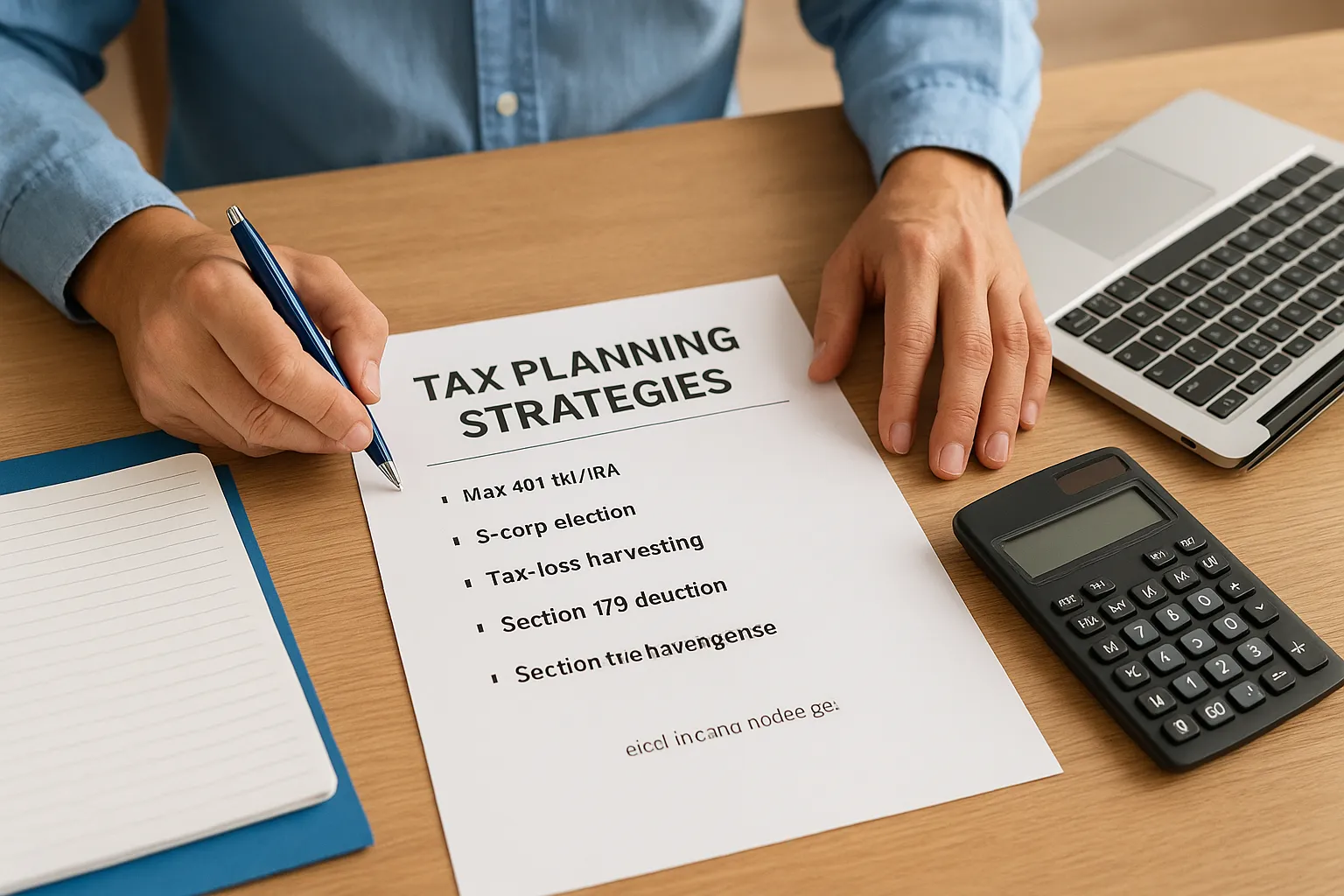
- Business owners: evaluate S-corp election, accelerate equipment purchases under Section 179
- Investors: plan capital gains timing and tax-loss harvesting before year-end
The right strategy depends on where your income comes from, not what worked for your neighbor.
Weigh the trade-offs before committing
Every strategy has a cost, whether that's cash flow, complexity, or a filing deadline you can't miss. Comparing them side by side keeps you from committing to something that sounds good but doesn't fit your situation.
| Strategy | Best for | Trade-off |
|---|---|---|
| Max 401(k)/IRA | Employees, high earners | Reduces current cash flow |
| S-corp election | Profitable self-employed | Adds payroll admin |
| Tax-loss harvesting | Investors with gains | Requires active monitoring |
| Section 179 deduction | Equipment-heavy businesses | Front-loads the expense |
Selecting more than one strategy is normal, and most solid plans stack two or three together rather than relying on a single move. If you're unsure which combination fits your income and risk tolerance, our tax planning services walk through these trade-offs with a CPA before you commit to anything irreversible.
Step 3. Review your plan mid-year and adjust
July is the best month to pull out the plan you built in January and check it against reality. Income rarely tracks a straight line, so a mid-year review catches the freelance contract that came in bigger than expected, or the bonus that pushed you closer to the next bracket. Waiting until December to look means you've lost half your options to actually respond.
Recalculate your projected liability
Grab your pay stubs or business P&L from January through June and double that number as a rough estimate for the full year. Compare it against what you projected back in Step 1. If your income jumped, you may need to increase quarterly estimated payments or fill out a new W-4 correctly before the next paycheck. If income dropped, you might have room to convert some traditional IRA funds to a Roth at a lower rate than you'd planned.
The mid-year checkpoint is where you catch problems while you still have time to fix them.
Adjust for life changes
Life doesn't wait for tax season, and neither should your plan. Run through this quick checklist every June or July:
- Did you get married, divorced, or have a child this year?
- Did you buy or sell a home?
- Did you start or close a business, or change entity type?
- Did you receive an inheritance, bonus, or large capital gain?
- Are you still on track for your retirement contribution goal?
Any yes answer means your personal tax planning strategies from Step 2 might need revising, not scrapped entirely, just tuned to the new numbers.
Confirm your estimated payments are accurate
Underpayment penalties add up fast, and they're one of the easiest problems to avoid with a single afternoon of math. Compare your year-to-date withholding plus estimated payments against 90% of this year's projected liability or 100% of last year's total tax, whichever the IRS safe harbor rules require for your situation. If you're short, adjust your Q3 estimated payment rather than waiting for the surprise in April. Skipping this checkpoint is how otherwise well-planned taxpayers end up owing penalties on money they had all year to set aside.
Step 4. Finalize your taxes and plan for next year
November and December are when your tax planning process shifts from monitoring to closing out the year. By now you know roughly where you'll land, so this is the window to make your last moves: finish any remaining retirement contributions, harvest investment losses against gains, and confirm charitable giving before December 31. Once the calendar flips to January, most of these levers disappear until next year.
Lock in your year-end moves
Go through this checklist before the holidays get in the way:
- Confirm 401(k) or SEP contributions hit before the plan's cutoff (note: IRAs allow until the filing deadline, but 401(k)s do not)
- Finalize charitable donations, including any donor-advised fund contributions
- Sell losing investments to offset gains if tax-loss harvesting fits your plan
- Pay any deductible business expenses you were planning to make anyway
- Double-check your Q4 estimated payment matches your recalculated liability
The moves you can make in December disappear the moment the calendar flips to January.
File with intention, not just accuracy
When you actually file, treat the return as confirmation of a plan you already executed, not the moment you start looking for deductions. If your preparer surfaces a new opportunity you hadn't considered, like an overlooked credit or a missed entity election deadline, note it for next year rather than scrambling to fix it retroactively. Filing season should feel anticlimactic if the planning happened earlier.
Set next year's plan while this year is fresh
Before you file away this year's documents, write down what worked and what didn't. Did you underpay and get hit with a penalty? Did an S-corp election save what you expected? These notes become the starting point for next January's Step 1, so you're not rebuilding your personal tax planning strategies from scratch every twelve months.
Business owners and anyone with multiple income sources benefit from a second set of eyes here. A quick year-end review with our personal and business tax filing services catches last-minute opportunities before the window closes, and sets up a cleaner plan for the year ahead.
Making tax planning a year-round habit
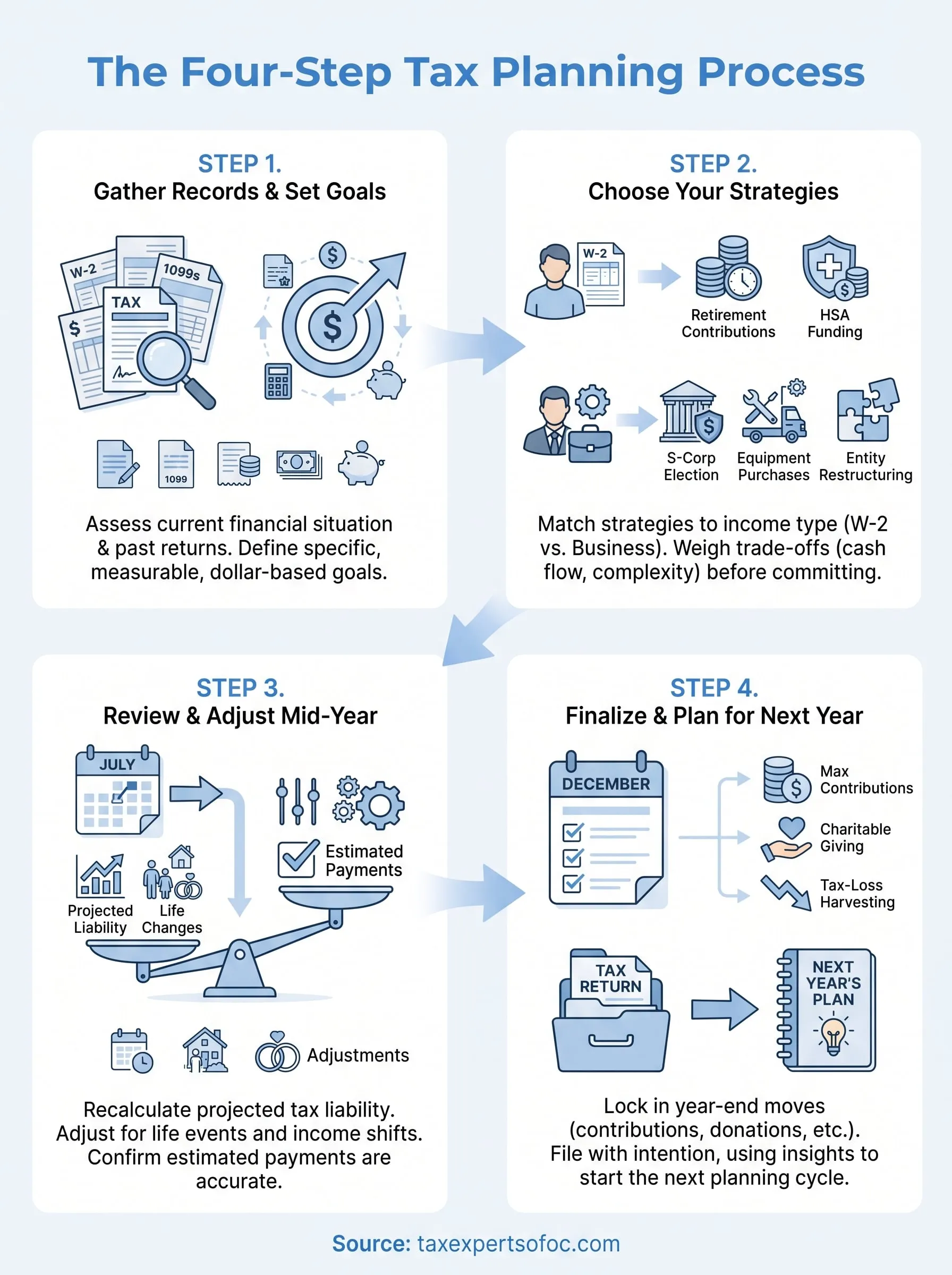
Four steps, repeated every year, is really all the tax planning process comes down to. Gather your records and set real goals, match strategies to your actual income, check your progress mid-year, and close out December with intention instead of panic. Skip any one of these steps and you're back to reactive filing, hunting for deductions after the year that could have used them is already gone.
Getting this right once makes every following year easier, since your notes from this year become the starting point for the next. Habit beats intensity here; a plan you revisit quarterly will always outperform a scramble every April.
Just don't try to build that habit alone if your situation involves back taxes, multiple income streams, or a business entity. Book a free 30-minute consultation for tax planning in Orange County and get a plan built around your actual numbers, not a generic checklist.