
Every tax season, small business owners scramble for the same missing receipt or forgotten 1099. If you're digging through shoeboxes and email attachments trying to figure out what the IRS actually needs, you're not alone, and you're not going to fix that with a vague list of tips. You need a small business tax preparation checklist that walks through every document, deadline, and decision point before you file.
This article gives you exactly that. We built a 10-step checklist for small business taxes based on what actually trips up business owners: missing income records, misclassified expenses, and payroll filings that fall through the cracks. Each step tells you what to gather, what to double check, and where a small mistake turns into an IRS notice months later.
You'll get a practical, step-by-step breakdown covering income documentation, expense tracking, entity-specific forms, and estimated payments, plus guidance on when a downloadable tax prep checklist isn't enough and you need a CPA or Enrolled Agent reviewing your books directly. Work through these steps now, and filing season stops being a fire drill.
1. Decide whether to DIY or hire a tax professional
Before you touch a single receipt, figure out who's actually going to prepare this return. Small business tax preparation gets more complicated every year the IRS adds new reporting thresholds, and software built for a W-2 employee doesn't always catch what a business return requires. This decision shapes everything else on your checklist, since a CPA will want your records organized differently than a DIY filing tool would.
What this step involves
Start by being honest about your complexity. A sole proprietor with a handful of clients and no employees can often manage with quality software. But once you've got payroll, multiple revenue streams, or an S-corp election, the math and the forms multiply fast. Ask yourself three questions: Did your revenue or expenses change significantly this year? Did you receive any IRS notices in the past 12 months? Do you have employees, contractors, or business assets you depreciate? A yes to any of these is a strong signal to bring in an Enrolled Agent or CPA rather than gamble on self-preparation.
If your business has grown more complicated than your filing method, it's time to change the filing method, not push through with the wrong tool.
Documents you'll need
Even before hiring anyone, pull together a starter packet so the conversation is productive:
- Last year's federal and state business tax returns
- A current profit and loss statement
- Your business entity documents (articles of incorporation, LLC operating agreement)
- Any IRS or state tax notices received this year
- A rough list of major purchases, hires, or business changes
Handing this over during a consultation, like the free 30-minute one Tax Experts of OC offers, lets a professional spot problems before they become filing errors.
Common mistakes to avoid
Owners frequently wait until the deadline is a week away to decide they need help, which limits your options and often means paying rush fees. Others assume a general tax preparer at a seasonal chain has the same training as a CPA or Enrolled Agent, when in reality only the latter two can represent you before the IRS if a return gets questioned. Software also lulls people into a false sense of completeness, since it will happily file an incomplete return without flagging that you skipped a required schedule. Underestimating this first decision is the single most common way a checklist for small business tax preparation falls apart before it even starts.
2. Identify your business entity and required tax forms
Your business entity type determines which tax forms you file, when they're due, and how your profits get taxed. A sole proprietorship and an S-corp report income completely differently, and mixing up the forms wastes hours and sometimes triggers penalties for late or incorrect filings. Pin this down early, since every other step in this checklist depends on knowing which return you're actually building.
What this step involves
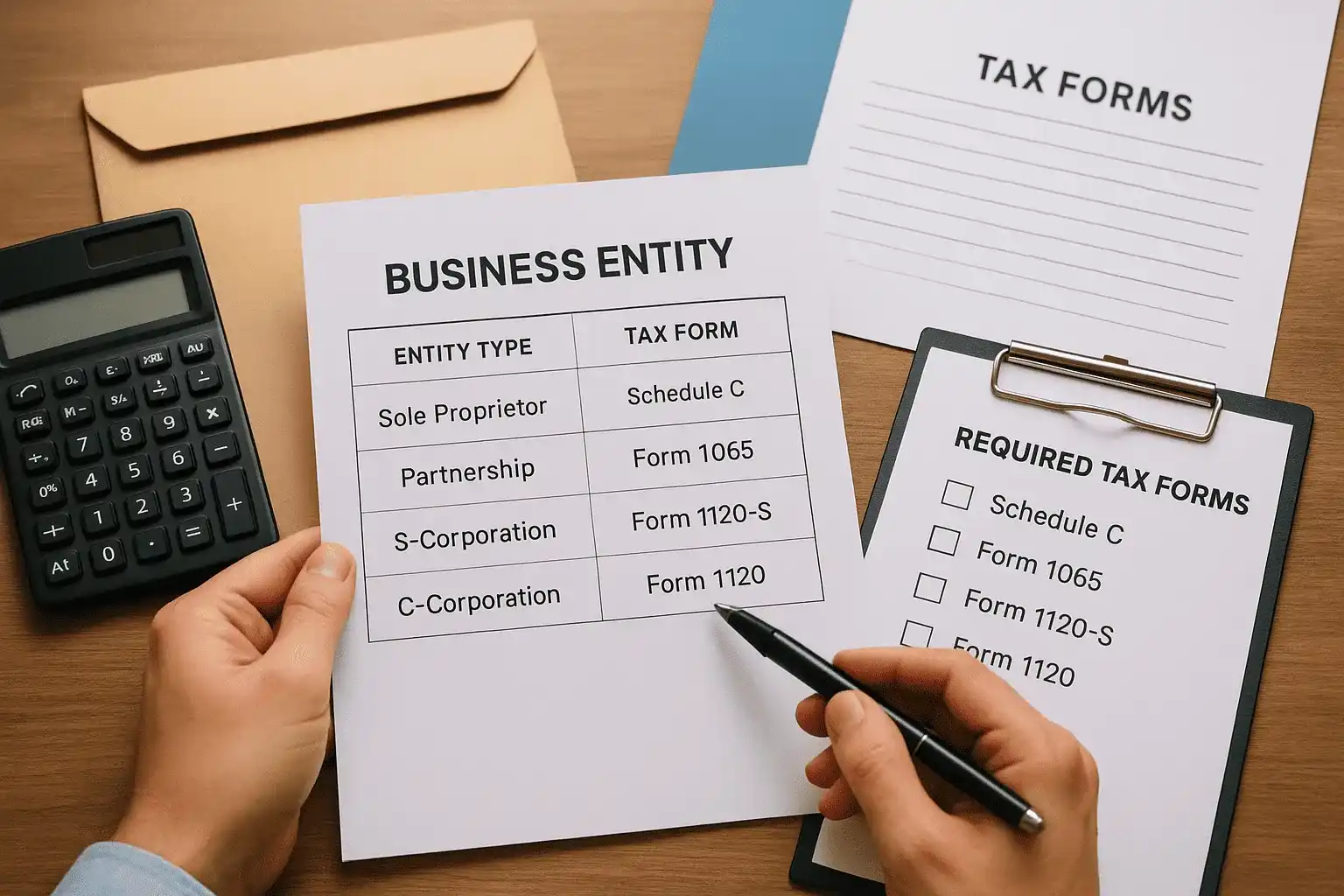
Confirm your legal structure with your Secretary of State filing or IRS confirmation letter, then match it to the correct form using the table below.
| Entity Type | Primary Tax Form | Typical Deadline |
|---|---|---|
| Sole Proprietor | Schedule C with Form 1040 | April 15 |
| Partnership | Form 1065 | March 15 |
| S-Corporation | Form 1120-S | March 15 |
| C-Corporation | Form 1120 | April 15 |
| LLC | Varies by election | Varies |
Filing the wrong form doesn't just delay your return, it can invalidate deductions tied to your actual entity type.
Documents you'll need
Gather your IRS entity confirmation letter (like the CP 575 for an EIN), your Articles of Organization or Incorporation, and any S-corp election paperwork (Form 2553) if you filed one. If your LLC elected to be taxed as a corporation, keep that election letter handy too, since it overrides the default classification.
Common mistakes to avoid
A lot of owners assume their LLC automatically files like a corporation, when by default it's taxed as a sole proprietorship or partnership. Others forget they made an S-corp election years ago and file the wrong form entirely. Double check your entity status every year, especially after any ownership changes.
3. Gather your income and revenue records
Every dollar your business earned this year needs to show up on your return, whether it came through a merchant account, a client invoice, or a cash sale. This is the step where small business taxes checklist items most often go missing, since income scattered across multiple platforms rarely gets reconciled until tax time forces the issue. Treat this as your foundation, because deductions only matter once your revenue is accurate.
What this step involves
Pull a full year of gross revenue records from every channel you sold through, then reconcile those numbers against your bank deposits. If you use Stripe, Square, PayPal, or a similar processor, download their annual summary report and compare it line by line with what hit your business bank account. Don't forget cash payments or client checks that never ran through a card processor, since the IRS expects those reported too.
A tax return is only as accurate as the revenue numbers behind it, so reconcile before you file, not after.
Documents you'll need
- Form 1099-K from payment processors
- Form 1099-NEC from clients who paid you as a contractor
- Bank and merchant account statements for the full year
- Sales records or invoicing software exports
- Year-end profit and loss statement
Common mistakes to avoid
Owners often report only what shows up on a 1099, forgetting that all income counts even without a form. Others double-count revenue that appears on both a 1099-K and a client's 1099-NEC for the same transaction. Reconcile every source once, not twice.
4. Collect expense receipts and deduction records
Deductions are where a well-run small business tax preparation checklist actually saves you money, but only if you can document every expense you claim. The IRS doesn't take your word for a write-off, it wants a paper trail showing the expense was ordinary, necessary, and business related. Skip this step and you either lose deductions you earned or claim ones you can't back up if audited.
What this step involves
Sort your business expenses into categories the IRS actually recognizes: supplies, advertising, travel, professional fees, insurance, rent, and utilities are common ones. Match every receipt or statement to a category before you hand records to a preparer, since reclassifying expenses after the fact costs billable hours you don't need to pay for. If you use accounting software like QuickBooks, run a full-year expense report and flag anything uncategorized.
A deduction without a receipt is just a hopeful guess, and the IRS doesn't accept guesses.
Documents you'll need
- Receipts for supplies, equipment, and materials
- Credit card and bank statements for the business account
- Invoices from vendors and contractors
- Mileage logs for business travel
- Records for meals, entertainment, and client gifts
Common mistakes to avoid
Owners commonly mix personal and business purchases on the same card, which makes deductions harder to defend later. Others estimate expenses from memory instead of pulling actual statements, a habit that rarely survives an audit. Keep receipts digitized as you go instead of scrambling every April.
5. Organize payroll and contractor tax forms
If you paid anyone besides yourself this year, payroll and contractor forms turn into a separate filing obligation with its own deadlines. Employees need W-2s, contractors need 1099-NECs, and both come with penalties that stack up fast when they're late or missing. This step trips up more small business owners than almost any other item on a small business tax preparation checklist, mostly because payroll taxes run on a different calendar than income taxes.
What this step involves
Gather every quarterly payroll tax filing you submitted this year (Form 941 for federal withholding, plus your state equivalents) and reconcile them against your total payroll expense for the year. Confirm you issued W-2s to every employee and 1099-NECs to any contractor paid $600 or more. If you use a payroll provider like Gusto or ADP, pull their year-end tax summary report, since it usually flags mismatches before the IRS does.
Missing a single 1099-NEC deadline can cost more in penalties than the contractor invoice itself.
Documents you'll need
- Form 941 (quarterly) or Form 944 (annual) filings
- W-2s and W-3 transmittal form
- 1099-NEC forms and 1096 summary
- State unemployment and withholding filings
- Payroll register or year-end payroll summary
Common mistakes to avoid
Owners often misclassify employees as independent contractors to skip payroll taxes, a mistake the IRS actively audits for. Others forget state-level filings entirely, assuming federal payroll compliance covers everything. Verify both layers before you file.
6. Compile asset purchases and depreciation records
Buying equipment, vehicles, or software for your business doesn't get deducted all at once, and mixing that up with regular expenses is a fast way to overstate a deduction. Depreciation records spread the cost of a major purchase across its useful life, and the IRS has specific rules about which method applies to which asset. Any complete checklist for tax preparation small business owners rely on needs a dedicated step for this, since asset purchases often get buried in a general expense report instead of tracked separately.
What this step involves
List every capital asset you bought or disposed of this year, including the purchase date, cost, and how you're using it in the business. Section 179 lets you deduct the full cost of many assets in the year you bought them instead of spreading it out, but only up to certain limits set by the IRS each year, so check the current threshold on IRS.gov before assuming full deduction applies. If you sold or scrapped an asset, note that too, since it affects your depreciation schedule going forward.
Treat every equipment purchase as a separate line item, because lumping it into general supplies erases the deduction you're entitled to.
Documents you'll need
- Purchase invoices and receipts for equipment, vehicles, or property
- Prior year depreciation schedule
- Records of any asset sales or disposals
- Loan or financing documents tied to asset purchases
Common mistakes to avoid
Owners often deduct the full purchase price as a regular expense instead of depreciating it, which invites correction letters later. Others lose track of an asset's original purchase date, making it impossible to calculate remaining depreciation accurately.
7. Gather home office and vehicle use documentation
Working from a spare bedroom or driving your own car for client meetings creates two of the most misunderstood deductions in small business tax preparation. The home office deduction and vehicle expense deduction both require specific documentation, not a rough estimate scribbled at tax time. Get this step right and you claim real money back; get it wrong and you hand the IRS an easy reason to ask questions.
What this step involves
Measure your dedicated home office space in square feet and compare it to your home's total square footage, since that ratio determines what percentage of rent, mortgage interest, utilities, and insurance you can deduct. For vehicles, decide between the standard mileage rate and the actual expense method, then track whichever one you choose consistently through the year. A logbook, whether paper or an app like MileIQ, needs the date, purpose, and miles for every business trip.
Deductions built on memory instead of measurement rarely survive a closer look.
Documents you'll need
- Square footage measurements and a floor plan sketch of your home office
- Mortgage interest, rent, and utility statements for the full year
- Mileage log with dates, destinations, and business purpose
- Vehicle purchase or lease documents and total annual mileage
Common mistakes to avoid
Claiming a home office that doubles as a family room disqualifies the deduction entirely, since the space must be used regularly and exclusively for business. Switching between mileage methods year to year without recalculating your basis also creates errors that catch up with you later.
8. Track estimated payments and prior year returns
Most small business owners don't have taxes withheld from a paycheck, so the IRS expects quarterly estimated payments throughout the year instead of one lump sum in April. Skip this step on your checklist and you risk an underpayment penalty even if you pay your full balance by the filing deadline. Pulling this together also means confirming your prior year return matches what you're carrying forward this year.
What this step involves
Total up every estimated tax payment you sent in for the year, whether through EFTPS, IRS Direct Pay, or your state's equivalent portal. Match each payment to its due date (typically mid-April, June, September, and January) since a payment applied to the wrong quarter can trigger a confusing penalty notice. Pull last year's return too, and confirm any carryforward items, like a net operating loss or unused credit, transferred correctly.
A payment that lands in the wrong quarter looks like a missed payment to the IRS, even when the money arrived on time.
Documents you'll need
- Estimated payment confirmations or bank records for each quarter
- Prior year federal and state tax returns
- IRS account transcript showing payments received
- Records of any carryforward losses or credits
Common mistakes to avoid
Owners frequently forget a quarter entirely, especially the January payment that falls outside the calendar tax year. Others assume last year's refund automatically applied to this year's estimates without checking the actual election on the return. Always verify against an IRS transcript rather than memory.
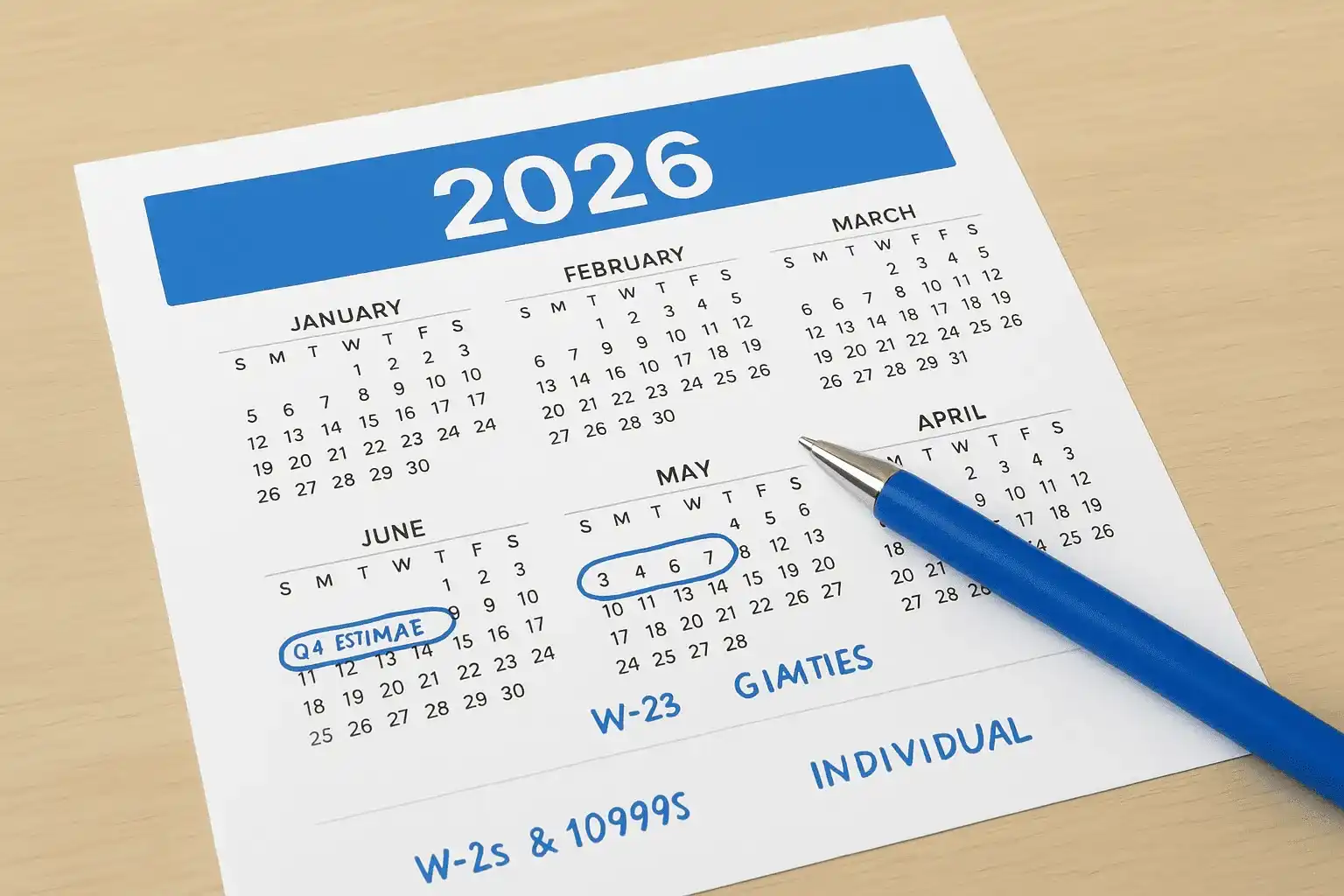
9. Mark your 2026 tax deadlines on a filing calendar
Missing a filing date costs you money even when your paperwork is perfect, since the IRS charges penalties based on the calendar, not your intentions. A 2026 tax filing calendar keeps every deadline in one place instead of scattered across emails and sticky notes. Building this calendar now, before documents pile up, turns your small business tax preparation checklist into something you actually follow instead of something you remember too late.
What this step involves
Plot every relevant deadline for your entity type, including quarterly estimated payments, payroll filings, and your final return date, onto one shared calendar.
| Deadline | Date (2026) |
|---|---|
| Q4 2025 estimated payment | January 15 |
| W-2s and 1099-NECs due | January 31 |
| S-corp and partnership returns | March 15 |
| Individual and C-corp returns | April 15 |
| Q2 estimated payment | June 15 |
| Q3 estimated payment | September 15 |
A deadline you haven't scheduled is a deadline you're going to miss.
Documents you'll need
Pull your extension filings from last year if you requested one, since that pattern often repeats. Keep a copy of your entity's specific due dates from Step 2, plus any state-specific deadlines that differ from federal ones.
Common mistakes to avoid
Owners often confuse an extension to file with an extension to pay, then owe penalties on top of interest. Others set one deadline for the whole year and forget the quarterly ones in between.
10. Organize and store your tax documents securely
Once you've gathered every document from the previous nine steps, you still need a system that keeps them safe and findable for years, not just through filing season. The IRS can audit a return up to three years after filing, and sometimes six years if income was substantially underreported, so a secure document storage system protects you long after you hit submit. Treat this final step of your small business tax preparation checklist pdf as the one that makes every earlier step worth the effort.
What this step involves
Set up both a digital backup and a physical archive, since a single storage method leaves you exposed if a laptop crashes or a filing cabinet floods. Cloud storage with encryption, like a dedicated business Google Drive or Dropbox folder, works well for scanned receipts and forms. Label folders by tax year and category so a future audit or a new accountant can find what they need in minutes, not hours.
A tax return you can't back up with records is a tax return you can't defend.
Documents you'll need
- Scanned copies of every form filed this year
- Digital backups of receipts and bank statements
- A locked physical file for original signed documents
- Access credentials shared with a trusted backup person
Common mistakes to avoid
Owners often store everything on one device with no backup, then lose years of records to hardware failure. Others shred documents too early, unaware that some retention periods extend well past the standard three years for underreported income or bad debt claims.
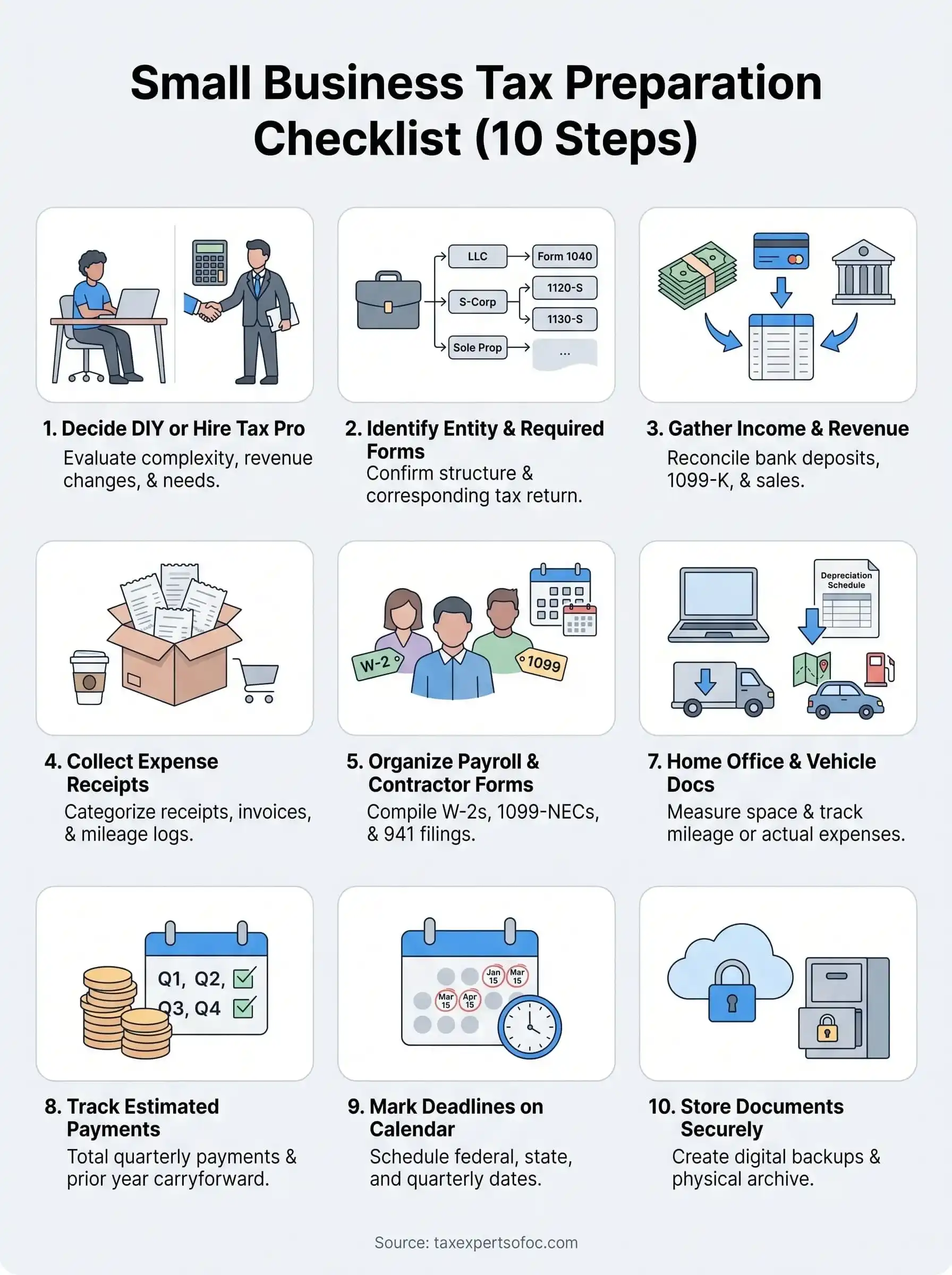
Putting your checklist into action
Ten steps sounds like a lot until you realize most of the work is just gathering documents you already have, then matching them to the right category. Filing season stops being stressful the moment you stop treating it as one giant task and start working through it step by step, the way this checklist lays out. Print it, save it as your own tax preparation checklist pdf, and pull it out every January before the paperwork starts piling up again.
Working through this list catches most problems before they become IRS notices, but some situations still need a professional set of eyes, especially payroll compliance, depreciation schedules, or an entity structure that changed mid-year. If any step here raised more questions than it answered, that's your signal. Schedule a free consultation with Tax Experts of OC and get a CPA or Enrolled Agent reviewing your records before you file, not after the IRS asks why.