

You know you're overpaying the IRS, but you're not sure where the leaks are. Maybe it's your investment accounts, your business structure, or the way you're withdrawing retirement funds. A financial advisor for tax planning looks at your whole financial picture and finds the moves that keep more money in your pocket, not just once a year, but as part of an ongoing strategy.
So what does a tax planning advisor actually do, and how is it different from hiring a CPA or an Enrolled Agent? The short answer: tax planning advisors focus on forward-looking strategy tied to your investments, retirement, and long-term goals, while tax preparers and resolution specialists handle filings, IRS notices, and compliance, which is how planning differs from preparation. Many clients need both, working together.
In this article, we'll break down exactly what a financial advisor tax planning relationship looks like, the services you should expect, how these professionals differ from CPAs, and what to check before you hire one. If you're weighing a tax planning financial advisor against working directly with a CPA or Enrolled Agent, like the team here at Tax Experts of OC, you'll walk away knowing which fits your situation.
Why tax planning matters in your financial strategy
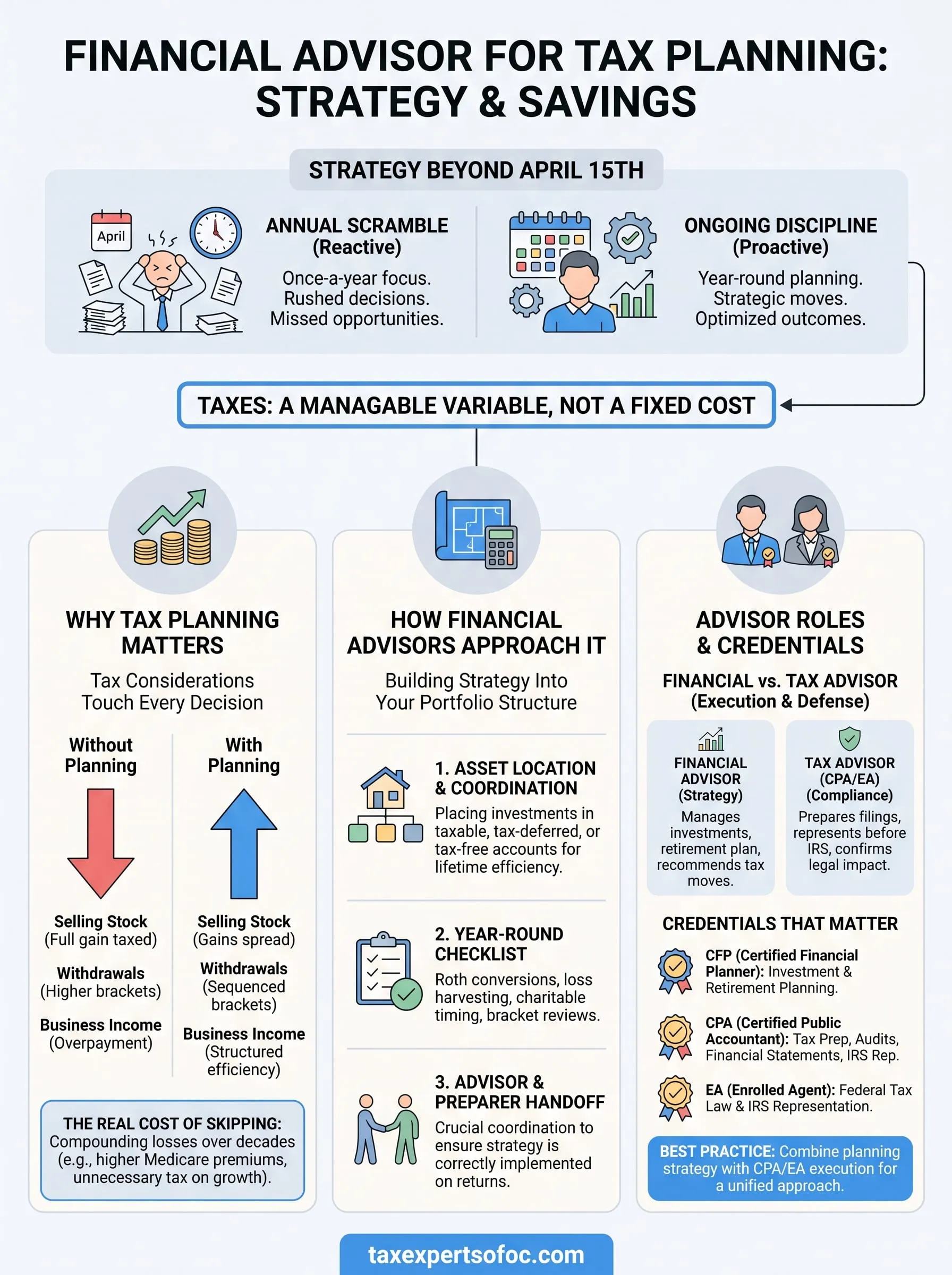
Taxes touch every dollar you earn, save, and eventually spend, yet most people only think about them once a year at filing time. That's backwards. A financial advisor for tax planning treats taxes as a variable you can manage year-round, the same way you'd manage risk in a portfolio. Skip that discipline and you leave money on the table in ways that compound over decades: a poorly timed capital gain, an oversized required minimum distribution, or a retirement account funded with the wrong type of dollars.
The real cost of skipping tax strategy
Consider two investors who each save $500,000 for retirement. One never coordinates withdrawals with a tax strategy and pulls from a traditional IRA in a way that pushes them into a higher bracket and triggers extra Medicare premiums. The other works with an advisor who sequences withdrawals across taxable, tax-deferred, and Roth accounts to stay in a lower bracket. Over a 20-year retirement, that difference can easily total tens of thousands of dollars, money that never left the household but simply avoided being handed over unnecessarily.

A dollar saved in taxes today is a dollar that keeps compounding for you instead of the IRS.
Where tax planning touches every major decision
Tax considerations show up far beyond your April return. They shape how you invest, when you sell assets, how you structure a business, and how you pass wealth to the next generation. A tax planning financial advisor looks at these moments before they happen, not after.
| Financial decision | Without tax planning | With tax planning |
|---|---|---|
| Selling appreciated stock | Full gain taxed in one year, possible bracket jump | Gains spread across years or offset with losses |
| Retirement withdrawals | Random order triggers higher brackets and Medicare surcharges | Coordinated sequencing keeps income in lower brackets |
| Business income | Owner overpays self-employment or corporate tax | Entity structure and deductions minimize liability |
| Charitable giving | Cash donations with limited deduction value | Appreciated assets or donor-advised funds maximize benefit |
| Estate transfers | Heirs face avoidable estate or income tax exposure | Gifting and trust strategies reduce future tax burden |
Each row on that table represents a decision most households make at some point, often without realizing a tax-smart move was available. That's the gap a good advisor closes.
A year-round discipline, not an April scramble
Most people associate tax work with a rushed conversation in February or March. Real tax planning happens on a different calendar, one that runs all twelve months instead of only April. It means reviewing your bracket in October before year-end, checking whether a Roth conversion makes sense while the market is down, or timing a business expense in December instead of January because it changes which tax year absorbs the deduction.
Small business owners feel this especially hard. Between quarterly estimated payments, payroll tax deposits, and entity-level decisions, a single missed deadline or miscalculated withholding can trigger penalties that dwarf the original tax owed. Working proactively with someone who understands both your investment picture and planning around your business structure prevents these surprises before they show up as an IRS notice.
Owners who wait until a problem lands in the mailbox often end up needing resolution help rather than planning help, which is a more expensive and stressful position to be in. If you're already facing back taxes, penalties, or an audit notice, planning forward is only half the equation; you also need someone who can clean up what's already happened. That's where a firm like Tax Experts of OC fits in, pairing proactive planning with hands-on tax resolution when the IRS is already involved.
Taxes aren't a once-a-year event you survive. They're a recurring input into nearly every financial choice you make, from the account you fund first to the way you exit a business. Treating tax strategy as an ongoing part of your financial plan, rather than an afterthought, is what separates households that keep more of what they earn from those that quietly leak money to avoidable taxes year after year.
How financial advisors approach tax planning
Financial advisors build tax strategy into the structure of your portfolio and financial plan, not as a separate exercise. Instead of reacting to a tax bill after the fact, a financial advisor tax planning relationship starts with mapping every account you hold, taxable, tax-deferred, and tax-free, and deciding where new contributions and withdrawals should go to minimize the tax hit over your lifetime.
Asset location and account coordination
Getting the right investments in the right accounts matters as much as picking good investments in the first place. Bonds and REITs that generate ordinary income often belong in tax-deferred accounts, while growth stocks with long holding periods fit better in taxable brokerage accounts where you control when gains get realized. Advisors also coordinate Roth conversions during low-income years to build tax-free retirement income, harvest losses to offset gains, and time capital gains around other income events so a single year doesn't push you into a higher bracket.

Where you hold an investment can matter as much as what you invest in.
Building tax efficiency into ongoing decisions
Beyond account placement, a tax planning financial advisor typically works through a recurring checklist each year rather than a one-time setup:
- Reviewing your current tax bracket and projecting where you'll land by year-end
- Deciding whether a Roth conversion makes sense given this year's income
- Coordinating retirement account withdrawals with Social Security timing
- Harvesting investment losses before December 31 to offset realized gains
- Timing charitable gifts, especially appreciated stock or donor-advised fund contributions
- Adjusting withholding or estimated payments to avoid underpayment penalties
Running through that list regularly is what separates advisors who genuinely plan for taxes from those who mention taxes only in passing during an annual review.
Working alongside your tax preparer
Since most financial advisors don't file your return, they rely on your CPA or Enrolled Agent to execute the paperwork and confirm the numbers hold up under actual tax law. The strongest arrangements have the advisor and preparer sharing information directly, so a Roth conversion recommended in November shows up correctly on the return filed the following spring, and estimated payments reflect any mid-year strategy changes.
That handoff is exactly where many households run into trouble. An advisor might suggest a smart move, but if it's never communicated to whoever prepares the return, the strategy either gets missed or triggers an unexpected tax bill. Firms that combine financial planning with direct access to a CPA or Enrolled Agent, rather than routing everything through a third-party preparer, close that gap and keep the strategy and the filing in sync from the start.
Financial advisor vs. tax advisor: what's the difference
People use "financial advisor" and "tax advisor" like they're interchangeable, but the two roles rarely overlap in practice. A financial advisor manages your investments, retirement timeline, and overall financial plan, weaving tax strategy into those decisions. A tax advisor, which usually means a CPA or Enrolled Agent, prepares your return, represents you in front of the IRS, and confirms that whatever strategy your financial advisor recommended actually holds up under current tax law. One builds the plan; the other executes and defends it.
What each professional actually handles
Understanding the split matters because hiring only one leaves gaps. A financial advisor for tax planning can suggest a Roth conversion or a tax-loss harvest, but they typically don't sign your return or represent you in an audit. A tax advisor can file accurately and respond to an IRS notice, but most don't manage a portfolio or advise on asset location across accounts.
| Task | Financial advisor | Tax advisor (CPA/EA) |
|---|---|---|
| Manages investment portfolio | Yes | No |
| Recommends Roth conversions | Yes | Confirms tax impact |
| Prepares and files tax return | No | Yes |
| Represents you before the IRS | No | Yes |
| Advises on entity structure | Limited | Yes |
| Handles back taxes and penalties | No | Yes |
One professional builds your strategy, the other makes sure it stands up on paper and with the IRS.
Why most people need both, not either
Skipping one side of this partnership creates real risk. Rely only on a financial advisor and you may end up with smart-sounding strategies that a preparer either can't verify or executes incorrectly on the return. Rely only on a tax preparer and you'll likely get an accurate filing based on decisions that were never optimized in the first place, because nobody looked at your portfolio holistically before December 31. Distressed taxpayers feel this gap hardest: someone juggling wage garnishment or unfiled returns needs resolution expertise immediately, not portfolio rebalancing advice.
Growing businesses run into a similar mismatch. A founder might have a financial advisor for personal retirement accounts but no one coordinating payroll tax deposits, entity-level elections, or quarterly estimated payments. That's precisely why firms built around CPAs and Enrolled Agents, like Tax Experts of OC, pair compliance work with the kind of forward-looking planning conversation a financial advisor usually starts. Instead of shuttling information between two disconnected professionals, you get one team confirming the strategy is both smart and correctly filed.
Credentials that matter: CFP, CPA, and EA explained
Letters after a name mean something specific in this field, and knowing what each one authorizes saves you from hiring the wrong professional for the job. A Certified Financial Planner (CFP) passes a rigorous exam covering investments, retirement, insurance, and estate planning, then commits to a fiduciary standard when giving financial advice. A Certified Public Accountant (CPA) is licensed by a state board after passing the CPA exam and meeting education and experience requirements, with a CPA's authority to handle IRS matters, prepare returns, and audit financial statements. An Enrolled Agent (EA) earns federal authorization directly from the IRS, either by passing a three-part exam covering individual and business tax law or through prior IRS work experience, and can represent taxpayers in any state without additional licensing.

What each credential actually authorizes
Overlap exists, but each credential centers on a distinct skill set. A CFP builds and monitors your investment and retirement plan. A CPA can do that same planning work in some cases, but their core authority covers preparing accurate returns and handling audits. An EA specializes almost entirely in tax law and IRS representation, without the broader financial planning training a CFP receives.
| Credential | Licensing body | Core focus | Represents you before IRS | |---|---|---| | CFP | CFP Board | Investment and retirement planning | No | | CPA | State board of accountancy | Tax prep, audits, financial statements | Yes | | EA | IRS | Federal tax law and representation | Yes |
Ask which letters someone holds before you ask what they charge, because the credential tells you what they're actually licensed to do.
Why the combination matters more than any single title
Questions worth asking before you hire include:
- Which credential do you hold, and is it currently active?
- Do you personally sign and file my return, or does that go to someone else?
- Can you represent me directly if the IRS sends a notice, and do you hold the credentials IRS representation requires?
- How often do you coordinate with a financial advisor or a CPA on shared clients?
Seeking out someone with more than one credential often closes the gap between planning and filing. Many tax planning advisors carry a CFP designation, but they lack CPA or EA authority to prepare a return or sit across from an IRS agent on your behalf. Reaching a firm where a CPA and an Enrolled Agent work directly on your file, rather than routing everything through a call center, gives you both the technical accuracy and the representation authority in one place. Tax Experts of OC structures its team this way, with a CPA and EA handling client cases directly rather than delegating to general staff.
How to choose a financial advisor for tax planning
Picking the wrong advisor costs more than a bad fee structure. It costs you missed strategies year after year because nobody flagged them. Before you sign an engagement letter, know what separates an advisor who genuinely practices tax planning advisors work from one who mentions taxes once during your annual review and moves on.
Questions to ask before you hire
Getting straight answers to a short list of questions tells you more than any glossy brochure. Ask directly:
- Do you hold a CFP, CPA, or EA credential, and is it currently active?
- How often do you review my tax situation, quarterly, annually, or only at tax time?
- Do you coordinate directly with whoever prepares my return, or do I relay information between you two?
- Can you show me an example of a tax-saving strategy you implemented for a client with a similar situation to mine?
- What happens if I get an IRS notice, do you handle it or refer me elsewhere?
An advisor who answers these clearly, with specifics rather than vague reassurance, is usually one who actually does the work rather than just talks about it.
Hire the advisor who can describe a specific strategy they've implemented, not just the one with the best sales pitch.
Red flags that signal a planning gap
Watch for these warning signs during your consultation:
| Red flag | Why it matters |
|---|---|
| Only discusses taxes once a year | Suggests reactive rather than proactive planning |
| Can't explain how they'd handle an IRS notice | No coordination with tax representation |
| Vague about credentials or licensing status | May lack authority to execute what they recommend |
| No process for coordinating with your CPA | Strategies risk getting lost between planning and filing |
| Pushes products before understanding your full picture | Prioritizes commission over your tax situation |
Finding even one of these during a first conversation is worth pausing over. Finding several means you should keep looking.
Matching the advisor to your situation
Someone with straightforward W-2 income and a 401(k) has different needs than a small business owner juggling payroll, quarterly estimates, and entity elections. Individuals nearing retirement need an advisor fluent in withdrawal sequencing and Roth conversions. Business owners need someone who understands entity structure and can coordinate with payroll and bookkeeping, not just portfolio management. Requesting a free consultation before committing lets you test whether the advisor asks about your specific situation or recites a generic script, one of several tips for choosing a tax planning service near you.
Vetting also means checking whether the firm can scale with you. A financial advisor tax planning relationship that works fine for a simple return can fall apart the moment your business grows or the IRS sends a notice. Firms structured around direct CPA and Enrolled Agent access, like Tax Experts of OC, can absorb that complexity without forcing you to find a second professional mid-crisis.
What financial advisors charge for tax planning
Fee structures vary enough that two advisors doing nearly identical work can charge you completely different amounts. Most financial advisors bill using one of four models: a percentage of assets under management (AUM), a flat annual fee, an hourly rate, or a retainer. Understanding which model you're paying into tells you whether tax planning is actually included or billed separately as an add-on.
Common fee structures compared
Breaking down the typical ranges, much like average preparation fees by return type, helps you spot whether a quote is reasonable or inflated:
| Fee model | Typical range | Tax planning included? |
|---|---|---|
| AUM percentage | 0.5% to 1.5% of assets annually | Often bundled, but depth varies |
| Flat annual fee | $2,000 to $10,000+ | Usually explicit and itemized |
| Hourly rate | $150 to $400 per hour | Billed per project or session |
| Retainer | $500 to $2,000+ per month | Ongoing, includes tax reviews |
AUM-based advisors often fold tax planning into the overall relationship, which sounds convenient until you realize the fee scales with your portfolio size regardless of how much actual tax work happens. A $2 million account pays a much larger dollar amount for the same Roth conversion analysis a $500,000 account would receive.
Ask exactly what's included in the fee before you sign, because "comprehensive planning" means something different at every firm.
Why bundled fees can hide gaps
Coordination between your financial advisor and whoever prepares your return often costs extra, and that's where clients get surprised. An advisor's flat fee might cover the strategy conversation, but the CPA or EA who actually files the return bills separately, sometimes at a firm you never chose and can't easily vet. Layering two separate invoices from two disconnected professionals adds cost without necessarily adding coordination.
Distressed taxpayers face a different pricing reality altogether. If you're dealing with back taxes, an audit, or unfiled returns, you're not shopping for portfolio management, you're shopping for what resolution work actually involves, which typically gets billed as a flat fee tied to the complexity of your case rather than a percentage of assets. Tax Experts of OC prices its tax resolution services this way, with upfront pricing disclosed before any work begins, plus a free 30-minute consultation so you know the cost before committing.
Evaluating any quote means asking what happens if your situation changes mid-year. Someone offering flat, transparent pricing with flexible payment options for clients facing financial hardship gives you a clearer picture than a firm that quotes a range and fills in the details later. Getting that clarity upfront, before you sign anything, protects you from paying premium fees for planning that never actually materializes.
Bringing tax planning into your financial plan
Good tax strategy isn't a once-a-year scramble, it's a habit built into every financial decision you make, from which account absorbs your next contribution to how you time a stock sale. A financial advisor for tax planning brings that discipline to your portfolio and retirement timeline, while a CPA or Enrolled Agent makes sure the strategy actually holds up on paper and stands if the IRS ever asks questions. Neither role fully replaces the other, and pretending otherwise is how households end up with smart ideas that never get filed correctly, or accurate returns built on decisions nobody optimized first.
If you're weighing whether to hire a tax planning financial advisor, a CPA, or both, start by getting a straight answer about credentials, coordination, and cost. Schedule a free consultation for CPA-led tax planning in Orange County with Tax Experts of OC and find out exactly where your plan has room to improve.