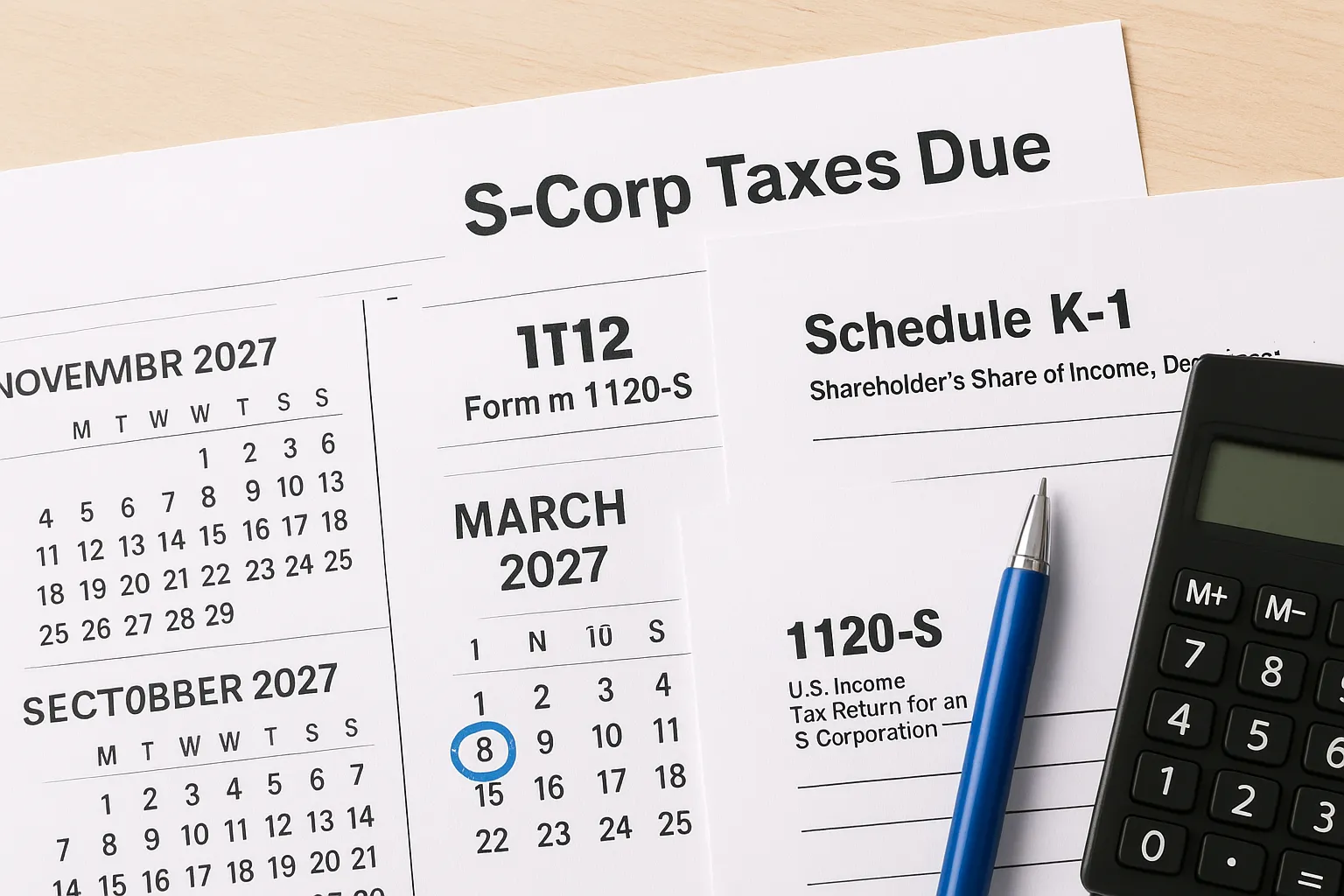
S-corp taxes due on the 15th day of the third month after the corporation's tax year ends, which is March 15 for a calendar-year company. That date covers Form 1120-S and a Schedule K-1 for every shareholder. When March 15 lands on a weekend, the deadline moves to the next business day, which is why the 2025 return was due on Monday, March 16, 2026. The next deadline is Monday, March 15, 2027. Filing Form 7004 by that date extends the filing deadline to September 15, 2027, but it does not extend the time to pay.
An S corporation is a pass-through entity, so the company usually owes no federal income tax when it files. The profit moves to the shareholders' personal returns. That is why the due dates are easy to confuse. The return is due a month before personal returns, the "quarterly" dates belong to shareholders and payroll rather than the corporation, and the penalties apply even when nothing is owed.
This article walks through every date in order. You will see how to find your own due date, how the extension works, which quarterly dates apply to you, which payroll forms run on separate schedules, and what late filing costs. At Tax Experts of OC, a CPA and an Enrolled Agent prepare business returns and handle IRS problems for clients in all 50 states. Treat this as general information, because your tax year, state, and facts can change the answer.
Why your S-corp due date matters and what late costs
S-corp taxes due dates matter because the corporate deadline comes first, everything personal depends on it, and a miss is penalized per shareholder per month even when no tax is owed. The calendar punishes late filers faster than most owners expect.
The K-1 domino effect
Form 1120-S produces the Schedule K-1 that each shareholder uses to report their share of income, losses, and deductions on a personal Form 1040. No 1120-S means no final K-1, and no final K-1 means you cannot complete an accurate personal return. The March date sits a month ahead of April 15 for exactly that reason.
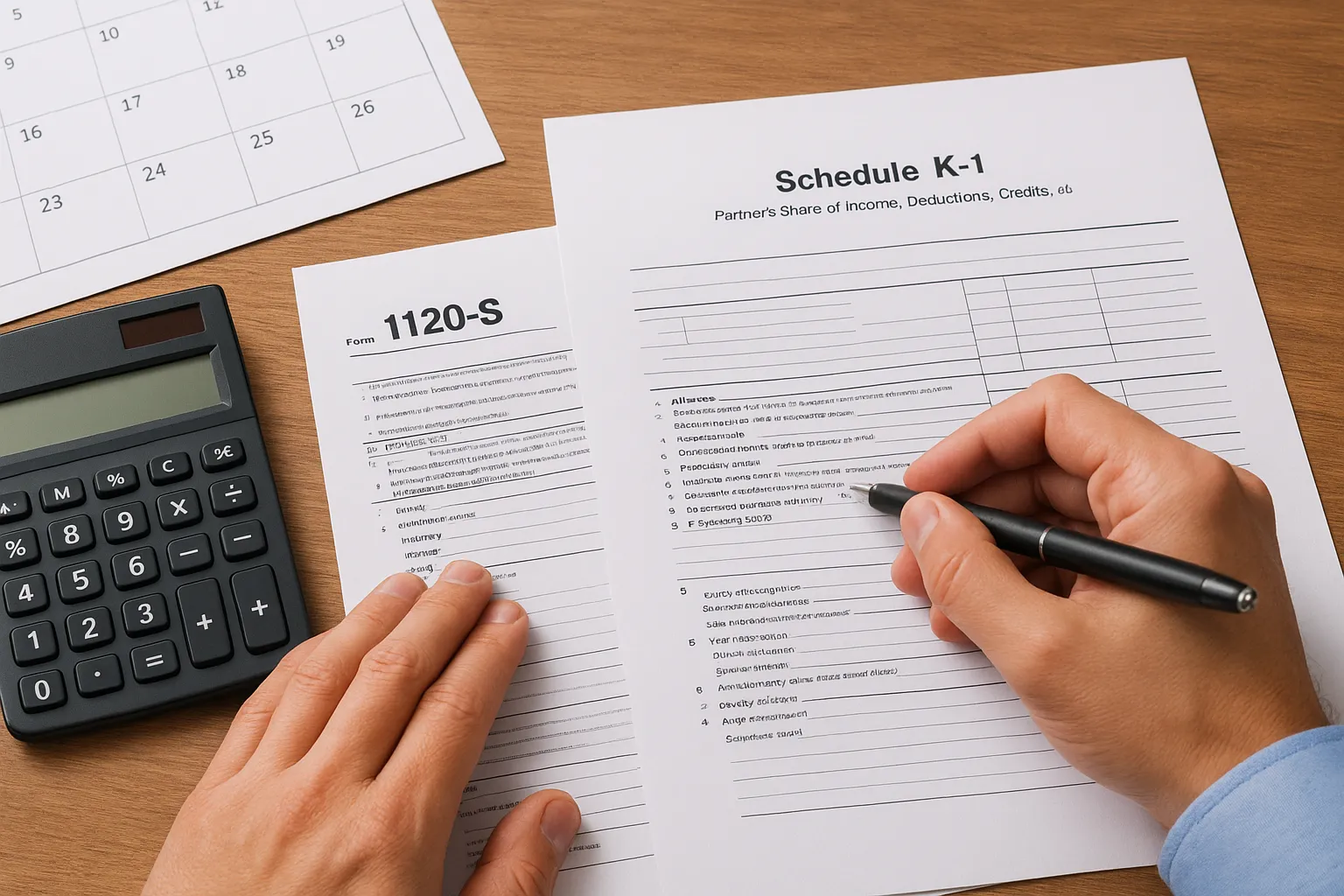
A late corporate return therefore tends to cause a second late return. Owners either file late themselves or file with estimates and amend later, which adds cost and risk. Late K-1s can also throw off the shareholders' estimated tax payments, which leads to underpayment penalties of their own.
Your personal return depends on the S corp's return, so the March date is the one that sets every other date in motion.
What a late Form 1120-S costs
The failure-to-file penalty is charged per shareholder for each month or part of a month the return is late, for up to 12 months. The IRS lists it at $255 for returns due in 2026 and $260 for returns due in 2027, and it is adjusted for inflation each year. Because it is multiplied by the number of shareholders, a small corporation with several owners gets hit hardest. The table uses the $260 figure for the return due March 15, 2027.
| Shareholders | 1 month late | 4 months late | 12 months late (maximum) |
|---|---|---|---|
| 1 | $260 | $1,040 | $3,120 |
| 2 | $520 | $2,080 | $6,240 |
| 3 | $780 | $3,120 | $9,360 |
| 5 | $1,300 | $5,200 | $15,600 |
Other charges stack on top. If the corporation owes any tax, a failure-to-pay penalty of 0.5% of the unpaid tax applies for each month, up to 25%, plus interest. A separate penalty applies to each Schedule K-1 that you fail to furnish to a shareholder on time. For K-1s due in 2026 it was up to $340 each, and it is higher if the delay is intentional. You can check current amounts on the IRS failure-to-file penalty page.
Penalty relief exists, but you have to ask
The IRS can reduce or remove penalties when you show reasonable cause, such as a serious illness or a records loss you could not control. Forgetting the date does not count. The request is more persuasive when you file the missing return first and explain the facts in writing. A tax professional can tell you whether a first-time penalty abatement is available for your situation.
How to find when your S-corp taxes are due
Your S-corp due date is the 15th day of the third month after your tax year ends, moved to the next business day if that date falls on a weekend or federal holiday. Find your tax year first, then count three months.
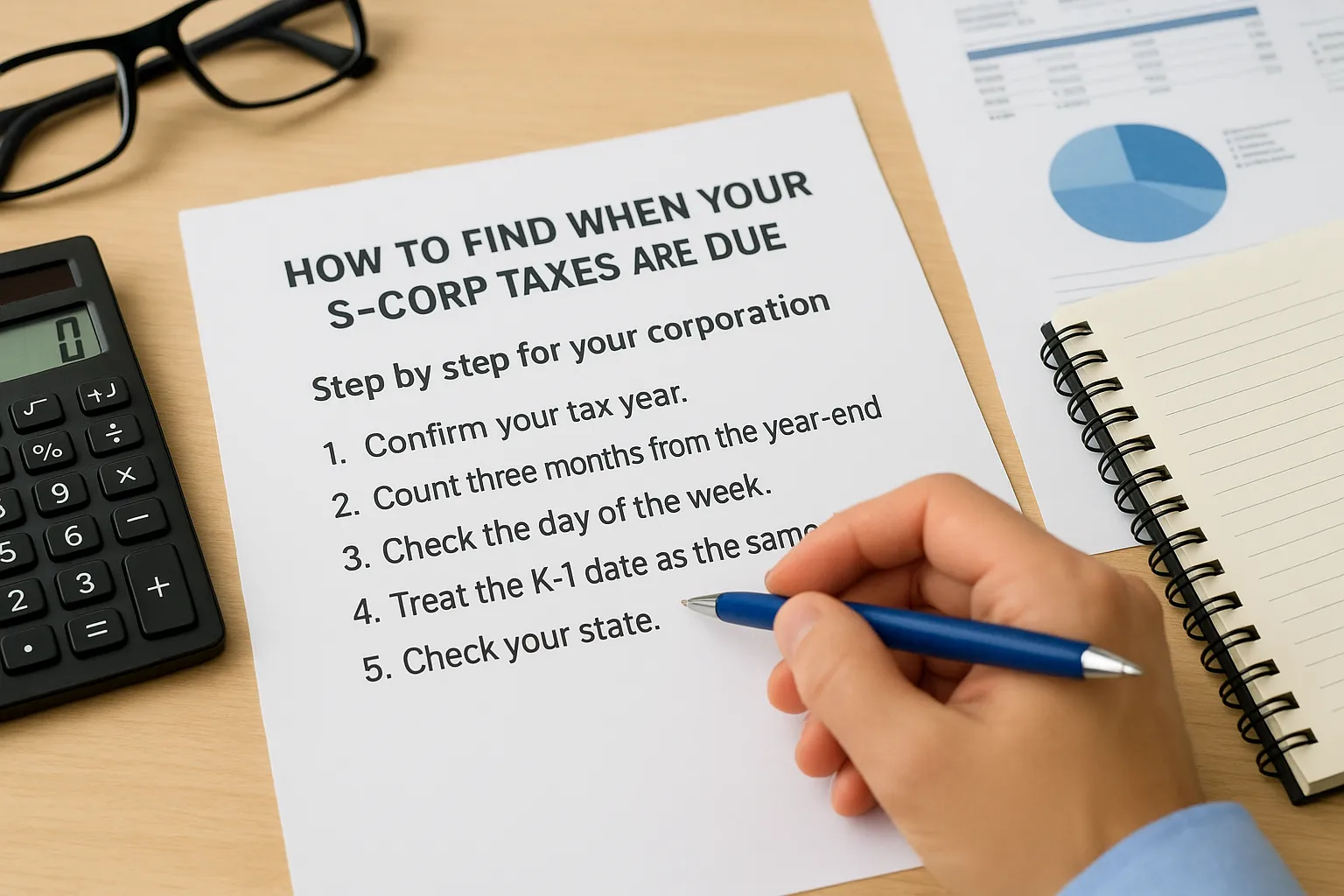
Step by step for your corporation
- Confirm your tax year. Most S corporations use the calendar year, ending December 31. Your prior Form 1120-S shows the tax year on its first page.
- Count three months from the year-end and take the 15th of that month.
- Check the day of the week. If it is a Saturday, Sunday, or legal holiday, the due date becomes the next business day.
- Treat the K-1 date as the same date. Each shareholder's K-1 is due with the return.
- Check your state. Many states follow the federal date, but some use different dates or separate S corporation or franchise returns, so confirm with your state revenue department.
For a calendar-year company, step 2 always gives March 15. That date fell on a Sunday in 2026, so the deadline was Monday, March 16. In 2027 it falls on a Monday, so March 15, 2027 is the due date for your 2026 return.
The requirement does not depend on income. A corporation that had no revenue still has to file Form 1120-S, and the penalties apply to it too.
If your tax year is not the calendar year
Most S corporations must use the calendar year. A fiscal year is allowed only with IRS approval or a qualifying election. If you have one, the same rule applies from your own year-end. The table shows how it works for common year-ends, with the extended date six months later.
| Tax year ends | Return due | Extended due date |
|---|---|---|
| June 30 | September 15 | March 15 |
| September 30 | December 15 | June 15 |
| November 30 | February 15 | August 15 |
A short tax year, such as a corporation's first year or a year in which it dissolves, runs the same count from the end of that short year. A new company that formed in October and elected S status, for example, ends its first calendar-year period on December 31 and files by the following March 15.
S-corp taxes due with an extension
If you file a corporate extension with Form 7004 on or before the original due date, a calendar-year S corporation has until September 15 to file its return, six months later. For the 2026 return, that means September 15, 2027 after a March 15, 2027 request. The same six-month shift applies to a fiscal-year company, as the table above shows.
What the extension does and does not cover
The extension covers the filing of Form 1120-S and the K-1s. It does not cover payment. Since most S corporations owe no entity-level income tax, the payment question is often moot. If your company owes tax, such as built-in gains tax, it still has to estimate and pay by the original date. An extension to file is not an extension to pay.
Shareholders are in a different position. Their personal tax is still due April 15, whether or not the S corp extended. If the K-1s are not ready, shareholders should estimate and pay on time, then file their own extension on Form 4868, which moves the personal filing date to October 15. Then they can file once the K-1s arrive, instead of paying penalties for the corporation's delay.
An extension buys you time to file the S corp return, never time to pay, and your shareholders' April 15 payment date does not move.
How to file Form 7004
- Use Form 7004 and select the S corporation return, Form 1120-S, in the form code table.
- Enter the corporation's name, EIN, address, and tax year.
- Estimate any entity-level tax and pay it with the request if it applies.
- E-file or mail it before the original deadline. A request filed after March 15 is late and gets no relief.
- Keep the e-file acknowledgement with your records.
The IRS page for Form 7004 has the current instructions. If you also need a business return prepared, our Business Tax Return Services cover filing for companies of all sizes and structures, including corporations.
Why the September date is not a second chance
Missing September 15 triggers the same per-shareholder, per-month penalty as missing March 15. It starts accruing from the extended date. Plan the work so the extended date is a backstop. If your accountant needs a January document that has not arrived, extend in early March and set a firm internal date in August.
S-corp quarterly taxes due dates: what you actually owe
An S corporation does not normally pay quarterly federal income tax, because the profit passes through to shareholders. The quarterly dates that matter are shareholders' estimated tax payments and the company's payroll tax filings, so check which of the two applies to you.
The four quarterly categories side by side
| Payment | Who pays | Calendar-year due dates |
|---|---|---|
| Estimated income tax on K-1 income | Each shareholder, with Form 1040-ES | April 15, June 15, September 15, January 15 |
| Payroll tax return, Form 941 | The S corp, if it has employees | April 30, July 31, October 31, January 31 |
| Estimated tax on built-in gains or excess passive income | The S corp, only if that tax applies | April 15, June 15, September 15, December 15 |
| Regular federal income tax | No one at the entity level | None |
The January 15 payment belongs to the previous tax year. A due date that falls on a weekend or holiday moves to the next business day. October 31, 2026 is a Saturday, for example, so the third-quarter 2026 Form 941 is due Monday, November 2.
Estimated payments for shareholders
You owe tax on your share of the S corp's income whether or not the company distributed cash to you. If you work in the business, your wages are withheld through payroll, but K-1 income is not withheld on. That is where estimated payments come in.
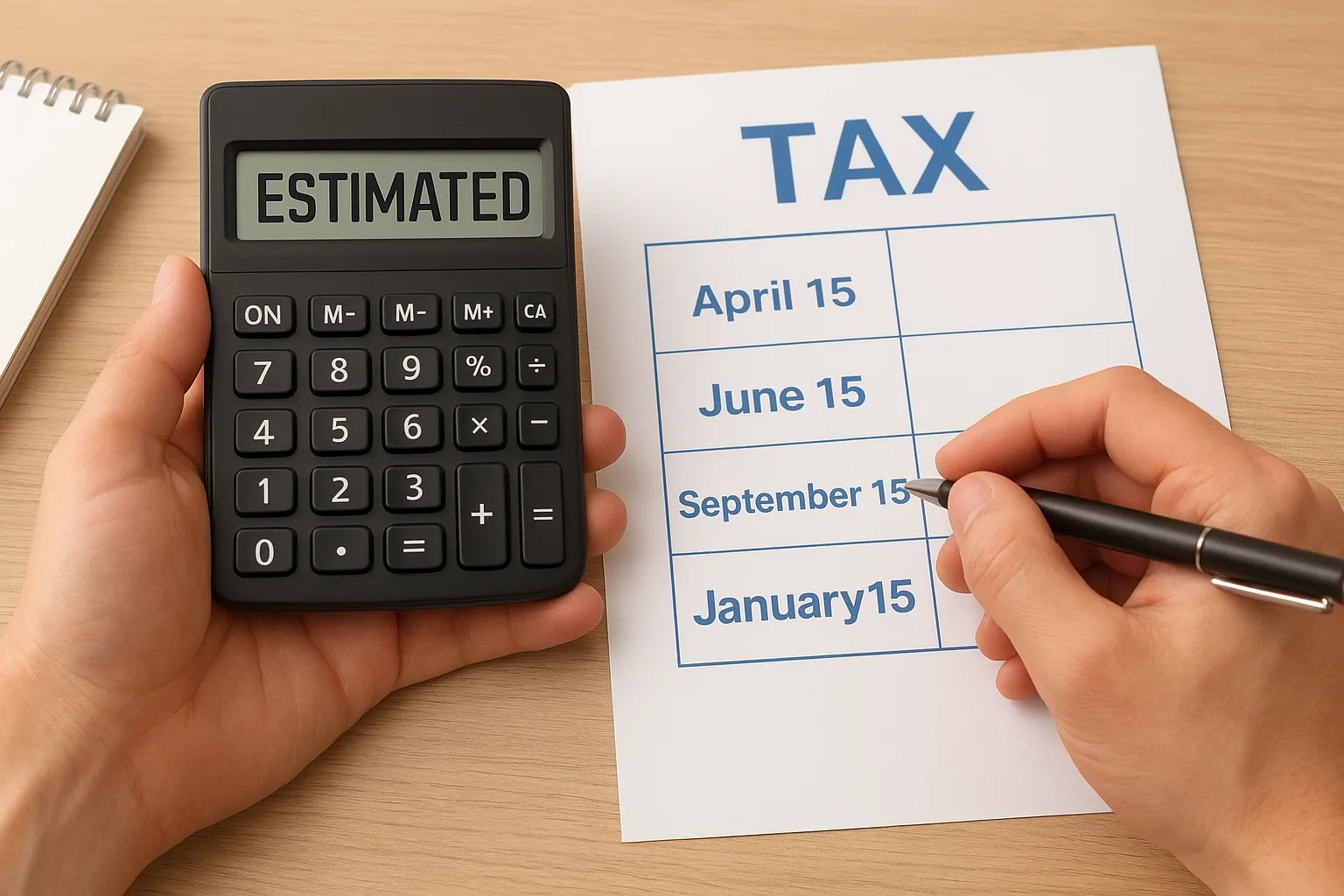
The usual way to avoid underpayment penalties is to pay at least 90% of this year's tax, or 100% of last year's tax, or 110% if your adjusted gross income was above $150,000. Say you calculate that you will owe $12,000 beyond payroll withholding. You would make four payments of $3,000 each, on April 15, June 15, September 15, and January 15.
Payroll deposits and Form 941
If your corporation pays you or anyone else wages, it has to file Form 941 each quarter, and it has to deposit withheld income tax, Social Security, and Medicare on a schedule, usually monthly by the 15th of the following month or semiweekly. If you deposited all the tax on time and in full, the IRS gives you an extra 10 days to file the 941. Late deposits and late filings are penalized separately from the 1120-S, so keep them on their own calendar.
Entity-level estimates and state taxes
A few S corporations owe tax at the entity level. Built-in gains tax can apply to a company that converted from a C corporation within the last five years, and excess net passive income tax can apply to one with C corporation earnings and profits. These taxes require corporate estimated payments on the 15th of the fourth, sixth, ninth, and twelfth months. Some states also impose entity-level taxes or fees with their own payment dates, so ask your preparer what applies in each state where you operate.
For most S corporations the real quarterly deadlines are the owners' estimates and the payroll forms, not a corporate income tax payment.
Payroll and year-end filings that run on their own dates
Beyond the 1120-S, an S corporation with employees has a set of year-end filings, most due January 31. These are separate from the March return, and missing them has its own penalties, so give them their own place on your calendar.
Annual wage and contractor forms
Form W-2 goes to each employee by January 31, and the W-2s plus Form W-3 go to the Social Security Administration by the same date. Form 940, the federal unemployment tax return, is also due January 31, and the IRS allows until February 10 if you deposited all the tax on time. Form 1099-NEC for contractors you paid $600 or more is due January 31 as well. January 31, 2027 is a Sunday, so these move to Monday, February 1, 2027.
The owner's own W-2
If you own and work in your S corporation, you are an employee and the corporation should pay you reasonable compensation through payroll. The IRS looks at owners who take profit distributions and little or no wages. Your W-2 also feeds your personal return, so a missing or late one creates a second filing problem on top of a late K-1. Our payroll team can run weekly, bi-weekly, semi-monthly, or monthly schedules and file these forms for you.
Treat the January forms as a second deadline season, because the 1120-S is not the only return an S corporation with payroll has to file.
Your S-corp tax calendar through 2027
The calendar below puts every date for a calendar-year S corporation with employees in order, from the next payroll deadline through the extended personal return deadline in October 2027. Dates that fall on weekends are already moved to the next business day.
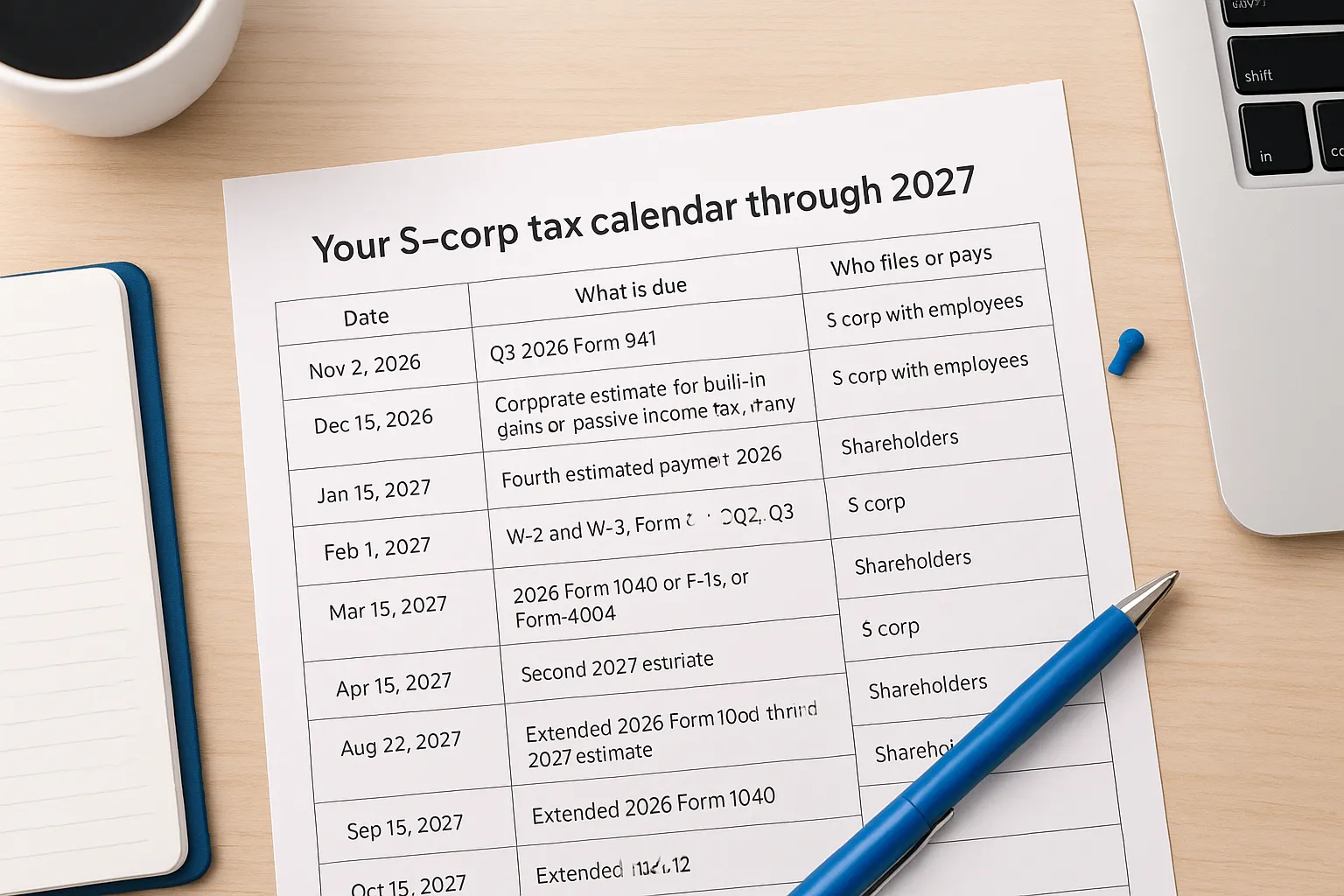
Dates from November 2026 to October 2027
| Date | What is due | Who files or pays |
|---|---|---|
| Nov 2, 2026 | Q3 2026 Form 941 | S corp with employees |
| Dec 15, 2026 | Corporate estimate for built-in gains or passive income tax, if any | S corp, only if it applies |
| Jan 15, 2027 | Fourth estimated payment for 2026 | Shareholders |
| Feb 1, 2027 | W-2 and W-3, Form 940, Q4 2026 Form 941, 1099-NEC | S corp with payroll |
| Mar 15, 2027 | Form 1120-S and K-1s, or Form 7004 | S corp |
| Apr 15, 2027 | 2026 Form 1040 or Form 4868, and first 2027 estimate | Shareholders |
| Apr 30, 2027 | Q1 2027 Form 941 | S corp with employees |
| Jun 15, 2027 | Second 2027 estimate | Shareholders |
| Aug 2, 2027 | Q2 2027 Form 941 | S corp with employees |
| Sep 15, 2027 | Extended 1120-S deadline and third 2027 estimate | S corp and shareholders |
| Oct 15, 2027 | Extended 2026 Form 1040 | Shareholders |
Using the calendar
Add each date to a shared calendar with a reminder two weeks ahead, and add an earlier internal date for gathering documents. Bookkeeping needs to be closed for December before an accountant can finish the return, so a realistic target for your year-end books is early February. If you work with a bookkeeper, ask for a monthly close so the year-end work is not one big scramble.
If your company has a fiscal year, no payroll, or more than one state, remove or add the rows that apply. A company with no employees can ignore the Form 941 and January wage rows. A multi-state company needs to add each state's return date to the calendar.
The S election deadline, the 2% rule, and the 5-year rule
Three related S corporation rules affect your calendar and your return: the election deadline for Form 2553, the 2% shareholder rule for health insurance, and the five-year rule for re-electing S status.
The S election deadline
A corporation or LLC elects S status by filing Form 2553. The election generally has to be filed within 2 months and 15 days of the start of the tax year it takes effect, or at any point in the prior tax year. A calendar-year corporation that wants S status for all of 2027, for example, has until March 15, 2027, the same date as the 2026 Form 1120-S. A new company has the same 75 days counted from its first day of business.
If you miss it, the IRS offers late-election relief. The usual route requires reasonable cause, is generally available within three years and 75 days of the intended effective date, and uses a specific filing procedure. This is where a professional earns the fee, because a wrong filing can leave you taxed as a C corporation.
The 2% rule
A shareholder who owns more than 2% of the S corporation's stock is treated like a partner for fringe benefits. Health insurance premiums the corporation pays for you have to be included in your W-2 wages, though they are not subject to Social Security and Medicare tax. You can then claim the self-employed health insurance deduction on your Form 1040 if you qualify. Skipping that W-2 reporting is a common cause of corrections.
The 5-year rule
The term covers two different rules. First, if your S election ends, whether you revoke it or lose it, you generally cannot re-elect S status for five tax years without IRS consent. Second, a corporation that converts from a C corporation faces the built-in gains tax on appreciated assets sold within a five-year recognition period after the conversion. Both are good reasons to talk to a CPA before you change your entity status.
The S election has its own deadline and its own five-year consequences, so decide on your entity structure before the filing season, not during it.
What to do if you already missed a deadline
If you missed an S-corp due date, file the return as soon as you can, because the penalty grows every month and filing stops the clock. Do not wait until you can pay or until every document is perfect.
The first week
- Find out which date you missed, March 15 or the extended September 15, and how many shareholders you have.
- Gather the books for the year, including bank statements, payroll reports, and shareholder basis records.
- File the 1120-S and the K-1s, even if you have to file with a note that some items are being finalized.
- Send each shareholder a K-1, so they can fix their own personal returns.
- Respond to any IRS notice, typically a letter proposing a late-filing penalty, by its stated date.
Say your calendar-year S corporation extended its 2025 return to September 15, 2026 and still has not filed. With three shareholders and the $255 penalty for returns due in 2026, each month or part of a month adds $765 (3 × $255). Filing in the second month after September 15 costs $1,530, and three more months add $2,295.
Asking for relief and getting help
After you file, request abatement in writing if you have reasonable cause, or ask whether first-time relief applies. Unfiled prior-year returns, payroll tax problems, and penalty notices that keep coming are a different level of problem. Our Tax Resolution Services work directly with the IRS and state agencies on back taxes, notices, and unfiled returns, and the first consultation is 30 minutes and free. Flexible payment options are available for qualified clients.
The IRS also keeps its general S corporation guidance on its S corporations page. A missed deadline is fixable, but each month you wait raises the cost.
Stay ahead of the next S-corp deadline
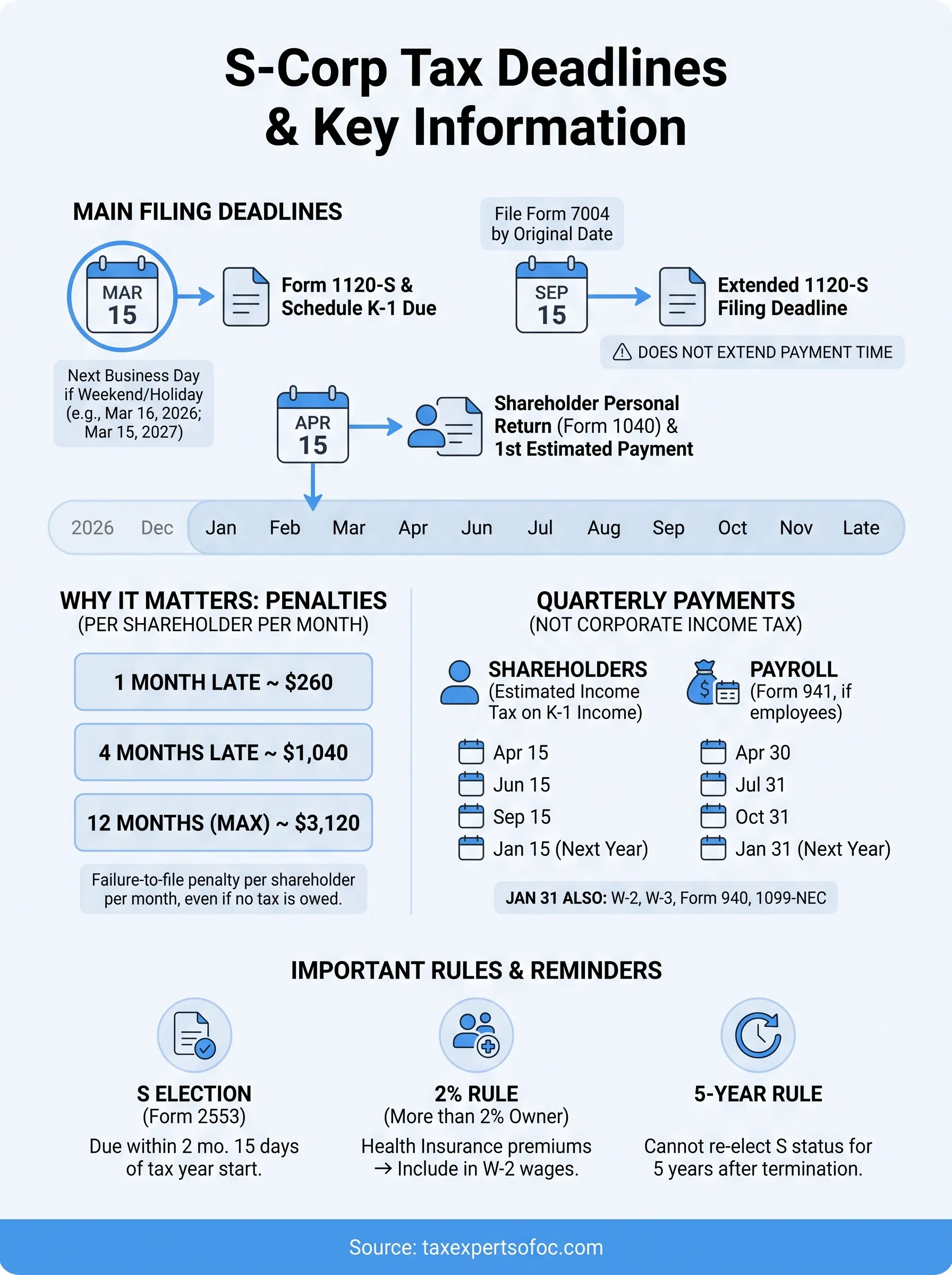
The base rule is simple. Your S corporation files Form 1120-S and the K-1s by the 15th day of the third month after year-end, which makes March 15, 2027 the next date for a calendar-year company, and Form 7004 moves that to September 15 without moving payment. Shareholders pay estimates on April 15, June 15, September 15, and January 15, payroll forms follow their own quarterly and January dates, and penalties accrue per shareholder every month.
The easiest way to stay on time is to set the dates once, close your books monthly, and decide by early March whether you need an extension. If you want someone to own that calendar, talk to a CPA or Enrolled Agent at Tax Experts of OC about business tax return services for your S corporation, your extension, or a deadline you have already missed.