

Searching "business tax preparer near me" usually means one thing: you got burned by cheap software, missed a deduction, or you're staring down a deadline with books that aren't ready. Maybe you just formed an LLC and have no idea who should handle the filing. Whatever brought you here, picking the wrong preparer costs more than a bad return. It can trigger an audit, a missed payment, or a penalty you'll be fighting for years.
The right answer isn't just "someone local." It's a professional tax preparer near me who actually holds a CPA or Enrolled Agent credential, understands your entity type, and can defend that return if the IRS comes knocking. Location matters less than you'd think once you factor in secure virtual consultations, but credentials, experience with your industry, and transparent pricing matter a lot.
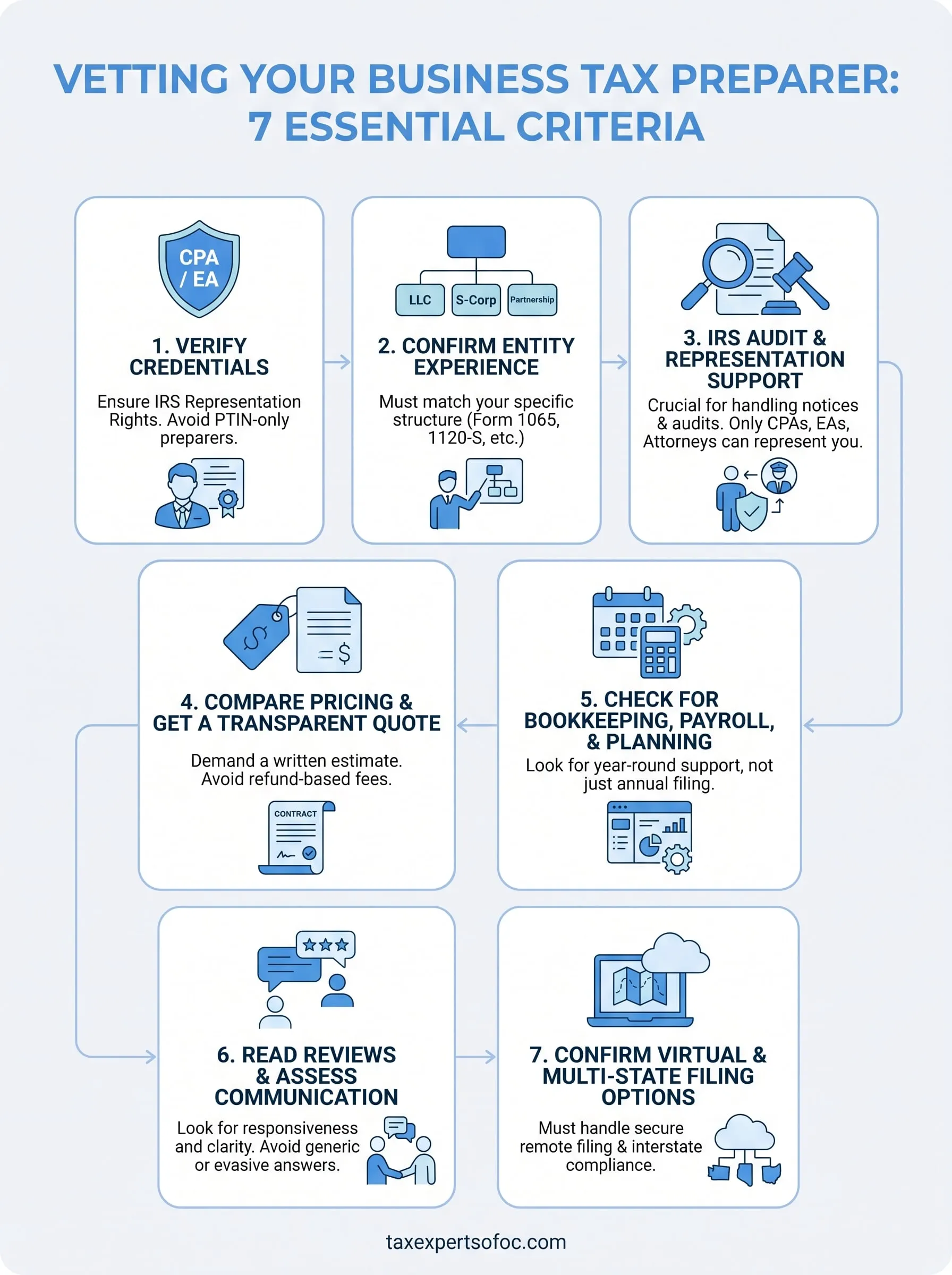
Below are seven concrete criteria for vetting anyone offering corporate tax preparation services, from checking licenses to asking the right questions before you hand over your financial records. Use them to separate a real tax professional from someone just running numbers through a program.
1. Verify CPA, EA, or PTIN credentials
Anyone can call themselves a "tax preparer." There's no law stopping a person with a laptop and a $100 course certificate from filing your corporate return. That's why the first filter you apply when choosing the right tax pro, before pricing or reviews, has to be credentials. A CPA (Certified Public Accountant) has passed a rigorous state exam and carries ongoing education requirements. An Enrolled Agent (EA) is federally licensed by the IRS specifically to prepare returns and represent taxpayers before the agency. Both are miles ahead of an uncredentialed preparer who only has a PTIN (Preparer Tax Identification Number), which the IRS requires of anyone paid to prepare returns but which by itself proves almost nothing about competence.
Why it matters
Credentials determine what happens after the return is filed, not just how accurate it is going in. If the IRS sends a notice or opens an audit, only a CPA, EA, or attorney can legally represent you in front of the agency. A preparer with just a PTIN can't sit across from an IRS agent on your behalf. You'd be forced to hire someone else mid-dispute, often at a worse rate and with less context on your situation. You can confirm any preparer's PTIN status directly through the IRS Directory of Federal Tax Return Preparers.
A preparer who can't represent you in an audit isn't a long-term partner, just a data-entry service.
Red flags to avoid
Watch for preparers who dodge direct questions about their license number or get vague when you ask which state issued their CPA certification. A legitimate professional answers instantly, because they use that information daily. Other warning signs cluster around how the practice actually operates:
- No verifiable license number or refusal to provide one when asked directly
- Fees based on a percentage of your refund, which incentivizes inflated deductions
- Promises of unusually large refunds before they've even reviewed your books
- Unwillingness to sign the return as the paid preparer, a legal requirement they're trying to skip
- Generic staff handling your file instead of the CPA or EA whose name is on the door
That last point matters more than most people realize. Plenty of firms advertise a credentialed founder but route actual client work to junior staff or seasonal hires with no license at all. You want direct access to the person signing your return, not a middleman.
Questions to ask
Before you hand over a single financial document, get specific answers to these questions. A confident, immediate response is a good sign. Hesitation or deflection is not.
- Are you a CPA, an Enrolled Agent, or a tax attorney, and can you provide your license or enrollment number?
- Will you personally prepare and sign my business return, or will it go to someone else on staff?
- Can you represent me directly if the IRS opens an audit or sends a notice?
- How many years have you held this credential, and how much of your practice is corporate versus individual returns?
- Are you in good standing with your state board or the IRS Office of Professional Responsibility?
At Tax Experts of OC, every return goes through a CPA or Enrolled Agent, and that same person is available for a free 30-minute consultation before you commit to anything. That upfront transparency is exactly what you should expect from any firm you're vetting, local or not.
2. Confirm experience with your business structure
A preparer who mostly handles W-2 individuals isn't automatically qualified to file for your LLC, S-corp, or partnership. Business returns carry different forms, different deadlines, and different rules for how income passes through to your personal return. Someone comfortable with a Schedule C sole proprietorship might fumble a multi-member LLC's Form 1065, or miss the reasonable-compensation rules that trip up S-corp owners. Before you commit, ask directly how much of their corporate tax preparation services work matches your actual entity type, not just "business returns" in general.

Why it matters
Every entity type has its own filing logic, and getting it wrong doesn't just cost you a deduction, it can trigger penalties or force an amended return. An S-corp owner who isn't advised on reasonable salary versus distributions can end up flagged for payroll tax underpayment. A partnership with an inexperienced preparer might see allocations of income and loss handled incorrectly across partners. Non-profits face their own filing track entirely, with Form 990 requirements that have nothing in common with a standard corporate return.
The wrong preparer for your entity type doesn't just file slower, they file wrong.
Red flags to avoid
Be cautious of a preparer who treats every business the same way regardless of structure. Specific warning signs include:
- Vague answers about which entity types they file most often
- No mention of entity-specific issues, like basis limitations for S-corp shareholders or self-employment tax for partners
- One-size-fits-all pricing that doesn't account for added complexity of multi-member LLCs or non-profits
- Reluctance to discuss entity structure changes, even when it could save you money
Questions to ask
Use these questions to gauge whether their experience actually lines up with your business:
- How many returns like mine, by entity type, did you file last season?
- Do you handle Form 1065 partnerships, Form 1120-S S-corps, and Form 990 non-profits regularly, or mostly one type?
- Can you explain how reasonable compensation or basis limitations apply to my specific structure?
- Would restructuring my entity save money given my current revenue and situation?
A firm that works across entity types, from single-member LLCs to established corporations and non-profits, brings pattern recognition you simply can't get from a generalist. That breadth also means they can flag structural changes worth considering as your business grows, not just file the same forms year after year.
3. Ask about IRS audit and representation support
Filing the return is only half the job. The real test of a business tax preparer near me is what happens if the IRS flags something months or years later. Audits, notices, and back-tax collection cases don't disappear because you already filed; they show up unannounced, often on returns prepared by someone who's long gone or unreachable. Before you sign anything, find out whether your preparer sticks around after tax season or vanishes the moment your return is accepted.
Why it matters
Representation rights aren't optional extras, they're the difference between handling an IRS notice calmly and scrambling to find help under deadline pressure. Only a CPA, EA, or attorney can represent you before the IRS under its Circular 230 rules. If your preparer can't do that, you're on your own the moment a notice arrives, forced to explain a return you didn't fully understand to begin with. Firms that specialize in tax resolution, not just preparation, catch problems before they escalate into wage garnishments or liens.
If your preparer can't stand next to you in an audit, they were never really on your team.
Red flags to avoid
Some preparers treat the filing as the finish line and quietly step back once the invoice clears. Watch for these patterns:
- No mention of audit support anywhere in their service list or contract
- Seasonal-only availability, with no way to reach them outside of tax season
- Outsourcing representation to a third party they don't work with directly
- Refusal to discuss past IRS notices you've received, treating them as someone else's problem
- No experience with penalty abatement or installment agreements for clients who owe back taxes
A preparer who only files and disappears leaves you exposed exactly when you need backup most.
Questions to ask
Get clear on representation before you're facing a real notice, not after:
- If the IRS audits this return, will you personally represent me, and is that included in your fee or billed separately?
- Have you handled audit defense, penalty abatement, or installment agreements before, and can you describe an outcome?
- What's your response time if I receive an IRS notice six months from now?
- Do you offer resolution services for back taxes and unfiled returns, or only current-year filing?
A firm built around both preparation and resolution, the kind that handles IRS notices, audits, and back taxes as core services rather than afterthoughts, gives you continuity. You're not starting over with a stranger the moment a letter from the IRS shows up in your mailbox.
4. Compare pricing and get a transparent quote
Price shopping a business tax preparer near me search feels risky because average fees vary widely by return type, and the cheapest quote often hides costs that surface later. A flat-rate quote for a simple LLC return might balloon once the preparer discovers you also need payroll reconciliation or multiple state filings. Before you commit, get a written estimate that names every service included, not just "business tax prep" as a catch-all line item.
Why it matters
Unclear pricing usually signals unclear scope, and unclear scope means surprise invoices in April. A preparer who can't tell you upfront what a partnership return with two states costs probably hasn't standardized their process enough to know their own time investment. Transparent pricing also protects you from the incentive problems tied to refund-based fees, since a flat or hourly structure means the preparer has no reason to inflate deductions just to boost their own cut.
If a preparer can't quote you a real number before touching your books, don't expect a real answer after.
Red flags to avoid
Some pricing structures exist specifically to obscure the final bill until you're already committed. Watch for these patterns:
- "It depends" with no follow-up specifics, even after you describe your entity type and revenue
- Refund-percentage fees, which reward inflated numbers over accuracy
- Add-on fees disclosed only after the engagement starts, like separate charges for e-filing or extensions
- No free consultation, meaning you pay just to find out if the relationship is a fit
- Pressure to sign before reviewing your documents, which skips the step where real pricing gets set
Questions to ask
Run through these before agreeing to anything in writing:
- What's included in the quoted price, and what triggers an additional charge?
- Is pricing flat-rate, hourly, or based on complexity, and how do you calculate that complexity?
- Do you offer payment plans if I'm dealing with financial hardship alongside my tax filing?
- Can I get this quote in writing before you start any work?
- Does the price change if my business needs multi-state filing or catch-up bookkeeping?
Tax Experts of OC offers a free 30-minute consultation specifically so you get a real quote before any commitment, along with flexible payment options for clients facing financial strain. That's the standard worth holding every corporate tax preparation services provider to: a number you can trust before you sign, not a surprise after.
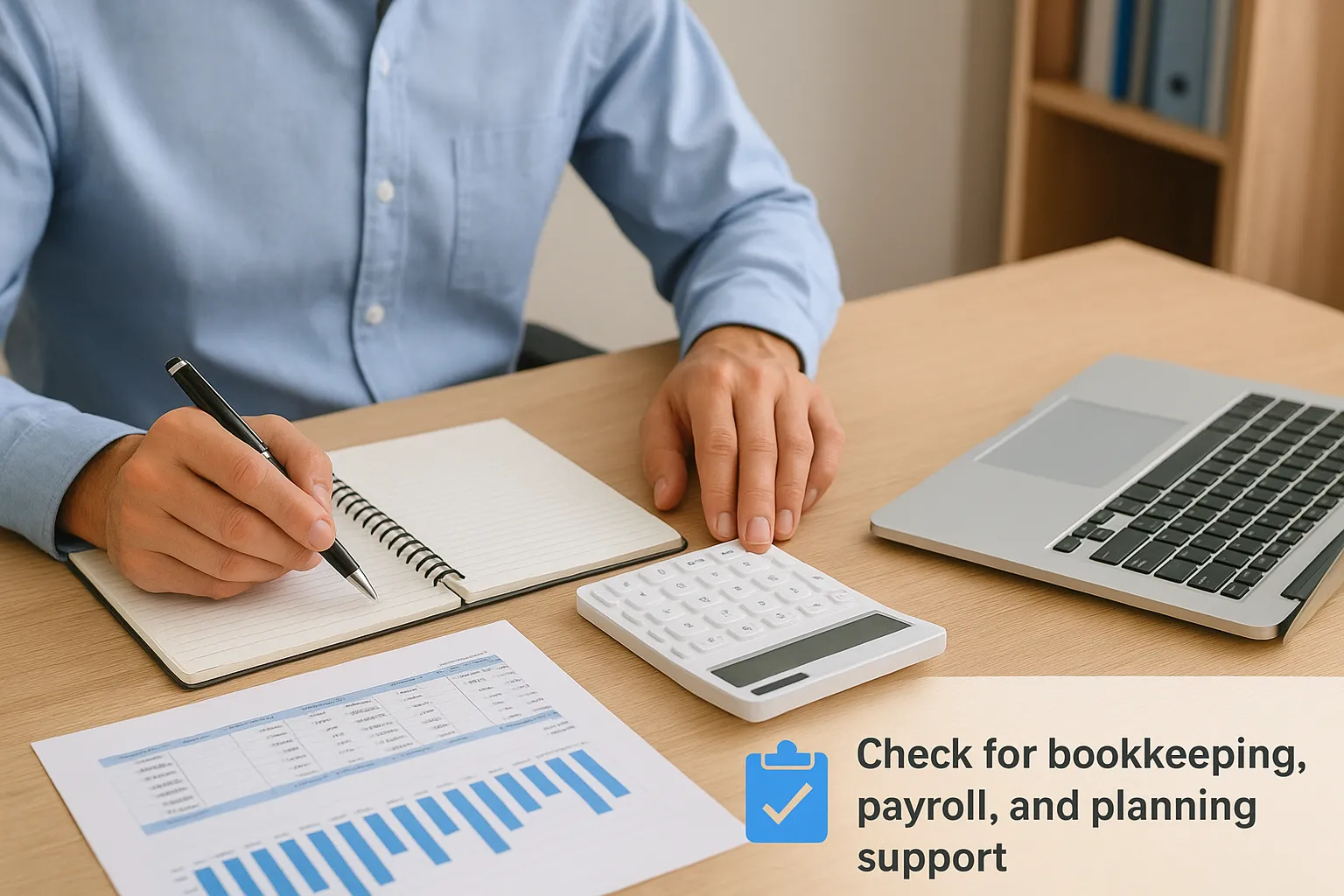
5. Check for bookkeeping, payroll, and planning support
A business tax preparer near me search often stops at "who can file my return," but that's a narrow way to pick a long-term partner. Books that are a mess in December make for a rushed, expensive return in March. Bookkeeping for small businesses, payroll, and forward-looking tax planning aren't separate services from filing, they're the foundation that makes filing accurate and cheap in the first place. Before you sign with anyone, find out whether they can support your business year-round or only show up once a year with a form.
Why it matters
Separating bookkeeping from tax prep almost always costs more in the long run. A preparer who never sees your monthly numbers has to reconstruct a year's worth of transactions from bank statements and guesswork, which means more billable hours and more chances for errors. Strategic tax planning works the same way: a preparer who only meets you at filing time can't advise on quarterly estimated payments, retirement contributions, or entity elections while there's still time to act. By the time you're signing a return, most planning opportunities for that year are already gone.
A preparer who only shows up at tax time can't plan anything, they can only report what already happened.
Red flags to avoid
Some firms advertise "full-service" without actually offering the infrastructure to back it up. Watch for:
- No in-house bookkeeping or payroll, meaning you're stuck coordinating between three separate vendors
- Zero mention of quarterly check-ins or mid-year tax planning conversations
- Payroll handled through a generic third-party app with no oversight from your actual preparer
- No experience with outsourced CFO or controller-level work for businesses that have outgrown basic bookkeeping
Questions to ask
Run through these before deciding whether a firm can grow with your business:
- Do you offer monthly, quarterly, or annual bookkeeping, and how does that connect to my tax return?
- Can you manage payroll and the related tax filings, or do I need a separate provider?
- Will we meet during the year for tax planning, and what does it include, or only at filing time?
- At what size or complexity would I need outsourced CFO support, and do you offer that?
Firms that bundle bookkeeping, payroll, and strategic tax planning under one roof catch issues early and use real-time numbers to plan, not last year's guesswork.
6. Read reviews and assess communication style
Online reviews only tell you part of the story, but they're still worth reading before you trust anyone with your business finances. Look past the star rating and read what clients actually wrote about response times, clarity, and whether the preparer explained things or just handed over a finished return. A professional tax preparer near me search will surface plenty of five-star listings, but the details in the actual comments matter more than the average score. Pay attention to how a firm responds to negative reviews too, since a thoughtful, specific reply says more about their professionalism than a wall of glowing testimonials ever will.
Why it matters
Communication style predicts how the entire relationship will feel, especially during a stressful season like an audit or a missed deadline. A preparer who takes days to answer emails in July probably won't move faster in April when everyone's under the same deadline pressure. Client reviews often reveal patterns that a sales call won't, like whether a firm actually returns calls or whether you'll be chasing them for updates on your own return.
If a preparer is slow to respond before you're a client, expect that to get worse, not better, after you sign.
Red flags to avoid
A glowing five-star average with no substance behind it should make you dig deeper, not feel reassured. Watch for these patterns:
- Reviews that read like templates, with generic praise and no specific details about the service
- A pattern of complaints about slow responses, missed deadlines, or ignored calls
- No responses at all to negative reviews, suggesting no one's managing client relationships
- Vague or evasive answers during your first call, a preview of how future questions will get handled
- Long delays just to schedule an initial consultation, before you're even a paying client
Questions to ask
Use your first conversation to test communication directly, not just to gather information:
- What's your typical response time for phone calls or emails during tax season versus off-season?
- Who will be my main point of contact once I'm a client?
- How do you handle disagreements or complaints from past clients?
- Can you connect me with a current client for a reference?
A firm that answers these questions clearly, and offers a free consultation so you can judge their communication firsthand before committing, is showing you exactly what to expect once you're on the books.
7. Confirm virtual and multi-state filing options
Geography matters less than it used to, but only if the firm you're vetting has actually built the systems to support remote clients. A business tax preparer near me doesn't need to be in your zip code anymore, as long as they let you file remotely with secure document upload, e-signature, and video or phone consultations that replace the in-person meeting entirely. This matters even more if your business operates across state lines, hires remote employees, or you've relocated but want to keep the same preparer. Confirm early whether the firm can file in every state your business touches, not just the one where they're headquartered.

Why it matters
Multi-state filing isn't just "the same return twice." Each state has its own nexus rules, apportionment formulas, and filing deadlines, and a preparer unfamiliar with a particular state can misallocate income or miss a registration requirement entirely. Businesses with remote employees or contractors in multiple states face payroll tax obligations that vary by jurisdiction too. A firm limited to one state's rules either turns away that work or, worse, files it incorrectly.
A preparer who can't file across state lines will eventually box in a growing business.
Red flags to avoid
Some firms advertise nationwide service but lack the actual infrastructure or licensing depth to back it up. Watch for:
- No secure client portal, meaning sensitive financial documents get sent over unencrypted email
- Limited state experience, with vague answers about which states they've actually filed in
- No video or phone consultation option, forcing an in-person visit that defeats the point of remote service
- Confusion about nexus rules when you describe remote employees or out-of-state sales
Questions to ask
Run through these before assuming a remote-friendly firm can actually handle your situation:
- Do you use a secure portal for document sharing, and how is my data encrypted?
- How many states have you filed corporate or partnership returns in during the past year?
- Can we handle everything, including signatures, by phone or video without an in-person visit?
- If I have employees or contractors in multiple states, can you manage the related payroll tax filings?
Tax Experts of OC serves clients across all 50 states through virtual consultations, secure document handling, and multi-state filing experience, so a corporate tax preparation services relationship doesn't have to hinge on your physical location at all.
Finding the right fit for your business
Seven criteria, one goal: find a preparer who does more than plug numbers into software. Credentials tell you who's actually licensed to represent you. Experience with your entity type tells you whether they'll file it correctly the first time. Everything else, pricing clarity, bookkeeping support, communication, and virtual capability, tells you whether the relationship will hold up once tax season ends and real business decisions start piling up. A business tax preparer near me search shouldn't end with the first five-star listing you find. It should end with someone who answered every question above without flinching.
Run through this checklist with any firm before you sign, including ours. Tax Experts of OC puts CPAs and Enrolled Agents on every file, prices transparently, and serves clients nationwide through secure virtual consultations. If you want to see how our business tax preparation services work for your specific situation, schedule your free 30-minute consultation and get real answers before you commit to anything.