

Searching for a good tax preparer near me usually starts after something goes wrong: a confusing IRS letter, a missed deduction, or a preparer who vanished after filing season. You want someone local enough to trust but skilled enough to handle your actual situation, not just plug numbers into software. That gap between convenience and competence is where most people get stuck.
The honest answer is that "near me" matters less than credentials, communication, and track record. A licensed CPA or Enrolled Agent can represent you before the IRS if issues come up later, while an unlicensed preparer often can't. Reviews help, but you need to know what to actually check: PTIN registration, disciplinary history, and whether they've handled cases like yours, whether that's a simple W-2 return or a multi-state business filing.
This article walks through the specific criteria that separate a reputable tax professional from someone who just has a storefront and a slogan. We'll cover credential checks, red flags in reviews, questions to ask before you sign anything, and why firms offering virtual consultations, like ours, can sometimes serve you better than the office three blocks away.
1. CPAs and enrolled agents who handle complex tax issues
A Certified Public Accountant (CPA) or Enrolled Agent (EA) sits at the top of the tax professional hierarchy for a reason: both are licensed to represent you before the IRS, not just prepare your return. A CPA earns that license through state exams and accounting coursework, while an EA earns federal licensure directly from the IRS by passing a three-part exam covering individual, business, and representation issues. Either credential grants what the IRS calls unlimited representation rights, meaning they can speak for you during audits, collections, and appeals even if they didn't prepare the original return, so it's worth understanding how far a CPA's IRS authority extends. Unlicensed preparers, by contrast, can only represent returns they personally filed, and even then only in limited settings.
The credential you hire determines whether someone can fight for you later, not just file for you now.
How it works
CPAs and EAs work through a structured relationship that usually starts with a records review before they touch your return. They pull your prior filings, IRS transcripts if needed, and financial documents, then identify deductions, credits, or compliance gaps a generic preparer might miss. If the IRS sends a notice six months after filing, the same professional can step in under IRS Circular 230 rules and manage the correspondence directly, which matters enormously if you've ever tried to get a straight answer from the IRS on your own.
Who it's best for
This tier makes the most sense once your taxes stop being simple. Consider a CPA or EA if you fall into any of these categories:
- You own a business structured as an LLC, S-corp, or partnership
- You've received an IRS notice, audit letter and what it actually means, or collections warning
- You have income across multiple states
- You're carrying significant back taxes or unfiled returns
- You need an ongoing tax planning service near you, not just annual filing
Someone with a single W-2 and no dependents generally doesn't need this level of service, but the moment complexity enters the picture, the representation rights alone justify the higher fee.
Typical costs
Pricing varies by region and complexity, but here's a realistic range based on typical engagement scope, and a closer look at tax preparation costs by return type fills in the details:
| Service Type | Typical Cost Range |
|---|---|
| Simple individual return | $220 - $400 |
| Return with itemized schedules or rental income | $500 - $900 |
| Business return (LLC, S-corp, partnership) | $800 - $2,500 |
| IRS audit or collections representation | $2,000 - $10,000+ |
Firms that quote a flat number without reviewing your documents first are often underpricing to win the job, then adding fees later. Transparent, upfront pricing after a real assessment is the standard to expect.
How to check credentials and reviews
Before you hire anyone, verify their licensing status directly rather than trusting a website badge. Run through this checklist:
- Search the preparer's PTIN in the IRS Directory of Federal Tax Return Preparers
- Confirm CPA licensure through your state's board of accountancy website
- Verify EA status using the IRS Enrolled Agent lookup
- Check for disciplinary actions or license suspensions
- Read reviews specifically mentioning IRS representation, not just filing speed
A firm like Tax Experts of OC publishes exactly this kind of credential information upfront, because clients looking for CPAs who handle IRS problems locally need proof of standing before they hand over sensitive financial records, not after.
2. Tax attorneys for IRS audits and legal disputes
When your tax problem crosses from a paperwork issue into a legal one, a tax attorney for IRS matters becomes the right hire, not a CPA or EA. Tax attorneys handle situations where the IRS is alleging fraud, where you're facing criminal exposure, or where you need attorney-client privilege that a CPA simply can't offer. That privilege matters more than most people realize: anything you tell a CPA can, in some circumstances, be subpoenaed, while communications with an attorney generally cannot.
If the IRS is using the word "fraud" or "willful," you need a lawyer in the room, not just an accountant.
How it works
Tax attorneys typically get involved after a notice of deficiency, a summons, or a referral to the IRS Criminal Investigation division. They review the legal theory behind the IRS's position, negotiate settlements like offers in compromise on the legal end, and represent you in U.S. Tax Court if litigation becomes necessary. Unlike a CPA who focuses on the numbers, an attorney focuses on your legal exposure and how to limit it.
Who it's best for
This option fits a narrower slice of taxpayers than CPAs or EAs do. You likely need a tax attorney if:
- The IRS has raised allegations of fraud or willful evasion
- You're facing a criminal tax investigation
- You need to petition U.S. Tax Court
- You're negotiating a complex settlement involving multiple tax years and significant liability
- You want attorney-client privilege protecting your communications
Routine audits without fraud allegations usually don't require an attorney; a CPA or EA can handle most of those, and it helps to know when a tax attorney is worth hiring for an IRS audit.
Typical costs
Attorneys bill differently than CPAs, and the fees reflect the legal risk involved. Most charge hourly rather than flat rates:
| Service Type | Typical Cost Range |
|---|---|
| Initial consultation | $200 - $500 |
| Hourly rate for representation | $300 - $600/hour |
| Full audit defense (non-criminal) | $5,000 - $15,000 |
| Criminal tax defense | $20,000 - $100,000+ |
Expect a retainer upfront, often several thousand dollars, before work begins.
How to check credentials and reviews
Verify that any tax attorney is licensed and in good standing before signing a retainer agreement.
- Confirm bar membership through your state bar association's attorney search
- Check for disciplinary history or ethics complaints
- Ask specifically about experience with IRS Criminal Investigation cases if that applies to you
- Look for board certification in tax law where your state offers it
- Read reviews mentioning courtroom or Tax Court experience, not just paperwork help
Many firms, including Tax Experts of OC, pair tax attorneys with tax resolution services in California on cases that start as resolution work but escalate into legal territory, so ask whether your CPA or EA has that referral relationship already in place.
3. National tax prep chains like H&R Block and Jackson Hewitt
When you search for a good tax preparer near me, national chains like H&R Block and Jackson Hewitt often dominate the results simply because of storefront density. These companies operate thousands of seasonal locations, often inside strip malls or big-box retailers, staffed largely by preparers who complete a company training course rather than earn a CPA or EA license. That doesn't make them bad, but it does mean the depth of expertise varies wildly from one location to the next, even within the same chain.

A national logo guarantees consistency in software, not consistency in expertise.
How it works
Chains standardize the intake process: you bring your documents, a preparer enters them into proprietary software, and the return gets reviewed by a supervisor before filing. Most locations offer audit support add-ons for an extra fee, which typically means help drafting a response letter rather than full IRS representation. Some chains also promote refund advance loans, which can be useful if you need cash fast but usually carry fees that reduce your actual refund.
Who it's best for
This tier suits taxpayers with straightforward situations who want a physical office and same-day turnaround, though how long tax preparation takes still depends on your return. Good candidates include:
- W-2 employees with no business income
- Renters or homeowners without rental property complications
- Filers who want in-person document handoff rather than digital upload
- People needing a fast refund advance product
Anyone with self-employment income, multiple states, or an open IRS notice usually outgrows this tier fast.
Typical costs
Pricing depends heavily on return complexity and location, and chains rarely quote a firm number upfront:
| Service Type | Typical Cost Range |
|---|---|
| Simple W-2 return | $150 - $300 |
| Return with itemized deductions | $250 - $450 |
| Small business or Schedule C add-on | $400 - $700+ |
Watch for pricing that climbs once the preparer starts entering your information, since base advertised rates rarely reflect the final invoice.
How to check credentials and reviews
Before booking an appointment, confirm the specific preparer's qualifications rather than trusting the brand alone.
- Ask directly whether your preparer holds a PTIN and how many seasons they've worked
- Request the preparer's individual name, not just the location, for review searches
- Check the Better Business Bureau for pattern complaints about that specific franchise location
- Read reviews mentioning correction requests or amended returns, a sign of rushed preparation
- Confirm in writing what the audit support add-on actually covers before paying for it
4. Local independent tax preparers in your neighborhood
Many people typing good tax preparer near me into a search bar are actually picturing this option: the solo practitioner or small firm that's operated out of the same office for fifteen years, knows your name, and doesn't rotate staff every season. Independent preparers range from unlicensed part-timers to seasoned EAs who simply chose to run a small practice instead of joining a national brand. That range is exactly why this category requires more homework than any other on this list, starting with what to check before hiring a preparer.
A neighborhood reputation built over a decade is worth more than a chain's national ad budget, but only if you verify it yourself.
How it works
Independent preparers typically build relationships over multiple years, which means they often catch changes in your situation, like a new dependent or a side business, that a rotating chain staffer would miss. Appointments tend to be longer and less scripted, since there's no corporate software forcing a rigid intake process. Some operate seasonally, closing shop after April and becoming hard to reach if an IRS notice arrives in July, so ask about year-round availability before you commit.
Who it's best for
This option fits taxpayers who value continuity and a personal relationship over brand recognition. It works well for:
- Retirees with straightforward but recurring investment income
- Small business owners already using the same preparer for bookkeeping
- Families who've used the same preparer for years and trust the history
- People who prefer face-to-face meetings over app-based document uploads
Typical costs
Pricing runs lower than national chains in some markets and higher in others, depending on local demand and the preparer's credentials:
| Service Type | Typical Cost Range |
|---|---|
| Simple individual return | $150 - $350 |
| Itemized or rental income return | $350 - $650 |
| Small business return | $500 - $1,500 |
Cash-only pricing or a reluctance to provide a written invoice should raise concern regardless of how friendly the preparer seems.
How to check credentials and reviews
Small practices rarely have the marketing budget of a national chain, so their online presence can be thin even when their work is excellent. Verify independently rather than relying on word of mouth alone:
- Look up their PTIN in the IRS preparer directory
- Ask directly whether they carry professional liability insurance
- Search Google and Yelp for their business name plus "complaint" or "audit"
- Confirm whether they sign returns themselves, a legal requirement paid preparers often skip
- Ask how they handle client cases once tax season ends
5. Virtual and online tax preparation services
Searching for a good tax preparer near me doesn't have to mean a physical location at all anymore. Virtual tax preparation services connect you with a licensed CPA or EA through secure document upload portals, video calls, and encrypted messaging, and for many clients it now beats driving across town for an in-person meeting. The category ranges from software-driven platforms that pair you with a random preparer each season to established firms that offer real virtual consultations with the same professional every year.

Remote doesn't mean lower quality; it means the same expertise without the waiting room.
How it works
You start by uploading tax documents through a secure client portal rather than handing over paper folders. A licensed preparer reviews everything remotely, then schedules a video or phone call to walk through questions, deductions, and any red flags before filing. If the IRS sends a notice later, the same firm can typically continue representing you without ever requiring an office visit, since most correspondence and even audits now happen through mail or phone. Tax Experts of OC runs its consultations this way specifically because clients dealing with back taxes often live outside California and still need California-level expertise.
Who it's best for
Virtual services fit a wide range of taxpayers, but they're especially strong for:
- Multi-state filers who can't find one local preparer familiar with every jurisdiction
- Business owners in rural areas without a nearby CPA or EA
- Clients who value flexible scheduling over in-person visits
- Anyone comparing multiple firms before committing, since remote consultations lower the barrier to shopping around
People who feel more comfortable handing over sensitive financial documents face-to-face may still prefer a local office, and that's a reasonable preference, not a wrong one.
Typical costs
Pricing for virtual services generally mirrors in-person CPA and EA rates, since the credentials and workload don't change:
| Service Type | Typical Cost Range |
|---|---|
| Simple individual return | $200 - $400 |
| Business return | $700 - $2,200 |
| Ongoing virtual tax planning | $150 - $400/month |
Some platforms advertise flat low rates but assign a different preparer every year, which undercuts the continuity that makes tax planning effective.
How to check credentials and reviews
Before paying for a virtual engagement, confirm you're getting a licensed professional rather than a call center representative reading from a script.
- Ask for the preparer's name and PTIN before uploading documents
- Verify licensure through the IRS or state board lookup, just as you would locally
- Check whether you'll work with the same preparer year over year
- Read reviews mentioning audit representation delivered remotely, not just refund speed
- Confirm the security standards used for document storage and transmission
6. Free IRS-sponsored tax help through VITA and TCE
If your return is simple and your income is low to moderate, you might not need to pay anyone at all. The Volunteer Income Tax Assistance (VITA) program and its counterpart, Tax Counseling for the Elderly (TCE), are IRS-sponsored initiatives that provide free tax preparation through trained volunteers at community centers, libraries, and schools nationwide. These low-cost tax preparation options exist specifically to serve people who'd otherwise get priced out of professional help entirely.

Free tax prep exists for a reason: use it if your situation qualifies, and save the paid fee for when complexity actually demands it.
How it works
Volunteers complete IRS training and certification each year before they're allowed to prepare returns, and every return goes through a quality review by a second certified volunteer before filing. You bring your documents to a physical site, often by appointment, and the volunteer enters your information into IRS-provided software. Sites and other free filing assistance programs typically run from late January through the April deadline, with limited hours and heavy demand as the deadline approaches, so early scheduling matters more here than with any paid option.
Who it's best for
This option works well for a specific slice of taxpayers rather than everyone searching for a good tax preparer near me:
- Individuals earning roughly $67,000 or less annually (the income cap adjusts yearly)
- People with disabilities who need accessible preparation help
- Limited English speakers who benefit from multilingual volunteer sites
- Seniors, particularly through TCE sites that specialize in retirement and pension issues
- Anyone with a genuinely simple return: W-2 income, standard deduction, no business activity
If you've got self-employment income, rental property, or an open IRS notice, VITA volunteers generally aren't equipped to help, and most sites will tell you that upfront.
Typical costs
There's no fee structure to compare here, since both programs are entirely free. The IRS funds them through grants to nonprofit and community organizations, and volunteers donate their time. The only real cost is your own: travel to a site and the wait time during peak season, which can stretch to an hour or more in late March and early April.
How to check credentials and reviews
Verification looks different for volunteer programs than for paid preparers, but it's still worth doing.
- Confirm the site is listed on the IRS VITA/TCE locator tool
- Ask whether your preparer is IRS-certified for the tax topics in your return
- Confirm a second volunteer will quality-review your return before filing
- Bring prior-year returns so the volunteer can check for missed credits
- Keep a copy of everything, since these sites don't offer ongoing representation if a notice arrives later
7. Accounting firms that bundle bookkeeping and taxes
Business owners searching for a good tax preparer near me often need more than a once-a-year filing appointment, which is why tax preparation services built for small business owners look different from individual filing. A full accounting firm combines bookkeeping and tax services with payroll under one roof, which means the numbers feeding your tax return come from books that same firm maintained all year, not a shoebox of receipts handed over in March. That continuity catches errors a seasonal preparer working from your spreadsheet would never see.
When the same firm keeps your books and files your return, tax time stops being a surprise.
How it works
These firms typically start with a bookkeeping review, either taking over your monthly reconciliations or cleaning up whatever system you've been using, whether that's QuickBooks, spreadsheets, or nothing at all. Throughout the year, they categorize expenses, track payroll tax deposits, and flag deductions as they happen instead of hunting for them retroactively. When filing season arrives, tax preparation becomes almost mechanical, since the underlying data is already clean and reconciled. Many firms extend this into outsourced CFO work for growing businesses, offering cash flow forecasting, entity structuring advice, and business tax planning alongside the compliance work.
Who it's best for
This tier fits business owners who've outgrown DIY bookkeeping but aren't ready for a full-time finance hire. Consider it if you match any of these:
- You run an LLC, S-corp, or partnership with monthly transaction volume
- Your books are messy, incomplete, or maintained by whoever had time that week
- You need payroll processed correctly alongside your tax filings
- You're scaling fast and need financial reporting, not just a return
Solo filers with no business activity generally don't need this level of service.
Typical costs
Bundled pricing usually runs monthly rather than as a single annual invoice:
| Service Type | Typical Cost Range |
|---|---|
| Monthly bookkeeping (small business) | $300 - $900/month |
| Bookkeeping plus payroll | $500 - $1,500/month |
| Annual tax filing included in bundle | Often included or discounted |
| Outsourced CFO services | $1,500 - $5,000/month |
Ask whether tax preparation is included in the monthly fee or billed separately at year-end, since firms handle this differently.
How to check credentials and reviews
Verify that the firm's tax preparers hold real credentials, not just bookkeeping certifications.
- Confirm CPA or EA licensure for whoever signs your return
- Ask how bookkeeping data flows into tax preparation, and whether the same team handles both
- Read reviews mentioning year-round support, not just tax season responsiveness
- Check whether the firm offers bookkeeping and accounting as a standing service or a seasonal add-on
- Ask for references from businesses similar in size and industry to yours
8. Directories and marketplaces like Yelp and Thumbtack
Typing good tax preparer near me into Google usually surfaces directories and marketplaces before it surfaces any actual firm. Platforms like Yelp, Thumbtack, and Angi aggregate local businesses, collect star ratings, and in Thumbtack's case, let preparers bid on your job directly. These sites are useful starting points, but they're aggregators, not vetting services, so pair them with a real method for finding a top rated tax preparer. A five-star rating tells you clients were happy with communication or price, not whether the preparer holds a valid PTIN or has ever handled an IRS notice.
A directory can point you toward a preparer, but it can't tell you if that preparer is licensed to defend your return later.
How it works
You search your zip code, filter by service type, and get a list ranked by review volume, star rating, and paid placement. Thumbtack works differently from Yelp: instead of browsing existing profiles, you submit your project details and preparers send you quotes, sometimes within hours. Yelp leans more toward passive browsing, where you read reviews and reach out directly. Neither platform independently verifies credentials before listing a business, so the burden of confirming licensure still falls entirely on you.
Who it's best for
These platforms work well as a discovery tool rather than a final decision-maker. They suit:
- People who don't yet know any local preparers and need a starting list
- Taxpayers comparing multiple quotes quickly through Thumbtack's bidding format
- Anyone who reads reviews carefully rather than sorting by star rating alone
- Buyers researching a preparer they already found elsewhere, to check for complaint patterns
Someone dealing with an active IRS collections case shouldn't stop at a directory listing; that situation calls for direct credential verification, not crowd-sourced ratings.
Typical costs
The platforms themselves don't charge you directly for basic searches, though Thumbtack preparers sometimes price slightly higher to offset the referral fees they pay the platform. Actual preparation costs still land in the same ranges covered earlier in this list, roughly $150 to $2,500 depending on complexity, since the directory is just the entry point.
How to check credentials and reviews
Treat directory listings as a lead, not a verified endorsement.
- Cross-check the preparer's name against the IRS Directory of Federal Tax Return Preparers
- Read the negative reviews first, since they reveal patterns star ratings hide
- Confirm the business address matches a real, verifiable location
- Ask the preparer directly for their PTIN before sending any documents
- Look for consistency between the directory profile and the preparer's own website
9. DIY tax software for simple returns
Sometimes the smartest answer to searching for a good tax preparer near me is realizing you don't need one at all. DIY tax software like TurboTax, TaxSlayer, or FreeTaxUSA walks you through a guided interview, pulls in W-2 and 1099 data automatically in many cases, and files electronically once you confirm the numbers. For a straightforward return, this route costs less and takes less time than booking any appointment on this list.
Software works great until your return asks a question the interview screen can't answer.
How it works
You create an account, answer a series of prompts about income, dependents, and deductions, and the program calculates your liability or refund in real time. Most platforms offer document import from payroll providers and major brokerages, which cuts down on manual entry errors. Before you file, the software runs an error check and flags obvious mismatches, though it can't catch a missed 1099 you never uploaded or a deduction you didn't know existed.
Who it's best for
This option fits a narrow but real slice of taxpayers well:
- Single filers with one or two W-2s and no dependents
- Renters with the standard deduction and no itemized expenses
- People with straightforward student loan interest or education credits
- Anyone comfortable reading IRS instructions if the software prompts get confusing
Once self-employment income, rental property, or multi-state filing enters the picture, software alone tends to miss deductions a licensed preparer would catch automatically, which is exactly when to hire a CPA rather than filing yourself.
Typical costs
Pricing scales with the forms you need, not the complexity of your actual finances:
| Service Type | Typical Cost Range |
|---|---|
| Federal filing, simple return | $0 - $60 |
| Federal plus state filing | $40 - $120 |
| Self-employment or itemized add-ons | $90 - $200 |
Many platforms advertise free filing, then charge once you add a Schedule C or itemize deductions, so read the fine print before you start entering data and check the IRS Free File eligibility rules first.
How to check credentials and reviews
There's no preparer to vet here, so verification shifts toward the software itself.
- Confirm the platform is IRS-authorized for e-file
- Read reviews mentioning accuracy guarantees and what they actually cover
- Check whether audit support is included or sold separately
- Compare state filing fees before committing, since they vary widely
If a notice arrives after filing through software, firms like Tax Experts of OC regularly step in to sort out what the program missed.
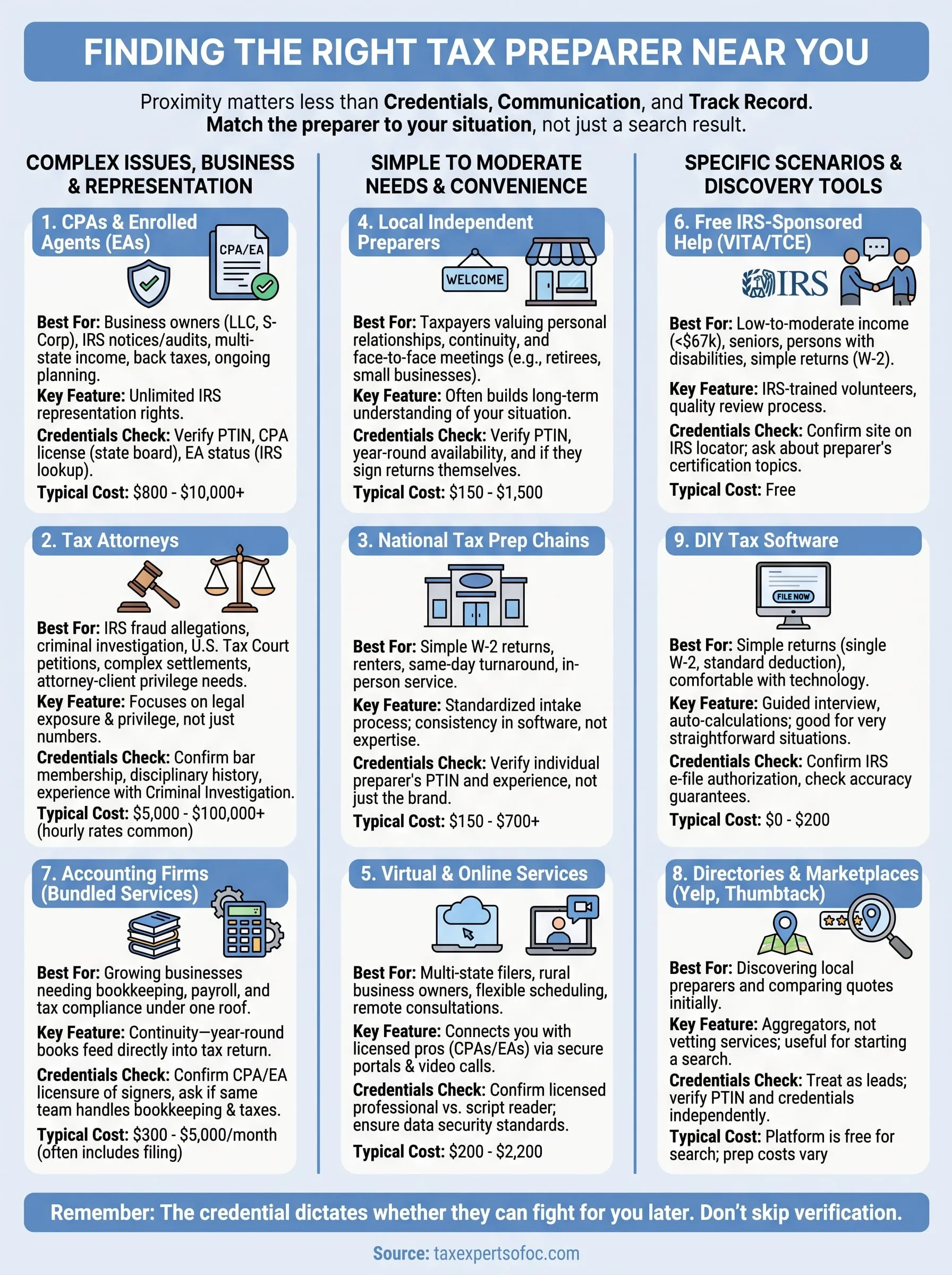
Finding the right tax preparer for your situation
Nine options, one decision: match the preparer to the actual problem, not the search ranking. A simple W-2 return doesn't need a CPA, and an open IRS notice doesn't belong with a seasonal chain preparer who closes shop in May. Credentials and representation rights matter more than proximity, and reviews only help once you know what to check: PTIN status, disciplinary history, and whether the preparer has handled a case like yours before.
If your situation involves back taxes, an audit, or a business return that's gotten too complex for software, don't wait for it to get worse. A licensed CPA or Enrolled Agent who offers real representation, not just filing, is worth the extra cost every time the stakes are real. Schedule a free consultation with Tax Experts of OC to resolve back taxes and audits with professional representation, and talk through your specific situation with someone qualified to actually fix it, not just file it.