

An IRS notice shows up in your mailbox and suddenly your bank account feels smaller. Maybe it's a lien on your house, a levy that just drained your checking account, or a wage garnishment eating into every paycheck. If you're searching for tax resolution services california, you're probably past the point of hoping the problem fixes itself, and you want to know exactly who can help and how.
Tax resolution is the process of negotiating directly with the IRS or California's tax agencies to settle what you owe, stop collection actions, and get you back into compliance. It covers everything from offers in compromise and installment agreements to penalty abatement and audit defense. A qualified firm doesn't just file paperwork; it represents you so you're not the one on the phone with an IRS agent.
This article breaks down what these services actually include, who performs them, and how a California-based firm like ours handles cases for clients across the state and nationwide. You'll get a clear picture of the resolution options available and what to expect once you bring in a CPA or Enrolled Agent to fight on your behalf.
Why California taxpayers need specialized tax resolution help
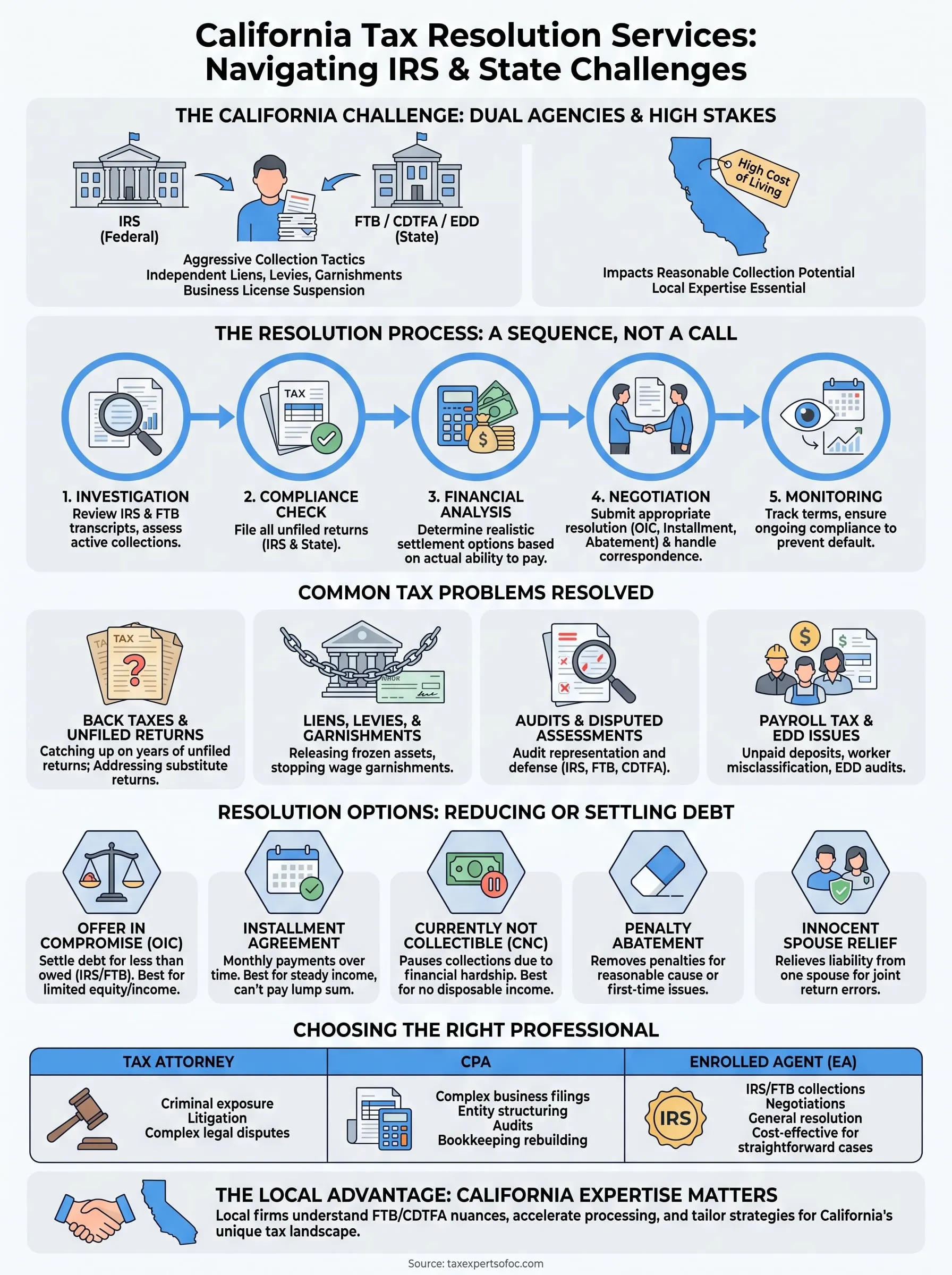
California taxpayers face a problem most other states don't create: two aggressive collection agencies working against you at the same time. The IRS handles your federal tax debt, but the Franchise Tax Board (FTB) chases you for state income tax, and if you own a business, the California Department of Tax and Fee Administration (CDTFA) and Employment Development Department (EDD) can jump in too. Each agency has its own rules, its own deadlines, and its own collection tools. Someone dealing with just an IRS problem in a low-tax state has one adversary. You might have three or four, all with the authority to file liens, freeze accounts, or garnish wages independently of each other.
Because of that overlap, generic tax help often falls short here. A national tax relief company that never touches an FTB Notice of State Income Tax Due, or a CPA who's never negotiated an installment agreement with the CDTFA, is learning on your case. That's expensive when the clock is running on a levy. State-specific tax problems require someone who already knows how the California FTB offer in compromise is calculated, which differs from the IRS version in meaningful ways, including lower acceptance thresholds and different documentation requirements.
Two agencies chasing the same debt means you need one advocate who knows how to negotiate with both.
California's collection tactics move fast
California doesn't wait around. The FTB can issue a wage garnishment order without the same notice period the IRS gives, and it can suspend a business's corporate status for unpaid taxes, which stops you from legally operating until it's resolved. Business owners in Orange County and across the state routinely discover their corporate suspension only after a bank refuses to process a loan or a client demands proof of good standing. Resolving that requires filing revivor paperwork with the Secretary of State on top of settling the underlying tax debt, a step out-of-state firms rarely know to include.
High cost of living, high stakes
Orange County's cost of living raises the stakes on every negotiation. Reasonable collection potential calculations, the formula agencies use to decide what you can afford to pay, weigh your income against local expenses. A firm unfamiliar with California housing costs, healthcare premiums, or transportation expenses in this market can undervalue your allowable expenses and push you toward a payment plan you can't sustain. Getting these numbers right the first time avoids a defaulted agreement and a second round of collections a year later.
Local representation, real leverage
Having a firm physically based in California, one that regularly appears before FTB and CDTFA representatives, changes how your case gets handled. Agencies deal with unfamiliar out-of-state preparers differently than they deal with a local Enrolled Agent or CPA who calls the same regional office repeatedly. That familiarity translates into faster document processing, quicker callbacks, and negotiators who already understand which settlement terms a given office tends to approve. For a taxpayer facing an active levy or garnishment, that speed isn't a convenience. It's the difference between keeping your next paycheck intact and losing it to collections.
How to resolve a tax debt problem in California
Fixing a tax debt problem in California follows a predictable sequence, whether you owe the IRS, need to apply for an FTB payment plan, or both. Skipping steps or tackling them out of order is how taxpayers end up with a rejected offer or a defaulted payment plan. Here's the process a competent firm follows from the first phone call to the final resolution letter.
The core steps in order
- Case investigation: Your representative pulls your IRS wage and income transcripts and your FTB account history to see exactly what's owed, what's been filed, and what collection actions are already active.
- Compliance check: Every unfiled return gets prepared and submitted first. Neither the IRS nor the FTB will negotiate a settlement while you're missing returns.
- Financial analysis: Your representative documents income, expenses, assets, and equity to determine your realistic settlement options based on what you can actually pay.
- Negotiation: Your representative submits the appropriate resolution, whether that's an offer in compromise, an installment agreement, or a penalty abatement request, and handles all agency correspondence.
- Monitoring: Once terms are set, your case gets tracked to confirm compliance and prevent a default that would restart the entire collection process.
A tax debt gets resolved through a sequence, not a single phone call, and shortcuts almost always cost you later.
Why compliance comes before negotiation
Neither agency will touch a settlement offer while you're missing returns, so getting current isn't optional, it's the entry ticket. Attempting to negotiate an offer in compromise before filing three years of back returns is one of the most common reasons a case gets rejected outright. Filing compliance also stops the IRS or FTB from estimating a tax bill on your behalf, which almost always overstates what you actually owe.
Handling active levies and garnishments
Speed matters most when a levy or garnishment is already active. A release request paired with proof that a resolution is in progress can often unfreeze your bank account within days, buying time to complete the fuller negotiation described above without losing another paycheck in the meantime.
Common IRS and California tax problems these services resolve
Tax resolution services california firms handle a narrower set of problems than people expect, but each one requires different documentation and a different negotiation strategy. Knowing which category your notice falls into tells you what kind of help to look for and how urgent your timeline really is.

Back taxes and unfiled returns
Owing money is only half the problem for a lot of clients who walk through our door. Many need help catching up on years of unfiled returns, and the IRS has already filed substitute returns on their behalf that ignore every deduction they were entitled to claim. Preparing accurate original returns often cuts the balance owed by thousands of dollars before any negotiation even starts.
Liens, levies, and wage garnishments
Unpaid balances eventually turn into enforced collection, and California moves faster than most states on this front. A federal tax lien attaches to your property and shows up on credit reports until you get a California tax lien release, while a levy lets the IRS or FTB pull funds directly from your bank account or paycheck without a court order.
Stopping a wage garnishment already in motion needs a phone call today, not a strategy session next month.
Audits and disputed assessments
Getting audited by the IRS, FTB, or CDTFA means proving every number on your return with receipts, mileage logs, or bank statements. With audit and notice representation, a representative attends these interviews so you're not the one improvising an answer that creates a bigger liability than the original question.
Payroll tax and EDD issues
Business owners face a separate set of problems tied to employees. Unpaid payroll tax deposits, misclassified workers, or EDD audits over independent contractor status can trigger personal liability for the owner even after the business closes.
| Problem | Agency Involved | Typical Trigger |
|---|---|---|
| Unfiled returns | IRS, FTB | Substitute return, estimated balance |
| Bank/wage levy | IRS, FTB | Ignored collection notices |
| Property lien | IRS, FTB | Balance exceeding $10,000 |
| Sales tax audit | CDTFA | Industry sweep, mismatched 1099s |
| Payroll tax delinquency | IRS, EDD | Missed deposits, worker misclassification |
Each row above calls for a different filing, negotiation, or defense strategy, which is why matching the problem to a firm's actual experience matters more than picking the first ad you see.
IRS and state programs that can reduce or settle what you owe
Once you're compliant, the actual programs that reduce IRS tax debt fall into a handful of categories, and each one solves a different problem. Picking the wrong program wastes months, so matching your financial situation to the right relief option is where a firm's experience actually pays off. Below is a quick comparison of the main paths available at both the federal and state level.

| Program | What It Does | Best For |
|---|---|---|
| Offer in Compromise (IRS/FTB) | Settles debt for less than owed | Taxpayers with limited equity and income |
| Installment Agreement | Monthly payments over time | Steady income, can't pay lump sum |
| Currently Not Collectible | Pauses collections | Financial hardship, no disposable income |
| Penalty Abatement | Removes penalties only | First-time or reasonable-cause situations |
| Innocent Spouse Relief | Removes liability from one spouse | Joint returns with a spouse's error or fraud |
Offers in compromise
An offer in compromise lets you settle your tax debt for less than the full balance, but qualifying takes more than just asking. The IRS and FTB both calculate your reasonable collection potential using your income, assets, and allowable expenses, and they'll reject an offer that undervalues what you can actually pay. Getting the math right the first time avoids a rejection that costs you months of waiting.
An offer in compromise only works when the numbers match what the agency's own formula says you can pay.
Installment agreements and currently not collectible status
When a full settlement isn't realistic, an installment agreement spreads your balance into monthly payments you can estimate ahead of time and sustain long-term. If your income doesn't cover basic living expenses at all, how to qualify for currently not collectible status becomes the question, since it pauses enforced collection entirely, though interest keeps accruing in the background. Both agencies review your financials periodically, so documentation needs to hold up over time, not just at the moment you apply.
Penalty abatement and innocent spouse relief
Sometimes the tax itself isn't the problem, the penalties are. Requesting penalty relief removes added charges when you have reasonable cause or a clean compliance history, while innocent spouse relief protects a taxpayer from a former partner's tax mistakes on a joint return. Our tax resolution services team evaluates every one of these programs before recommending which fits your case.
Choosing the right tax resolution firm: attorney, CPA, or EA
Deciding who handles your case matters as much as deciding to get help at all. Three types of professionals can legally represent you before the IRS and California agencies: tax attorneys, Certified Public Accountants, and Enrolled Agents. Each has different training, and each fits certain cases better than others. Picking based on price alone often means ending up with someone who can file the paperwork but can't argue your case effectively when an agent pushes back.
What each credential actually covers
Attorneys bring legal training and attorney-client privilege, which matters most in criminal tax matters or when litigation is a real possibility. CPAs bring deep accounting expertise, useful when your case involves complex business returns, multiple entities, or bookkeeping that needs to be rebuilt before a settlement can even be proposed, which is why choosing a CPA for IRS problems deserves its own comparison. Enrolled Agents are among those who can represent you before the IRS, federally licensed specifically for tax representation, tested directly on IRS procedure, and often the most cost-effective choice for straightforward collection cases like wage garnishments or offers in compromise.
| Credential | Best For | Licensing Body |
|---|---|---|
| Tax Attorney | Criminal exposure, litigation, complex legal disputes | State Bar |
| CPA | Complex business filings, entity structuring, audits | State Board of Accountancy |
| Enrolled Agent | IRS/FTB collections, negotiations, general resolution | U.S. Treasury (IRS) |
The right credential depends on your problem, not on which title sounds most impressive.
Questions to ask before you sign
Before hiring anyone, ask these directly:
- Who specifically will work my case, and will I speak with them or a call center?
- Have you negotiated with the FTB or CDTFA before, not just the IRS?
- What's your fee structure, and is it flat or hourly?
- Can you show a resolution letter from a case similar to mine?
Our firm gives clients direct access to a CPA and an Enrolled Agent rather than routing you through general staff, and a free 30-minute consultation lets you evaluate fit before committing to anything. That access matters when your case needs both accounting depth and IRS-specific negotiation experience working together instead of separately.
What to expect: costs, timelines, and the resolution process
Once you've picked a firm, the next question is practical: what does this actually cost, and how long until the IRS or FTB stops calling? Most tax resolution services california firms price by the complexity of the case, not a flat industry rate, so getting a real number requires a review of your transcripts first. Anyone who quotes a fee before pulling your file is guessing.
How pricing usually works
Expect a flat fee structure tied to the specific work involved, investigation, compliance filing, and negotiation, rather than an hourly clock that punishes you for a slow-moving agency. Simple cases like a single penalty abatement might run a few hundred dollars, while a full offer in compromise with multiple years of unfiled returns and business entities involved can run into the thousands. Ask for a written scope before signing anything, and confirm whether payment plans are available if cash flow is tight, since firms that only work in lump sums aren't always practical for someone already behind on taxes.
A fair firm prices the work in front of them, not a guess based on how scared you sound on the phone.
Realistic timelines by case type
Timelines vary widely depending on which agency and which program is involved. Here's what to expect roughly:
| Case Type | Typical Timeline |
|---|---|
| Penalty abatement | 2 to 4 months |
| Installment agreement | 1 to 3 months |
| Currently not collectible | 1 to 2 months |
| Offer in compromise (IRS) | 6 to 12 months |
| Offer in compromise (FTB) | 4 to 9 months |
These ranges assume your compliance filings are already done, since missing returns add months before an agency will even look at your case.
What the process feels like week to week
Expect periodic check-ins rather than daily contact. Your representative handles agency correspondence, requests updates on your behalf, and flags anything that needs your signature or documentation. Slow response times from the agency itself, not your firm, account for most of the wait, particularly with the IRS offer in compromise unit, which can take months just to assign a caseworker. A good firm keeps you informed during those gaps instead of going quiet until there's news.
Taking the next step toward tax peace of mind
A tax problem doesn't shrink while you wait. Liens attach, levies drain accounts, and penalties compound every month you sit on a notice instead of acting on it. What you've read here covers the full path: understanding why California's dual agencies make this state harder than most, working through the compliance-first sequence that actually resolves debt, and knowing which credential fits your specific problem.
Bringing in the right help early changes the outcome. Someone who's negotiated with the FTB and CDTFA, not just the IRS, catches issues an out-of-state preparer would miss, and catches them before they cost you a settlement. If you're facing a lien, a levy, or years of unfiled returns, don't guess your way through it alone. Schedule your free consultation for IRS tax help and back tax relief with Tax Experts of OC and talk directly with a CPA or Enrolled Agent about what your case actually needs.