
You've probably filed your taxes the same way for years: gather documents, hand them off, sign, done. But if you're only thinking about taxes once a year, you're leaving money on the table. A cpa for tax planning works differently. Instead of reacting to what already happened, they look ahead and structure your income, deductions, and business decisions to lower what you owe before the year closes.
So what actually separates a CPA from the tax advisors, enrolled agents, and software tools flooding your search results? The short answer: licensing and scope. A CPA has passed a rigorous state exam, holds continuing education requirements, and can represent you in front of the IRS while also handling complex accounting, entity structuring, and multi-year strategy that a generic "tax advisor" title doesn't guarantee.
In this article, we'll break down exactly what a CPA does for tax planning, how their role differs from tax attorneys and enrolled agents, and when hiring one actually makes financial sense for your situation, whether you're an individual with a growing income, a small business owner, or someone juggling multi-state obligations. By the end, you'll know what to look for and what questions to ask before you commit.
Why hiring a CPA for tax planning matters
Most people treat their tax return as a single event that happens every April. That mindset costs money. When you only look at your finances once a year, you've already missed the chance to shift income, time deductions, or restructure a business before the tax year locks in. A cpa for tax planning works on a different timeline entirely, checking in quarterly or even monthly to catch opportunities while they're still actionable, not after the fact.
The gap between filing and planning
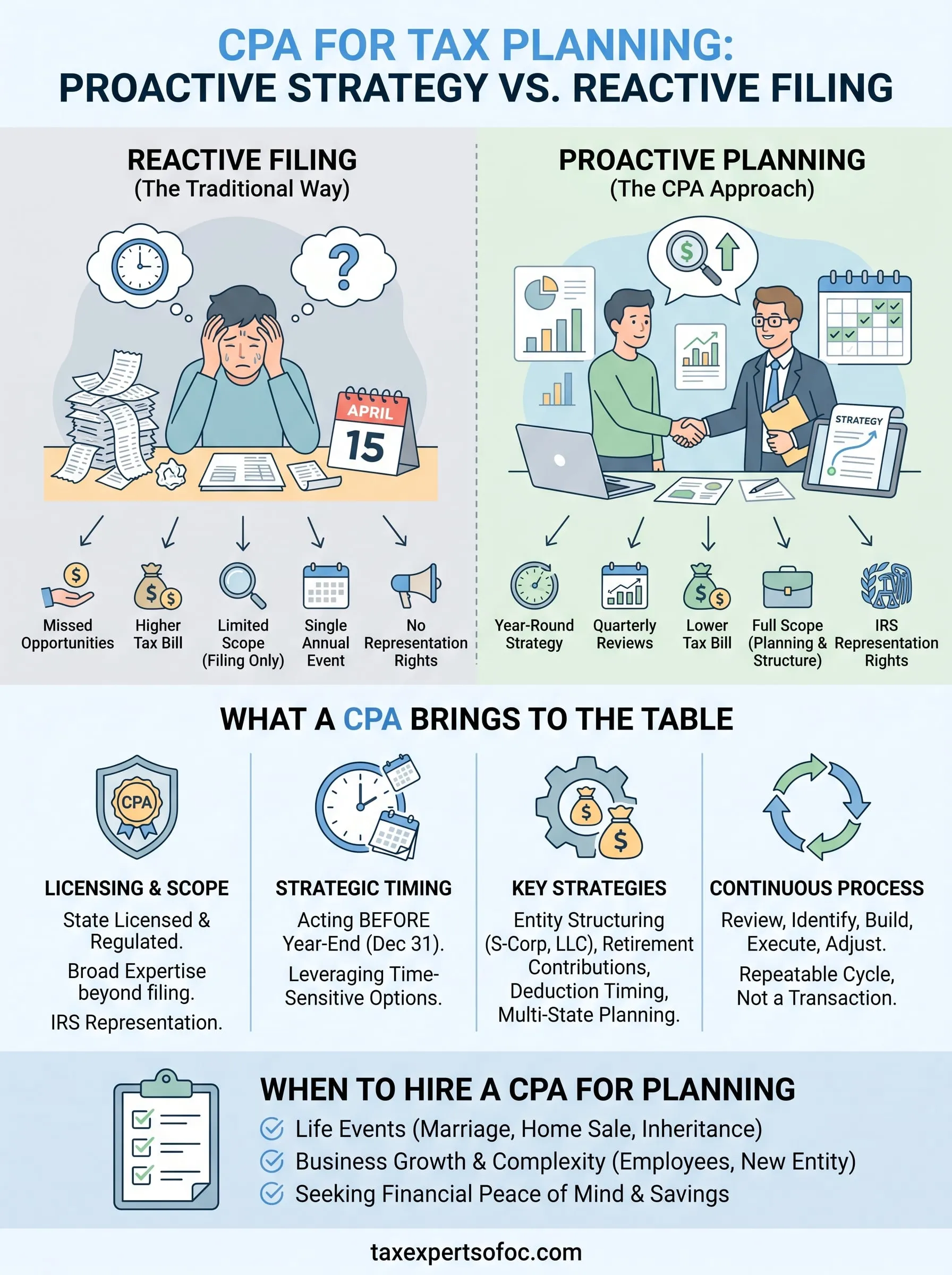
Consider the difference between someone who files reactively and someone who plans ahead, which is really the difference between tax planning and tax preparation. The reactive filer hands over a shoebox of receipts in March and hopes for the best. The proactive client has already discussed a Roth conversion in October, adjusted quarterly estimated payments in July, and restructured their LLC's tax election before year-end. Neither person is doing anything illegal or shady. One of them is simply using the tax code strategically instead of passively.
According to the IRS, taxpayers are entitled to arrange their affairs to legally minimize their tax burden, a principle upheld repeatedly in federal court. A CPA's job is to know exactly which levers are available to you and pull them before December 31, not after. That's the entire value proposition of hiring one instead of relying on a preparer who only touches your file once a year.
A CPA who only shows up at tax time can only report what already happened; a CPA who plans with you can change what happens next.
What proactive planning saves you in real dollars
Beyond the peace of mind, the financial gap between reactive and proactive tax management is measurable. Small business owners who work with a strategic tax planning professional throughout the year routinely uncover deductions, entity restructuring options, and retirement contribution strategies that a once-a-year filer never sees, simply because those opportunities require decisions made before the year closes.
| Scenario | Reactive filing only | Proactive CPA planning |
|---|---|---|
| Entity structure | Locked in from prior year, no review | Reassessed annually for S-corp, LLC, or C-corp savings |
| Retirement contributions | Often missed or maxed too late | Timed and maximized before deadlines |
| Estimated tax payments | Guessed or based on last year | Recalculated quarterly to avoid penalties |
| Deduction timing | Claimed only if documented after the fact | Planned in advance (equipment purchases, charitable giving) |
| Multi-state income | Filed as-is, often overpaying | Structured to reduce double taxation |
Every row in that table represents money that either stays in your pocket or doesn't, depending on whether someone was watching your numbers before the year ended. Few software tools or seasonal preparers have the bandwidth or incentive to do that kind of forward-looking work.
Beyond savings: protection and representation
Savings aside, there's a protective layer a CPA adds that most taxpayers underestimate until they need it. Enrolled Agents and attorneys aren't the only professionals with IRS representation rights; a CPA's right to defend you in an audit means they can also respond to notices and negotiate on your behalf. If your return ever draws IRS attention, having the same professional who built your tax strategy defend it in front of the agency is far more effective than starting from scratch with someone unfamiliar with your history.
Many business owners also discover, often too late, that a poorly structured entity or a missed quarterly payment can snowball into real IRS trouble. If that's already happened to you, working with a firm that handles both tax resolution and tax planning under one roof means the same team that fixes today's problem can prevent tomorrow's. That continuity matters more than most people realize until they've lived through the alternative: a preparer who vanishes after April, leaving you to explain a notice you don't understand months later.
How CPAs approach tax planning step by step
Good tax planning isn't a single meeting in December. It's a repeatable process that a cpa for tax planning runs on your file every year, adjusting as your income, business, or family situation changes. Understanding the actual steps helps you know what to expect from a professional relationship instead of just handing over documents and hoping for the best.
Step 1: Full financial review
Everything starts with a real look at where you stand. A CPA pulls prior returns, current income projections, business structure, and any life changes on the horizon, like a home sale, inheritance, or new dependent. This isn't a quick glance; it's the foundation for every recommendation that follows.
Step 2: Identify opportunities and risks
Once your CPA understands your full picture, they start flagging both tax-saving opportunities and exposure you didn't know existed. That might mean an entity election that no longer fits your income level, an underused retirement account, or a multi-state filing requirement you've been ignoring.
The value of a CPA isn't in filing your return correctly. It's in catching the decision points you didn't know existed until it was too late to act on them.
Step 3: Build a strategy tied to deadlines
A plan without dates attached is just a wish list. Your CPA maps recommendations to actual deadlines: quarterly estimated payments, retirement contribution cutoffs, equipment purchase windows before year-end, or entity election deadlines like the March 15 S-corp filing date. Here's what that timeline typically looks like:
- Q1 (Jan-Mar): Finalize prior year filing, review entity elections, set current-year strategy
- Q2 (Apr-Jun): Adjust estimated payments based on actual first-quarter results
- Q3 (Jul-Sep): Mid-year check-in, revisit retirement contributions and business deductions
- Q4 (Oct-Dec): Lock in year-end moves like charitable giving, equipment purchases, or Roth conversions
Step 4: Execute and document
Strategy only matters if it's actually carried out. Your CPA coordinates the paperwork, whether that's filing an entity election, adjusting payroll withholding, or documenting a business expense properly so it survives an audit later. Sloppy documentation is one of the fastest ways to lose a deduction you were otherwise entitled to.
Step 5: Review and adjust throughout the year
Finally, the process repeats. Life changes, tax law changes, and business income fluctuates, so a static plan built in January is often outdated by July. Firms that offer ongoing strategic tax planning, rather than a single annual sit-down, catch these shifts before they cost you money.
This is exactly the workflow behind Tax Experts of OC's approach to strategic tax planning: a continuous cycle, not a once-a-year transaction. If your current preparer only talks to you at filing time, you're likely missing steps 2 through 5 entirely, and that's usually where the real savings live.
CPA vs. tax advisor vs. tax attorney: knowing the difference
Search for help with your taxes and you'll run into three overlapping titles: CPA, tax advisor, and tax attorney. They aren't interchangeable, and mixing them up can cost you time or money if you hire the wrong professional for the job. Understanding the actual licensing differences behind each title tells you who can do what, and who can't legally do certain things at all.
"Tax advisor" isn't a licensed credential
Anyone can call themselves a tax planning advisor. It's not a protected title backed by a state license or a national exam, which means the person using it might be a CPA, an enrolled agent, or someone with no formal credential at all. That doesn't automatically make them unqualified, but it does mean you have to ask directly what license or certification actually backs the advice you're getting. If the answer is vague, treat that as a warning sign.
CPAs bring licensing, scope, and representation rights
Because a CPA has passed the Uniform CPA Examination and meets ongoing state education requirements, they can prepare complex returns, advise on entity structure, and represent you before the IRS in an audit or collections matter. Enrolled Agents share that same IRS representation right, but their credential is federal rather than state-issued and typically focuses more narrowly on tax matters rather than the broader accounting and financial planning work a CPA also handles, like bookkeeping, payroll, and outsourced CFO functions.
A title tells you what someone calls themselves. A license tells you what they're actually allowed to do for you.
When you actually need a tax attorney
Despite the overlap, a tax attorney handling IRS matters serves a different purpose entirely. Attorneys hold attorney-client privilege, which matters most when you're facing potential criminal exposure, litigation, or a dispute headed to Tax Court. If you're just trying to lower this year's tax bill or catch up on unfiled returns, a tax attorney is often more expensive and less suited to the day-to-day planning work than a CPA.
| Professional | Licensing body | Can represent you before the IRS | Best suited for |
|---|---|---|---|
| CPA | State board of accountancy | Yes | Ongoing tax planning, entity structuring, audits, bookkeeping |
| Enrolled Agent | IRS (federal) | Yes | Federal tax matters, IRS negotiations |
| Tax advisor | No standard license required | Depends on underlying credential | General guidance, varies widely in qualification |
| Tax attorney | State bar association | Yes | Litigation, criminal exposure, privileged legal disputes |
Zeroing in on the right professional usually comes down to what you're trying to solve. If your goal is proactive planning, entity decisions, and a single point of contact who can also handle your books and payroll, a CPA typically covers more ground than either an advisor without a formal license or an attorney whose expertise leans legal rather than financial. Firms like Tax Experts of OC often staff both a CPA and an Enrolled Agent, so you get planning depth and representation rights under the same roof instead of shuffling between separate professionals for separate problems.
Common tax planning strategies a CPA can use for you
Every client's numbers look different, but the toolkit a cpa for tax planning draws from is fairly consistent. What changes is which strategies actually apply to your income level, entity type, and timeline. Below are the tax saving strategies for small businesses that show up most often in real client files, not theoretical examples pulled from a textbook.
Entity structure and income splitting
How your business is legally structured determines how much of your income gets hit with self-employment tax. A sole proprietor paying 15.3% on every dollar of net income might save thousands by electing S-corp status and splitting income between a reasonable salary and distributions, which is why it pays to compare S-corp and LLC tax treatment. Your CPA runs the actual numbers instead of guessing, because the S-corp election only pays off past a certain income threshold, and getting it wrong can cost more in payroll compliance than it saves in tax.
The right entity structure isn't about following a trend; it's about matching your legal structure to your actual income level.
Retirement account timing
Solo 401(k)s, SEP IRAs, and defined benefit plans all have different contribution limits and deadlines, and retirement tax planning times contributions to both reduce taxable income and build long-term retirement savings simultaneously. A business owner who waits until April to think about retirement contributions has already missed the window for several of these strategies, since some require the account to be established before December 31 even if the contribution itself is made later.
Depreciation, deductions, and timing purchases
Equipment purchases, Section 179 deductions, and bonus depreciation all give a business owner control over when a deduction hits, not just whether it exists, and they sit alongside the other write-offs LLC owners can claim. A CPA maps planned purchases against your projected income so a large deduction lands in the year it actually helps, rather than getting claimed by default in whatever year the receipt happens to show up.
Multi-state and residency planning
Remote work and multi-state business activity create tax exposure a lot of taxpayers don't see coming until a notice arrives from a state they didn't expect. A CPA reviews where you actually work, where your business is registered, and where you claim residency to prevent double taxation across state lines, something Tax Experts of OC handles regularly for clients spread across all 50 states.
Charitable giving and Roth conversions
Bunching charitable contributions into a single high-income year, or converting traditional IRA funds to a Roth during a lower-income year, are both timing strategies that only work if planned before year-end. Here's a quick reference for how these strategies typically line up with a client's situation:
- S-corp election: Best for self-employed income above roughly $80,000-$100,000 net profit
- Retirement plan selection: Best for business owners with fluctuating or high income wanting to shelter more than a standard IRA allows
- Section 179/bonus depreciation: Best for businesses making planned equipment or vehicle purchases
- Charitable bunching: Best for taxpayers close to the standard deduction threshold
- Roth conversion: Best during a temporary low-income year, like a sabbatical or business loss year
None of these strategies work in isolation. A CPA's real value is knowing which combination applies to your specific numbers, then executing it before the deadline passes.
What to look for in a CPA for tax planning
Not every CPA license comes with the same level of tax planning skill. Some CPAs focus almost entirely on audit work for large corporations and rarely touch individual or small business strategy. Choosing a tax planning service near you means looking past the credential itself and checking for specific signals that this person actually does proactive planning work, not just annual compliance.
Look for representation experience, not just filing experience
Anyone can prepare a return. Fewer CPAs have actually sat across the table from an IRS agent during an audit or negotiated a resolution on a client's behalf. Ask whether the CPA you're considering has direct IRS representation experience, not just theoretical knowledge of how it works. A CPA who has handled real audits understands which deductions hold up under scrutiny and which ones invite a notice, and that knowledge shapes the advice they give you before you ever get audited.
The best CPA for tax planning is the one who's already defended a return in front of the IRS, not just filed one.
Check for industry and entity-specific experience
A CPA who mostly works with W-2 employees won't necessarily know the nuances of S-corp reasonable compensation rules or multi-state nexus issues. If you run an LLC, a non-profit, or a business with contractors in three states, ask directly whether they've handled similar entity structures before. Vague reassurance isn't the same as a specific answer backed by examples.
Confirm they offer year-round contact, not just tax season
Since proactive planning depends on decisions made throughout the year, a CPA who disappears after April 15th can't deliver on the strategy piece at all. Before signing on, ask how often they check in and whether quarterly reviews are part of their standard service or an upsell you have to request separately.
Here's a quick checklist to run through before you commit to a CPA for tax planning:
- Licensing verification: Confirm active CPA status through your state board of accountancy
- Representation history: Ask about actual audits or IRS notices they've handled
- Entity familiarity: Confirm experience with your specific business structure (LLC, S-corp, non-profit, etc.)
- Communication cadence: Clarify whether check-ins happen quarterly or only at filing time
- Fee transparency: Get pricing in writing before work begins, not after the invoice arrives
- Multi-state capability: If you have income or residency across state lines, confirm they handle that regularly
Weigh transparency and access to the actual professional
A lot of larger firms route clients through junior staff or seasonal preparers, with the CPA only reviewing the file at the final stage. That structure might work fine for a simple return, but it undermines the entire point of hiring a CPA for strategic tax planning in the first place. Ask directly whether you'll be working with the CPA themselves or a rotating team member you've never spoken to. Firms like Tax Experts of OC are built around direct access to a CPA and Enrolled Agent, plus a free 30-minute consultation, so you can gauge fit before committing to anything, which is worth confirming with any firm you're evaluating.
Questions to ask before you hire a CPA
Before signing an engagement letter, you need direct answers, not marketing language. Asking the right questions upfront saves you from discovering mismatched expertise six months into a relationship, right when you actually need help with a cpa for tax planning decision. Treat the first consultation as an interview, not a formality.
Questions about credentials and experience
Start with licensing and history, since those facts are verifiable and non-negotiable. A CPA should answer these without hesitation:
- Are you currently licensed and in good standing with your state board of accountancy?
- How many years have you specifically handled tax planning, not just annual filing?
- Have you represented clients directly in an IRS audit or collections matter?
- Do you have experience with my specific entity type (LLC, S-corp, non-profit, multi-state business)?
If a CPA can't answer a licensing question specifically, that's a bigger red flag than any fee they might quote.
Vague answers to any of these should push you toward a different candidate, regardless of how polished the sales pitch sounds.
Questions about process and communication
Once credentials check out, dig into how the actual working relationship functions day to day. This is where a lot of firms quietly fall short, promising strategic tax planning but delivering nothing beyond a once-a-year filing appointment. Ask these directly:
- Will I work with you personally, or get routed to junior staff for most of the year?
- How often do we meet or check in, quarterly, monthly, or only at tax time?
- What does your process look like for flagging opportunities before a deadline passes?
- How do you document strategies so they hold up if the IRS ever questions them?
Every answer here tells you whether you're hiring an active partner or a seasonal preparer wearing a CPA title.
Questions about pricing and access
Transparency around cost matters just as much as expertise, since surprise invoices erode trust fast. Push for specifics rather than ranges:
- Is pricing flat, hourly, or based on complexity, and can I get that in writing?
- Do you offer a free consultation before I commit to anything?
- What happens if my situation changes mid-year, does the fee adjust automatically?
- Can I reach you directly by phone or email, or only through a scheduling system?
Zeroing in on these answers before you sign anything protects you from a mismatched engagement later. Firms that offer a free 30-minute consultation, like Tax Experts of OC, give you a low-risk way to test these questions in real time rather than guessing from a website.
Questions about entity familiarity and multi-state capability deserve extra weight if your situation is anything but a simple W-2 return. Getting a confident, specific answer here now is far cheaper than discovering a gap in expertise after a deduction gets disallowed or a state notice arrives unexpectedly.
How much does a CPA for tax planning cost
Pricing for a cpa for tax planning varies more than most people expect, mostly because "tax planning" isn't a single service with a fixed price tag. A one-time consultation costs far less than an ongoing quarterly relationship, and a sole proprietor with a simple Schedule C pays less than a business owner running payroll across three states. Knowing the pricing structures upfront keeps you from comparing quotes that aren't actually measuring the same scope of work.
Flat fee vs. hourly billing
Almost every CPA bills one of two ways: a flat annual or quarterly fee, or an hourly rate that adds up as questions come in, much like what tax preparation services cost by return type. Flat fees give you predictability, since you know the number before the year starts and it doesn't change if you call three times in October instead of once. Hourly billing can work fine for a single strategy session, but it gets expensive fast if your situation needs regular check-ins.
| Service level | Typical structure | Rough annual range |
|---|---|---|
| Single strategy consultation | Flat fee, one-time | $300-$800 |
| Individual with investment/rental income | Flat annual fee | $800-$2,000 |
| Small business, single entity | Flat quarterly or annual retainer | $2,000-$5,000 |
| Multi-state or multi-entity business | Custom retainer | $5,000-$15,000+ |
| Hourly consultation (any tier) | Hourly rate | $150-$400/hour |
What actually drives the price up or down
Complexity, not the CPA's ego, sets the price. A business with multi-state filings, several entities, or payroll for a growing team requires more hours than a single W-2 earner asking about a Roth conversion, which is also what drives S corp tax preparation fees. Frequency matters too: a firm that checks in quarterly and adjusts your strategy mid-year charges more than one that only meets you once in December, but that extra fee is usually what pays for itself in caught deductions.
The cheapest CPA quote and the cheapest tax bill are rarely the same thing.
Why the lowest quote isn't always the best deal
Saving a few hundred dollars on planning fees while missing an entity election that would have saved five thousand in self-employment tax isn't a win. Before comparing prices, ask what's actually included: does the fee cover quarterly reviews, or just the return itself? Does it include representation if a notice arrives later, or is that billed separately? A firm offering transparent upfront pricing and a free 30-minute consultation, like the one you'll get from Tax Experts of OC, lets you compare real numbers before committing instead of guessing from a website's vague "contact us for pricing" page. That upfront clarity, more than the number itself, is what separates a fair quote from a costly surprise later.
When to bring a CPA into your financial picture
Timing matters more than most taxpayers realize. Waiting until you're already in trouble, or until your income has grown so complex that you can't track it yourself, means you've missed months or years of savings a cpa for tax planning could have captured earlier. The right moment to bring in a CPA instead of filing yourself isn't a fixed date on the calendar; it's tied to specific changes in your income, business, or family situation.
Life events that change your tax picture
Certain milestones almost always shift what you owe, and each one is a signal to get a CPA involved before the decision is finalized rather than after. A marriage, divorce, inheritance, or home sale can all trigger tax consequences that are far easier to manage with advance planning than after the transaction closes. Selling a rental property, for example, opens the door to strategies like a 1031 exchange, but only if you plan the timing before the sale, not after you've already deposited the check.
The best time to call a CPA is before the transaction, not after you've already signed the paperwork.
Business milestones that call for professional oversight
Growth creates complexity, and complexity is exactly where a CPA earns their fee. If any of the following apply to your business, it's worth scheduling a consultation now rather than at your next filing deadline:
- You've hired your first employee or contractor and need to get payroll compliance in place
- Your net income has crossed roughly $80,000-$100,000, putting an S-corp election on the table
- You're expanding into a second state and facing multi-state nexus questions
- You're considering incorporating for the first time or restructuring an existing entity
- You've received an unexpected IRS notice tied to a business filing
Each of these points marks a decision that's cheaper to make correctly the first time than to unwind later.
Warning signs you've already waited too long
Sometimes the signal isn't a happy milestone but a warning sign. Owing significantly more than expected at filing time, receiving repeated IRS notices, or realizing you haven't filed a return in a year or more all mean the window for simple planning has closed and you now need both help resolving back taxes and a forward-looking strategy at the same time. This is exactly the situation where a firm handling both sides under one roof, rather than sending you to a separate specialist for each problem, saves you time and money.
A simple rule of thumb
If you can't answer, off the top of your head, whether your current entity structure still fits your income level, or whether you're on track for this year's estimated payments, that uncertainty itself is the signal. You don't need to wait for a crisis. A short conversation now, before a life event or business decision locks in, costs far less than untangling a mistake after the fact. Reaching out for a free consultation as soon as one of these triggers appears puts you back in the proactive column instead of the reactive one.
Finding the right tax partner for your situation
A cpa for tax planning isn't a luxury reserved for large corporations. It's the difference between reacting to a tax bill every April and actively shaping what that bill looks like months before it arrives. You've seen how the right CPA differs from a tax advisor or attorney, what strategies actually move the needle, and which questions separate a real planning partner from a seasonal preparer.
Getting this right matters more than picking whoever answers the phone first. Your financial situation deserves someone who checks in year-round, knows your entity structure, and can represent you if the IRS ever comes calling. Waiting for a crisis to force the decision only costs you money you didn't need to lose.
If you're ready to stop guessing and start planning, explore CPA-led tax planning in Orange County from Tax Experts of OC and book a free 30-minute consultation to see what a real strategy looks like.