
If you requested a tax extension back in April, you already know the IRS gave you extra time. What you might not know is exactly when that extra time runs out. The deadline for filing income tax returns that have received extensions is October 15, and if that date falls on a weekend or holiday, it shifts to the next business day. Miss it, and you're back in penalty territory, even though you thought you were covered.
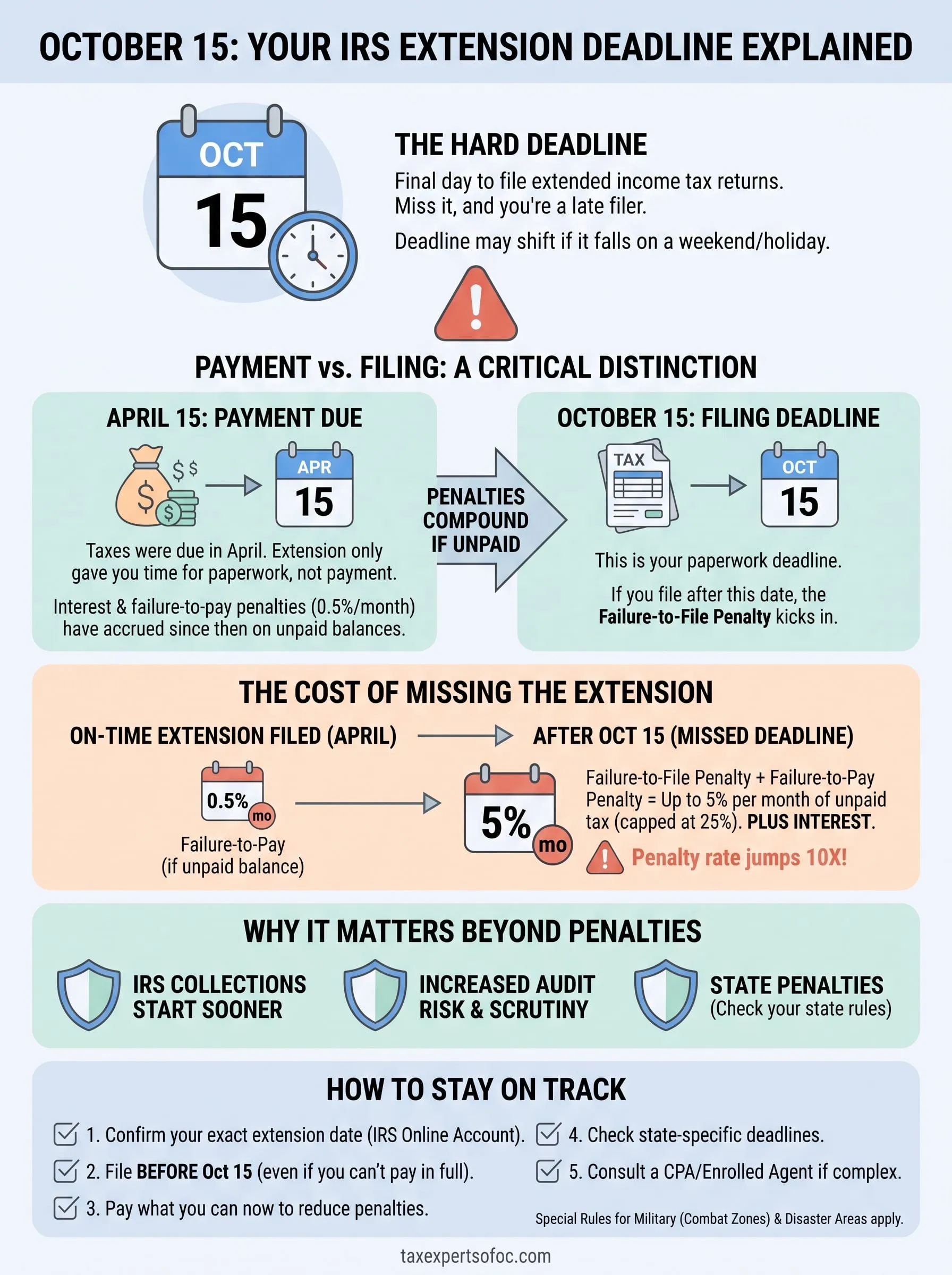
Here's the direct answer: an extension moves your filing deadline, not your payment deadline. You still owed the IRS by April 15, whether you paid in full or not. October 15 is your hard stop for actually submitting the completed return itself.
In this article, we'll break down what that October date really means, what happens if you file late even with an extension on file, and how penalties and interest keep accruing in the background. If you're already behind, or worried you might be, we'll also cover when it makes sense to bring in a CPA or Enrolled Agent rather than scramble on your own before the clock runs out.
Why the extended deadline still matters
A lot of taxpayers treat October 15 as a soft suggestion rather than a real cutoff. That's a costly mistake. The deadline for filing income tax returns that have received extensions carries the same legal weight as the original income tax filing deadline in April. The IRS doesn't view it as optional just because you already asked for more time once. Once October 15 passes, you're a late filer, full stop, and the penalty clock resets to a much harsher rate than what you may have already been dealing with since spring.

The Extension Only Bought You Paperwork Time
Form 4868's extension rules give you six extra months to prepare and submit your return. It does not extend how long the IRS will wait for its money. This distinction trips up more people than you'd expect, especially first-time filers who assume "extension" means the whole tax obligation got pushed back. It didn't. Your tax liability was due on the original April deadline, and the extension only ever applied to the physical act of filing the return itself.
Penalties Don't Pause, They Escalate
Here's where the stakes actually rise. If you filed an extension but never sent in your payment, you've been accruing a failure-to-pay penalty of 0.5% of your unpaid balance every month since April, according to the IRS penalty guidelines. That's manageable compared to what kicks in if you also miss the October deadline to file. At that point, the failure-to-file penalty activates: 5% of your unpaid tax per month, capping at 25%. That's ten times steeper than the failure-to-pay penalty, and the two can stack.
Missing the extended deadline doesn't just cost you a late fee, it multiplies your penalty rate tenfold overnight.
| Scenario | Penalty Type | Rate | Monthly Cap |
|---|---|---|---|
| Filed on time, tax unpaid | Failure-to-pay | 0.5% per month | 25% total |
| Filed after Oct 15, tax unpaid | Failure-to-file + failure-to-pay | Up to 5% per month combined | 25% total (5% floor after 60 days) |
| Filed after Oct 15, tax paid in full | Failure-to-file only | 5% per month | 25% total |
Interest compounds daily on top of both penalties, based on the federal short-term rate plus 3%, and it doesn't stop accruing just because you eventually file. The longer you wait past October 15, the more expensive every additional week becomes.
Business Owners and Self-Employed Filers Face Extra Exposure
Small business owners and self-employed taxpayers have more riding on this date than a typical W-2 employee. Missing the extended deadline can delay loan applications, mess up quarterly estimated tax calculations for the following year, and in some cases trigger IRS scrutiny that pulls other filings into question. Owners of LLCs, S-corps, or partnerships, each with their own corporate filing deadlines by entity type, often need a finalized personal return to close out year-end bookkeeping or satisfy lender documentation requirements. Falling behind on one return has a way of cascading into delays elsewhere in your financial paperwork.
It Signals Something to the IRS
Moreover, a pattern of missed extension deadlines tends to draw more attention from the IRS, not less. Enforcement systems flag repeat late filers differently than someone who's late once. If you've already got a history of unfiled returns or IRS notices, blowing through October 15 adds fuel to a fire that's often already smoldering. That's one reason working with a CPA or Enrolled Agent before the deadline matters more than most people assume: they can often identify partial payment options, penalty abatement eligibility, or reasonable cause arguments that soften the blow if you're already running late.
Why This Date Deserves Real Attention
Ultimately, treating October 15 with the same seriousness as April 15 protects you from penalties that compound fast and quietly. Taxpayers who assume the extension gave them a permanent buffer often discover, months later, that interest and penalties have added hundreds or thousands of dollars to what they originally owed. Verifying your exact deadline, confirming your return is complete, and filing before the date arrives isn't just good practice, it's the difference between closing out your tax year cleanly and opening a new set of problems with the IRS.
How to find your exact extension deadline
Most filers assume October 15 applies to everyone, and most years it does, but you should never take that date for granted without checking your own paperwork first. The deadline for filing income tax returns that have received extensions can shift depending on how you filed your extension, where you live, and even what day of the week October 15 lands on. Confirming your exact date takes ten minutes and saves you from guessing wrong when penalties are on the line.

Start With Your Form 4868 Confirmation
If you filed Form 4868 electronically through tax software or a paid preparer, you should have received a confirmation number or acceptance notice. That confirmation is your proof the extension was granted, and it usually states the new filing date in plain language. Locate this record before you do anything else. If you mailed a paper Form 4868, check your certified mail receipt or canceled check for the date it was sent, since the IRS calculates your extension window from when they received it, not when you dropped it in the mailbox.
Check the IRS Online Account
Your IRS online account is the most reliable source for verifying extension status. Sign in to your IRS online account, navigate to your tax records, and look for confirmation that your extension request was processed for the current tax year. This tool also shows any notices the IRS has sent you, which matters if there's a discrepancy between what you filed and what they recorded. Don't rely on memory or old software screenshots when a live government record is available for free.
Your extension deadline isn't a guess, it's a documented date sitting in your own IRS account right now.
Account for Weekends, Holidays, and Leap Years
October 15 shifts to the next business day whenever it falls on a Saturday, Sunday, or federal holiday. This adjustment happens automatically under IRS rules, but it's easy to miss if you're working off a generic calendar reminder set months earlier. Before you finalize your filing plan, confirm the actual weekday for October 15 in the current tax year and adjust your internal deadline accordingly.
Use a Quick Checklist to Confirm Your Date
Run through this short list before you consider your extension deadline settled:
- Locate your Form 4868 confirmation number or mailing receipt
- Log into your IRS online account and verify extension status
- Check whether October 15 falls on a weekend or federal holiday this year
- Confirm your state extension deadline separately, since it may differ from the federal date
- Note whether you qualify for a disaster relief or combat zone extension, which can push the date further out
When in Doubt, Call or Ask a Professional
If your online account shows conflicting information, or you filed your extension through a preparer who hasn't confirmed receipt, don't wait until the last week of the deadline period to sort it out. Calling the IRS directly or reaching out to a CPA who handles IRS problems at a firm like Tax Experts of OC gets you a definitive answer faster than guessing based on last year's calendar. A quick verification call now beats discovering a filing gap after October 15 has already passed.
Why the extension doesn't delay your tax payment
Confusion about Form 4868 causes more IRS debt than almost any other filing mistake. The filing extension only pushes back your paperwork deadline. Your payment obligation was due on the original April date, whether or not you'd finished your return. The IRS designed the extension this way on purpose: it wants your money on time even if it's willing to wait for the paperwork. Anyone treating October 15 as a payment deadline is already behind without realizing it.
The IRS Requires an Estimate When You File the Extension
Form 4868 itself asks you to estimate your total tax liability and report what you've already paid through withholding or estimated payments. That's not a formality. The IRS expects you to send in a good faith payment alongside your extension request, based on your best estimate of what you owe. If you skipped that step in April, or your estimate turned out too low, interest has been accruing on the shortfall since the original due date, not from October 15 forward.
An extension buys you time to file, never time to pay.
Payment Options That Keep Interest From Compounding
Even now, before your extended deadline arrives, paying down what you owe reduces the interest and failure-to-pay penalty stacking up in the background. You have several ways to send a payment before you finish the return itself:
- IRS Direct Pay, a free option that transfers funds straight from your bank account
- The Electronic Federal Tax Payment System (EFTPS), useful for recurring or scheduled payments
- Debit or credit card payment through an IRS-approved processor, though these carry a small transaction fee
- A short-term payment plan, which you can request through an IRS payment plan application if you can't cover the balance in one transaction
Sending even a partial payment now lowers the balance that penalties and interest calculate against later.
Safe Harbor Rules Can Reduce Your Exposure
Self-employed filers and business owners should also check whether they met safe harbor thresholds for estimated payments during the year. Generally, if you paid at least 90% of your current year's tax liability or 100% of last year's (110% for higher earners), you avoid the underpayment penalty even if your final bill isn't settled until October. This detail matters most for freelancers and small business owners whose income swings year to year, since a single missed quarterly estimated payment can trigger penalties independent of anything tied to the extension itself. According to IRS guidance on estimated taxes, these thresholds apply regardless of your extension status.
Working through these numbers with a CPA or Enrolled Agent before your extended deadline arrives often uncovers a smaller balance than you feared, or confirms a payment plan is your best option. Either way, treating April as your true payment deadline, and October 15 as strictly a filing deadline, keeps you from compounding a problem you thought was already handled.
What happens if you miss the extended deadline
Filing after the deadline doesn't trigger a warning letter first. It triggers penalties immediately, calculated from the day after your extended deadline passes. The failure-to-file penalty jumps into effect at its full 5% monthly rate, and unlike the failure-to-pay penalty you may have already been accruing since April, this one applies to your entire unpaid balance, not just the portion left over after partial payments. Filers who assumed they had more breathing room often discover the math has already worked against them by the time they realize the date came and went.
The Penalty Math Gets Worse, Not Better
Once you're past the extended deadline, the IRS combines the failure-to-file and failure-to-pay penalties into one steep monthly charge, capped at 25% of your unpaid tax. If your return sits unfiled for more than 60 days past the deadline, a minimum penalty applies too, whichever is smaller: $510 (adjusted periodically) or 100% of the unpaid tax. That minimum penalty catches people who owe smaller amounts by surprise, since it can equal or exceed the actual tax owed on modest returns.
Once you're past the extended deadline, the penalty clock doesn't slow down, it accelerates.
Collections Activity Can Start Sooner Than You Expect
Beyond penalties, a missed extension deadline puts you back on the IRS's radar for collections activity. That means notices demanding payment, and eventually the possibility of a federal tax lien filed against your property or a levy against your bank account or wages if the balance goes unaddressed long enough. According to the IRS collection process overview, these actions typically follow a series of notices, but the timeline moves faster once you're flagged as a non-filer rather than someone who filed on time and simply owes a balance.
You Risk Losing a Refund You're Actually Owed
Ironically, some taxpayers who miss the deadline are actually due a refund, not a bill. If that's your situation, the IRS won't penalize you for late filing, since failure-to-file penalties only apply when you owe tax. But waiting too long to file forfeits your refund entirely. You generally have three years from the original due date to claim it, after which the money becomes property of the U.S. Treasury permanently.
What to Do Once You Realize You're Late
Finding yourself past October 15 isn't the end of the road, but it does require quick action rather than continued delay:
- File your return as soon as possible, even if you can't pay in full, since the failure-to-file penalty stops accruing once you submit
- Pay whatever you can immediately to reduce the balance penalties calculate against
- Request a payment plan through the IRS if a lump sum isn't realistic
- Ask about penalty abatement using Form 843 if you have a reasonable cause, such as a documented illness or disaster
- Contact a CPA or Enrolled Agent who offers help with audits and IRS notices before responding to any collections notice, since the wording of your response matters
Your situation gets worse the longer it sits unaddressed, but it rarely gets easier by waiting for a better moment to deal with it.
State tax extension deadlines vs the federal one
Assuming your state follows the same October 15 date as the IRS is one of the fastest ways to end up with a state penalty even after you handled your federal return correctly. Every state runs its own tax agency with its own rules for filing a state income tax return online, and while many states mirror the federal calendar, plenty don't. Before you check October 15 off your list, confirm whether your state's extended filing deadline matches the federal one or requires something entirely separate.

Most States Follow October 15, But Not All
States that collect income tax generally align their extension deadlines with the IRS, since it simplifies filing for residents who already submitted Form 4868. California's state income tax return, for example, gets an automatic state extension that lines up with the federal date, so if you're covered federally, you're typically covered at the state level too. But automatic doesn't mean identical everywhere. Some states require you to file a separate state-specific extension form even if your federal extension was automatic, and skipping that step can leave you exposed to a state-level late filing penalty despite being fully compliant with the IRS.
Matching your federal extension doesn't guarantee your state extension is covered too.
A Few States Set Their Own Rules Entirely
A handful of states diverge from the federal timeline in ways that catch filers off guard. Some set earlier deadlines, some require a separate form regardless of your federal filing status, and a few states with no income tax at all make the whole question irrelevant. Here's a quick comparison of how different states typically handle this:
| State Situation | Extension Behavior |
|---|---|
| California | Automatic extension aligned with federal Oct 15 date, no separate form required for most filers |
| New York | Requires a separate state extension form (IT-370) even with a federal extension on file |
| Texas, Florida, Nevada | No state income tax, so no state extension deadline applies |
| Virginia | Automatic six-month extension, but payment still due by the original spring deadline |
This table only covers a sample. Since state rules change and vary by residency, income type, and even local jurisdiction rules in some cases, confirm your specific state's requirements directly through your state's department of revenue rather than relying on general assumptions.
Multi-State Filers Face the Most Risk
If you moved during the tax year, work remotely for an employer based in another state, or run a business with income sourced from multiple states, filing taxes across state lines could leave you juggling more than one extension deadline at once. Missing the requirement in a state where you spent even part of the year can trigger a notice of deficiency or penalty from an agency you weren't expecting to hear from. This is one of the more common blind spots we see at Tax Experts of OC, especially among clients who relocated for work or split time between two residences.
Treat State and Federal Deadlines as Separate Obligations
Ultimately, the safest approach is to stop assuming your state deadline mirrors October 15 automatically. Verify each state where you have a filing obligation, note whether a separate extension form is required, and calendar each deadline individually rather than lumping them together. If your situation touches more than one state, working with a CPA or Enrolled Agent who handles multi-state filings removes the guesswork and keeps you from missing a deadline you didn't know existed.
Special deadline rules for military and disaster areas
Not everyone works off the same October 15 date. Certain groups get automatic extra time built into the tax code, and if you qualify, you could be filing well past the standard deadline for filing income tax returns that have received extensions without owing a single penalty. The trouble is that a lot of eligible taxpayers don't realize these rules apply to them, and they scramble to file by October 15 when they actually had until December or later.

Combat Zone Extensions Push the Deadline Further Out
Members of the military serving in a designated combat zone get an automatic extension that runs 180 days after they leave the combat zone, on top of however many days were left in the filing period when they entered it. This isn't something you have to request separately. The IRS tracks combat zone service through Department of Defense records, though it's still smart to write "COMBAT ZONE" at the top of any paper return you eventually file. Spouses of deployed service members typically qualify for the same extension, which matters for anyone filing jointly while a partner is stationed overseas.
Combat zone service can push your real deadline months past October 15, but only if you know to claim it.
Disaster Relief Extensions Depend on Your Location, Not Your Choice
When the Federal Emergency Management Agency (FEMA) declares a major disaster area, the IRS often follows with an announcement postponing tax deadlines for affected taxpayers, sometimes by weeks, sometimes by several months. These postponements apply automatically to anyone with an address of record in the disaster area, so you don't file extra paperwork to claim it. According to the IRS disaster relief announcements, recent examples have pushed extended deadlines from October into February or later depending on the severity and location of the disaster.
Confirming Whether You Qualify
Before assuming a disaster extension covers you, verify your specific county or parish appears on the IRS disaster relief list for the current tax year, since declarations are usually issued at the county level rather than statewide. Run through this quick check:
- Search the IRS disaster relief page for your state and county
- Confirm the announcement covers the tax year and return type you're filing
- Check whether the extension applies to filing only, or filing and payment both
- Keep documentation of your address during the disaster period in case the IRS requests proof later
These Extensions Stack With Your Original Extension
What surprises a lot of filers is that a disaster or combat zone extension applies on top of whatever extension you already secured with Form 4868, not instead of it. If you already filed for the standard six-month extension and then a disaster hits your area before October 15, your new deadline moves out from wherever the disaster relief announcement sets it, not from your original April date. This stacking effect can genuinely buy affected taxpayers several extra months, but only if they check the current IRS announcements rather than assuming October 15 still applies by default. If you're unsure whether a disaster declaration touches your situation, a CPA or Enrolled Agent can confirm it in minutes rather than leaving you to guess against a deadline that may not even be real for your circumstances.
Common mistakes that cause missed extension deadlines
Most missed deadlines don't happen because someone forgot October 15 exists. They happen because of small, avoidable errors that snowball until it's too late to fix them. Understanding the deadline for filing income tax returns that have received extensions is one thing, but avoiding the traps that make people miss it entirely is a separate skill. Below are the tax filing mistakes to avoid that we see most often at Tax Experts of OC, along with what actually prevents them.
Assuming the Extension Was Automatically Approved
Filing Form 4868 doesn't guarantee it was received or processed correctly. Paper filers sometimes mail the form too close to April 15, and it arrives after the deadline with no proof of timely mailing. Electronic filers occasionally submit through software that fails silently, leaving no confirmation number at all. Without a confirmation record, you have no way to prove an extension exists if the IRS later disputes it. Always verify acceptance through your IRS online account rather than assuming a submitted form equals an approved one.
Losing Track of Documents Over Six Months
Six months feels like plenty of time in April, right up until October arrives and half of the documents you need for tax preparation have gone missing. Receipts get misplaced, 1099s from side gigs get buried in email, and business owners forget which expenses they meant to deduct. This is the single most common reason filers scramble in the final week rather than the final month. Building a simple document folder in April, physical or digital, and adding to it as records arrive saves you from a frantic search when the deadline is days away.
Waiting Until the Last Week to Start
Procrastination compresses your options. Filers who wait until the first week of October to open their return often discover a missing form, an unclear deduction, or a math discrepancy that needs professional input, and there's no time left to get it. Knowing how long tax preparation takes and starting your return by mid-September gives you room to fix problems before they become emergencies.
The taxpayers who miss October 15 almost never plan to. They just run out of runway to fix a small problem before it becomes a missed deadline.
Ignoring State-Specific Extension Requirements
As covered earlier, some states require a separate extension form even when your federal extension is automatic. Filers who assume one extension covers everything sometimes discover a state penalty notice months later, entirely disconnected from their federal filing status.
Not Accounting for Weekend or Holiday Shifts
A smaller but real mistake: setting a calendar reminder for October 15 without checking whether that date falls on a weekend this year. It rarely changes anything, but relying on a stale reminder from a prior year is an easy way to misjudge your actual cutoff.
Handling It Alone When the Return Is Complex
Self-employed filers, business owners, and anyone with multi-state income face more moving pieces than a standard W-2 return, which is one of the times to hire a CPA instead of filing yourself. Attempting a complicated return solo, without checking in with a CPA or Enrolled Agent until problems surface, is how straightforward extensions turn into missed deadlines. A quick review earlier in the process catches issues while there's still time to correct them.
- Verify your extension confirmation instead of assuming it processed
- Organize documents as they arrive rather than searching in October
- Start your return weeks before the deadline, not days
- Confirm your state's separate extension requirements
- Check the actual weekday for October 15 each year
- Loop in a professional early if your return has any complexity
Staying on track before October 15
The deadline for filing income tax returns that have received extensions isn't a formality you can push off again. October 15 carries the same weight as April 15, and every mistake covered here, from unverified confirmations to ignored state rules, comes from treating that date too casually. You already know your extension bought you paperwork time, not payment time, and that penalties compound fast once the window closes.
Giving yourself a few weeks of buffer, confirming your exact deadline, and paying down what you owe now rather than later puts you in a far better position than scrambling in the final days. If your return involves self-employment income, multiple states, or a balance you're still working through, don't wait until the clock runs out to get help. Schedule a free consultation for tax preparation services for individuals and businesses with Tax Experts of OC and let a CPA or Enrolled Agent confirm your deadline, review your numbers, and get your return filed before October 15 becomes a problem instead of a plan.