
Missing your filing income tax deadline can trigger penalties that grow every month your return sits unfiled, and confusion about the exact date only makes things worse. Most years the deadline falls on April 15, but weekends, holidays, and special circumstances can push that date later, and if you don't know where you stand, you risk owing more than you should.
This article gives you the answer straight away: the current deadline, what happens if you file late, and how the failure-to-file penalty stacks against the failure-to-pay penalty so you understand exactly what's at stake. We also cover how to request a tax extension the right way, since an extension buys you time to file but not to pay.
We put this guide together from years of representing clients facing IRS notices and back taxes, so you'll find practical steps here, not just dates. If you're already behind, you'll also see when to hire a CPA for taxes instead of trying to sort out the mess alone.
Why the tax filing deadline matters more than you think
Missing the tax filing deadline doesn't just mean a late stamp on your return. It sets off a chain of consequences that touch your refund, your loan applications, your Social Security benefits calculation, and in some cases your legal standing with the IRS. Most taxpayers think of April 15 as a soft suggestion, something you can push a few weeks without real cost. That assumption is wrong, and it's one of the most expensive misunderstandings we see in our practice.
Two penalty clocks start ticking the moment you're late
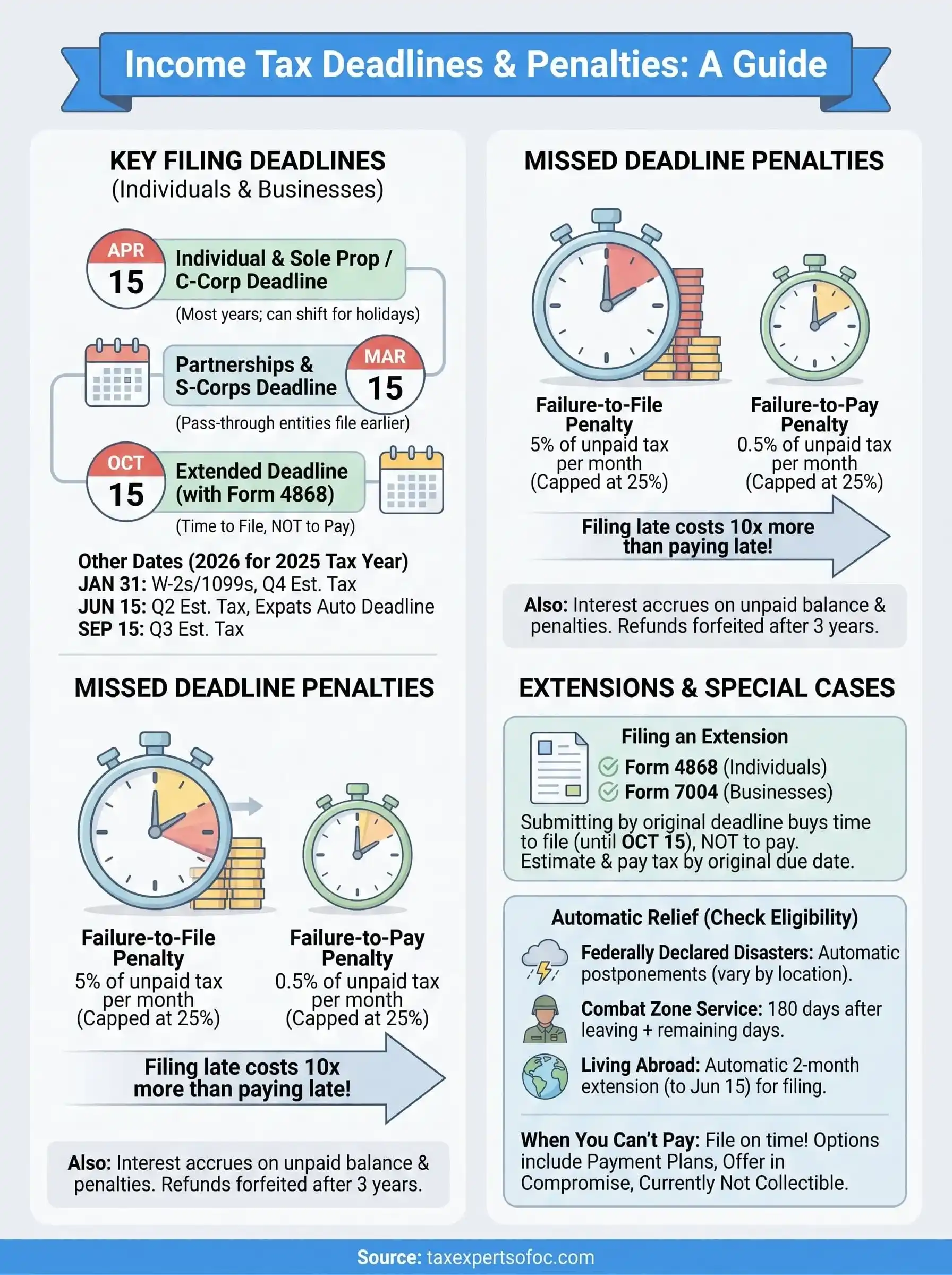
Once the income tax due date passes without a filed return, the IRS starts two separate calculations at the same time. The failure-to-file penalty runs at 5% of your unpaid tax per month, capped at 25%, and it's five times steeper than the failure-to-pay penalty of 0.5% per month. If both penalties apply in the same month, the IRS combines them but caps the total at 5%. This structure exists for a reason: the IRS wants your paperwork even more than it wants your money right away, because a filed return gives them a legal basis to collect.
Filing late costs you ten times more per month than paying late, so file on time even if you can't pay in full.
A missed deadline can cost you money you're actually owed
Beyond, if you're due a refund, the IRS doesn't pay you interest for the time you waited to file, but you do have a hard limit. You generally have three years from the original due date to claim a refund before the money becomes the property of the U.S. Treasury for good. We've seen clients discover, years too late, that a $4,000 refund from an old return simply expired. According to the IRS Statute of Limitations guidance, that three-year window is not flexible, no matter how good your excuse is.
It shapes decisions far outside the tax world
Furthermore, lenders, immigration officers, and even landlords sometimes ask for copies of your filed return or an IRS transcript as proof of income. If you're applying for a mortgage, refinancing, or sponsoring a family member's visa application, an unfiled return can stall the entire process for months. Self-employed taxpayers face an added wrinkle: unfiled returns mean unreported income to the Social Security Administration, which can quietly shrink your future retirement benefit calculation since the SSA only credits income it can see on a filed return.
The deadline also protects you from bigger IRS action
Additionally, staying current with your IRS filing deadline keeps you out of the agency's more aggressive enforcement tools. Taxpayers with several years of unfiled returns are far more likely to see the IRS file a Substitute for Return on their behalf, a version that skips deductions and credits you'd normally claim, and it usually results in a bigger bill than if you'd filed yourself. Once that happens, collection notices, liens, and wage garnishment threats tend to follow much faster than most people expect.
Here's a quick snapshot of what's actually at stake when that date slips by:
| Consequence | Why it matters |
|---|---|
| Failure-to-file penalty | 5% of unpaid tax per month, up to 25% |
| Failure-to-pay penalty | 0.5% of unpaid tax per month, up to 25% |
| Refund forfeiture | Unclaimed refunds expire after 3 years |
| Substitute for Return | IRS files for you, often with no deductions |
| Loan and visa delays | Lenders and agencies request filed transcripts |
Given all of this, treating the deadline as a real, hard line rather than a flexible suggestion is the single most cost-effective habit you can build into your financial routine. The next sections walk you through exactly how to find your current deadline, what to do if you need more time, and how to limit the damage if you're already behind.
How to find your exact tax filing deadline
Finding your income tax due date sounds simple until you realize the calendar doesn't always cooperate. The default rule puts the federal deadline on April 15, but when that date lands on a Saturday, Sunday, or the Emancipation Day holiday observed in Washington, D.C., the IRS pushes it to the next business day. That's why some years you'll see a deadline of April 17 or April 18 instead. Checking a generic calendar isn't enough; you need to confirm the actual date for the current tax year before you plan around it.
Start with your filing status and entity type
Before anything else, confirm which category you fall into, because the tax filing deadline shifts depending on whether you're an individual, a sole proprietor, a partnership, or a corporation. Individual filers and single-member LLCs taxed as sole proprietors generally follow the April deadline, while partnerships and S-corporations file in March. We break down the full entity-by-entity schedule in the next section, but knowing your category now saves you from checking the wrong date later.
Confirm your filing category first; the wrong assumption about your entity type is the fastest way to miss the real deadline.
Verify the date directly with the IRS
Rather than relying on secondhand sources, go straight to the source. The IRS Filing Season Statistics and deadline pages publish the confirmed date for the current year, along with any announced extensions for specific states or disaster zones. This step matters most in years affected by federal holidays or emergency declarations, when even experienced preparers sometimes work off outdated information from a prior tax season.
A quick checklist makes this easier to track:
- Confirm your entity type (individual, partnership, corporation, trust)
- Check the current year's official date on IRS.gov, not a cached search result
- Note whether your state has a different filing deadline
- Flag any disaster relief announcements covering your area
- Mark the date in a calendar with a reminder at least two weeks out
Don't assume your state matches the federal date
State income tax filing deadlines don't always mirror the federal one. Some states extend their deadline further, others shorten it, and a handful, like Texas and Florida, skip a state income tax filing altogether. Overlooking this distinction leads to a common and costly mistake: filing your federal return on time while missing a separate state deadline entirely, which can trigger its own penalty structure.
Ultimately, the safest approach is treating deadline research as an annual task, not a one-time lookup. Tax law changes, disaster relief gets announced mid-season, and holiday shifts vary year to year. If you'd rather skip the guesswork, the team at Tax Experts of OC confirms your exact deadline as part of every consultation, so you're working from a verified date instead of a guess.
Key tax dates to mark on your calendar this year
Knowing one deadline isn't enough. The tax calendar for individuals runs on several fixed dates throughout the year, and missing any one of them, not just the April filing deadline, can trigger its own penalty or lost opportunity. For the 2025 tax year, which you file in 2026, here's the full lineup you need on your radar.

Early-year dates that set up your filing
January sets the pace for the rest of your filing season. Employers and payers must send out W-2s and 1099-NEC forms by January 31, which is also the same day your fourth-quarter estimated tax payment for the prior year is due if you're self-employed. Roughly two weeks later, the IRS typically opens e-file season, usually in the last week of January, meaning nothing you submit gets processed before that window opens no matter how early you finish your paperwork.
The main event: April 15
April 15, 2026 is the standard income tax filing deadline for most individual returns, and it's also the deadline for your first quarterly estimated tax payment of the year and your final day to contribute to a traditional or Roth IRA for the 2025 tax year. Since April 15 falls on a Wednesday in 2026, there's no weekend or holiday shift to complicate things this time around.
Treat April 15 as three deadlines rolled into one: your return, your first estimated payment, and your IRA contribution window all close the same day.
Mid-year and extension dates that still matter
Summer doesn't mean you're off the hook. June 15 is the deadline for your second quarterly estimated payment, and it doubles as the automatic filing deadline for U.S. citizens living abroad. September 15 brings your third estimated payment, and October 15 closes out the year as the final deadline for anyone who filed Form 4868 for an extension back in April.
| Date (2026) | What's due |
|---|---|
| January 15 | Q4 2025 estimated tax payment |
| January 31 | W-2s and 1099s issued; Q4 payment alternative |
| Late January | IRS e-file season opens |
| April 15 | Individual return, Q1 estimated payment, IRA contribution deadline |
| June 15 | Q2 estimated payment; automatic deadline for expats |
| September 15 | Q3 estimated payment |
| October 15 | Extended individual return deadline |
Self-employed taxpayers and freelancers should circle the four quarterly tax payment dates separately from the filing deadline itself, since the IRS treats underpayment of estimated tax as its own penalty category, calculated independently from whether your final return was filed on time.
Business tax filing deadlines by entity type
Your business structure decides your tax filing deadline far more than the calendar does. The IRS assigns different due dates to partnerships, S-corporations, C-corporations, and sole proprietorships, and mixing them up is one of the most common mistakes we see among first-time business owners. Getting this wrong doesn't just mean a late filing; it means the failure-to-file penalty clock starts on a date you didn't even know applied to you.

Partnerships and S-corporations file first
Specifically, partnerships filing Form 1065 and S-corporations filing Form 1120-S both face a March 15 deadline, a full month ahead of the individual date most people have memorized. This earlier date exists because these are pass-through entities, meaning the income flows onto each partner's or shareholder's personal Schedule K-1 before it ever reaches their individual return. If the business files late, every owner's personal filing gets delayed too, since they can't accurately report income they haven't received documentation for yet.
Pass-through businesses file in March, not April, because their late filing delays every owner's personal return.
C-corporations follow their own calendar
Meanwhile, C-corporations filing Form 1120 generally follow the April 15 deadline, matching the individual date for calendar-year filers. Corporations that operate on a fiscal year rather than a calendar year get a different rule entirely: their return is due on the 15th day of the fourth month after their fiscal year ends. A corporation with a June 30 fiscal year-end, for example, files by October 15, not April.
Sole proprietors and non-profits round out the list
Along the same lines, sole proprietors and single-member LLCs report business income on Schedule C attached to their personal Form 1040, so they simply follow the standard individual deadline of April 15. Non-profit organizations filing Form 990 work on a different clock altogether, with their return due on the 15th day of the fifth month after their fiscal year closes, commonly May 15 for organizations running on a calendar year.
| Entity type | Form | Standard due date |
|---|---|---|
| Partnership | Form 1065 | March 15 |
| S-corporation | Form 1120-S | March 15 |
| C-corporation (calendar year) | Form 1120 | April 15 |
| Sole proprietor / single-member LLC | Schedule C with Form 1040 | April 15 |
| Non-profit organization | Form 990 | May 15 |
Given how many moving parts a single business structure can carry, especially once you add employees, multiple states, or a fiscal year that doesn't match the calendar, it's worth having someone track these dates for you rather than relying on memory. The team behind Tax Experts of OC handles entity-specific filings for partnerships, corporations, and non-profits alike, so each deadline gets flagged well before it becomes a penalty.
How to file a tax extension the right way
Requesting more time to file starts with one form: IRS Form 4868 for individuals. Submitting it before the original tax filing deadline pushes your paperwork due date to October 15, and the process itself takes minutes once you have last year's return and a rough estimate of this year's tax liability in front of you. Skipping this step and simply filing late instead of requesting an extension is the single most avoidable mistake we see, since the extension is free and automatic once submitted correctly.
File electronically and keep proof
Because the IRS processes extensions almost instantly through e-file, that's the route worth taking over paper mail. You can file a tax extension through IRS Free File, through most commercial tax software, or by having your preparer transmit it on your behalf. Whichever method you choose, save the confirmation number or accepted e-file receipt somewhere safe, since that's your proof if a penalty notice ever shows up questioning whether you actually requested the extension on time.
- Gather last year's tax return and this year's income documents
- Estimate your total tax liability as accurately as possible
- Submit Form 4868 electronically before the original deadline
- Pay any estimated balance due with the extension request
- Save your confirmation number for your records
An extension buys time to file, not time to pay
However, the extension only covers your paperwork. Your tax bill is still due on the original filing income tax deadline, and interest plus the failure-to-pay penalty start accruing the day after that date regardless of whether you filed an extension. Paying a reasonable estimate along with your Form 4868 keeps that penalty clock as small as possible, even if you can't cover the full amount right away.
An extension moves your paperwork deadline, not your payment deadline, so pay something by April 15 even if you can't pay it all.
Business extensions run on a separate form
Given that partnerships, S-corporations, and C-corporations don't use Form 4868, business owners need Form 7004 instead. This form grants a six-month extension for most business entities, moving a partnership's March 15 deadline to September 15, or a calendar-year C-corporation's April 15 deadline to October 15. The same rule applies here as with individuals: Form 7004 extends the filing date, not the payment date, so any tax owed still needs to be estimated and paid by the original due date to avoid interest charges.
Overall, an extension works best as a planned tool rather than a last-minute panic move. If your records are incomplete, if you're waiting on a K-1 from another entity, or if you simply need more time to get your documentation organized, filing Form 4868 or Form 7004 early keeps you compliant while you sort things out. The preparation team at Tax Experts of OC files extensions for individuals and businesses alike as part of their standard process, so nothing slips through when a return can't be finished by the original date.
What happens if you miss the filing deadline
Once the filing income tax deadline passes without a submitted return or an extension on file, the IRS doesn't wait to act. The failure-to-file penalty starts accruing the very next day, and if you also owe money, the failure-to-pay penalty kicks in alongside it. Nothing about this process requires a human to review your file first; the penalty calculation runs automatically based on the date stamped on whatever you eventually submit.

The penalty math keeps compounding
Since the failure-to-file penalty runs at 5% per month and caps at 25% of your unpaid tax, filing taxes late by even a few extra months turns a manageable bill into a serious one. Interest also accrues on top of both penalties, and that interest rate adjusts quarterly based on federal short-term rates, so it doesn't stay fixed the longer you wait. A taxpayer who owes $10,000 and waits five months past the deadline could see penalties alone add well over $2,000 before interest is even factored in.
Every month you wait past the deadline adds real dollars, not just paperwork stress, to what you eventually owe.
IRS notices escalate quickly
After the deadline slips by, the IRS typically sends a series of notices, starting with a simple reminder and escalating toward a formal notice of intent to levy if the account stays unresolved. Here's roughly how that escalation tends to unfold:
- CP59 or similar notice flagging an unfiled return
- CP14 balance due notice once a return is processed or estimated
- CP501 and CP503 reminders as the account ages
- CP504 final notice before levy action begins
- Letter 1058 or LT11, the formal notice of intent to levy
Ignoring these letters doesn't make the account disappear; it just moves you closer to a wage garnishment or bank levy, since the IRS has legal authority to collect once the notice period on that final letter expires.
Reasonable cause can reduce penalties, but rarely erases them
Additionally, the IRS does offer a path called reasonable cause relief, which can reduce or remove penalties if you can show a legitimate reason for filing late, such as a serious illness, a natural disaster, or the death of an immediate family member. Documentation matters here; a vague explanation rarely succeeds, while records like hospital admission dates or a copy of a disaster declaration carry real weight. Requesting abatement on Form 843 is another option worth checking, since taxpayers with a clean three-year filing history often qualify automatically, no elaborate excuse required.
Given how quickly notices stack up once a deadline is missed, the fastest way to limit the damage is filing the return immediately, even without full payment ready, and requesting relief where you qualify. The resolution team at Tax Experts of OC handles exactly this kind of cleanup, from unfiled returns to penalty abatement requests, so the situation stops getting worse while it gets sorted out.
What to do if you can't pay your full tax bill
Owing more than you can pay right now doesn't mean you should skip filing. File your return by the filing income tax deadline regardless of your bank balance, then deal with the payment separately. The failure-to-file penalty costs ten times more per month than the failure-to-pay penalty, so the math always favors filing on time and figuring out payment afterward.
The IRS offers more flexibility than most people realize
Granted, the IRS has several formal programs built specifically for taxpayers who can't pay in full, and most people never ask about them because they assume the only options are pay now or face collections. A short-term payment plan gives you up to 180 days to pay off the balance with no setup fee, while you can also apply for a long-term installment agreement that spreads payments over months or years with a modest setup cost. For taxpayers facing genuine financial hardship, an Offer in Compromise lets you settle for less than the full amount owed, and Currently Not Collectible status pauses collection entirely if paying anything would leave you unable to cover basic living expenses.
Filing on time and arranging payment separately almost always beats ignoring the return because you can't pay in full.
Compare your options before picking one
Here's a quick side-by-side so you can see which program fits your situation:
| Option | Best for | Typical timeframe |
|---|---|---|
| Short-term payment plan | Balances payable within 180 days | Up to 6 months |
| Long-term installment agreement | Larger balances needing monthly payments | Up to 72 months |
| Offer in Compromise | Genuine inability to pay full balance | Case-by-case |
| Currently Not Collectible | Financial hardship with no disposable income | Reviewed periodically |
Applying for any of these requires documentation, and the IRS reviews your income, expenses, and assets before approving an Offer in Compromise application or Currently Not Collectible status, so incomplete paperwork is the most common reason applications stall.
Small steps now prevent bigger problems later
Meanwhile, even a partial payment submitted with your return reduces the interest and failure-to-pay penalty that accrue on the unpaid balance, so paying something, even a few hundred dollars, is always better than paying nothing while you sort out a longer-term plan. Setting up a payment plan online through the IRS also stops the more aggressive collection notices from escalating toward a levy while your application is under review.
Ultimately, the right payment path depends on your income, your assets, and how much flexibility you actually need, and picking the wrong one can mean higher fees or a rejected application that wastes months. The resolution team at Tax Experts of OC evaluates your full financial picture before recommending an installment agreement, an Offer in Compromise, or Currently Not Collectible status, so you apply for the option most likely to get approved the first time.
How disasters and other special cases shift deadlines
Not every taxpayer works from the same calendar. When the filing income tax deadline collides with a federally declared disaster, active military service, or life abroad, the IRS builds in automatic relief that most people don't know exists until they need it. Recognizing these exceptions early keeps you from panicking over a deadline that may not even apply to your situation.

Federally declared disasters push deadlines automatically
Given California's exposure to wildfires and the broader pattern of hurricanes and severe storms across the country, the IRS regularly issues disaster relief announcements that postpone filing and payment deadlines for affected counties, sometimes by months. These postponements apply automatically based on your address on file, so you typically don't need to call the IRS or file separate paperwork to claim the extension. The IRS disaster relief page lists every current declaration by state and county, and checking it directly matters more than trusting a news headline, since relief periods and covered ZIP codes shift as declarations get updated.
A federally declared disaster in your county can push your deadline back automatically, no extension request required.
Military service and combat zones bring their own rules
Meanwhile, service members deployed to a combat zone get an automatic extension that runs 180 days after they leave the combat zone, plus however many days were left in the filing season when they deployed. This rule covers both filing and payment, which sets it apart from a standard extension that only postpones paperwork. Spouses of deployed service members generally qualify for the same relief, which matters for joint returns filed while one spouse is stationed overseas.
Living abroad adds two extra months, not more
Along similar lines, U.S. citizens and resident aliens living outside the country on the regular due date receive an automatic two-month extension, pushing their deadline to June 15 without filing any extra form. This relief covers filing, but interest on any unpaid balance still starts accruing from April 15, so the extra time helps with paperwork, not with the payment clock.
Here's a quick reference for the most common special-case extensions:
| Situation | Extension granted |
|---|---|
| Federally declared disaster | Varies by declaration, often 1-6 months |
| Combat zone service | 180 days after leaving zone, plus days remaining |
| U.S. citizens living abroad | Automatic 2 months (to June 15) |
| Identity theft case pending | Case-by-case, coordinated with IRS unit |
Identity theft and IRS errors create their own timeline
Occasionally, a pending identity theft case or an IRS processing error delays a return through no fault of the taxpayer, and in these situations the IRS generally works with you individually rather than applying a blanket rule. Documentation from the IRS Identity Theft Victim Assistance unit becomes essential here, since it establishes the timeline the agency later uses to waive penalties tied to the delay. Anyone caught in one of these overlapping situations, whether it's a disaster zone combined with an unresolved identity theft case, benefits from professional review rather than guessing which rule takes priority.
Keeping your tax deadlines on track
Every deadline covered here points to the same lesson: the filing income tax deadline is a fixed line, not a suggestion, and treating it that way saves you money every single time. File on time even when you can't pay in full, request an extension the moment you know you'll need one, and check for disaster or military relief before assuming the standard date applies to you. Missing a deadline doesn't have to spiral into liens or garnishment if you act fast and file the return, even late, rather than letting silence pile up notices.
Most of the costly mistakes we see start with confusion, not carelessness. If your situation involves back taxes, multiple entities, or a deadline that already slipped, don't guess your way through it. Talk to Tax Experts of OC about IRS tax resolution and back tax relief in a free consultation, and get a clear, verified plan for your exact filing situation.