
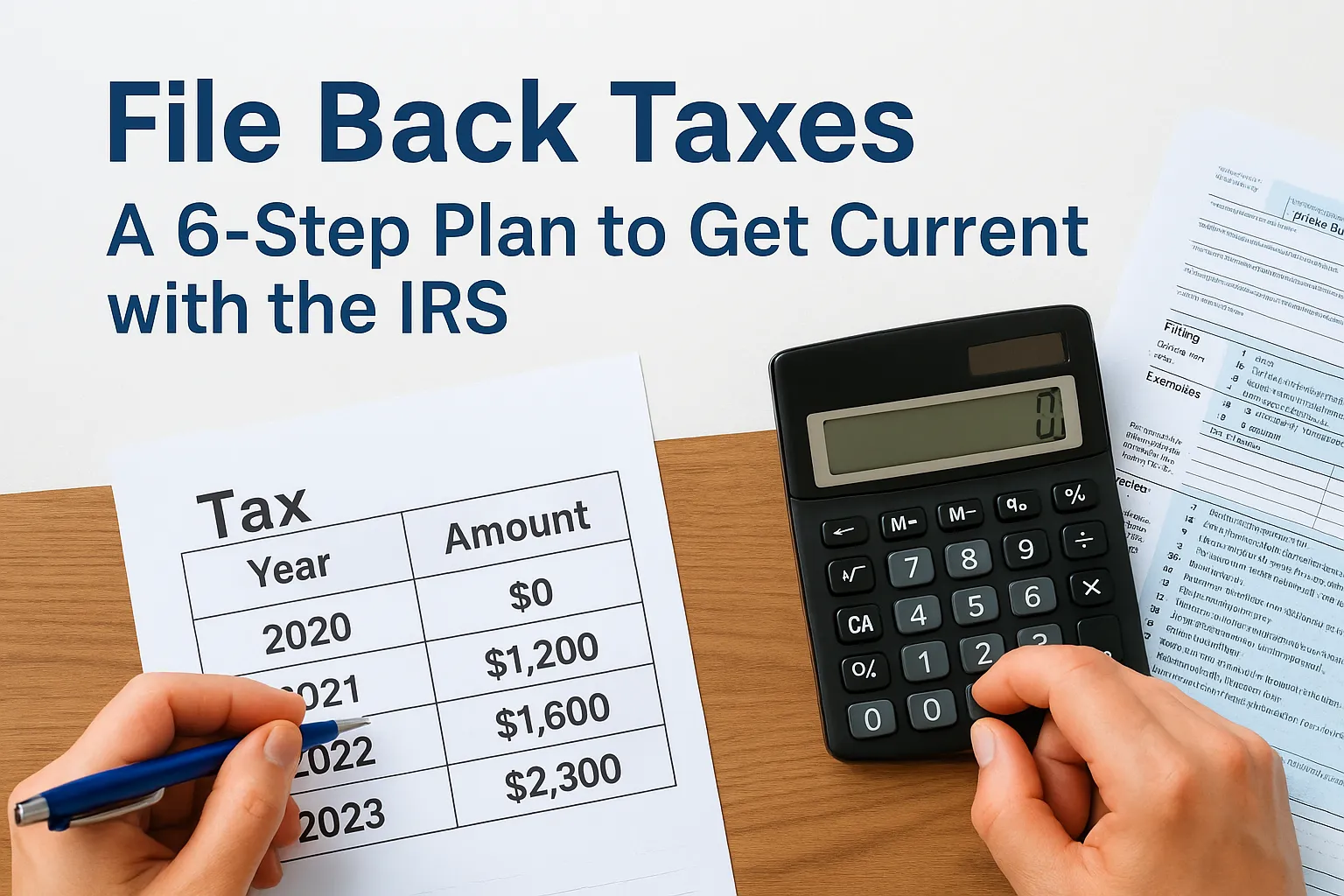
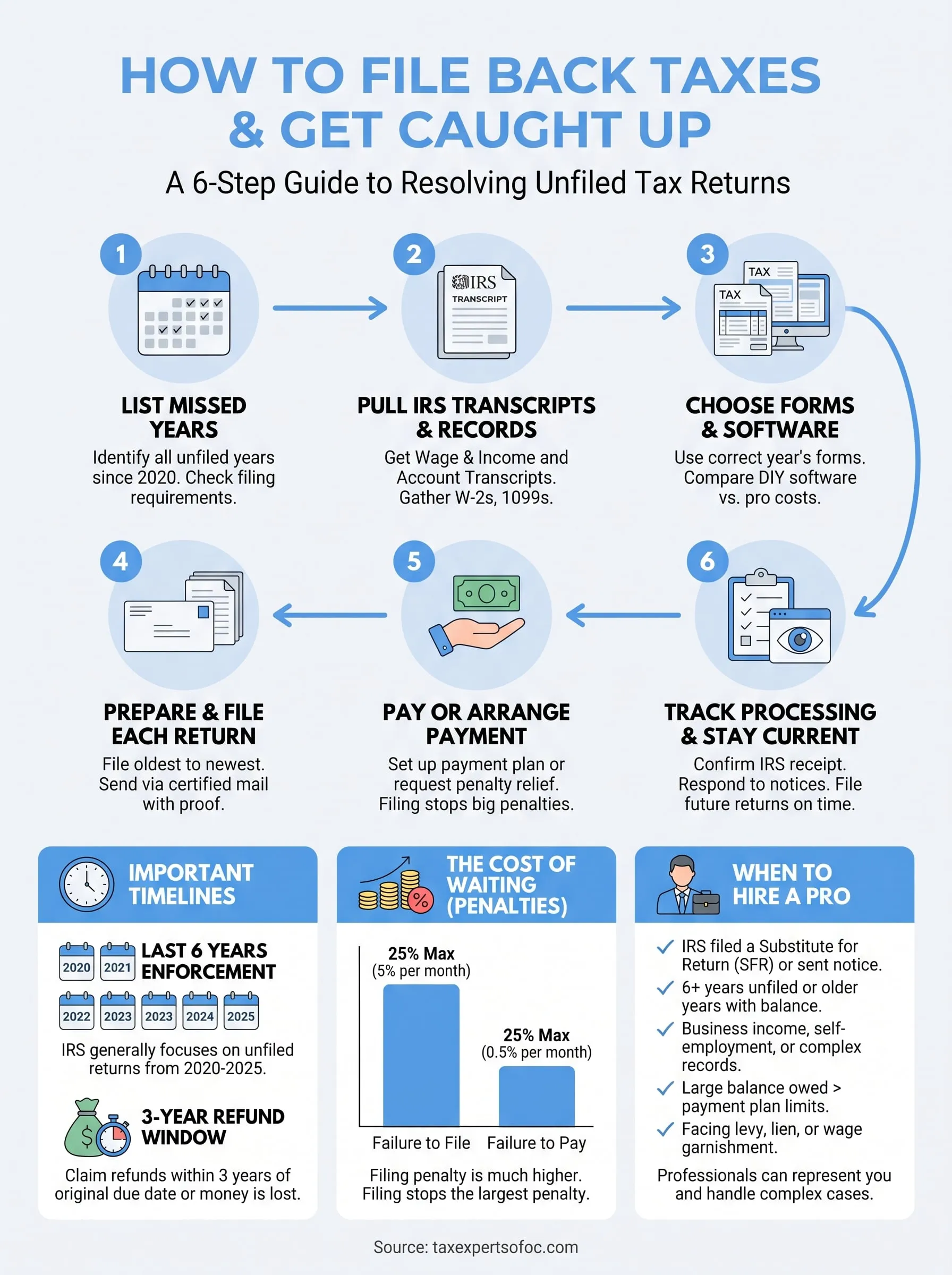
The way to file back taxes is to work in six steps. List the years you missed, pull your IRS transcripts, get the forms for each year, prepare and send the returns oldest first, pay or arrange payment of any balance, and then confirm the IRS processed everything. Most people only need to catch up on the last six years. A return that shows a refund carries no late-filing penalty.
Unfiled returns pile up quietly. One missed year becomes three, a notice arrives, and penalties and interest grow every month. A refund you were owed can also slip past the three-year deadline. The paperwork is rarely the hard part. Not knowing where to start is, and fear of the IRS keeps many people from filing at all.
This guide covers each step with the deadlines, penalty math, forms and costs you need. At Tax Experts of OC, our CPA and Enrolled Agent work on unfiled returns for clients nationwide, so we also point out where doing it yourself stops making sense.
Why you should file back taxes now
Filing late costs less than not filing. Penalties keep growing while a return sits unfiled, you lose refunds after three years, and the IRS can file a return for you that includes no deductions or credits.
How many years back you need to file
You can technically file a return for any year you missed, and the IRS prefers that you file all of them. In practice, the IRS generally enforces on the last six years. In 2026, that means roughly tax years 2020 through 2025. Filing those six usually puts you in good standing.
Refunds follow a separate and stricter clock. You have three years from the original due date to claim a refund or credit for a year you never filed. After that, the money belongs to the U.S. Treasury. Here is where the refund windows stand for the most recent years:
| Tax year | Original due date | Refund window closes |
|---|---|---|
| 2022 and earlier | Already passed | Closed |
| 2023 | April 15, 2024 | April 2027 |
| 2024 | April 15, 2025 | April 2028 |
| 2025 | April 15, 2026 | April 2029 |
If you owed tax in a year older than six years, or the IRS has asked about it, talk to a professional before you decide to skip it. A year with no filed return stays open for assessment indefinitely.
What waiting costs you
Two penalties apply to a late return that shows tax due, and interest runs on top of both. The failure-to-file penalty is 5% of the unpaid tax per month, capped at 25%. The failure-to-pay penalty is 0.5% per month, capped at 25%. When both apply, the filing penalty drops to 4.5%, so the first five months cost a combined 5% each. Interest is the federal short-term rate plus 3 percentage points, reset quarterly and compounded daily. A minimum penalty also applies to returns more than 60 days late, and the amount is listed in each year's Form 1040 instructions.
| Months late | Failure to file | Failure to pay | Combined |
|---|---|---|---|
| 1 | 4.5% | 0.5% | 5.0% |
| 5 | 22.5% | 2.5% | 25.0% |
| 12 | 22.5% | 6.0% | 28.5% |
| 24 | 22.5% | 12.0% | 34.5% |
| 30 | 22.5% | 15.0% | 37.5% |
| 50 | 22.5% | 25.0% | 47.5% |
Take a freelancer who owes $6,000 for 2023 and files 30 months late. The penalties are 37.5% of $6,000, or $2,250, so the bill is $8,250 before interest. At recent rates of roughly 7% to 8% a year, interest adds about $1,000 or more.
The table also shows the most important rule. The filing penalty maxes out after five months, but the payment penalty keeps running. Filing now stops the biggest penalty even if you cannot pay.
Every month a balance sits unfiled adds penalty and interest, and filing is what stops the largest part.
What the IRS does if you never file
The IRS can prepare a substitute for return (SFR) from the W-2s and 1099s it holds. An SFR uses the least favorable filing status and gives you no deductions or credits beyond the basics. It then mails a notice of deficiency, the 90-day letter, and assesses tax that is often far higher than what you really owe.
You can fix this by filing your own accurate return, which replaces the IRS version. Once the amount is assessed, collection tools such as liens, levies and wage garnishments become available.
The usual three-year window for the IRS to assess tax never starts for a year with no return. Criminal prosecution for willful failure to file exists, but it is rare and reserved for deliberate cases. For most people, the real risk is a large, avoidable bill.
Step 1. List the years you need to file
Start by writing down every year since 2020 and marking each as required, optional or refund-only. This list drives everything that follows.
Check whether you were required to file
You must file for a year if your gross income reached the filing threshold for your status. For people under 65, the threshold matches the standard deduction:
| Tax year | Single | Married filing jointly |
|---|---|---|
| 2022 | $12,950 | $25,900 |
| 2023 | $13,850 | $27,700 |
| 2024 | $14,600 | $29,200 |
| 2025 | $15,750 | $31,500 |
Several situations require a return even below these amounts. You must file if you had net self-employment earnings of $400 or more. The same goes if you owe special taxes, such as household employment tax or an additional tax on an IRA. A married person filing separately must file with gross income of just $5. Dependents and people over 65 have different thresholds, which the IRS Interactive Tax Assistant on irs.gov will calculate.
If you were below the threshold, you don't have to file, but you should still file for any year when tax was withheld from your pay, because that withholding is a refund waiting to be claimed.
You must file for any year your income reached the threshold, and you should file for any year you are owed a refund.
Build your year-by-year list
Make a simple list or spreadsheet with one row per year from 2020 through 2025. For each year, record four things:
- Whether your income crossed the threshold or you had self-employment income.
- Whether you likely had tax withheld or credits, which signals a possible refund.
- Whether the IRS sent you a notice about that year.
- Whether you filed a state return for that year.
Add any older year where you know you owed tax or received a notice. Mark refund years with their deadlines from the table above. When you finish, you have your filing scope and your priorities. The next step tells you what the IRS already knows about each year.
Step 2. Pull your IRS transcripts and records
Request your IRS transcripts first, then fill the gaps from your own records. Transcripts show what employers and banks reported, so you rarely need to hunt down every old W-2.
Get your wage and income transcripts
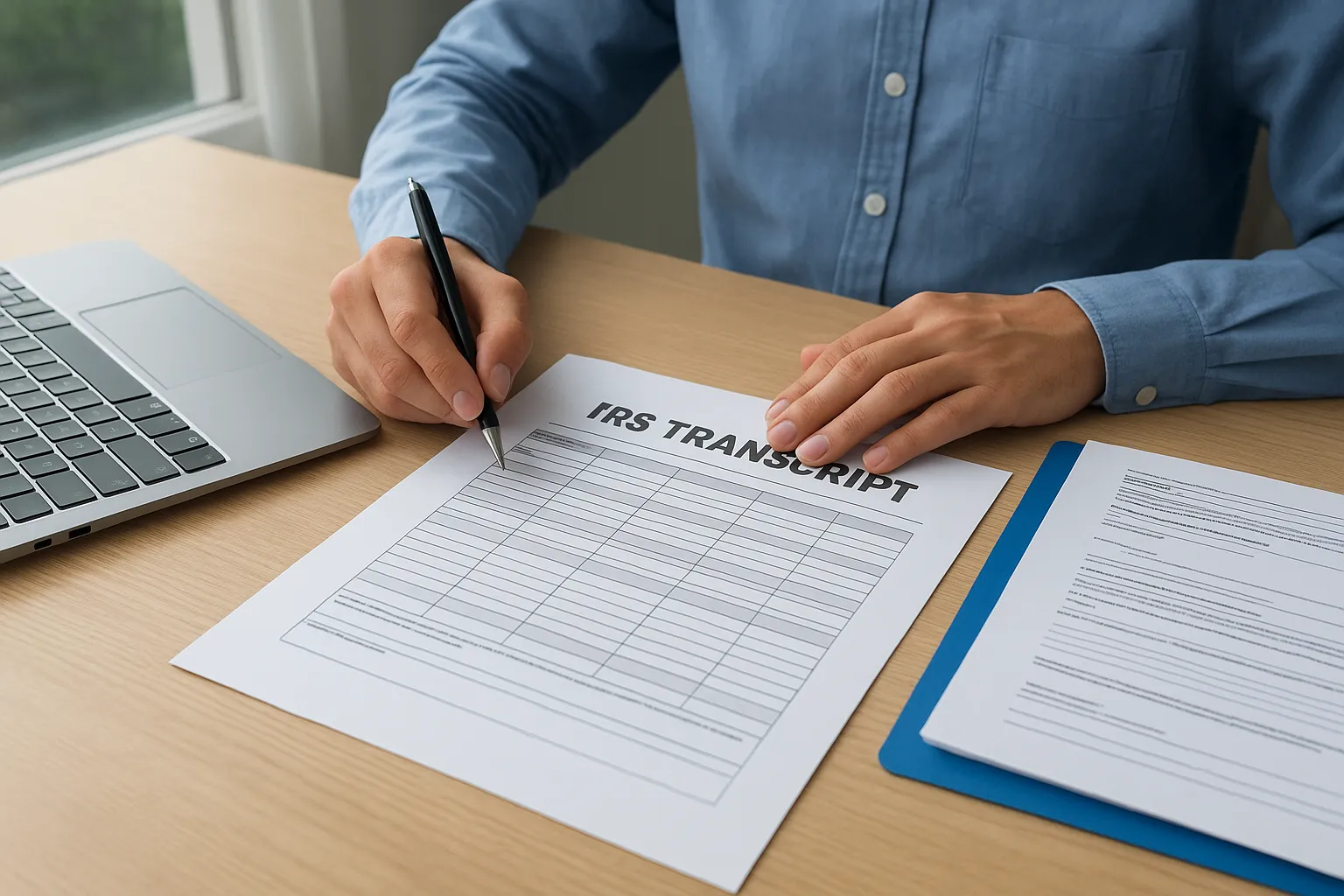
A wage and income transcript lists the W-2s, 1099s, 1098s and similar forms reported to the IRS under your Social Security number. The IRS keeps these for roughly the last 10 years. There are two ways to get them:
- Create or sign in to your IRS online account at irs.gov, verify your identity, and open the tax records section to view or download a transcript for each year.
- Mail or fax Form 4506-T and choose the wage and income transcript for each year you need.
While you are there, pull the account transcript for each year too. It shows balances, penalties, payments and whether the IRS filed an SFR. If an SFR exists, you need to know before you file.
Transcripts are only a starting point. They don't include cash or unreported self-employment income, expenses, deductions or credits, and information for older years can be incomplete.
Rebuild what the IRS doesn't have
Gather the records for everything the transcripts leave out. This checklist covers most households:
- Bank and credit card statements for the year
- 1099-K forms and invoices, if you were self-employed
- Receipts for business expenses, mileage logs and home office details
- Mortgage interest, property tax and charitable donation records
- Childcare, tuition (Form 1098-T) and health savings account statements
- Records of estimated tax payments, which also appear on your account transcript
- Any prior returns you filed, which carry over figures like capital loss and depreciation
If a W-2 is missing, ask the employer for a copy, and fall back on the transcript if they don't respond. For self-employment income, total your bank deposits and remove transfers and refunds so you report only real income. Expenses need support, so use statements and receipts. A reasonable reconstruction beats leaving a year unfiled.
The transcript tells you what the IRS already knows, and your own records fill in everything it does not.
Step 3. Choose forms and software for each year
Use the form and instructions for the tax year you're filing, then pick the cheapest preparation method that matches the complexity of your return.
Use the form for the year you're filing
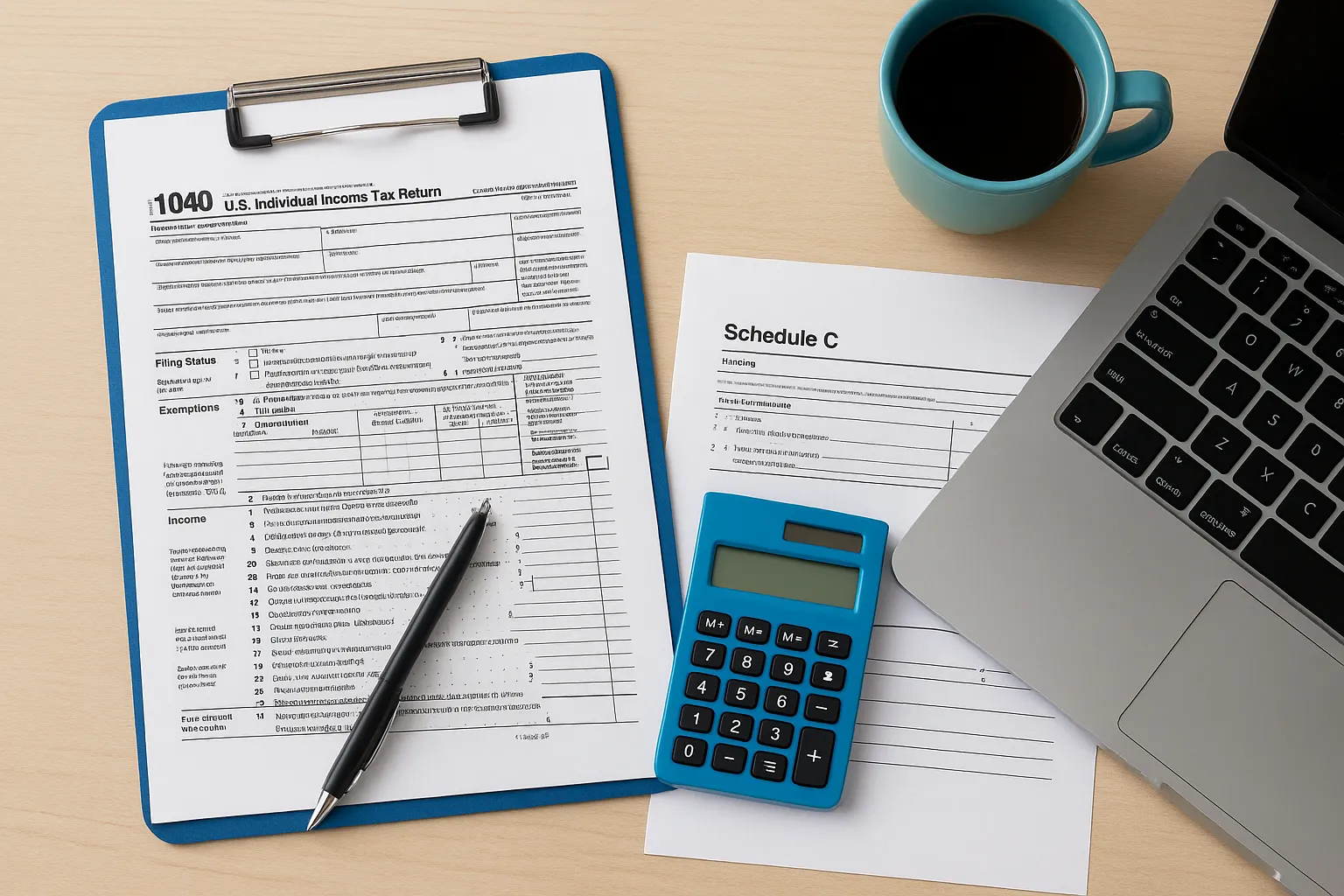
You must file a 2023 return on the 2023 Form 1040, not the current one. Tax rules change from year to year. The single standard deduction, for example, rose from $12,950 for 2022 to $15,750 for 2025, and credits and phase-outs shift as well. The IRS publishes prior-year forms and instructions on its past-due returns page. You can also order forms by calling 800-TAX-FORM (800-829-3676).
Self-employed filers also need Schedule C and Schedule SE, and investors need Schedule D. State returns are separate forms from your state tax agency, with their own penalties and lookback rules. Plan to file them in the same order as the federal returns.
Compare ways to prepare the returns
You have four realistic options, and cost depends mostly on how many years you have and how complicated each one is.
| Option | Typical cost | Best for |
|---|---|---|
| Prior-year software, do it yourself | Some products charge $0 federal and about $17.99 per state return | Simple W-2 returns |
| Software plus live expert help | Add-on access, one provider lists $60 | Simple returns with questions |
| Volunteer help (VITA) | Free, with income limits, and not every site does prior years | Basic returns, lower income |
| Professional preparer | Quoted per return or as a package | Business income, many years, notices |
A worked example shows how the costs add up. Suppose you have three simple W-2 years and one state each, using software with free federal filing and a $17.99 state fee. That is 3 × $17.99, or about $54 in total, plus postage.
Check how each product delivers the return. Many support e-filing for the current year and the two prior years, and older years must be printed and mailed. Some products, including TurboTax, print for mail only on prior years. IRS Free File is built for the current season, so it generally won't cover back years.
For simple returns, free-federal prior-year software keeps the cost near zero, and complex returns justify a professional.
Step 4. Prepare and file each return
Prepare the returns from the oldest year to the newest, sign each one, and send each year with proof of delivery.
Prepare returns from oldest to newest
Working oldest first matters because later years often depend on earlier ones. Capital loss carryovers, business losses, depreciation and credit carryforwards all move forward from year to year. Start with your oldest required year, and use your transcripts to check that every W-2 and 1099 amount is on the return.
There is one exception. If a refund year is close to its three-year deadline, file that return right away and don't wait for the others. Also check whether the IRS has already filed an SFR for any year. If it has, your return replaces it, and it's worth including a note with the notice number.
Report all income, including income with no 1099. The IRS matches third-party reports against your return, and an omitted form leads to a mismatch notice months later. Sign and date every return, and if you file jointly, both spouses sign.
Send each year with proof
Each return goes to the address listed in the Form 1040 instructions for that year, which depends on your state and whether you enclose payment. If you are responding to an IRS notice, use the address on the notice. Then follow this checklist:
- Put each year in its own envelope, never bundled together.
- Mail with certified mail and a return receipt, and keep the receipt.
- Attach copies of W-2s and 1099s showing withholding.
- Keep a full copy of each return and its mailing proof.
- Use your current mailing address, even if you lived elsewhere that year.
- E-file only the years your software supports, and print and mail the rest.
If you are responding to a notice, you can enclose a short note like this:
Re: Tax year 2023, Form 1040
Name: [Your full name]
SSN (last 4): [XXXX]
Notice number and date: [CP59 / date, if you received one]

Enclosed is my Form 1040 for tax year 2023, filed late.
I am filing this return in response to the notice above.
Please process it and send any balance due notice to
the address on the return.
Mail each year in its own envelope with certified delivery, because your receipt is your proof if the IRS says it never arrived.
Step 5. Pay or arrange payment of what you owe
File even if you can't pay, then reduce the balance with a payment plan or penalty relief. The filing penalty is nine times larger than the payment penalty each month, so filing comes first.

Know what the bill will include
After the IRS processes a late return, it mails a bill showing the tax, penalties and interest. Expect the bill to differ from your own math, because the IRS calculates penalties and daily interest automatically. Pay what you can immediately, since interest stops accruing only on the paid portion. Direct Pay on irs.gov takes a payment from a bank account without a fee.
If the amount looks wrong, compare it to your account transcript before you pay or dispute it. Errors usually come from missed withholding or payments, and a corrected return or a short letter fixes them.
Set up a payment plan
If you can't pay in full, the IRS offers payment plans. You generally must have filed all required returns before the IRS will grant one, which is another reason to finish Steps 1 through 4. As of the IRS's current guidance, individuals who owe $50,000 or less in combined tax, penalties and interest can apply online for a long-term payment plan. A short-term plan of up to 180 days is available for balances under $100,000.
For people facing real hardship, two other routes exist:
- Offer in compromise: settles the debt for less than the full amount when you can't pay it all, and requires all returns filed.
- Currently not collectible status: pauses collection when paying would prevent you from covering basic living expenses, though interest continues.
These options carry strict rules, so most people with a large balance get advice before they apply.
Ask for penalty relief
Penalties can sometimes be removed. First-time penalty abatement can remove failure-to-file and failure-to-pay penalties if you had no penalties in the prior three years, filed all currently required returns, and paid or arranged to pay. Because it usually applies to only one tax year, it helps less when you have several unfiled years.
Reasonable cause relief applies when circumstances beyond your control, such as serious illness, a death in the family or a disaster, kept you from filing. Request relief by calling the number on your bill, replying to the notice, or sending Form 843. Interest is generally not removed, except interest charged on penalties that are abated.
Filing stops the largest penalty, and a payment plan or penalty relief request can shrink what's left.
Step 6. Track processing and stay current
Confirm that the IRS posted each return, then set up simple habits so you don't fall behind again.
Confirm the IRS processed each return
Processing of late and paper returns often takes many months, so don't expect quick confirmation. Check your IRS online account every few weeks to see whether each year posted and what the balance shows. If the account shows no return after several months, call the IRS with your certified mail receipt in hand.
If the IRS sends a notice, respond by the deadline printed on it, even to say you agree. Ignoring a notice is what leads to levies. If the IRS delay is causing financial hardship, the Taxpayer Advocate Service is a free, independent IRS office that can help. Also keep every return and receipt for at least seven years.
Prevent another backlog
Once you are caught up, a few habits keep you there. File the current year by its due date, or file Form 4868 for an extension. An extension gives you more time to file, not more time to pay. Then match your payments to your income:
- Employees: update your Form W-4 so withholding covers your actual tax.
- Self-employed: make quarterly estimated payments, and set aside a percentage of every deposit.
- Everyone: put filing dates on your calendar and keep documents in one folder.
If you used a payment plan, never miss a payment or a filing. A single missed return can default the agreement.
Confirm each return posted, answer every notice, and file the next one on time.
When to hire a tax professional instead
Hire a professional if your situation involves an IRS notice, business income, many unfiled years or a balance you can't pay. For a simple one- or two-year catch-up, software is enough.
Signs a DIY filing isn't enough
Several situations call for expert help before you file anything:
- The IRS has filed a substitute for return or sent a notice of deficiency
- You have six or more years unfiled, or older years with tax owed
- You have self-employment income without clean records, or unfiled business returns
- You owe more than a payment plan can realistically cover
- You face a levy, lien or wage garnishment
- You must file in several states
Unfiled business returns carry their own penalties, and some are charged per owner for each month late. Putting off those filings can cost more than personal returns do.
What a professional adds and what it costs
A CPA or Enrolled Agent can pull your transcripts, prepare each year, and represent you before the IRS under Form 2848 so you don't deal with collection calls yourself. A professional also decides which years to file first, how to ask for penalty relief and which payment option fits your income. At Tax Experts of OC, a CPA and an Enrolled Agent handle this work through phone and virtual meetings for clients in all 50 states, and we offer transparent upfront pricing and flexible payment options for qualified clients.
Cost depends on the number of years, how complete your records are and whether business returns are involved. Ask for a written quote that covers every year before you start, so the total is clear. Our Tax Resolution Services work directly with the IRS and state agencies on back taxes, unfiled returns, liens and garnishments.
Handle simple catch-ups yourself, and bring in a professional when notices, business income or large balances enter the picture.
Your next move on back taxes
To file back taxes, list the years you missed, pull your transcripts, use each year's forms, send the returns oldest first with proof, and deal with any balance through a plan or penalty relief. The penalty math is simple. Filing stops the biggest penalty right away, and a refund year can still be claimed if you act within three years of its due date.
Begin with the oldest year in your six-year window and the nearest refund deadline. If your situation involves notices, business income or a balance you can't pay, book a free 30-minute consultation with the Tax Resolution Services team at Tax Experts of OC and get a clear plan for every unfiled year.