
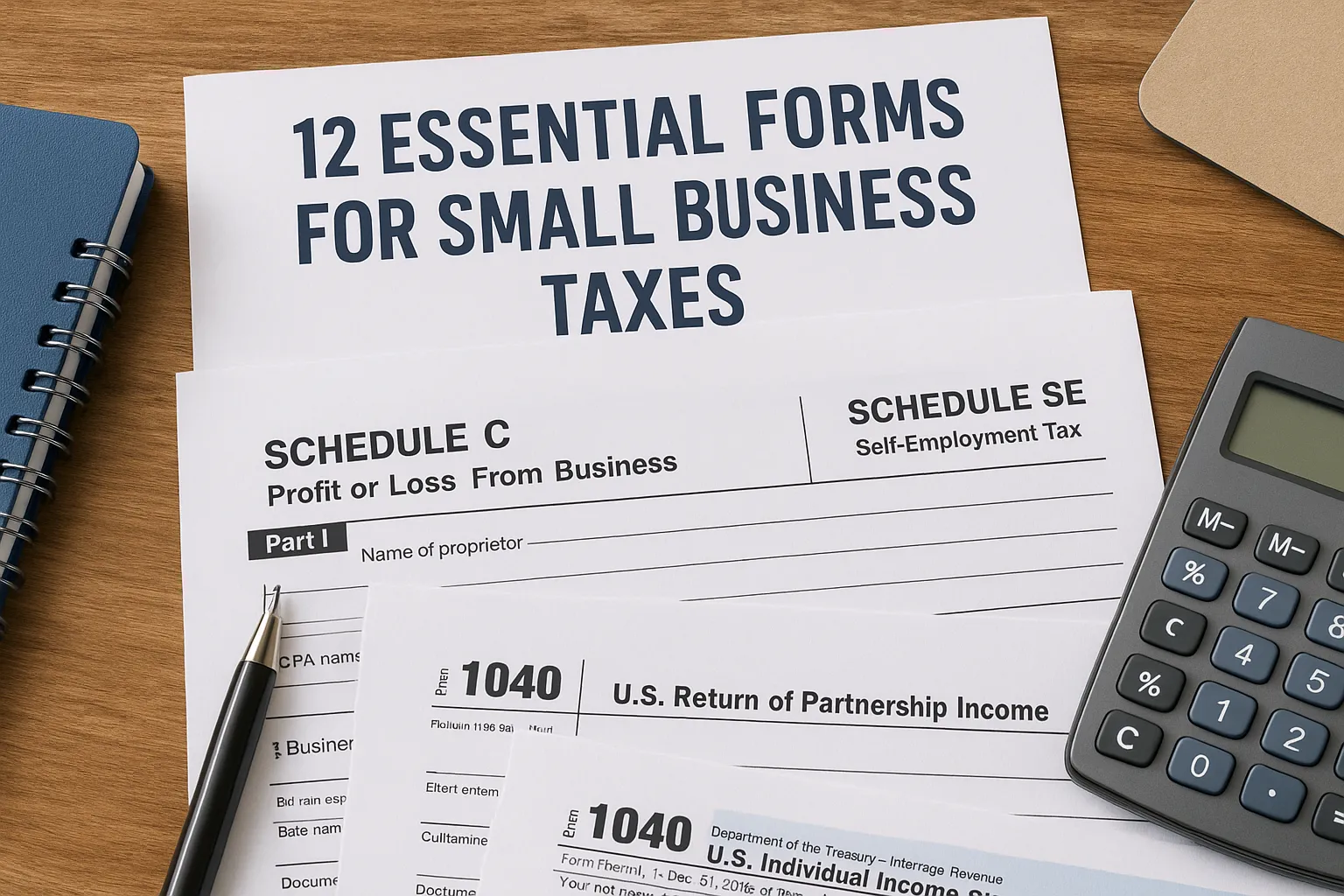
Tax season hits different when you own a business. You're not just filing one return, you're juggling forms based on your entity type, your employees, your contractors, and whatever else changed in your business this year. Miss one, and you're looking at penalties or an IRS notice that eats up your week.
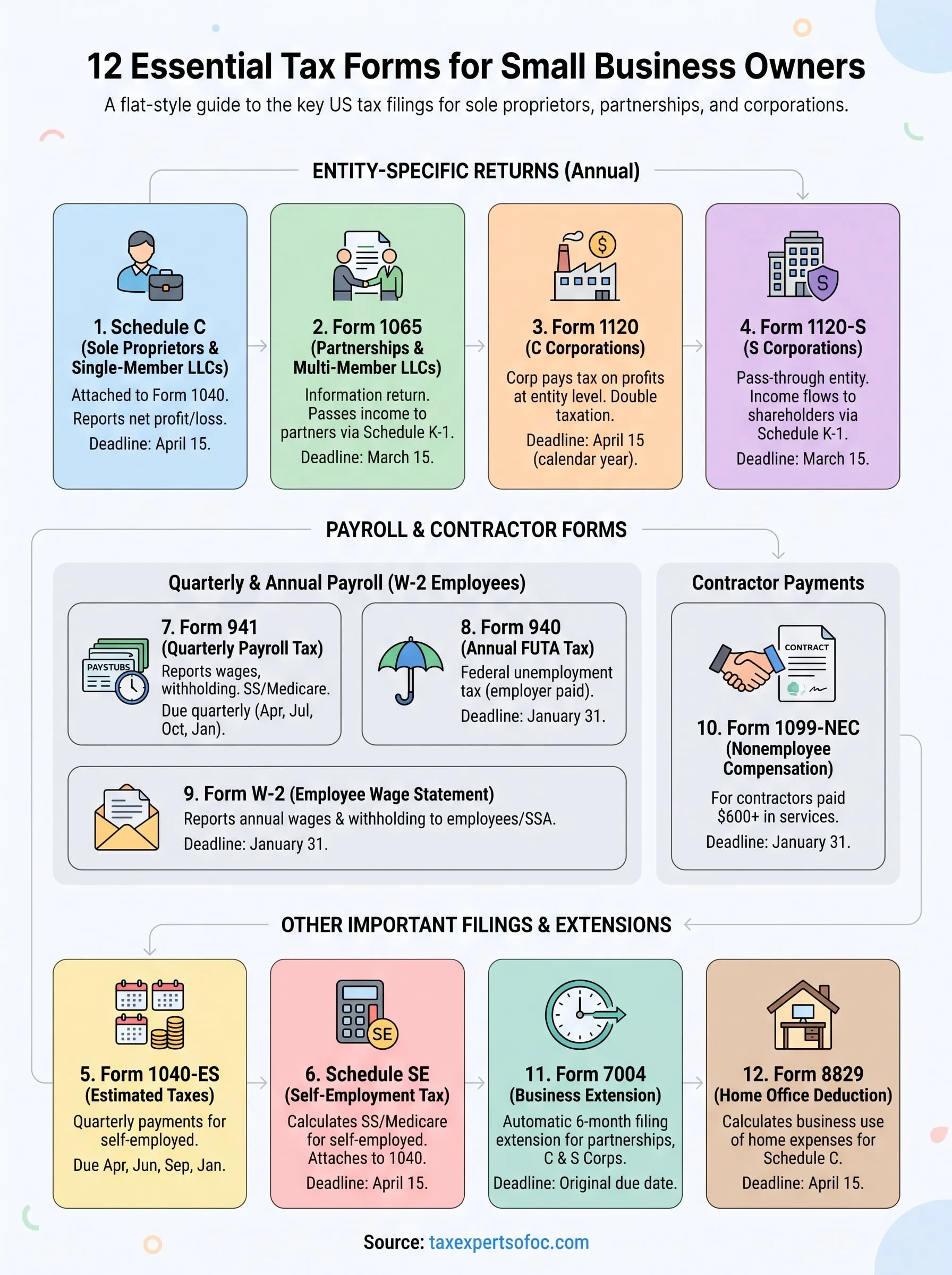
If you searched for forms for small business taxes, you already know the IRS website isn't exactly built for quick answers. This article breaks down the 12 forms most small business owners actually need, from Schedule C for sole proprietors to Form 1120-S for S-corps, plus the ones tied to payroll and contractor payments. You'll see which forms match your specific structure, whether you're an LLC, partnership, or corporation.
We pull this list from what we see daily at Tax Experts of OC, where our CPAs and Enrolled Agents prepare these exact small business forms for taxes for clients across every state. We've also flagged the deadlines and common mistakes that trigger IRS attention, so you can file correctly the first time instead of scrambling to fix a form for small business taxes after the fact.
1. Schedule C for sole proprietors and single-member LLCs
Schedule C is the form most solo business owners meet first, and it's often the one that causes the most confusion. It attaches directly to your Form 1040 personal tax return, which means your business income and your personal income get reported on the same filing. There's no separate business return to worry about here, which is exactly why so many freelancers, consultants, and single-member LLC owners default to this structure in their first few years.
What it reports
Schedule C calculates your net profit or loss from a business you operate as a sole proprietor, and knowing how to complete Schedule C line by line is what keeps that number accurate. You list your gross receipts, then subtract your business expenses, things like advertising, supplies, vehicle costs, and contract labor, to arrive at a net figure. That net profit then flows onto your Form 1040 and gets taxed at your individual rate. If you had a loss, it can offset other income on your return, which is one reason this form matters even in a slow year.
A single missed expense category on Schedule C can mean paying tax on income you never actually kept.
Who needs to file it
Anyone running a business as a sole proprietor or a single-member LLC that hasn't elected corporate tax treatment needs to file Schedule C, which is the starting point for filing taxes for an LLC. This includes freelancers, gig workers, independent contractors, and small shop owners who never formally incorporated. Here's a quick way to check if you fall into this category:
- You operate under your own name or a DBA, not a registered corporation
- You're the only owner of your LLC and haven't filed Form 8832 or Form 2553
- You received 1099-NEC forms from clients instead of a W-2
- You report business income directly on your personal tax return
Owners who mix personal and business expenses run into trouble here more than almost anywhere else on this list. The IRS looks closely at Schedule C deductions, especially in categories like meals, travel, and home office use, because they're the easiest to inflate. Keeping separate business bank accounts and clean books all year makes this form far less stressful to prepare.
Filing deadline
Schedule C follows the same deadline as your personal return, which is April 15 in most years, since it's filed as part of Form 1040. If April 15 lands on a weekend or holiday, the deadline shifts to the next business day. Requesting an extension on your Form 1040 (via Form 4868) also extends your Schedule C deadline, but remember that an extension to file isn't an extension to pay. Any tax owed is still due by the original April deadline, and the IRS will charge interest and penalties on unpaid balances even if you filed for more time. Working with a CPA or Enrolled Agent to project your tax bill before the deadline helps you avoid that penalty trap entirely.
2. Form 1065 for partnerships and multi-member LLCs
Form 1065 is the return that partnerships and multi-member LLCs file to report their business activity to the IRS, and if you want the mechanics of how to file a partnership return, the details matter, because here's the twist: the partnership itself never pays income tax on this form. Instead, it's an information return that passes profit and loss through to each partner, who then reports their share on their own personal return. If you and a business partner formed an LLC together without electing corporate status, this is almost certainly the form your accountant is preparing for you every year.
What it reports
The form itself lays out total business income, deductions, and net profit or loss for the entire partnership. Alongside Form 1065, each partner receives a Schedule K-1, which breaks down that partner's specific share of income, deductions, and credits. That K-1 amount is what actually lands on each partner's individual return, so accuracy here directly affects everyone's personal tax bill.
One partner's mistake on Form 1065 becomes every partner's problem come tax season.
Who needs to file it
Any business structured as a general partnership, limited partnership, or multi-member LLC taxed as a partnership must file Form 1065, regardless of whether the business turned a profit. Even a partnership that lost money or stayed dormant for the year still owes this filing. Our team at Tax Experts of OC sees plenty of new business partners caught off guard by this rule, especially when they assumed no income meant no filing obligation.
Filing deadline
Partnerships must file Form 1065 by March 15, a full month earlier than the typical individual deadline. That earlier date exists so partners have their K-1s in hand before their own personal returns are due. Missing this deadline triggers a penalty calculated per partner, per month late, which adds up fast for partnerships with several owners. Filing Form 7004 for an automatic six-month extension buys you time, but K-1s still need to reach partners promptly to avoid delaying their individual filings.
3. Form 1120 for C corporations
Form 1120 is the tax return for businesses incorporated as C corporations, and how to file a C-corp return works differently from everything covered so far. Unlike Schedule C or Form 1065, the corporation itself pays tax on its profits at the entity level, then shareholders pay tax again on any dividends they receive. That double-tax structure is the tradeoff for the liability protection and growth flexibility a C corp offers, and it's why this form for small business taxes looks nothing like the pass-through returns partnerships and sole proprietors file.
What it reports
Form 1120 reports the corporation's gross income, deductions, and taxable income for the year, arriving at a flat corporate tax rate of 21%. The return includes schedules for cost of goods sold, dividends received, and net operating losses carried forward from prior years. Officer compensation, executive salaries, and retained earnings all get documented here too, since the IRS wants a clear picture of how corporate profits were used or distributed.
Paying tax twice, once at the corporate level and again on dividends, is the real cost of choosing C corp status.
Who needs to file it
Any business formally incorporated as a C corporation files Form 1120, whether it's a small startup or a company with dozens of shareholders. This includes businesses that filed Form 8832 to elect corporate tax treatment even if they started as an LLC. Growing companies planning to raise venture capital often choose this structure specifically because investors prefer the C corp framework, according to the IRS.
Filing deadline
C corporations must file Form 1120 by the 15th day of the fourth month after the tax year ends, which lands on April 15 for calendar-year filers. Corporations using a fiscal year get a different due date based on their year-end. Form 7004 extends the deadline six months, but estimated tax payments are still due quarterly regardless of extension status.
4. Form 1120-S for S corporations
Form 1120-S belongs to businesses that elected S corporation status, a structure many owners choose specifically to avoid the double taxation that comes with Form 1120. Like partnerships, an S corp doesn't pay federal income tax at the entity level, which is the heart of the S corporation pass-through rules. Instead, profits and losses pass through to shareholders, who report their share on personal returns. If you filed Form 2553 for the S corp election to convert your LLC or corporation into an S corp, this is the return your business now owes every year.
What it reports
The return documents the corporation's total income, deductions, and pass-through allocations to each shareholder, and the step-by-step S corp return instructions walk through each schedule. Just like partnerships file Schedule K-1s for partners, S corps issue a Schedule K-1 to every shareholder, showing their proportional share of income, losses, and credits. That K-1 figure then lands on the shareholder's Form 1040. The form also tracks officer compensation separately, since S corp owners who work in the business must set a reasonable salary subject to payroll tax, not just take distributions.
Skipping a reasonable salary and taking pure distributions instead is one of the fastest ways to trigger an IRS audit.
Who needs to file it
Any business that made a valid S corp election with the IRS files Form 1120-S, regardless of profit or loss for the year. This covers small businesses that started as LLCs and later elected S corp treatment purely for the payroll tax savings, plus corporations that elected S status from formation. According to the IRS, the corporation must meet ownership restrictions too, capped at 100 shareholders, all of whom must be individuals, certain trusts, or estates, not other corporations or partnerships.
Filing deadline
S corporations file Form 1120-S by March 15, the same early deadline partnerships face, so shareholders get their K-1s before the individual filing deadline. Late filing penalties accrue per shareholder, per month, similar to the partnership penalty structure. Form 7004 grants a six-month extension, pushing the deadline to September 15, though any tax owed by shareholders is still due through their personal estimated payments.
5. Form 1040-ES for quarterly estimated taxes
Form 1040-ES exists because business owners don't have an employer withholding taxes from every paycheck. When you're self-employed, that job falls on you, and this form is how to pay quarterly taxes when self-employed, in installments throughout the year instead of one lump sum in April. Skip it, and the IRS doesn't just wait patiently for your annual return, it charges an underpayment penalty even if you pay everything owed by the deadline.
What it reports
Unlike the returns covered so far, Form 1040-ES isn't really a report of past income, it's a worksheet for projecting what you'll owe. You estimate your expected income, deductions, and self-employment tax for the year, then divide that total into four payments. The form includes payment vouchers you can mail with a check, though most filers now pay directly through IRS Direct Pay or EFTPS instead.
Waiting until April to pay what you owe on business income almost guarantees a penalty, even if you pay in full.
Who needs to file it
Anyone who expects to owe $1,000 or more in tax for the year after subtracting withholding and credits generally needs to make estimated payments. This applies to sole proprietors, partners, S corp shareholders, and anyone else with income that isn't subject to automatic withholding. Corporations follow a similar rule but use Form 1120-W instead. Owners who also hold a W-2 job can sometimes cover their business tax liability by increasing withholding there rather than filing separate estimated payments, according to the IRS.
Filing deadline
Estimated payments follow a quarterly schedule, though the quarters aren't quite even three-month blocks. Payments are due April 15, June 15, September 15, and January 15 of the following year. Missing a quarter doesn't mean skipping it entirely, you catch up with the next payment, but the IRS still calculates a penalty for the gap based on how late that installment arrived.
6. Schedule SE for self-employment tax
Schedule SE calculates the tax that replaces the Social Security and Medicare withholding an employer would normally handle for you. Since nobody's taking that cut out of your paycheck when you work for yourself, the IRS collects it through this form instead. It attaches to your Form 1040 alongside Schedule C, and skipping it is one of the more common gaps we catch when reviewing prior-year returns for new clients.

What it reports
The form calculates your self-employment tax, currently set at 15.3% of net earnings, split between 12.4% for Social Security and 2.9% for Medicare. You start with your net profit from Schedule C, apply a small adjustment factor, then multiply by that combined rate. Schedule SE also lets you deduct half of this tax on your Form 1040, which softens the blow slightly since a traditional employee never pays that employer-side match out of pocket.
Self-employment tax exists because nobody else is paying your half of Social Security and Medicare, so budgeting for it separately keeps April from feeling like a surprise.
Who needs to file it
You owe Schedule SE if your net earnings from self-employment hit $400 or more in the year. This covers sole proprietors, single-member LLC owners, and general partners receiving guaranteed payments, essentially anyone reporting profit on Schedule C or through a partnership K-1, so it helps to know how contractors calculate, file, and pay their taxes. S corp shareholders who take a reasonable salary are the exception here, since their payroll already covers this obligation through standard withholding, according to the IRS.
Filing deadline
Schedule SE follows your Form 1040 deadline, typically April 15, since it's filed as an attachment rather than a standalone form. The tax it calculates also factors into your quarterly estimated payments through Form 1040-ES, so underestimating your self-employment tax early in the year often means a larger bill and a bigger penalty by the time you file. Building this into your quarterly projections from the start avoids that scramble.
7. Form 941 for quarterly payroll taxes
Form 941 shows up the moment you hire your first employee, and it's a different beast than everything covered so far because it deals with payroll instead of profit. Every quarter, employers use this form to reconcile what they withheld from paychecks against what they actually deposited with the IRS, and our step-by-step Form 941 filing guide covers each line. If you run payroll but never file this form for small business taxes, the IRS notices fast, since W-2 wages and withholding get reported elsewhere too, and mismatches trigger notices almost automatically.
What it reports
The form documents wages paid, federal income tax withheld, and Social Security and Medicare tax owed by both employer and employee for that quarter. It reconciles the deposits you've already made against what's actually due, so any shortfall gets caught and paid with the filing rather than sitting unresolved. Employers also report any adjustments for sick pay, tips, and group-term life insurance here, which is where a lot of small business payroll errors get discovered after the fact.
Payroll tax deposits and Form 941 need to match exactly, and even small discrepancies get flagged.
Who needs to file it
Any business with W-2 employees files Form 941 quarterly, regardless of entity type, whether you're a sole proprietor with one part-time employee or an S corp with a full staff. Very small employers with an annual payroll tax liability under $1,000 may qualify to file the annual Form 944 instead, but that requires prior IRS approval, so don't assume you qualify without checking, according to the IRS. Household employers and agricultural employers use separate forms entirely.
Filing deadline
Form 941 is due the last day of the month following each quarter, meaning April 30, July 31, October 31, and January 31. Businesses that deposited payroll taxes on time and in full get an extra ten calendar days to file. Missing deadlines here compounds quickly, since penalties for late deposits and late filings apply separately, and interest accrues on unpaid balances the whole time.
8. Form 940 for federal unemployment tax
Form 940 covers a tax that surprises a lot of new employers, since it's not withheld from any employee's paycheck at all. Employers pay it entirely out of pocket to fund unemployment benefits for workers who lose their jobs. If you added your first employee this year and set up CPA-led payroll processing for small businesses, this is one of the filings we build into your compliance calendar right away, since it's easy to overlook when you're focused on Form 941 instead.
What it reports
The form calculates your Federal Unemployment Tax Act (FUTA) liability, based on the first $7,000 of wages paid to each employee during the year, and a step-by-step FUTA filing guide walks through the math. The standard rate is 6%, but most employers get a credit of up to 5.4% for paying state unemployment tax on time, bringing the effective rate down to 0.6% in most states. Businesses in states with unpaid federal loan balances sometimes lose part of that credit, which raises their effective FUTA rate.
Form 940 is one of the few taxes where doing everything right at the state level directly lowers what you owe federally.
Who needs to file it
Generally, you owe Form 940 if you paid wages of $1,500 or more in any calendar quarter, or if you had at least one employee for part of a day in 20 or more different weeks during the year. This applies across entity types, sole proprietors, partnerships, corporations, and nonprofits with paid staff all fall under this rule, according to the IRS. Household and agricultural employers follow slightly different thresholds worth checking separately.
Filing deadline
Form 940 is due January 31 each year, covering the prior calendar year's wages. If you deposited all FUTA tax on time throughout the year, you get an extra ten calendar days beyond that date. Quarterly deposits are still required whenever your cumulative FUTA liability exceeds $500, so waiting until January to think about this form usually means missing a required deposit along the way.
9. Form W-2 for reporting employee wages
Form W-2 is the document every employee expects by late January, and it's the one form on this list your workers actually see themselves. Unlike the payroll returns you file with the IRS, a W-2 goes to three places at once: your employee, the Social Security Administration, and the IRS itself. Get the numbers wrong here, and you're not just fixing a filing, you're reissuing a corrected form to someone who may have already filed their own return with it.
What it reports
Each W-2 documents an employee's total wages, tips, and compensation for the year, along with everything withheld from their paychecks, federal income tax, Social Security, Medicare, and any state or local withholding. The form also breaks out contributions to retirement plans, health savings accounts, and dependent care benefits in specific coded boxes. Accuracy matters here because these totals need to match what you already reported quarterly on Form 941, and any mismatch between the two tends to draw IRS attention on its own.
A W-2 that doesn't match your quarterly 941 filings is one of the fastest ways to trigger a payroll tax notice.
Who needs to file it
Any employer with W-2 employees must issue this form, regardless of entity type or how few workers you have. This includes a sole proprietor with one part-time hire and an S corp owner paying themselves a reasonable salary through payroll. Contractors paid on a 1099 basis don't get a W-2 at all, which is one of the clearest lines separating an employee from an independent contractor for tax purposes in the eyes of the IRS, according to the Social Security Administration.
Filing deadline
Employers must furnish W-2s to employees and file copies with the Social Security Administration by January 31 each year, with no automatic extension available for the SSA copy. Businesses using our payroll services team have this deadline tracked automatically alongside Form 940 and Form 941, since all three depend on the same underlying wage data staying accurate throughout the year.
10. Form 1099-NEC for contractor payments
Form 1099-NEC is the form you issue instead of a W-2 when you pay someone who isn't your employee, and completing and filing a 1099-NEC follows its own set of rules. It's become one of the most scrutinized small business forms for taxes in recent years, since the IRS uses it to catch contractors who underreport income on their own returns. If you paid a freelancer, consultant, or subcontractor this year, this form is likely already on your compliance list whether you realized it or not.
What it reports
The form documents nonemployee compensation, meaning payments for services performed by someone who isn't on your payroll. This covers freelance work, contract labor, professional fees, and commissions paid to individuals or unincorporated businesses. Rent, royalties, and payments to corporations generally fall under different reporting rules, so 1099-NEC is specifically about labor and services, not every payment you made to a vendor during the year.
Misclassifying an employee as a contractor to skip payroll taxes is one of the most expensive mistakes a small business can make.
Who needs to file it
You must issue Form 1099-NEC to any contractor you paid $600 or more during the year for services, provided they're operating as an individual, partnership, or LLC rather than a corporation. This applies across entity types, sole proprietors hiring a bookkeeper and corporations hiring a marketing consultant follow the same $600 threshold. Payments made by credit card or through a third-party platform like PayPal are generally excluded here, since the platform issues its own reporting through Form 1099-K instead, according to the IRS.
Filing deadline
Form 1099-NEC is due to both the contractor and the IRS by January 31, with no automatic extension available for the IRS copy. That's an earlier and stricter deadline than most other information returns, and it exists specifically to close the gap between what businesses report paying and what contractors report earning. Missing this deadline triggers penalties per form, scaled by how late you file, so gathering W-9s from contractors before year-end saves a scramble in January.
11. Form 7004 for a business tax filing extension
Form 7004 shows up throughout this list already, since it's the extension request tied to partnerships, C corps, and S corps alike. Filing it doesn't buy you extra time to pay, only extra time to file, but that distinction matters less than you'd think when the alternative is submitting a rushed return full of errors. If your books aren't closed by March or April, this form for small business taxes is often the smarter move over guessing at numbers just to hit a deadline.
What it reports
Rather than reporting income or deductions, filing a corporate tax extension with Form 7004 requests an automatic extension of time to file a business return. You select the specific form you're extending, whether that's Form 1065, 1120, or 1120-S, and provide a rough estimate of any tax owed. The IRS grants the extension automatically once the form is submitted correctly, no explanation required for why you need more time.
An extension buys you time to file accurately, not time to delay a payment you already owe.
Who needs to file it
Any partnership, corporation, or S corp that won't have its return ready by the original deadline should file Form 7004. Sole proprietors and single-member LLCs use Form 4868, the individual extension, instead, since their business income reports through the personal return. According to the IRS, the extension applies to a long list of business returns beyond the three most common ones covered here, so check the instructions if your entity type isn't listed above.
Filing deadline
Form 7004 must be filed on or before the original due date of the return it extends, meaning March 15 for partnerships and S corps or April 15 for C corps. Filing late defeats the purpose entirely, since a late extension request doesn't retroactively excuse a late return. Any estimated tax due still needs payment by that original date to avoid interest and penalties piling up during the extended filing window.
12. Form 8829 for home office deductions
Form 8829 closes out this list because it's the form that turns a spare bedroom or converted garage into a legitimate tax deduction. If you run your business from home and file Schedule C, this form calculates exactly how much of your rent, utilities, and maintenance you can write off. Skip it, and you're leaving real money on the table every year you qualify, the same way owners miss other write-offs they could legally maximize.

What it reports
The form calculates expenses for business use of your home, splitting costs between the percentage of your home used for business and everything else. You measure your office space against your home's total square footage, then apply that percentage to mortgage interest, rent, utilities, insurance, and repairs. The result flows onto Schedule C as a deduction against your business income, lowering both your income tax and your self-employment tax base.
Your home office deduction is only as strong as the square footage math backing it up, so measure it properly before you claim it.
Who needs to file it
You qualify for Form 8829 if you use part of your home regularly and exclusively for business, meaning that space isn't doubling as a guest room or family hangout spot. This covers sole proprietors and single-member LLC owners filing Schedule C, though partners and S corp shareholders claim home office expenses differently through their entity's return instead. The exclusive-use rule trips up more filers than any other requirement here, since the IRS denies the deduction outright if that space serves double duty, according to the IRS.
Filing deadline
Form 8829 attaches to Schedule C, so it follows the same April 15 deadline as your personal return. Filing Form 4868 for an extension pushes this filing back along with everything else on your Form 1040, but any tax you owe is still due by the original date. Keeping a simple floor plan and utility bills on hand throughout the year makes filling this form out at tax time far less tedious.
Keeping your small business tax filings on track
Twelve forms sounds like a lot until you realize most businesses only deal with three or four of them in any given year. A sole proprietor with no employees handles Schedule C, Schedule SE, and Form 1040-ES. Add payroll or contractors, and Form 941, Form 940, W-2, and 1099-NEC join the list. The trick isn't memorizing every form for small business taxes that exists, it's knowing which ones apply to your specific setup and building a calendar around their deadlines before they sneak up on you.
Getting this wrong costs more than a late fee. Misfiled forms trigger IRS notices, and notices turn into audits if you don't respond correctly. If you'd rather hand this off to someone who files these forms every week instead of once a year, book a free consultation for business tax preparation services led by a CPA and get your filings handled right the first time.