
Every new business owner hits the same wall eventually: you built a product or service people want, but nobody warned you how much time small business and taxes would eat up. Quarterly estimates, payroll withholdings, entity-specific rules, it adds up fast, and one missed deadline can trigger penalties you never budgeted for.
This article breaks down what you actually need to know as a small business owner, from choosing the right filing status for your LLC, partnership, or corporation to understanding which deductions apply to your situation. We'll walk through how to file taxes for a small business step by step, covering deadlines, required forms, and the recordkeeping habits that keep you compliant year-round instead of scrambling every April.
We wrote this guide because we sit across from business owners every week who are filing small business taxes for the first time or trying to untangle a mess from a previous filing. Tax Experts of OC works directly with small and medium-sized businesses across the country, and we know where owners typically get tripped up. By the end, you'll understand the basics well enough to file confidently or know exactly what questions to ask a CPA.
Why small business taxes matter more than you think
Most new owners treat small business taxes like a once-a-year chore, something you hand off to software or a preparer in March and forget about the rest of the year. That mindset causes more damage than any single bad quarter of sales. Taxes touch your pricing, your hiring decisions, your cash reserves, and whether you can legally keep operating. Understanding taxes for a small business early on isn't busywork, it's part of running the business itself.
Taxes shape decisions you make every day
Every choice you make as an owner has a tax consequence attached to it, whether you notice it or not. Hiring your first W-2 employee triggers payroll tax obligations. Buying equipment changes your depreciation schedule. Taking a draw versus a salary as an S-corp owner changes your self-employment tax exposure. Taxes on small business activity aren't separate from operations, they're baked into nearly every financial move you make, which is why owners who understand the rules tend to make better decisions than owners who only think about taxes when a bill arrives.
Penalties and interest compound quickly
The IRS doesn't send a friendly reminder before charging you. Miss a quarterly estimated payment, file taxes late, or underpay what you owe, and penalties start accruing immediately, plus interest on top of that. A single missed deadline can turn a $3,000 tax bill into $3,800 within a few months, and the gap keeps widening the longer it sits unresolved.
| Situation | Typical Penalty |
|---|---|
| Filing late (no extension) | 5% of unpaid tax per month, up to 25% |
| Paying late | 0.5% of unpaid tax per month, up to 25% |
| Underpaying quarterly estimates | Interest-based penalty, rate set quarterly by the IRS |
| Missing payroll tax deposits | Up to 15% depending on how late the deposit is |
A late tax payment doesn't just cost you the tax you owe, it costs you the penalty, the interest, and the stress of watching the balance grow every month you ignore it.
We see business owners come to us after ignoring an IRS notice for months, hoping it would resolve itself. It never does. If you're already behind, tax resolution services exist specifically to negotiate down penalties and set up manageable payment plans before the situation escalates to liens or levies.
The IRS pays closer attention to small businesses than you'd expect
Small businesses, especially sole proprietors and single-member LLCs, get flagged for review more often than most owners realize. Cash-heavy businesses, home office deductions, and vehicle expense claims are common business tax audit triggers because they're easy to overstate and hard to verify without solid records. According to the IRS Small Business and Self-Employed Tax Center, recordkeeping errors and misclassified expenses are among the most frequent issues found during examinations. That doesn't mean you should panic every April, it means you should keep documentation that backs up every deduction you claim.
Good tax habits protect your cash flow
Understanding small business owner taxes isn't just about avoiding trouble, it's about keeping money in your business when you need it most. Owners who track income and expenses consistently, set aside a percentage of revenue for taxes throughout the year, and file on time rarely get blindsided by a surprise bill. Owners who wait until tax season often discover they owe far more than they have on hand, which forces them into high-interest loans or missed payments elsewhere just to cover the gap.
Waiting to learn the rules until you're already in trouble puts you at a disadvantage. Business owners who understand their obligations from day one build systems that make filing predictable instead of stressful. That's the real reason taxes small business owners deal with deserve more attention than a once-a-year scramble. The rest of this guide walks through exactly how to build that system, starting with the actual filing process.
How to file your small business taxes step by step
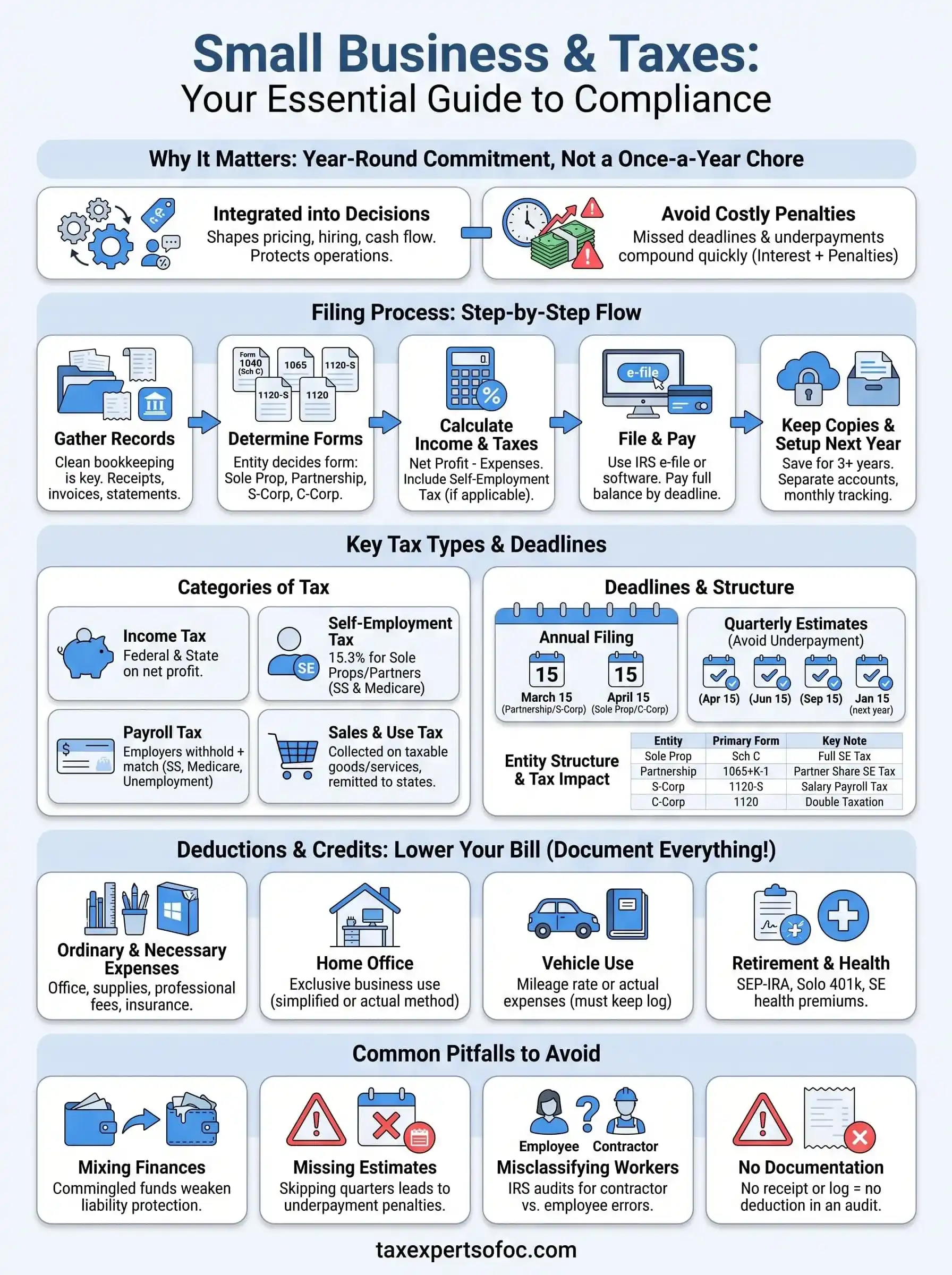
Filing taxes for a small business follows a predictable sequence once you've done it a time or two, but the first year feels like assembling furniture without instructions. Breaking the process into stages removes most of the guesswork. Below is the order we walk clients through, whether they're filing small business taxes for the first time or cleaning up after a chaotic prior year.
Step 1: Gather your financial records
Start by pulling together every record that shows money coming in and going out: bank statements, invoices, receipts, payroll reports, and last year's return if you have one. Clean bookkeeping at this stage saves hours later, because every deduction and every income figure needs to trace back to a document, which is why a repeatable bookkeeping process pays off before tax season. If your books are a mix of spreadsheets, a shoebox of receipts, and a bank app, reconcile everything before you touch a tax form.
Step 2: Determine your entity's filing forms
Your business structure decides which forms you actually file, and mixing this up is one of the fastest ways to invite an IRS notice. Sole proprietors report business income on Schedule C attached to their personal Form 1040, and the line-by-line Schedule C instructions show exactly where each figure goes. Partnerships file Form 1065 and issue Schedule K-1s to each partner. S-corps file an S corp return on Form 1120-S, and C-corps file Form 1120. We'll cover entity-specific obligations in more depth in the next section, but knowing the right form now keeps you from wasting time on the wrong paperwork.
Step 3: Calculate income, expenses, and self-employment tax
Next, calculate your business taxable income by totaling gross income and subtracting eligible business expenses to arrive at net profit. If you're self-employed, that net profit also determines your self-employment tax, which covers Social Security and Medicare at a combined 15.3% rate on top of regular income tax. Owners who skip this calculation often underestimate what they owe by a significant margin.
Get the math right before you file, because a wrong number on the form is harder to fix than a wrong number caught before submission.
Step 4: File electronically and pay what's owed
Once your numbers are set, file through IRS e-file or tax software that supports your entity type, and pay any balance due by the deadline for your structure. Paying late even after filing on time still triggers penalties, so don't treat submission and payment as the same step.
Step 5: Keep copies and set up next year's system
Finally, save a full copy of your return and every supporting document for at least three years, longer if you claim substantial losses or depreciation. This is also the point to build a simple system for the year ahead:
- Separate business and personal bank accounts
- A bookkeeping tool or spreadsheet updated monthly, not annually
- A folder (digital or physical) for receipts, sorted by category
- A calendar reminder for quarterly estimated payment dates
Owners who understand how to file taxes for a small business once rarely dread it the next year, because the process becomes routine instead of an emergency. If your situation involves back taxes, unfiled prior returns, or an entity change mid-year, tax preparation services built specifically for small businesses can catch issues before the IRS does.
Business structure and your tax obligations
The legal structure you chose when you started your business determines almost everything about how you're taxed, not just which form you file. Business structure and your tax obligations are tied together so closely that changing entities mid-year can shift your tax bill by thousands of dollars, for better or worse. If you registered your business without much thought about the tax consequences, now's the time to understand what you actually signed up for.
Sole proprietorships and single-member LLCs
If you never filed paperwork to form a separate entity, you're operating as a sole proprietor by default, and how an LLC files taxes works the same way for a single-member LLC unless you elect otherwise. All profit flows directly to your personal return on Schedule C, and you pay self-employment tax on the full net profit, currently 15.3% for Social Security and Medicare combined. There's no separation between you and the business for tax purposes, which keeps filing simple but offers zero liability protection on the tax side.
Partnerships and multi-member LLCs
Partnerships and multi-member LLCs file an informational return, Form 1065, but the entity itself doesn't pay tax. Instead, each partner receives a Schedule K-1 showing their share of income, and that amount gets reported on their personal return. Every partner still owes self-employment tax on their share unless they hold a passive ownership role, so don't assume a partnership shields you from that obligation the way some owners expect.
S corporations
Electing S-corp status changes the math significantly, and comparing S corp vs LLC taxes shows how much. Owners pay themselves a reasonable salary under IRS rules subject to payroll taxes, then take remaining profit as a distribution that avoids self-employment tax entirely. This structure saves real money once your profit clears a certain threshold, typically once net income exceeds what a fair market salary would be for your role.
Choosing the wrong entity doesn't just cost you paperwork, it can cost you real tax dollars every single year you leave it uncorrected.
C corporations
C corporations face double taxation: the corporation pays tax on profit at the entity level, and shareholders pay tax again on dividends. Few small businesses need this structure early on, but it makes sense for companies planning to raise outside investment or retain significant earnings inside the business.
| Entity Type | Tax Form | Self-Employment Tax | Double Taxation |
|---|---|---|---|
| Sole Proprietor | Schedule C (1040) | Yes, on full profit | No |
| Partnership/Multi-Member LLC | Form 1065 + K-1 | Yes, on partner share | No |
| S Corporation | Form 1120-S | Only on salary | No |
| C Corporation | Form 1120 | No | Yes |
Getting this decision right from the start matters more than most owners realize, and it's worth revisiting as your business grows. Our LLC and corporation formation help lets owners choose or restructure their entity before a mismatch starts costing them at tax time.
Types of taxes every small business should know
Beyond the entity-level rules, every small business runs into several distinct categories of business tax, and confusing one for another is a common way owners underpay without realizing it. Small business owner taxes aren't a single line item, they're a stack of separate obligations that layer on top of each other depending on how you're structured, whether you have employees, and what you sell. Knowing which ones apply to you keeps you from missing an obligation you didn't know existed until a notice shows up.
Federal and state income tax
Income tax applies to net profit after expenses, and it's the one most owners already expect. Federal rates depend on your entity type and personal tax bracket if you're a pass-through business, while most states layer their own income tax on top. A handful of states, including Texas and Florida, skip personal income tax entirely, but they usually make up for it with franchise or gross receipts taxes instead, so don't assume you're off the hook just because your state has no income tax line.
Self-employment tax
If you're a sole proprietor, partner, or single-member LLC owner, you owe self-employment tax on your net earnings, covering Social Security and Medicare at 15.3% combined. This tax exists separately from income tax, and it catches new owners off guard because nothing gets withheld from their pay the way it did at a W-2 job.
Payroll tax
Once you hire employees, you take on payroll tax responsibilities: withholding federal and state income tax, Social Security, and Medicare from each paycheck, plus matching the employer share and paying federal and state unemployment tax, which is why many owners hand the work to CPA-led payroll processing. Missing a payroll deposit deadline carries some of the steepest payroll tax penalties in the tax code, because the IRS treats withheld employee funds as money you're holding in trust, not your own.
Payroll tax mistakes get punished harder than almost any other tax error, because the IRS sees withheld wages as trust fund money, not business cash.
Sales and use tax
If you sell physical goods or certain taxable services, you likely need to collect sales tax and remit it to your state, and sometimes to local jurisdictions too. Rules vary widely by state and even by product category, so a business selling across multiple states needs to track nexus rules carefully.
Other taxes to watch
A few additional categories catch specific businesses:
- Excise tax on fuel, alcohol, tobacco, and certain equipment
- Property tax on business-owned real estate or equipment in some states
- Franchise tax, charged by several states simply for the right to operate as an entity there
| Tax Type | Who Pays It | When It's Due |
|---|---|---|
| Income Tax | All profitable businesses | Annually, with quarterly estimates |
| Self-Employment Tax | Sole props, partners, LLC members | With quarterly estimates |
| Payroll Tax | Employers | Per pay period/deposit schedule |
| Sales Tax | Sellers of taxable goods/services | Monthly or quarterly, by state |
| Franchise Tax | Entities in certain states | Annually |
Multiplying tax types across multiple states gets complicated fast, and it's exactly where our tax preparation team spends most of its time untangling misclassified obligations for growing businesses.
Deadlines and quarterly estimated tax payments
Missing a deadline is one of the easiest ways to turn a manageable tax bill into a costly one, and the confusion usually starts because owners assume there's just one date to remember. There isn't. Depending on your entity type, you're juggling an annual filing deadline plus four quarterly estimated payment dates throughout the year, and mixing those up is how penalties sneak up on otherwise organized business owners.
Annual filing deadlines by entity type
Your filing deadline depends entirely on your business structure. Sole proprietors and single-member LLCs file alongside their personal return, due April 15. Partnerships and S-corps file earlier, by March 15, because their income flows through to owners who need those K-1s before filing their own returns. C-corps generally file by April 15 as well, though fiscal-year corporations follow a different schedule tied to their year-end.
| Entity Type | Annual Deadline | Extension Deadline |
|---|---|---|
| Sole Proprietor / Single-Member LLC | April 15 | October 15 |
| Partnership / Multi-Member LLC | March 15 | September 15 |
| S Corporation | March 15 | September 15 |
| C Corporation | April 15 | October 15 |
Filing a tax extension with Form 4868 pushes the filing date back, but it doesn't push back payment. You still need to estimate and pay what you owe by the original deadline, or the extension just delays paperwork while penalties accrue on the unpaid balance.
The quarterly estimated tax schedule
Here's where most filing taxes for small business owners for the first time get caught off guard. If you expect to owe $1,000 or more for the year, the IRS wants quarterly tax payments spread across four due dates, not one lump sum in April. Skipping this step is one of the fastest ways to owe an underpayment penalty even if you paid your full balance on time at year-end.
- Q1: April 15
- Q2: June 15
- Q3: September 15
- Q4: January 15 of the following year
Notice the gaps aren't even quarters. The IRS built this schedule around income timing assumptions, not calendar neatness, so mark these dates well ahead of time rather than trusting your memory.
Safe harbor rules that protect you from penalties
You can avoid underpayment penalties entirely by hitting what's called a safe harbor. Pay at least 90% of your current year's tax liability, or 100% of last year's liability (110% if your prior-year income exceeded $150,000), and the IRS won't penalize you even if your final bill comes in higher than expected.
Hitting the safe harbor threshold matters more than guessing your exact tax bill, because the IRS penalizes underpayment, not imprecision.
Owners who track income monthly can estimate payments with real accuracy. Owners who guess, or who skip a quarter hoping to catch up later, usually end up paying more in penalties and interest than they would have if they'd just paid on schedule. Reference the IRS estimated taxes guidance directly if you're unsure which safe harbor applies to your situation, since the thresholds shift slightly based on your prior-year income.
Deductions and credits that lower your tax bill
Every dollar you deduct is a dollar the IRS doesn't tax, which is why understanding deductions and credits matters as much as knowing what taxes you owe in the first place. Many owners leave money on the table simply because they don't track expenses closely enough to claim everything they're entitled to, or they're afraid to claim legitimate deductions out of fear it triggers an audit. Neither approach serves you well. The goal is claiming every deduction you can support with documentation, nothing more and nothing less.

Ordinary and necessary business expenses
The IRS lets you deduct anything that's ordinary and necessary for running your business, a broad category that covers more than most new owners expect. Office supplies, software subscriptions, professional fees, business insurance, marketing costs, and a portion of your phone and internet bill if used for work all qualify, and there are more deductions small business owners can claim than most expect. Rent on a business location, equipment purchases, and even a percentage of your vehicle costs count too, provided you keep records that separate business use from personal use.
Home office and vehicle deductions
Home office and vehicle deductions deserve extra attention because they're also common audit triggers when claimed without documentation. For a home office, the space must be used regularly and exclusively for business, either using the simplified rate of $5 per square foot up to 300 square feet, or calculating actual expenses based on the percentage of your home used for work. For vehicles, you can deduct the standard mileage rate or actual expenses, but only one method per vehicle per year, and a mileage log is non-negotiable if you ever need to defend the claim.
Deductions only protect you if you can prove them, so a receipt or log beats a guess every time the IRS asks.
Retirement contributions and health insurance
Retirement contributions to a SEP-IRA, Solo 401(k), or SIMPLE IRA reduce your taxable income while building savings for your future, and self-employed owners can often contribute significantly more than a typical employee retirement limit allows. Self-employed health insurance premiums are deductible too, often dollar for dollar against your income, which makes this one of the more overlooked deductions among sole proprietors who assume it only applies to businesses with employees.
Tax credits worth knowing
Credits differ from deductions because they reduce your tax bill dollar for dollar, which makes them more valuable than deductions of the same size. A few worth checking:
- Qualified Business Income (QBI) deduction, up to 20% of pass-through business income for eligible owners
- Work Opportunity Tax Credit, for hiring from certain target groups
- Small Business Health Care Tax Credit, for businesses covering employee premiums
- R&D tax credit, for businesses investing in product or process improvements, even outside traditional tech industries
Qualifying rules vary by credit, and some phase out based on income, so verify eligibility before assuming you qualify.
Understanding which deductions and credits apply to your specific structure is exactly where strategic tax planning earns its keep, because the difference between claiming everything you're owed and missing half of it often comes down to proactive planning rather than a rushed filing in April.
Common tax mistakes new business owners make
Most tax trouble we see doesn't come from complicated planning, it comes from a handful of avoidable errors repeated year after year. Recognizing these patterns early saves you money and keeps you off the IRS's radar. Here's where taxes as a small business owner tend to go wrong most often.
Mixing personal and business finances
Running every expense through one bank account feels convenient until tax season arrives and you can't tell which charges were business-related. Commingled funds make deductions harder to defend and can even weaken the liability protection an LLC or corporation is supposed to provide. Open a separate business account the day you start earning income, even if you're still a sole proprietor with no formal entity, and route every business dollar through it.
Underestimating or skipping quarterly payments
Owners coming from a W-2 job are used to taxes disappearing automatically from every paycheck, so the idea of sending the IRS money four times a year on your own feels foreign. Skipping a quarter, or paying whatever's left in the account instead of a calculated amount, is one of the fastest ways to owe an underpayment penalty even after you've paid your full balance by April. Set aside a fixed percentage of every payment you receive, ideally 25 to 30%, so the quarterly amount is already sitting there when the deadline hits.
The owners who struggle most aren't the ones who owe the most, they're the ones who never set money aside to pay what they owe.
Misclassifying workers
Calling someone a 1099 contractor because it's simpler than running payroll is a mistake the IRS actively audits for. If you control how, when, and where someone does their work, they're likely an employee, not a contractor, regardless of what the paperwork says, and the differences between employee and contractor taxes decide what you owe. Getting this wrong triggers back payroll taxes, penalties, and sometimes state-level fines on top of the federal bill.
Claiming deductions without documentation
A deduction without a receipt, log, or record isn't a deduction, it's a liability waiting to surface in an audit. New owners either overclaim by guessing at expense percentages or underclaim out of fear, and both habits cost money in different ways. Keep every receipt, mileage log, and invoice organized by category as the year goes, not reconstructed from memory the week before filing.
Ignoring state and local obligations
Federal taxes get most of the attention, but state income tax, sales tax nexus, and local business licenses catch owners off guard constantly, especially once you sell across state lines. A business that's fully compliant federally can still owe back state taxes it never knew existed. If your situation already involves missed filings or IRS notices, our team's back tax relief and IRS representation helps small business owners sort out what's actually owed before penalties compound further.
What to remember about small business taxes
Running the numbers on small business and taxes doesn't get easier by ignoring it. It gets easier when you build habits: separate accounts, monthly bookkeeping, quarterly payments set aside before they're due, and documentation for every deduction you claim. The owners who struggle aren't the ones with complicated situations, they're the ones who waited until a notice showed up to learn the rules.
Getting your entity structure right, tracking every tax type that applies to you, and hitting your deadlines consistently protects your cash flow and keeps the IRS out of your business. None of this requires you to become a tax expert yourself, it just requires a system and, when things get complicated, someone who already knows where the pitfalls are.
If you're behind on filings, staring at an IRS notice, or just want a second set of eyes before your next deadline, book a free consultation for business tax filing with a CPA and get a straight answer instead of another guess.